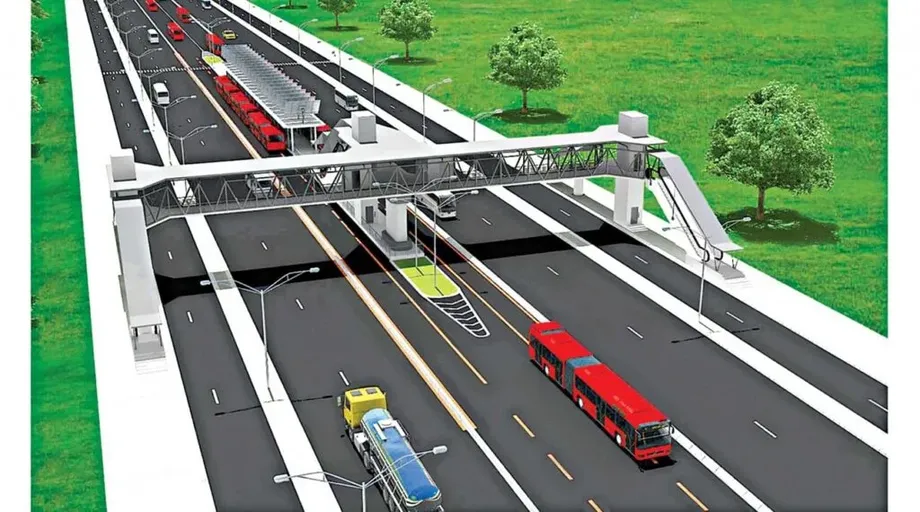
A bus corridor becomes a highway project
Bangladesh's government has decided to dismantle stations and lane dividers on the 20.5 kilometre Dhaka–Gazipur Bus Rapid Transit corridor and turn it into a highway with three lanes in each direction. About Tk28.11 billion has already been spent, yet the dedicated bus service for which the infrastructure was built has never opened.
Contents
- A bus corridor becomes a highway project
- What the government has ordered
- How a project approved in 2012 reached this point
- Money spent, budgets increased and another bill ahead
- Why 97 percent of construction did not produce a bus service
- The design problems behind the recommendation to close
- The alternatives that divided transport specialists
- Why planners and Gazipur residents oppose demolition
- What changes for passengers and road users
- Key Points
The cabinet approved the change at its October 18 meeting, chaired by Prime Minister Tarique Rahman. An October 19 letter from the Road Transport and Highways Division instructed the relevant agencies to begin implementing the decision, including widening two overpasses from two lanes to four.
The government also plans to dissolve Dhaka Bus Rapid Transit PLC, the company created to operate the service, and transfer its activities to the Roads and Highways Department. Formal closure requires discussions with development partners and settlement of legal and contractual issues.
The decision changes the purpose of a corridor running from Shibbari in Gazipur to Hazrat Shahjalal International Airport in Dhaka. Instead of reserving road space for buses carrying passengers past traffic queues, the government intends to make that space available to general traffic.
Transport specialists are divided. A Bangladesh University of Engineering and Technology review team recommended using the infrastructure as an improved highway, citing design weaknesses and limited usefulness as a bus corridor. The Bangladesh Institute of Planners and Gazipur civic organisations want the bus project completed, arguing that demolition would waste public money and leave commuters without the service they endured years of construction to obtain.
What the government has ordered
The October 19 instruction, signed by Road Transport and Highways Division Deputy Secretary Taslima Ahmed Poly, sets out both physical changes and administrative steps. Stations and barriers separating the bus lanes would be removed, while the two narrow overpasses would be expanded.
Agencies must submit an initial progress report within 15 days and provide further updates by the third day of each month until implementation is complete. Those are reporting deadlines. No date has been announced for completing the highway conversion, and no approved conversion budget has been disclosed.
Implementation had not reached every local office when the decision became public. Gazipur Roads Division Executive Engineer Tanvir Ahmed said his office had yet to receive a formal letter and would act according to the instructions it received.
Cabinet Secretary Nasimul Gani did not mention the BRT decision during the briefing after the October 18 meeting. The written instruction issued the following day set out the planned closure and conversion.
How a project approved in 2012 reached this point
The Executive Committee of the National Economic Council, known as ECNEC, approved the project in November 2012. Construction was supposed to finish in December 2016, allowing special buses to begin operating in 2017. Large scale construction instead began in 2018.
Land acquisition, design changes and the relocation of utility lines delayed progress. The project included separate bus lanes, stations, elevated sections, the Tongi bridge and a depot, requiring several agencies to work along an already busy highway.
- November 2012: ECNEC approved the airport–Gazipur BRT project.
- December 2016: The original construction deadline passed without completion.
- 2018: Large scale construction began on the corridor.
- December 31, 2024: The project's latest approved implementation period ended.
- July 27, 2025: ECNEC rejected a proposal to increase the budget to about Tk65.98 billion and extend completion to December 2029.
- October 18 and 19: The cabinet chose conversion to a general highway, followed by written implementation instructions.
After rejecting the 2025 revision, ECNEC directed officials to examine alternative uses and identify responsibility for planning and design faults. During October 2025, the interim government also decided against launching the BRT service, citing the additional time and money required.
Money spent, budgets increased and another bill ahead
Project expenditure figures put spending at Tk28.1062 billion through the end of the 2025–26 financial year, commonly rounded to Tk28.11 billion. The approved budget had grown from about Tk20.4 billion at the start to Tk42.6832 billion, more than twice the original amount.
The rejected revision would have lifted the budget to about Tk65.98 billion, roughly 3.2 times the initial allocation. Actual spending of Tk28.1062 billion amounts to about 66 percent of the Tk42.6832 billion approved budget. Money already spent, an approved spending ceiling and a rejected future budget describe different parts of the project's finances.
Bangladesh's government, the Asian Development Bank, France's Agence Française de Développement and the Global Environment Facility have supported the project. Their involvement makes consultation over outstanding agreements part of the closure process.
Demolition and conversion would create further expenses. The Bangladesh Institute of Planners estimates that removing infrastructure and compensating contractors could cost more than Tk10 billion. That is the institute's estimate; the government has not published an approved amount for those tasks.
The financial choice now concerns what each option would deliver for the next amount spent. Completing a bus system would require vehicles, operational arrangements and unfinished facilities. Creating a general highway would require removal work, changes to the road and wider overpasses.
Why 97 percent of construction did not produce a bus service
Project figures put civil construction progress at about 97 percent, while total physical progress was around 77.5 percent. The two measures cover different work: civil construction counts structures such as roads and stations, while the wider project includes other elements needed to provide the intended service.
Two attempts to buy BRT buses failed. Without suitable buses, the dedicated service could not start, even where substantial infrastructure had been built. The separated lanes were later opened to general vehicles.
Fifteen station structures were built along the corridor, but none was fully finished. Some pedestrian bridges have escalators and lifts, yet equipment and access facilities remain unusable in places. Rust and deterioration have added maintenance problems to the unfinished work.
About 15.07 kilometres of the route are at ground level, with the remainder elevated. Narrow sections, barriers and transitions between elevated and ground level roads have complicated traffic movements. The Roads and Highways Department is considering reusing lifts and other equipment elsewhere as stations are removed.
The design problems behind the recommendation to close
A BUET team led by civil engineering Professor Shamsul Hoque reviewed the project's technical condition and recommended abandoning BRT operation in favour of an improved highway. Its assessment identified weaknesses in planning, design, technical scrutiny, staffing and coordination.
The review followed assessments by two committees formed under the Road Transport and Highways Division. Problems included inadequate preparation for drainage, utility relocation and keeping traffic moving during construction. Responsibilities were divided among the Roads and Highways Department, the Bridges Division and the Local Government Engineering Department.
Station layout created another practical problem. The platforms require buses with doors on the right, while ordinary buses in Bangladesh generally have doors on the left. Special vehicles would therefore be needed to match the platforms, complicating proposals to use the existing bus fleet.
A planned second BRT corridor from Uttara to Keraniganj, intended to receive World Bank financing, was cancelled after delays to the Gazipur route. Without that onward connection, passengers travelling beyond the airport would need to change vehicles.
Hoque argued that a highway conversion would benefit users of Gazipur's industrial areas. He also said residents deserved an alternative after years of disruption and proposed commuter trains running to Kamalapur, pointing to work nearing completion on the railway's third and fourth tracks.
The alternatives that divided transport specialists
The cabinet considered four broad choices: complete the original BRT scheme, introduce an interim bus operation using existing facilities, convert the corridor into a toll expressway, or make it a general highway. Road Transport and Highways Division Secretary Mohammad Ziaul Haque said the four options had been presented to the prime minister.
The interim service proposal involved coordinated route management, sometimes called bus route franchising. Under that approach, operators serve planned routes within a common management arrangement rather than each company independently deciding how to compete along the corridor. The proposal envisaged using the stations, terminal and depot before moving towards full BRT operation.
Bangladesh Institute of Planners General Secretary Professor M. Mosleh Uddin Hasan argued that an initial BRT service could begin within six to 12 months with about Tk3 billion in additional spending. A later move to modern electric buses could require another Tk10 billion, according to the institute's proposal.
Transport specialist Professor Md. Hadiuzzaman also supported introducing BRT in stages. Their position differs from the BUET review team's recommendation: they favour adapting and completing the bus investment, while the review team favours changing its purpose.
The competing estimates concern different packages of work. A first stage bus service, a later electric fleet and demolition with contractor compensation would each produce different costs and results. The government's choice commits it to the highway approach while the detailed conversion bill still has to be settled.
Why planners and Gazipur residents oppose demolition
The Bangladesh Institute of Planners has called for the decision to be withdrawn. It says replacing the bus corridor with a general highway conflicts with the Gazipur Transport Master Plan and Dhaka's Revised Strategic Transport Plan, both of which support organised public transport.
The institute argues that the decision favours private vehicle users and construction interests over passengers who depend on buses. It has also proposed a common organisation to manage BRT and metro rail activities, alongside broader planning for bus rapid transit in major cities.
Gazipur Oitijhya O Unnayan, a civic organisation supporting completion, has warned that dismantling nearly finished structures would waste public money and prolong hardship. Its president, Md. Shamsul Haque, said residents had suffered through 14 years of disruption and opposed cancellation after so much construction.
Before the cabinet decision, civic representatives held a press conference demanding a rapid opening. Professor Md. Khasru Mia of Dhaka University of Engineering and Technology presented their written position, describing long journeys, congestion and rising travel costs as obstacles to Gazipur's industrial and commercial activity.
What changes for passengers and road users
Gazipur commuters lose the planned promise of buses running in protected lanes between Shibbari and the airport. Under the highway plan, buses and other vehicles would use general traffic lanes, with more road space available after stations and dividers are removed.
The corridor also serves travellers from greater Mymensingh, Tangail and northern Bangladesh. Removing narrow sections and widening overpasses could help traffic move more consistently. Passengers travelling deeper into Dhaka would still need workable onward connections, the same issue Hoque raised about the airport endpoint.
Construction has imposed costs beyond delayed journeys. Accident accounts record at least six deaths, while a broader tally puts the total at seven. The documented incidents include a worker killed by a falling crane in Gazipur in July 2022 and five people killed when a heavy girder fell from a crane onto a car in Uttara.
Dhaka BRT PLC, formed in 2013, currently has 18 officers and employees, including its managing director. Its closure would transfer activities to the Roads and Highways Department, bringing the corridor under road management rather than the company established for the dedicated bus operation.
The immediate tasks are to settle agreements with development partners, arrange the company transfer and prepare the physical changes. For commuters, the concrete issue is whether those steps deliver easier journeys without another prolonged period of road disruption.
Key Points
- The government plans to convert the 20.5 kilometre airport–Gazipur BRT corridor into a highway with three lanes in each direction.
- About Tk28.11 billion has been spent, but dedicated BRT buses never began operating.
- Stations and lane dividers would be removed, and two overpasses widened from two lanes to four.
- A BUET review team supports highway conversion; planners and civic organisations favour completing the bus service.
- Formal closure requires legal and contractual settlements, while the conversion budget and completion date remain unannounced.
- Agencies must report initial progress within 15 days and submit updates by the third day of each month.