A hospital door that must stay open
Bangladesh's draft Road Safety Act 2026 would require hospitals and clinics to provide free emergency first aid to road crash victims, protect voluntary rescuers from civil and criminal liability, and double the maximum penalty for people who repeat the same traffic offence. The proposal, prepared by the Road Transport and Highways Division, contains 15 chapters, 111 sections and two schedules.
Contents
- A hospital door that must stay open
- Who would pay for emergency treatment?
- Protection for people who stop to help
- A court order already requires urgent care
- Preventing crashes through safer roads and speeds
- New duties for drivers, riders and pedestrians
- Repeat offences could bring double penalties
- Safer vehicles and information for buyers
- A new authority, better records and the 2027 deadline
- Key Points
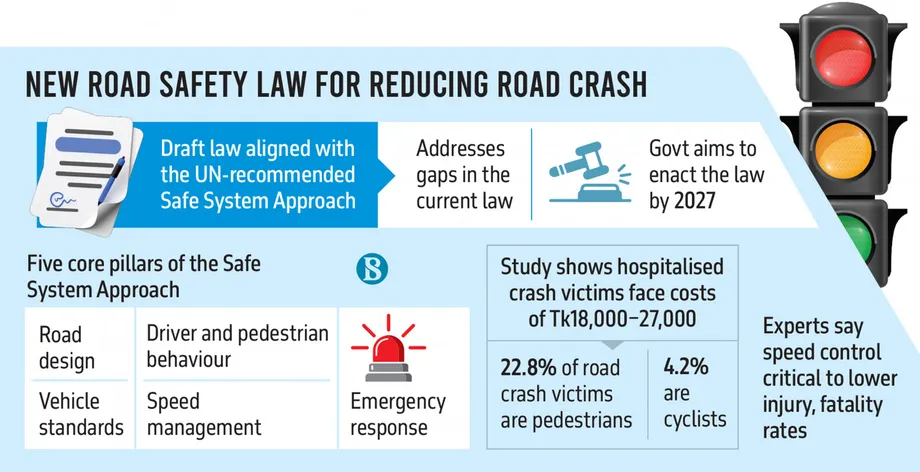
As of October 21, 2026, the draft was being prepared for cabinet consideration, with the government committed to enacting a comprehensive road safety law by 2027. Its reach extends beyond drivers and vehicles to hospital reception desks, road design, passenger behaviour, crash investigations and the rehabilitation of injured people.
Al-Ameen Md Nurul Islam, deputy secretary in the Bangladesh Road Transport Authority's Establishment Section, described the next step:
We have prepared the draft of the law, which will be placed before the cabinet for approval soon,
The immediate stakes are substantial. The World Health Organization estimates that road crashes kill around 31,578 people annually in Bangladesh, while BRTA recorded 5,490 deaths in 2025. The WHO figure is about 5.8 times the BRTA total. The figures come from different measurement approaches and reference periods, making better crash records a central part of the proposed reform.
For an injured person, the most immediate change would be at the nearest medical facility. The draft seeks to stop treatment being delayed by demands for advance payment, registration tickets or other formalities. Hospitals would have to provide primary care before transferring critically injured patients, bringing emergency medicine into the country's road safety framework alongside policing and engineering.
Who would pay for emergency treatment?
Public and private hospitals would initially bear the immediate treatment costs, with the government reimbursing them under the proposal. Facilities that refuse or delay the required care could face punitive action. The draft also seeks to prevent patients being referred elsewhere without initial treatment because a facility lacks staff or equipment.
The provision focuses on the critical period immediately after a crash, often called the Golden Hour. Rapid assessment, bleeding control and other urgent care can improve a person's chances of survival. In practical terms, the proposal would make providing that initial care a legal duty rather than leaving access dependent on a family's ability to produce money at the door.
Hospital patient welfare funds would support specified vulnerable patients, including people who are destitute, impoverished, widowed, abandoned or living with disabilities. The proposed assistance covers medicines, diagnostic tests, surgery and treatment during their hospital stay.
The financial burden can continue well beyond the emergency department. Professor Dr Abdul Awal Rizvi, an adviser to the Road Safety Injury and Prevention Programme at the National Heart Foundation and a former director of NITOR, cited a study in which people treated for road crash injuries stayed in hospital for an average of nine to 11 days, at a cost of Tk18,000 to Tk27,000. For families with limited income, those expenses can arrive just as an injured wage earner loses the ability to work.
Protection for people who stop to help
Voluntary rescuers would receive complete civil and criminal immunity under the draft's proposed good Samaritan protection. The term refers to someone who helps a stranger in need. The stated aim is to address fears of police harassment, criminal charges and court proceedings that can discourage people from taking an injured person to hospital.
District and upazila response teams would help transport victims to the nearest facility. An upazila is an administrative area below a district. The teams would be connected to local administrations and the 999 emergency helpline so that crash reports could trigger a local response.
The rescue and hospital provisions address successive stages of the same emergency: someone must reach the injured person, transport must be arranged, and a medical facility must begin care. The draft also covers medical expenses after crashes, passenger insurance and rehabilitation, extending responsibility beyond the initial rescue.
A court order already requires urgent care
Bangladesh's High Court issued a related direction on August 6, 2026. Justices Md Habibul Gani and Syed Mohammad Tajrul Hossain directed the health secretary to issue a circular instructing all public and private hospitals and clinics to provide emergency primary treatment to anyone injured in an accident.
The court also ordered the government to amend the Road Transport Act 2018 and prepare rules to ensure treatment at the nearest hospital or clinic without delay. The litigation began with a 2018 public interest petition by Human Rights and Peace for Bangladesh after Khulna businessman Ibrahim allegedly died after being denied immediate treatment following a mugging in Dhaka.
Senior Advocate Manzill Murshid, who represented the petitioner, said the court affirmed that the right to life under Article 32 of the constitution includes emergency medical treatment. The proposed Road Safety Act would add detailed arrangements for road crash care, reimbursement, rescue services and related responsibilities.
The legislation has developed through several stages:
- February 2025: Bangladesh committed at the ministerial road safety conference in Marrakech, Morocco, to enact a comprehensive law by 2027.
- June 2025: A preliminary draft was described as nearly complete and under committee review.
- July 20-21, 2026: Road Transport and Bridges Minister Shaikh Rabiul Alam reiterated the commitment at a United Nations meeting in New York.
- August 6, 2026: The High Court directed action to ensure emergency primary treatment for accident victims.
- October 14, 2026: Alam reaffirmed the 2027 legislative target at a road safety roundtable in Dhaka.
- October 21, 2026: Officials said the draft would soon be placed before the cabinet.
Preventing crashes through safer roads and speeds
The draft follows the Safe System Approach, which starts from a practical idea: people make mistakes, so roads, vehicles, speeds and emergency services should work together to keep those mistakes from becoming fatal. Responsibility extends to engineers, vehicle providers, medical services and enforcement agencies as well as road users.
Professor Sohel Mahmud of BUET's Accident Research Institute, a member of the drafting committee led by BRTA Road Safety Wing Director Sitangshu Shekhar Biswas, explained the gaps the committee was addressing:
The current Road Transport Act lacks clear instructions on speed management, pedestrian safety, and post-crash measures. These issues are being addressed in the new law, structured around the five pillars of the Safe System Approach,
Road networks and intersections would be designed to international standards, with safety audits and inspections beginning at planning and design and continuing through implementation. Authorities would regularly identify and correct locations with repeated crashes, commonly called black spots. An internationally recognised star rating system would assess road safety.
Speed cameras, speed humps, rumble strips and Intelligent Transport Systems are among the proposed tools. Rumble strips create vibration and noise to alert drivers; Intelligent Transport Systems use technology to monitor or manage traffic. Rizvi cited research estimating that a 1% reduction in vehicle speed could reduce injuries by 2%, serious injuries by 3% and fatalities by 4%. These estimates describe why even modest speed reductions can matter.
New duties for drivers, riders and pedestrians
Drivers would be prohibited from using mobile phones or similar devices, smoking, eating or listening to music at high volume while driving. Passengers would also be barred from activities that distract the driver. Seatbelts would become mandatory for both drivers and passengers.
Children younger than 14, or shorter than 135 centimetres, would be barred from the front row and would have to use an appropriate restraint system. Driving under the influence of alcohol or drugs would be prohibited, with police and authorised officials able to require breathalyser tests or laboratory examinations where necessary.
Motorcycle riders and passengers would have to wear standard helmets approved by the Bangladesh Standards and Testing Institution, or BSTI. Children below six would be prohibited from travelling as motorcycle passengers. The proposal also calls for bicycle lanes where road conditions permit and requires cyclists to use helmets and other protective equipment.
Pedestrians would have to use available footpaths and designated crossing points, including marked crossings and refuge islands. A refuge island provides a protected place to pause while crossing a road in stages. The draft pairs those duties with requirements for adequate footpaths and infrastructure accessible to people with disabilities, including footbridges with ramps or lifts.
Pedestrians and cyclists account for a substantial share of people needing hospital care. In the study cited by Rizvi, pedestrians made up 22.8% of discharged road injury patients and cyclists 4.2%, together accounting for 27%. The proposed infrastructure measures would give these road users more physical protection rather than relying on their behaviour alone.
Repeat offences could bring double penalties
The proposed licence demerit system would deduct points for traffic violations, with repeated violations potentially resulting in cancellation of a driving licence. The draft also proposes doubling the maximum prescribed penalty when the same person commits the same offence for a second or subsequent time.
Under proposed Section 74, a pedestrian who fails to use a footpath could face a fine of up to Tk1,000 for a first offence. Specified passenger violations could attract a similar fine, including boarding dangerously, encouraging speeding, distracting the driver or failing to follow designated seating rules.
The draft also addresses safety and treatment of women on public transport. Specified conduct, including harassment, obstructing women while boarding or leaving a vehicle, and sexually suggestive behaviour, could bring up to one year's simple imprisonment, a fine, or both.
Public transport operators would be required to make services accessible to women, pregnant women, children, older people and people with disabilities. Those obligations place responsibility on service providers alongside the proposed penalties for passengers and drivers.
Safer vehicles and information for buyers
A planned New Car Assessment Programme would provide another route to preventing deaths and serious injuries. Such programmes assess vehicle safety and make information available to buyers, helping people consider protection in a crash when choosing a vehicle.
Under the proposal, an expert committee would provide information about locally manufactured and imported vehicles, their source companies, company standards and their standing in the global market. The programme would be introduced after the law is finalised.
Vehicle safety would sit alongside driver training, public awareness, public transport and freight transport safety, and crash investigation within the proposed law. Its two schedules address services after crashes and the operation of motor vehicles after consuming alcohol or other intoxicating substances.
The division argues that further amendments to the Road Transport Act 2018 would be insufficient to cover this range of responsibilities. A separate law would connect vehicle standards and road engineering with speed management, pedestrian protection, medical care, research and coordination among agencies.
A new authority, better records and the 2027 deadline
A proposed National Road Safety Authority would coordinate road safety decisions with government agencies and other stakeholders. Its responsibilities would include national safety and strategic action plans, crash research, preventive measures and coordination of victim rehabilitation.
An Integrated Central Database System would collect, analyse, publish and preserve crash information according to international standards. A research fund would support studies, better collection methods and road safety initiatives. Adilur Rahman Khan, then an adviser on housing, public works and industry, had announced a target of establishing a centralised road safety database by 2026.
The large gap between WHO estimates and BRTA's recorded deaths gives that work practical urgency. Decisions about dangerous junctions, hospital capacity and enforcement depend on knowing where crashes happen, who is injured and how many people die. Consistent records would also help measure progress toward the government's goal of halving road crash fatalities by 2030.
At the October 14 roundtable organised by BRAC's Road Safety Programme and Road Safety Coalition Bangladesh, Alam outlined related plans: updated helmet standards, speed limit enforcement, stronger emergency care, underpasses, lanes on the left side of highways and improved crash records. The government also plans to prepare a speed management manual and helmet use guidelines by the end of 2026.
The draft is still awaiting approval. No cabinet consideration date, final licence point threshold or detailed reimbursement timetable has been announced. Legal review and further enactment procedures remain ahead, while 2027 is the stated deadline for passing the comprehensive law. Hospitals, transport operators and enforcement bodies would then need workable arrangements to carry out its duties.
Key Points
- The draft Road Safety Act 2026 would require free emergency first aid for road crash victims, with government reimbursement of hospital costs.
- Voluntary rescuers would receive civil and criminal immunity, supported by proposed local response teams linked to 999.
- A licence demerit system and doubled maximum penalties would target repeated traffic offences.
- The proposal covers safer roads, vehicle information, helmets, seatbelts, child restraints and protection for pedestrians and public transport users.
- A proposed national authority and central database would coordinate prevention, crash research and victim rehabilitation.
- The government aims to enact the law by 2027 and halve road crash fatalities by 2030.