A Tk 70 Monthly Cushion Against Illness and Lost Work
Bangladesh's average household earned Tk 32,685 a month and spent Tk 32,615, leaving just Tk 70, according to a Power and Participation Research Centre study that puts poverty at 27.93%. Beyond those already poor, about 31 million people belong to a financially fragile group that could fall below the poverty line after an illness, lost earnings or another unexpected expense.
Contents
- A Tk 70 Monthly Cushion Against Illness and Lost Work
- What the Survey Measured and When
- How Far Poverty Has Risen
- Who Are the 31 Million People Near the Edge?
- Why City Budgets Are Under Greater Strain
- Food and Illness Leave Little Room to Adjust
- Work Is Available, but Earnings Are Inadequate
- Public Services and Banking Add to the Pressure
- What PPRC Wants to Change
- Key Points
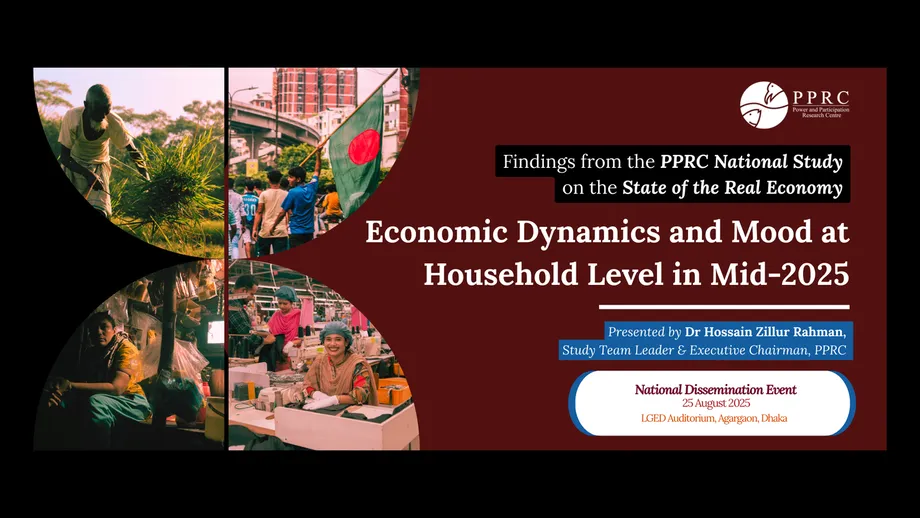
The findings were presented on October 17, 2026, at the launch of State of the Real Economy: Dynamics of Reversals and Resilience in Bangladesh at the CIRDAP Auditorium in Dhaka. The event coincided with the International Day for the Eradication of Poverty. PPRC Executive Chairman Hossain Zillur Rahman and Senior Research Associate Namira Shameem, the book's editor, presented the findings.
The book draws on interviews with 8,067 households across all eight divisions in May 2025. Its central finding is that having work, living above the poverty line or receiving a slightly higher income can still leave a family unable to absorb a financial shock.
For the poorest 40%, expenditure exceeded income. Medical bills triggered 67.4% of financial crises, while only 27.5% of households classified as vulnerable but not poor received safety net support. Taken together, those figures show how an ordinary household expense can become a lasting debt problem.
The Tk 70 average monthly surplus amounts to about 0.2% of household income. Averages also conceal large differences: rural households reported a surplus, while urban households spent substantially more than they earned.
What the Survey Measured and When
The Finance Division of the Ministry of Finance commissioned the research through a competitive process. PPRC's national survey announcement describes a nationally representative study using stratified two stage cluster sampling and interviews recorded on computers.
In simple terms, researchers selected households in stages from different parts of the country so the results could describe national conditions. The work examined income, expenditure, employment, debt, savings, public support, remittances and digital access. Researchers included Rahman, Syed M. Hashemi, Mohammad Abdul Wazed and Shameem.
The household findings and the later economic indicators cover different periods. The sequence is:
- 2022: The Bangladesh Bureau of Statistics conducted the Household Income and Expenditure Survey, the main comparison for poverty rates.
- May 8 to May 31, 2025: PPRC surveyed 8,067 households nationwide.
- August 25, 2025: Rahman presented the national survey findings in Dhaka.
- November 25, 2025: The World Bank launched its Bangladesh Poverty and Equity Assessment 2025.
- October 17, 2026: PPRC presented the book and its findings at the CIRDAP Auditorium.
The poverty estimates describe household conditions in 2025. The book launch presentation also cited banking figures from June 2026 and growth forecasts for fiscal 2027, bringing a later economic picture alongside the household survey.
How Far Poverty Has Risen
PPRC estimated that 27.93% of people lived below the upper poverty line in 2025, compared with 18.7% in the 2022 Household Income and Expenditure Survey. That is an increase of 9.23 percentage points, or roughly 49% relative to the earlier rate.
The upper poverty line is a spending threshold used to identify people unable to meet a defined set of basic needs. The lower line represents a more severe level of deprivation. PPRC put the share below that lower line at 9.35%, up from 5.6% in 2022, an increase of 3.75 percentage points.
Bangladesh had previously made substantial progress. The World Bank's Bangladesh Poverty and Equity Assessment 2025 found that moderate poverty fell from 37.1% in 2010 to 18.7% in 2022, while extreme poverty dropped from 12.2% to 5.6%.
The World Bank estimated about 36 million people were poor in 2025, while PPRC's survey put the poverty rate at 27.93%. The estimates come from different assessment exercises; a reconciliation of their methods and results was not given.
Who Are the 31 Million People Near the Edge?
PPRC classified 17.97% of households as vulnerable nonpoor: their spending placed them above the poverty line but below the national median. The median is the middle point, with half of households spending less and half spending more. PPRC estimated that this group contained about 31 million people.
More than half of these households had a chronically ill member. Only 27.5% received any safety net support, leaving nearly three quarters without such assistance. For a family with little spare income, regular medicine costs can consume money otherwise available for food, school or debt repayment.
The World Bank's wider vulnerability assessment placed nearly 62 million people at risk of falling into poverty after an illness, disaster or other shock. PPRC's 31 million figure uses its specific category between the poverty line and median expenditure; the World Bank's figure describes a broader population exposed to economic shocks.
Economist Selim Raihan, a Dhaka University professor and executive director of the South Asian Network on Economic Modeling, has argued that inflation, informal employment, weak investment and gaps in social protection are driving insecurity. His analysis also points to about half of the poorest households remaining outside social protection programmes.
Why City Budgets Are Under Greater Strain
Urban households earned an average of Tk 40,578 a month but spent Tk 44,961, producing a monthly shortfall of Tk 4,383. Rural households earned Tk 29,205 and spent Tk 27,162, leaving Tk 2,043. The urban deficit was about 10.8% of urban household income.
The poorest tenth of households earned Tk 8,477 but spent Tk 12,294, a gap of Tk 3,817 each month. The richest tenth earned Tk 109,390 and spent Tk 101,163. Their income was almost 13 times that of the poorest tenth.
PPRC's expenditure Gini coefficient rose from 0.334 in 2022 to 0.436. This measure describes how unequally spending is distributed: zero means everyone spends the same amount, while a value closer to one means spending is concentrated among fewer people. The urban figure was 0.532, compared with 0.347 in rural areas.
The World Bank assessment supplies an earlier explanation for the growing urban pressure. Between 2016 and 2022, rural poverty fell by 8.5 percentage points, compared with 4.6 points in urban areas. Agriculture generated nearly 80% of net employment over that period, while factory employment and earnings in cities failed to deliver comparable gains.
Food and Illness Leave Little Room to Adjust
Food accounted for 54.9% of household expenditure in PPRC's findings. When more than half of a household budget goes to eating, sustained price increases leave limited room to cut other spending without affecting basic needs.
PPRC's official survey summary said 12% of households had skipped meals in the previous week. Among the poorest households, 9% had gone a full day without food during the previous month. The survey also found that 36% of households lacked sanitary toilets.
Chronic illness affected about 51% of households. Medical expenses triggered 67.4% of financial crises, and the launch presentation put payments made directly by patients at 79.31% of health spending. Such payments come from household funds rather than being covered by insurance or another financing arrangement.
Rahman, PPRC's executive chairman, described the connection between illness and household finances when presenting the survey findings in August 2025:
This is the new dimension of vulnerability. Families are incurring additional expenses on healthcare due to chronic illnesses, which in turn is increasing their debt burden.
Household debt exceeded savings by 44.6% on average. Among the poorest tenth, debt exceeded savings by 218%, meaning debts were more than three times savings. The official survey summary also found that the poorest 40% held debts worth at least twice their savings.
Work Is Available, but Earnings Are Inadequate
About 37.7% of working adults worked fewer than 40 hours a week, rising to 65.5% among employed women. PPRC described widespread underemployment, with too little adequate work rather than simply an absence of employment.
Female labour force participation stood at 26%. This measures women working or seeking work, while the figure on shorter hours concerns women who were already employed. Nearly half of workers were self employed, making household security closely dependent on the earnings of small businesses and individual livelihoods.
The World Bank found that Bangladesh's growth had become less effective at reducing poverty after 2016. For each 1% of GDP growth, poverty fell by 0.9%, compared with a South Asian average of 1.5%. GDP measures the value of goods and services produced; household welfare depends on how that activity translates into earnings and affordable essentials.
Jean Pesme, the World Bank division director for Bangladesh and Bhutan, called for employment to take priority when the assessment was launched:
The fastest path to reducing poverty and ensuring the dignity of people is through job creation, particularly for youth, women, and vulnerable populations.
Public Services and Banking Add to the Pressure
About 48.9% of households reported harassment and informal payments in health services, according to the book launch presentation. For families already paying most medical costs themselves, difficulties obtaining care create another financial burden.
The earlier survey presentation recorded a decline in the share of respondents reporting bribes to access services, from 8.54% before the August 2024 political change to 3.69% afterward. Yet 75% of respondents selected "nothing works without money" as the description that best matched their experience of service dysfunction.
PPRC described a governance trap that developed between 2014 and 2024 and, in its assessment, largely remained. The presentation cited a ratio of nonperforming loans of 33.2% in June 2026. These are loans on which borrowers are failing to meet repayment obligations, weakening the banking system's ability to support productive activity.
The presentation also put tax revenue below 7% of GDP in fiscal 2025 and net foreign direct investment at about 0.3% of GDP in fiscal 2026. Limited tax collection constrains funding for health, education and income support. It cited fiscal 2027 growth projections of 3.2% from the International Monetary Fund, 3.4% from the World Bank and 4.0% from the Asian Development Bank.
What PPRC Wants to Change
PPRC proposed a transition compact built around five priorities: economic democracy, new drivers of growth, quality education, productive transformation and faster governance. Its practical recommendations focus on identifying financial trouble earlier and helping people secure more productive work.
The action plan calls for household monitoring with frequent updates, a national system to track skills and employment needs, and a basic layer of protection for vulnerable people above the poverty line. Safety net selection would consider exposure to shocks rather than relying only on a fixed poverty classification.
Raihan's analysis makes a related case for protection across different stages of life, alongside insurance against illness, injury and income loss. Better coordination and targeting would help limited public funds reach households currently excluded.
PPRC also identified resources households can draw on. About 15% received remittances averaging Tk 29,000 monthly. Smartphones were owned by 74% of households and 80% of households with young people. Those figures sit beside the survey's hardship measures, showing that access to money from abroad and digital tools is substantial but unevenly spread.
For families living close to the line, the proposed policy shift is concrete: support would begin when illness, debt or lost work threatens their ability to meet basic expenses, rather than waiting until their spending falls below the poverty threshold.
Key Points
- PPRC estimated poverty at 27.93% in 2025, up from 18.7% in the 2022 national household survey.
- About 31 million people belonged to PPRC's vulnerable group above the poverty line but below median expenditure.
- Average monthly household income exceeded spending by just Tk 70; urban households recorded an average deficit of Tk 4,383.
- Medical expenses triggered 67.4% of financial crises, and about half of households had a chronically ill member.
- About 37.7% of working adults worked fewer than 40 hours weekly, including 65.5% of employed women.
- PPRC called for protection based on vulnerability, more frequent household monitoring and stronger links between skills and productive employment.