257 Dhaka venues under police protection
Dhaka Metropolitan Police has strengthened monitoring of social media for rumours and misinformation during Durga Puja, alongside a security operation covering 257 worship venues across the capital. Its official plan assigns 2,072 additional police personnel, continuous police presence at venues and specialist teams ready for emergencies.
Contents
- 257 Dhaka venues under police protection
- Why police are watching social media
- Cameras connect temples to a central control room
- Specialist teams ready for emergencies
- More than 212,000 Ansar members nationwide
- Border deployments reach remote worship venues
- Coast Guard protects 615 sites
- Immersion brings security onto roads and rivers
- Key dates and the public's role
- Key Points
DMP Commissioner Mosleh Uddin Ahmad outlined the arrangements at Dhakeshwari National Temple at 10:45am on Friday, October 16, 2026. His briefing connected three parts of the operation: protecting temples and temporary worship spaces, responding to misleading information online, and securing the procession that will carry idols to Wiseghat for immersion.
The DMP security statement says worship venues have been divided into four categories according to their importance, expected attendance and surrounding security conditions. Police will patrol nearby streets as well as guard the venues themselves.
Across Bangladesh, the capital's operation is accompanied by deployments of 212,818 Ansar and Village Defence Party members, Border Guard Bangladesh personnel, and approximately 3,500 Coast Guard members. Their assignments extend from crowded urban temples to remote settlements, border districts and riverbanks.
For devotees, organisers and nearby residents, the arrangements mean security checks at important entrances, cameras watching gathering places and additional personnel along the immersion route. Police are also asking the public to verify information before sharing it and to report suspicious incidents through the nearest police station or the national emergency number, 999.
Why police are watching social media
Ahmad said DMP had increased cyber monitoring to counter attempts to spread rumours, false information and deliberate deception about the festival. Cyber monitoring here means watching online activity for information that could affect public safety, alongside the physical security work taking place at worship venues.
The commissioner asked residents not to circulate social media claims without checking their accuracy. He also urged people who encounter suspicious incidents or information concerning security to contact police promptly, giving officers an opportunity to investigate and respond.
Ahmad said police had received no information indicating a specific sabotage threat connected to the festival at the time of the briefing. He nevertheless described the force as ready to respond to attempts to disrupt celebrations or create fear.
The DMP commissioner explained the approach after inspecting security arrangements at Dhakeshwari National Temple:
"We are taking every possible threat seriously to ensure that no untoward situation arises during the festival," he said.
Border Guard Bangladesh has also announced special monitoring for rumours, misinformation and communal provocation. Its Director of Operations, Lieutenant Colonel Md Mahbub Murshed Rahman, asked people to check sensitive information before passing it on. Both forces are pairing that public appeal with information sharing among personnel in the field.
Cameras connect temples to a central control room
DMP's surveillance arrangements combine fixed CCTV cameras with cameras worn by police officers. Ahmad said CCTV systems at all 257 worship venues had been connected to the DMP control room, allowing officers there to observe conditions across the city throughout the day and night.
Officers assigned to the venues have also been equipped with body cameras whose video can be watched live from the control room. Fixed cameras show the areas they face, while cameras carried by officers provide a view from wherever those officers are working.
Important venues have security screening archways at their entrances. Police will also maintain patrols around worship spaces and watch for suspicious people and objects. A mandap is a space arranged for worship during the festival, often including a temporary structure housing the idols.
Nine major mandaps will each have 50 police and Ansar personnel, according to the commissioner. Together, those assignments account for 450 personnel. Staffing at other venues will follow the four categories established by DMP, rather than an equal allocation to every location.
Specialist teams ready for emergencies
DMP's official deployment figure is 2,072 police personnel in addition to those performing regular duties. Different police divisions will coordinate their work, linking venue guards, patrols and emergency response teams.
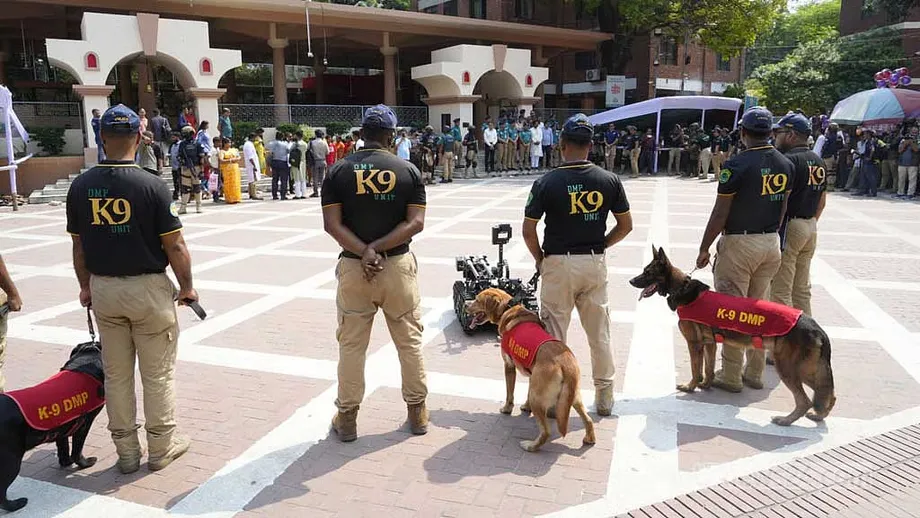
The Special Weapons and Tactics team, known as SWAT, will remain ready alongside the Explosive Recovery and Bomb Disposal Team, Dog Squad and Crime Scene Unit. These units provide specialist support when an incident requires more than the personnel stationed at a venue.
Bomb disposal personnel deal with suspected explosive devices, while the Crime Scene Unit supports the examination of incident sites. Their readiness forms part of a wider plan to respond quickly while regular officers continue guarding worshippers and managing activity around the venues.
Senior officials attending the briefing included additional police commissioners Md Abul Bashar Talukder, Md Shafiqul Islam, Mohammad Shamsul Haque and Mohammad Osman Gani. Their portfolios cover protective security, detective work, counterterrorism, technology and operational responsibilities, bringing several parts of DMP into the festival preparations.
More than 212,000 Ansar members nationwide
Ansar and Village Defence Party Director General Major General Abdul Motaleb Sazzad Mahmud announced a nationwide deployment of 212,818 members from October 15 to October 22. The force includes 146,488 men and 66,330 women, meaning women account for about 31 percent of the announced deployment.
Ansar's venue assignments use three categories, compared with the four used by DMP in Dhaka. Eight members are assigned to each of 6,914 highly important mandaps. Six members are assigned to each of 11,781 important mandaps and 14,470 general category mandaps.
Those categories cover 33,165 mandaps. Multiplying the number of venues by their assigned staffing produces the announced total of 212,818 members, showing how the national deployment is distributed across individual worship spaces.
A further 624 personnel organised into 104 strike force teams will remain ready to respond to emergencies. Ansar battalions will coordinate those teams, adding a mobile response capacity to the personnel assigned to fixed locations.
Ansar and VDP will use its Sharadiya Surokkha App to collect information, monitor conditions and support rapid responses. VDP members at mandaps will provide information from the ground, helping the force identify developing risks and respond to incidents and rumours.
Border deployments reach remote worship venues
Border Guard Bangladesh will protect 2,727 mandaps through October 22, according to the deployment breakdown announced by Lieutenant Colonel Md Mahbub Murshed Rahman; another account of his briefing gives a total of approximately 2,787. The three published geographic categories add up to 2,727.
Those categories comprise 1,425 mandaps within eight kilometres of the border, 1,119 within three kilometres of battalion headquarters, and 183 in difficult or remote locations. BGB has established 21 base camps to support security work in remote areas.
Rahman said personnel had already visited worship venues and assessed access routes, local conditions and communications. Those checks help determine how personnel can reach a location and respond when assistance is needed, especially where travel is difficult.
BGB personnel will also serve in Gopalganj, Madaripur and Faridpur from October 16 to October 22, alongside the force's assignments in border districts. Operations will be coordinated with local administrations, police and puja celebration committees.
Monitoring cells at headquarters and in the field will support information sharing and decisions. BGB will also use an application called Sharadiya Surokkha to coordinate its personnel and assess conditions during the festival.
Coast Guard protects 615 sites
Bangladesh Coast Guard Director General Rear Admiral Md Moinul Hasan said approximately 3,500 personnel were working to protect 615 temples and mandaps in coastal and river areas. He described the deployment after visiting Mirpur Central Temple on October 16.
The force's assignments cover 63 sites in the East Zone, 144 in the West Zone, 371 in the South Zone and 37 in the Dhaka Zone. The South Zone therefore accounts for about 60 percent of the Coast Guard's 615 sites, making it the largest part of that operation.
Personnel are working in coastal areas around Chattogram and Khulna, across substantial parts of Barishal division, and in areas around Dhaka's rivers. Their duties include patrols, intelligence monitoring and coordination with other security forces and local authorities.
The Coast Guard deployment began on October 16 and is scheduled to continue through idol immersion. Hasan said the force had increased intelligence surveillance and cooperation with other agencies so Hindu worshippers could take part in the festival safely.
The Coast Guard's emergency assistance number is 16111. The force has asked people to use it when help is needed within its areas of responsibility.
Immersion brings security onto roads and rivers
DMP has drawn up a separate plan for Bijoya Dashami, when idols are taken for immersion in water as part of the festival's concluding observances. Dhaka's procession will begin at Dhakeshwari National Temple and end at Wiseghat.
Additional police will be deployed according to the route, crowd size and surrounding conditions. DMP says it will coordinate with the relevant organisers and authorities to keep the procession moving while maintaining public access through the city. The briefing gave no departure time for the procession.
The Coast Guard will keep specialist diving teams ready at immersion locations to respond to boat accidents and other emergencies in the water. Its patrols and public awareness activities will continue as crowds gather near rivers and waterways.
The force's water safety campaign advises against overcrowding boats, urges passengers to wear life jackets and asks people who cannot swim to avoid boarding vessels. Those measures address a different part of festival safety from policing at temples: the movement of large numbers of people onto and around the water.
Key dates and the public's role
The announced deployments follow several overlapping schedules, with Ansar personnel starting before the October 16 briefings and BGB continuing through October 22. The Coast Guard's end point is tied to the completion of idol immersion.
- October 15, 2026: Ansar and VDP's nationwide deployment begins, with 212,818 members assigned through October 22.
- October 16: DMP outlines Dhaka's arrangements at Dhakeshwari National Temple at 10:45am. Coast Guard deployments begin, and BGB's assignments in Gopalganj, Madaripur and Faridpur start.
- Bijoya Dashami: Dhaka's immersion procession is planned from Dhakeshwari National Temple to Wiseghat, with additional police and Coast Guard diving teams ready for their respective duties.
- October 22: The announced Ansar and BGB deployment periods end.
Ahmad asked puja celebration committees, temple management committees, volunteers and residents to work with law enforcement. He also urged devotees and visitors to follow venue security rules and cooperate with officers conducting their duties.
For the public, the main requests are concrete: cooperate with entrance screening, verify sensitive online claims before sharing them, and report suspicious incidents promptly. The nearest police station and 999 are the contacts identified by DMP, while 16111 connects callers to the Coast Guard.
Bangladesh's festival operation brings together guards at worship venues, central camera monitoring, mobile emergency teams and river rescue preparations. Its practical task is to protect people throughout their participation, from arriving at a mandap to travelling with the final immersion procession.
Key Points
- DMP's official plan covers 257 worship venues with 2,072 additional police personnel.
- Cyber monitoring, CCTV and police body cameras form part of Dhaka's security arrangements.
- Nine major Dhaka mandaps will each have 50 police and Ansar personnel.
- Ansar and VDP has announced 212,818 personnel nationwide from October 15 to October 22.
- BGB's detailed categories cover 2,727 mandaps, with 21 base camps supporting remote locations.
- The Coast Guard is protecting 615 sites and keeping diving teams ready for immersion emergencies.
- Dhaka's immersion procession will run from Dhakeshwari National Temple to Wiseghat.
- Police emergency assistance is available through 999; the Coast Guard helpline is 16111.