A forest stream reveals six steps from 120 million years ago
Six footprints preserved in sandstone near Tat Noi Waterfall in Thailand's Udon Thani province have been confirmed as the tracks of a carnivorous dinosaur that lived about 120 million years ago. The Department of Mineral Resources announced the finding on October 20, 2026, after specialists examined a forest stream bed in Mueang Phan subdistrict, Ban Phue district.
Contents
- A forest stream reveals six steps from 120 million years ago
- How a family outing led to an investigation
- What the scientists identified
- A dinosaur about 6.3 metres long
- How a temporary footprint becomes stone
- The water that exposed the tracks now threatens them
- Why footprints receive legal protection
- Protection comes before tourism development
- What researchers and the public can do next
- Key Points
The prints form a single trackway, a sequence of steps left as an animal moved across the ground. Each measures about 29 centimetres long and 26 centimetres wide, with three prominent, pointed toes. Researchers estimate that the dinosaur stood approximately 1.42 metres high at the hip and measured about 6.3 metres from head to tail.
The discovery has brought an immediate conservation problem. Water helped expose the footprints, but the stream now threatens to wear them away. Officials are considering changes to the water's course and restrictions on access while assessing how the site could support research, education and tourism.
The confirmed trackway follows a discovery by Pichai Prathetsena, who photographed the unusual marks during a visit with his children. What began with attention to one impression became a survey of four possible tracks, then a scientific inspection that identified six.
How a family outing led to an investigation
Pichai photographed the marks on October 17 near ranger station No. 3 at Phu Phra Bat, in the area of Ban Tiu village. Images shared online, including in a Facebook group whose name translates as "What is this creature?", brought the impressions to wider attention.
Winai Thongpan, head of the proposed Phu Hin Chom That–Phu Phra Bat National Park, led an initial survey. He said park patrol staff had previously noticed the spot but had been unable to identify the marks with confidence. Staff recorded the location using GPS and installed a barrier to reduce disturbance.
The investigation then moved through several stages:
- October 17, 2026: Pichai photographed the unusual impressions beside the stream.
- October 19: Officials described four possible footprints and announced a specialist inspection for the following day.
- October 20: The inspection identified two additional prints, bringing the confirmed trackway to six.
- October 21: The government explained the legal protection process and said conservation and development planning were continuing.
What the scientists identified
The Department of Mineral Resources classified the tracks as belonging to a theropod, a dinosaur that walked on its two hind legs. The group included many carnivorous species. At this site, the three clearly separated toes and pointed ends helped specialists identify the impressions as tracks of a meat eater.
The footprints lie in sandstone of the Phu Phan Formation, part of the Khorat Group. A formation is a body of rock with shared features that geologists can recognise and map. The department assigned the sandstone to the Early Cretaceous period, about 120 million years ago.
The confirmed measurements replaced rough figures from the first survey. On October 19, park officials described impressions about 32 centimetres long and wide and discussed a possible age of at least 130 million years; the specialist assessment gave dimensions of 29 by 26 centimetres and an age of about 120 million years. Initial suggestions of an animal standing two to three metres tall were followed by the more specific estimate of 1.42 metres at the hip.
Officials recorded roughly 80 centimetres between successive prints. Six connected impressions give researchers a sequence to examine, allowing them to study how the feet were placed along the route rather than relying on the shape of a single mark.
A dinosaur about 6.3 metres long
Researchers used the footprint dimensions to estimate the animal's body size. Hip height describes the distance from the ground to the joint where the hind leg meets the body. It is a useful measurement for an animal that carried its body above two supporting legs.
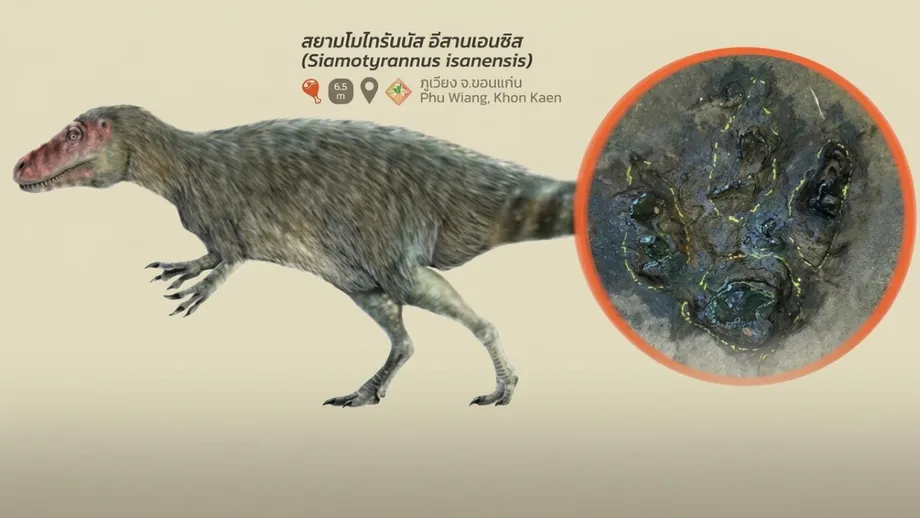
The department compared the estimated size with Siamotyrannus isanensis, a theropod previously discovered in Thailand that lived during the same geological period. The animal responsible for the Udon Thani tracks has been identified at the broader theropod level; its precise species remains unknown.
The department described the discovery as the first such find in Udon Thani. Its announcement was also described as claiming Thailand's first confirmed fossilised footprints of a carnivorous theropod. During the field inspection, officials discussed dinosaur footprints elsewhere in the wider rock group, making the provincial description the narrower geographical claim attached to this site.
How a temporary footprint becomes stone
The sandstone preserves something that began as a brief contact between a foot and soft ground. The Department of Mineral Resources has explained the process through which such tracks can survive: an animal steps into wet sediment, leaving an impression that escapes immediate destruction.
Drier conditions can help the marked surface become firm. Later sediment then covers the impression without erasing its shape. As more layers accumulate and become rock over geological time, the footprint can remain preserved within them.
Movements of the Earth's crust and later erosion can bring the buried surface back into view. Rain and flowing water remove the material above it, eventually exposing the ancient impression. This explains how a step taken millions of years ago can appear on a rock surface today.
At Tat Noi Waterfall, park staff gave a specific explanation for the recent exposure. Part of a small weir, a structure used to hold back water, had been damaged during high flows. Water shifted towards the left bank and washed sediment away, revealing the marks. Officials found further impressions as they cleared nearby soil and leaves during the investigation.
The water that exposed the tracks now threatens them
Phannipha Sae Thian, director of the fossil standards and information section within the department's Fossil Protection Division, confirmed during the October 20 inspection that the impressions were tracks of a medium sized carnivorous theropod. She also identified flowing water as a concern for their preservation.
Officials are considering diverting water away from the footprints. Their immediate task is to protect the surface and the fine details of the toes from continued wear. Those details matter both for identification and for future measurements.
Visitor contact presents another risk. Phannipha asked people not to step on the impressions because doing so could make them fade or cause damage. The proposed protected zone would limit disturbance around the trackway while agencies work out how it can be studied and, potentially, viewed safely.
The Department of Mineral Resources is coordinating with the Department of National Parks, Wildlife and Plant Conservation and the Fine Arts Department. Their shared involvement reflects the site's location around Phu Phra Bat, where geological, natural and archaeological interests meet.
Why footprints receive legal protection
Thailand's Fossil Protection Act 2008 covers ancient traces of life as well as preserved body parts. Deputy government spokesperson Lalida Periswiwatana explained on October 21 that Section 3 includes evidence such as footprints. The confirmed tracks therefore qualify for protection even though no skeleton was found beside them.
Natural Resources and Environment Minister Suchart Chomklin instructed the Department of Mineral Resources to investigate and coordinate safeguards. Nipon Chamnongsirisak, deputy permanent secretary and acting director general of the department, assigned its Fossil Protection Division and regional office 2 to work with park officials, the Fine Arts Department and other agencies.
Section 25 provides a process for responding to newly discovered possible fossils. As explained by the government, a finder must notify a local official within seven days. The local official must prohibit use of or entry into the discovery area, display visible signs and report to the department's director general or an authorised official within seven days.
The responsible agency must then complete a preliminary inspection within seven days of receiving that report. Protection can begin during notification and examination, allowing officials to safeguard fragile evidence while the next legal steps are considered.
Protection comes before tourism development
The government said on October 21 that the site remained at the stage of protection and consideration of future development. It had not been formally registered as a fossil site or officially opened as a tourism attraction. No opening date was announced.
Section 25 governs the immediate protection process, while formal registration of a fossil site follows a separate procedure under Section 14. For the Udon Thani trackway, agencies are examining the possibility of a national centre for geological and fossil studies, research and tourism.
Lalida Periswiwatana, the deputy government spokesperson, said conservation and scientific examination must take priority. In a statement translated from Thai, she described the government's position:
The government gives importance to preserving natural heritage for future generations to study and learn.
The practical sequence is to secure the exposed rock, address erosion and assess future access. A research or visitor facility would depend on those decisions. The nearby waterfall and Phu Phra Bat could give the footprints a place within existing visits to the area, but the current work centres on keeping the evidence intact.
What researchers and the public can do next
The six prints provide material for studying the animal's anatomy and movement. Footprint shape can help estimate body proportions, while spacing and the arrangement of tracks can support research into walking patterns. The Udon Thani inspection has already produced measurements, photographs and a mapped location for further work.
The discovery also shows how public observations can lead to scientific investigation. Pichai's photographs brought attention to marks that park staff had noticed but could not identify, and a coordinated field survey turned that observation into a confirmed fossil trackway.
Members of the public who find possible fossils can notify their local subdistrict administrative organisation or municipality. The government advises recording the location, describing the marks and taking photographs where it is safe. People are asked to leave the evidence in place and avoid digging, moving it or doing anything that might damage it.
Key Points
- Specialists confirmed six theropod footprints in Ban Phue district, Udon Thani, on October 20, 2026.
- The tracks are preserved in Phu Phan Formation sandstone dating to about 120 million years ago.
- Each print measures about 29 by 26 centimetres; the dinosaur's estimated length is 6.3 metres.
- Pichai Prathetsena photographed the marks on October 17, prompting wider attention and investigation.
- Officials are considering a protected zone and water diversion to reduce visitor damage and erosion.
- The site is undergoing protection and development assessment, with no official tourism opening date announced.