Thousands remain displaced despite mass returns
About 24,000 Cambodians remain in temporary shelters, designated safe areas and villages after the 2025 conflict with Thailand, even as roughly 625,000 people have returned home, according to an October 7 update from Cambodia's Ministry of Interior. Barbed wire blocking access to border communities and unexploded ammunition remain obstacles to return.
Contents
- Thousands remain displaced despite mass returns
- A falling count, with different estimates still circulating
- From fighting to prolonged displacement
- Why access to homes remains contested
- Explosive hazards outlast the ceasefire
- Returning home does not mean services have recovered
- Temporary villages and the right to return
- Land negotiations and maritime proceedings are separate
- What is still unresolved
- Key Points
The ministry put the number displaced at approximately 649,000. Its damage assessment listed 1,558 houses, 26 schools, 14 hospitals and health centres, 87 road sections and five bridges, alongside damage to water supplies, electricity infrastructure and religious sites. Preah Vihear Temple, a UNESCO World Heritage Site, was among the ancient monuments reported damaged.
The rounded figures suggest that about 96.3 percent of displaced Cambodians have returned, leaving approximately 3.7 percent away from home. That is a substantial recovery from February, when the ministry recorded 65,174 people still unable to return. It does not establish whether those who have gone back have regained working schools, health services or secure livelihoods.
Cambodia attributes the displacement to Thai military attacks in July and December 2025. Thailand disputes Cambodia's territorial account and says its forces have reclaimed Thai land. The competing claims matter directly to families whose homes lie behind military positions and barriers.
The December 27, 2025 ceasefire stopped the fighting, but its provisions for civilian returns have not brought every family home. The remaining displacement connects three unresolved problems: access to contested communities, explosive hazards and damage to the services that make those communities habitable.
A falling count, with different estimates still circulating
The clearest dated Cambodian figures show a decline over several months. As of 7:00 a.m. on February 24, the Ministry of Interior counted 65,174 people unable to return, including 34,338 women and 21,793 children. By June 15, the total had fallen to 28,460, including 14,613 women and 9,592 children.
Compared with the February total, the approximately 24,000 recorded in October represents a reduction of about 41,174 people, or 63 percent. Against June's figure, the decline is approximately 4,460 people, or 16 percent. These comparisons describe changes in the reported counts, rather than a verified record of each family's movements.
Other public statements give lower estimates. UN Special Rapporteur on human rights in Cambodia Thomas Andrews cited around 20,000 people after a border visit and more than 18,000 during an address to the 63rd session of the UN Human Rights Council. At that session, Cambodian ambassador Ke Sovann said more than 20,000 remained unable to return.
Those figures differ from the October ministry count. Without matching reference dates and counting methods, they should not be treated as interchangeable or arranged into a precise sequence of returns. Descriptions ranging from about 24,000 to more than 24,000 also reflect the rounded nature of the latest total.
From fighting to prolonged displacement
The conflict involved two major rounds of combat in 2025. International Crisis Group's October 9 assessment says the fighting killed at least 150 people and displaced almost one million across both countries. Cambodia's approximately 649,000 displaced civilians are a national count, not the total for both sides.
The main developments and dated displacement updates are:
- May 2025: An exchange of fire killed a Cambodian soldier, preceding the larger clashes.
- Late July 2025: Five days of fighting ended with a ceasefire reached through Malaysian mediation and pressure from the United States.
- December 2025: A second major round of fighting drove further displacement before the December 27 ceasefire.
- February 24, 2026: Cambodia recorded 65,174 people still unable to return home.
- June 15, 2026: The remaining displaced population stood at 28,460.
- October 7, 2026: The ministry reported approximately 625,000 returns and about 24,000 people still displaced.
Andrews also cited government figures of approximately 650,000 displaced Cambodians and 400,000 displaced Thai citizens at the height of the conflict. Together, those estimates amount to about 1.05 million. That is slightly higher than Crisis Group's description of almost one million, although both convey the scale of displacement on both sides.
Why access to homes remains contested
Cambodia's Deputy Prime Minister and Foreign Minister Prak Sokhonn raised the barriers to return at the 61st session of the UN Human Rights Council in Geneva on February 24. An official government account of his address described barbed wire and container barriers restricting access to some border areas.
Sokhonn said civilians had been forcibly expelled from villages, homes had been destroyed and military infrastructure had been erected in areas Cambodia described as occupied. These are Cambodia's allegations, rather than findings issued by the Human Rights Council.
Thailand maintains that it is observing the ceasefire provision allowing troops to remain where they stood when the agreement took effect. It also says some displaced Cambodians had occupied Thai territory. At the later Human Rights Council session, Thai representative Pratana Dilsyatat argued that some affected areas originated as temporary shelters on Thai land in the 1970s.
Ke Sovann, Cambodia's ambassador and permanent representative to the UN Office in Geneva, rejected that account. He cited the 1904 Convention and 1907 Treaty as the legal basis for recognised boundaries and said the displacement resulted from the 2025 attacks.
For civilians, the practical consequence is that a ceasefire line is not necessarily an open route home. The October update named Rong Cham Village among the places where displaced people remain, alongside temporary shelters and safe camps. It did not give a location by location schedule for reopening access.
Explosive hazards outlast the ceasefire
The Cambodian Mine Action Centre has warned that unexploded ordnance could continue to threaten civilians after the peace agreement. Unexploded ordnance means bombs, shells or other ammunition that failed to explode when used but may still detonate if disturbed.
This is a separate obstacle from barbed wire. Removing a physical barrier does not establish that a house, road or field is safe. A family may regain permission to enter its village while still facing explosive hazards around the places where it lives and works.
Andrews, the UN special rapporteur, described seeing houses with bullet holes and a bomb among rubble during his visit to the border. Speaking about the urgency of addressing the displacement, he said:
This crisis has to be addressed as quickly as possible because of the human suffering involved.
Crisis Group says cooperation on demining has been suspended since the 2025 fighting, despite demining being stipulated in the ceasefire agreement. Thailand has also raised concerns about newly planted landmines and argues that its account of those incidents has not been adequately reflected in international discussion.
The distinction between landmines and unexploded ammunition matters for identifying and clearing hazards, but both can prevent safe civilian movement. The October displacement update gives no completed clearance schedule or date when every affected community can be declared safe.
Returning home does not mean services have recovered
The Ministry of Interior's damage inventory shows why reopening access alone cannot complete recovery. Alongside 1,558 damaged houses, it recorded damage to 26 schools and 14 hospitals and health centres. Roads, bridges, water systems and electricity transmission infrastructure were also affected.
A separate June assessment documented facilities that remained closed in three border provinces. Oddar Meanchey had eight closed schools and five closed hospitals or health centres. Banteay Meanchey had five schools and one health facility that had not reopened. Preah Vihear had seven closed schools and two closed hospitals or health centres.
That amounted to 20 schools and eight health facilities still closed across the three provinces in June. These closure figures should not be equated with October's damage totals: they measure different things at different dates. A damaged building may reopen, while a facility can remain closed because of access or security conditions.
The ministry also reported damage to administrative buildings, religious sites, Preah Vihear Temple and other ancient temples along the border. It did not specify the extent of damage to individual monuments, repair costs or restoration deadlines.
The combined figures show the limits of using return totals as the sole measure of recovery. Reaching a home is one step. Having reliable water, transport, schooling and medical care is another, and the October update does not establish how many returning households have all of those services.
Temporary villages and the right to return
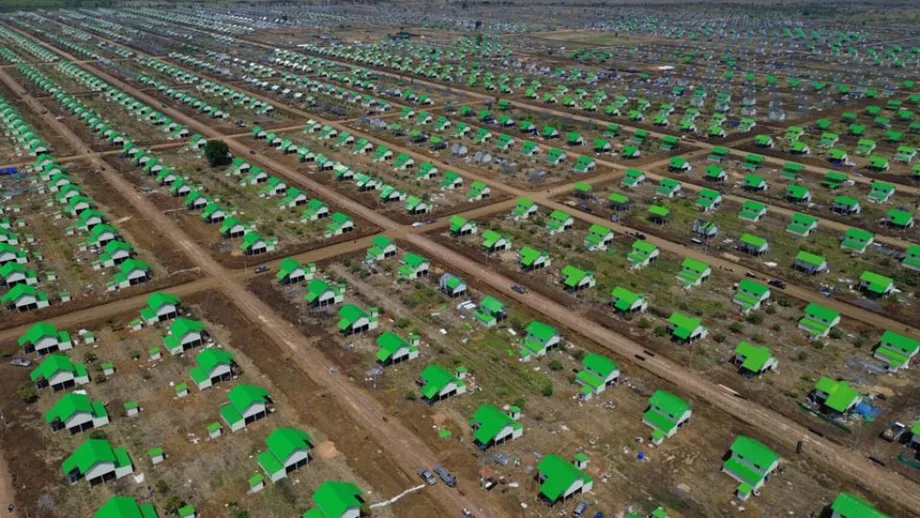
Senate President Hun Sen, speaking while serving as acting head of state, described accommodation for displaced residents as "Waiting Villages". He said they were intended to provide safety and stability while families awaited conditions that would allow them to return to their original communities, rather than become permanent settlements.
The June ministry statement described residents as separated from farmland, businesses and schools. This makes the displacement more than a housing problem: shelter does not restore access to land, work or the routines that supported daily life before the fighting.
Andrews, discussing the rights of displaced civilians after his border visit, said:
International law is very clear that those who have been displaced in a situation like this in a conflict have the right to go home.
At the Human Rights Council, he called for affected communities to return to a stable and secure environment and resume disrupted livelihoods. Cambodia and ASEAN representatives also called for implementation of the December 27 joint statement, including its provisions concerning civilian returns and livelihoods.
Andrews said his work would focus on the human rights consequences of the conflict rather than determining responsibility for starting hostilities. That distinction leaves the territorial disagreement unresolved while keeping civilian protection and access at the centre of his assessment.
Land negotiations and maritime proceedings are separate
The Crisis Group report, titled Toward a Thaw in the Cambodia-Thailand Border Conflict, identifies stalled diplomacy as a continuing risk to the ceasefire. It recommends restoring normal diplomatic relations, resuming boundary work and renewing cooperation on demining.
The Joint Boundary Commission operates under a 2000 memorandum of understanding governing land border surveys and demarcation. Crisis Group says it has succeeded in delimiting about 600 kilometres of the roughly 800 kilometre frontier, leaving approximately 200 kilometres outstanding. On those figures, about three quarters has been delimited.
Delimitation concerns establishing the boundary, while demarcation involves identifying or marking it on the ground. The commission provides a mechanism for technical work, but Crisis Group says it lacks the mandate or means to resolve the political deadlock on its own.
A separate dispute concerns overlapping maritime claims. According to the report, Thailand withdrew in May 2026 from the 2001 memorandum addressing those claims, prompting Cambodia to initiate compulsory conciliation under the UN Convention on the Law of the Sea, known as UNCLOS.
Compulsory conciliation is a legal process intended to help parties reach a settlement, rather than impose a binding judgment. Crisis Group says it will take at least a year to conclude. It is not a direct timetable for reopening land border villages, and the report says Thailand subsequently suspended participation in bilateral land boundary mechanisms.
What is still unresolved
The ceasefire has allowed hundreds of thousands of Cambodians to return, but no date has been announced for the return of everyone still displaced. The October ministry figures also do not provide a full breakdown of remaining residents by settlement or explain how their count relates to the lower totals cited at the United Nations.
Several practical milestones remain unreported: when blocked routes will reopen, which areas have been cleared of explosives, how many damaged public facilities are functioning again and what repairs are required at individual heritage sites. Without those details, the fall in displacement cannot be translated into a complete account of recovery.
Crisis Group warns that mutual accusations, suspended technical cooperation and domestic political pressures could allow a minor incident to trigger renewed fighting. Its proposed steps are recommendations, not an agreed schedule. No next meeting date for the Joint Boundary Commission or deadline for completing demining is specified.
Sokhonn, Cambodia's foreign minister, called in Geneva for implementation of existing agreements, withdrawal of Thai forces from Cambodian territory and peaceful settlement under international law. Explaining the approach Cambodia sought, he said:
Only such an approach will allow the two peoples to coexist in peace, stability, and mutual respect.
For the families still waiting, the immediate test is whether ceasefire commitments produce safe access to homes and livelihoods. The return of roughly 625,000 people marks substantial progress, but the remaining displacement shows that an end to combat has not ended the civilian consequences.
Key Points
- Cambodia's October 7 ministry update reported about 24,000 people still displaced and approximately 625,000 returned home.
- The remaining count fell from 65,174 in February and 28,460 in June, although other public statements give different estimates.
- Barriers, military positions and explosive hazards continue to obstruct returns to some border communities.
- The ministry reported damage to 1,558 houses, 26 schools, 14 health facilities, 87 road sections and five bridges.
- Cambodia and Thailand dispute territorial claims and the circumstances preventing civilian returns.
- Demining cooperation and land boundary work remain stalled, with no announced date for all displaced families to return.