A 20 trillion won backstop for a wounded market
South Korea's biggest financial institutions are weighing a near doubling of the country's stock market stabilization fund, from 10.76 trillion won to about 20 trillion won, roughly $15 billion, or HK$118.25 billion, as authorities try to steady an equity market that has given back most of a historic rally.
Contents
- A 20 trillion won backstop for a wounded market
- Where the money would come from
- The Sunday meeting that turned promises into cash
- Size was left for Monday and beyond
- Lee Jae-myung doubts size will decide the outcome
- Citi sees room for 40 trillion won
- The cost for banks arrives before any cash moves
- From a 116% rally to a record outflow
- Regulators hold the line on short selling
- A fund readied twice and never used
- Key Points
The plan rests on the five largest financial holding companies, which are each considering lifting their individual pledges to as much as 2 trillion won, about $1.5 billion. Added to commitments from other banks, insurers and securities firms, the fund would grow from the 10.76 trillion won already promised, worth about $8.1 billion.
Nothing has been announced. The expansion is under review, and no decision has been taken on whether it will go ahead or at what size. What the money is meant to defend is considerable: the existing commitments equal about 0.3% of the Kospi's market value, the combined worth of every company listed on the main board.
Where the money would come from
KB, Shinhan, Hana and Woori have each pledged 1 trillion won through their banks. NH NongHyup's 700 billion won is spread across its bank, life insurer, brokerage and nonlife insurer. Between them the five hold 4.7 trillion won of the fund's commitments.
If all five go to 2 trillion won, total commitments would climb to 16.06 trillion won. Pledges from insurers and securities firms could carry the vehicle to about 20 trillion won. Major insurers are reviewing extra contributions. How any increase would be divided among the subsidiaries of each group has not been decided.
Korea Development Bank, the fund's largest single contributor, has asked participants two questions: whether they can deliver the money they have already promised, and how much more they could add.
The Sunday meeting that turned promises into cash
About 20 people gathered on Sunday afternoon, Nov 29, at the Korea Securities Finance building in Yeouido, Seoul, for a meeting of the fund's investment management committee. Officials from the five financial holding companies attended, along with Mirae Asset Securities for the brokerage industry and Samsung Life for insurers. The committee decided to issue a capital call on the 10.76 trillion won already committed.
A capital call is the formal request that turns a pledge into money in the account. Participants promise funds in advance and pay in when the committee asks. Once the cash arrives, the fund holds real money it can spend on shares, which is more than can be said for its two previous incarnations.
The same meeting reviewed the rule that decides when the fund can be switched on. Under the investment guideline written in 2020, at the start of the COVID-19 pandemic, the fund was to be activated if the Kospi fell below 1,500. The benchmark closed at 4,915.68 on Friday, so the threshold needs a large upward revision before it has any meaning for today's market.
Size was left for Monday and beyond
The Nov 29 meeting did not take up expansion. That argument moves to an emergency review meeting chaired by the Financial Services Commission on Monday, Nov 30, where the chairmen of the five financial holding companies, the heads of industry associations and regulators are expected. The commission said the stabilization fund is not a main agenda item and described the session as an assessment of recent market conditions.
Spokesman Lee Dong Hoon said the meeting could be postponed depending on participants' schedules. No new date has been given.
The detailed work may land elsewhere. A private capital market reform body led by Kim Yong-beom, vice chairman of Meritz Financial Group, is expected to launch with about 10 members as early as next week, and the question of scale could be settled there.
Some participants want more than bigger promises. One idea in circulation is to put a set percentage of each institution's pledge limit into actual stock purchases, so the fund does not sit fully armed and entirely idle.
- Sunday, Nov 29: the fund's investment management committee approves a capital call on the existing 10.76 trillion won.
- Monday, Nov 30: the Financial Services Commission holds an emergency review meeting with financial group chairmen and industry associations, with the fund off the main agenda.
- Week of Nov 30: a private reform body led by Kim Yong-beom is due to launch.
- December: as much as 1 trillion to 2 trillion won from existing pledges could be available for investment.
- One to two months: the time new pledges need to clear internal reviews and board approvals.
Lee Jae-myung doubts size will decide the outcome
President Lee Jae-myung gave the plan a measured welcome. Speaking to reporters on Sunday after a hike on Mount Bugak with the presidential press corps, he said a fund of this scale could lift sentiment even if it cannot shift prices for long.
I question whether a fund of a manageable size can produce meaningful results.
Lee said the fund could help psychologically in the short term and that experts should settle its size. Repairing the market's underlying structure matters more than the size of the backstop, he said, adding: "We may have to do everything we can."
Citi sees room for 40 trillion won
Citigroup's Korea chief economist Kim Jin-Wook put numbers on the debate in a report published on Thursday. He sees the fund reaching between 20 trillion won and 40 trillion won, and he argues for speed as much as size.
His arithmetic starts with the market itself. The 10.76 trillion won commitment equaled about 0.94% of the combined market value of Kospi and Kosdaq stocks when it was assembled. A fund of 20 trillion to 40 trillion won would be about 0.47% to 0.95% of that combined value today, because Korean equities have grown since 2020.
A larger commitment and earlier timing could raise the efficacy of the signaling effects, in our view.
Kim expects new pledges to take one to two months to clear internal reviews and board approvals. That lag leaves a window: authorities could collect 1 trillion to 2 trillion won from pledges already in place and put it to work as early as December, before any expansion is settled. If the fund grows to the top of his range, he wrote, a government capital injection into Korea Development Bank could be considered, and the state would have ample room because tax revenue linked to chip exports is expected to run above budget in 2026.
The cost for banks arrives before any cash moves
The extra money is not free for the lenders. Under Korean rules, part of an undrawn pledge counts toward risk weighted assets, the yardstick regulators use to judge how much loss a bank can absorb. A bigger promise can therefore dent capital ratios before a single won leaves the building. Financial groups are expected to ask regulators at Monday's meeting to ease that burden, and they have warned that higher commitments could curb how much they can lend and how much they return to shareholders.
An official at one of the major banking groups said the burden should not fall on one part of the industry alone.
Banks need to play a role in stabilizing the market, but because the fund is intended to support the capital market, the burden should be shared more broadly across the financial sector rather than concentrated on one industry.
An official at another major banking group said the group supports expanding the fund while any increase should reflect market conditions and each contributor's financial capacity.
From a 116% rally to a record outflow
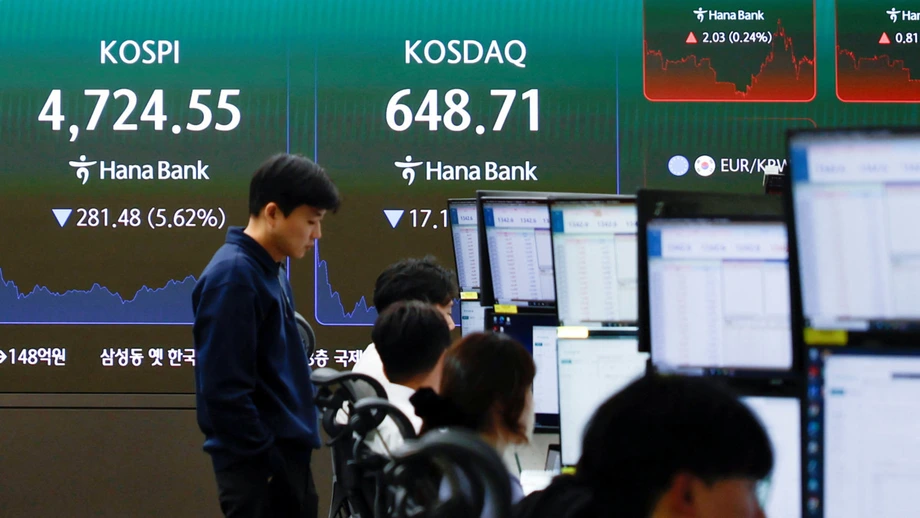
The Kospi rose as much as 116% through late June as a flagship of the global artificial intelligence trade, hitting an intraday high of 9,385.59 on June 19. It closed at 4,915.68 on Friday, up 16.6% for the year, having handed back roughly half of its peak value.
Foreign investors have withdrawn a record $154 billion from Korean equities. The Korea Exchange triggered sidecars on the buy and sell sides three times last week as volatility rose. A sidecar temporarily restricts program trading orders when futures prices move sharply, a speed bump rather than a halt.
Leveraged products took the damage hardest. XL Two South Pacific Hynix (07709), one of two Hong Kong listed products tracking chipmaker SK Hynix, fell from HK$193.65 on June 25 to HK$12.85 on Friday.
The year turned violent long before this month. On March 4 the Kospi fell 12.06% in a single session, its steepest daily loss in 46 years, as war between the United States, Israel and Iran pushed investors out of Asian stocks. In the week to Nov 6, doubts about AI spending drove an 11.71% weekly fall and pushed 844 of 2,659 listed companies to their lowest intraday prices of the year. On Nov 20 the benchmark closed below the 5,000 mark at 4,869.96, down 5.21%, with total market capitalization slipping under 4,000 trillion won. Opposition lawmakers seized on the losses, with the People Power Party demanding accountability for policies that, they argued, had drawn retail investors into the rally.
Regulators hold the line on short selling
Retail investors have made a ban on short selling their loudest demand. Short selling means selling shares borrowed from someone else in the hope of buying them back cheaper later, a practice that can amplify a fall when prices are already sliding. Regulators currently favour keeping existing rules rather than imposing a blanket ban, and are focusing on tighter surveillance of illegal short selling and of trading concentrated in individual stocks.
The government has also said it will ease restrictions on corporate share buybacks, which let companies buy their own stock and put a floor under the price.
Those measures sit alongside the fund, and none of them touches the force behind the sell-off. The Kospi slid because the artificial intelligence trade that made it the world's best performing major market earlier in the year went into reverse, and because foreign money left with it. Monday's meeting will not settle that.
A fund readied twice and never used
South Korea has used this tool before. The fund was deployed in 1990, 2003 and 2008, the last during the global financial crisis. It was readied in 2020 and again in 2022, when authorities considered drawing on it during the Legoland bond crisis, but no shares were bought. Purchases in the current round would be the first intervention of its kind since 2008.
Scale remains modest against the market it defends. Commitments of 20 trillion won would equal about 0.56% of the Kospi's market value, against 0.3% today, based on the figures used by the authorities and by Citigroup. Citigroup's upper estimate of 40 trillion won would amount to about 1.1% of the Kospi alone, and 0.95% of the combined Kospi and Kosdaq market on its calculation.
What the fund does with whatever it collects is the question the next two months will answer. A vehicle that is authorized but never tapped, as in 2020 and 2022, carries little weight with investors. Money that is called, received and actually spent, before an expansion is even finalised, would tell the market something different.
Key Points
- KB, Shinhan, Hana, Woori and NH NongHyup, which have committed 4.7 trillion won between them, are each weighing pledges of up to 2 trillion won.
- Total commitments could rise from 10.76 trillion won to 16.06 trillion won, and to about 20 trillion won, roughly $15 billion, with insurers and securities firms.
- The fund's investment management committee approved a capital call on the existing 10.76 trillion won at a Nov 29 meeting in Yeouido attended by about 20 officials.
- The 2020 activation trigger, a Kospi below 1,500, needs a large upward revision; the index closed at 4,915.68 on Friday.
- President Lee Jae-myung questioned whether a manageable fund can produce meaningful results, while saying it could help psychology in the short term.
- Citigroup expects the fund to reach 20 trillion to 40 trillion won and sees 1 trillion to 2 trillion won deployed as early as December.
- Banks want relief on risk weighted assets, warning that bigger pledges could limit lending and shareholder returns.
- The Kospi is up 16.6% this year after a 116% surge to a June peak, with record $154 billion of foreign outflows.
- The fund was deployed in 1990, 2003 and 2008 and readied but never used in 2020 and 2022.