The Flags, the Lion Dance and a Name in Two Alphabets
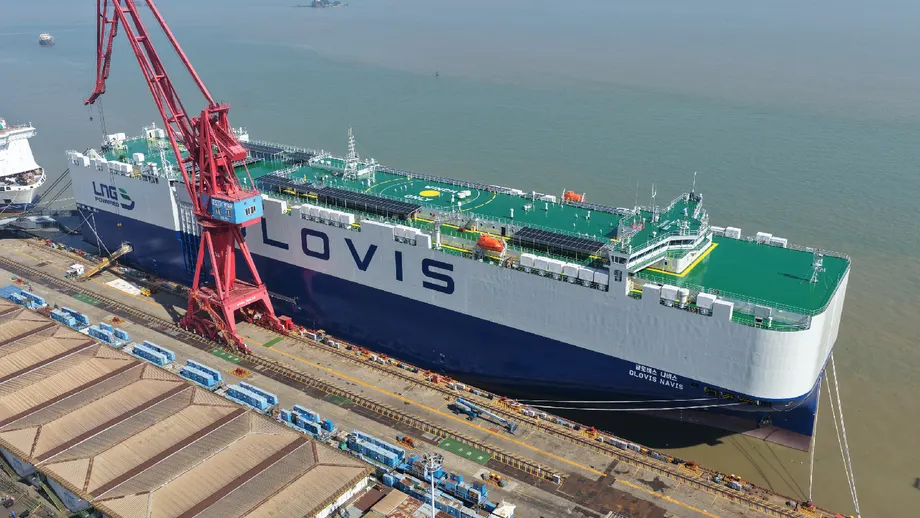
At the Guangzhou Shipyard International (GSI) yard on the Pearl River delta, Hyundai Glovis held the naming ceremony for the Glovis Navis on 26 November, with the South Korean flag and the Chinese flag flying side by side above the hull. Performers in pink and purple lion costumes danced to drums and gongs, and red dots were painted on the eyes of a lion mask in a traditional Chinese rite before the vessel's name was uncovered. The hull carried the words GLOVIS NAVIS in Korean and English, and next to them the letters LNG POWERED.
Contents
- The Flags, the Lion Dance and a Name in Two Alphabets
- What Ten Thousand Cars Look Like Inside
- Why Bigger Hulls Cut the Cost of Every Car
- The Boom That Left the World Short of Ships
- Public Money, Korean Cars and a Chinese Yard
- Gwangyang First, Then South America
- Twenty One People and Ten Thousand Cars
- First Place in China, and What It Is Worth
- The Case Against a Sudden Chinese Fleet
- From the Quay to the Dealership
- A Fleet of 128 Ships and a Fifth of the World's Cars
- Key Points
The godmother was Lee Seo-young, head of Hyundai Motor's Global SCM Support Office. Following a shipbuilding tradition in which a woman representing the owner cuts a cord and wishes the vessel well, she took a pair of scissors to the line holding the ship to the dock. Coloured paper went up as the cover came away. The name is Latin for ship.
We hereby name this ship the Glovis Navis. May good fortune and prosperity accompany it as it sails across the vast oceans.
Watching were Hyundai Glovis president Lee Kyu-bok, Kim Hyung-jun, head of the marine strategy division at the Korea Ocean Business Corporation (KOBC), and GSI president William Zhou. The ship they came to see weighs 102,590 tonnes, runs 230 metres long and 40 metres wide, and carries up to 10,800 small cars at a time. Hyundai Glovis calls it the largest pure car and truck carrier, or PCTC, in service anywhere in the world. From the quay, the top of it sits about as high as an apartment building with 15 floors.
What Ten Thousand Cars Look Like Inside
The ramp into the Glovis Navis sits on the fifth deck. Cars are driven up it one by one by port workers, an operation that has to be repeated more than 10,000 times to fill the vessel. Fourteen decks are given over to cargo, and their combined loading area matches 14 soccer fields. Every floor is punched with rows of holes so that lashing straps can be hooked in and each car tied down individually, which keeps the cargo still when the ship rolls in heavy weather.
Above the cargo space, the 15th deck holds living quarters for the crew and the 16th carries the bridge, the room from which officers steer a floating garage longer than two soccer pitches placed end to end. Five decks can change height: decks 2, 4, 6, 7 and 9. Standard cars are packed in tightly to use every cubic metre; with those decks raised, the ship can take buses, trucks, high roofed vans and excavators, with up to 7 or 8 metres of clearance. That flexibility lets Hyundai Glovis sell space to makers of commercial vehicles and construction machinery, not just to carmakers.
Why Bigger Hulls Cut the Cost of Every Car
Loading capacity is 80% higher than that of the 6,000-car vessels of the previous generation, while construction and fuel costs do not climb by the same proportion. A Hyundai Glovis official aboard gave a sharper version of the sum: the ship burns about as much fuel as a carrier that holds 6,500 cars, yet it takes 4,300 more vehicles, a gain of roughly 66% in capacity. Captain Kim Jang-hyun said that with fuel consumption roughly level, running large ships well pays a shipping line far more than running small ones, and that the advantage grows as conflict driven costs rise.
The engines are dual fuel and can run on liquefied natural gas, which Hyundai Glovis says cuts carbon emissions by about 26% compared with conventional fuel oil. At berth the ship can shut down its own generators and draw electricity from the quay through an alternative marine power system, a connection known in the industry as shore power. Ships normally burn fuel to keep lights, pumps and ventilation running while docked, which releases sulphur oxides, nitrogen oxides and fine dust over the port. Plugging in removes that pollution and helps the vessel meet tightening rules, including the European Union emissions trading system, which charges shipping companies for the carbon they emit on voyages to and from Europe.
The Boom That Left the World Short of Ships
China's Ministry of Industry and Information Technology counted 9,271,000 vehicles exported from January to October this year, 65.1% more than in the same period last year. Hyundai Glovis expects Chinese exports to reach as many as 12 million vehicles this year, against about 2 million in 2021, and as many as 15 million next year. The car carrier capacity available to move vehicles out of China is expected to reach only about 6.08 million this year and 7.4 million next year.
The shortage shows up in what shipowners pay to charter a vessel. Clarksons, a shipping market analysis firm, put average daily charter rates for car carriers at $100,000 in October, double the average of about $49,000 last year. Disruption to shipping through the Red Sea caused by conflict in the Middle East has lengthened voyages and tightened the market further. Hyundai Glovis says an order placed now would not be delivered until the second half of 2030 or around 2031, which is why capacity cannot catch up quickly.
Chinese automakers have covered part of the gap by loading cars into container ships, a slower and less efficient method, and the shortage has pushed up the price of moving a car by sea for everyone. Global seaborne vehicle cargo is put at 28.79 million units this year and more than 31 million next year, and Hyundai Glovis expects the trade to grow at an average of 8.3% a year between 2022 and 2028.
Public Money, Korean Cars and a Chinese Yard
The Glovis Navis exists because of a 2024 agreement between Hyundai Glovis and KOBC to secure ultra large car carriers. Under that arrangement KOBC, a state backed policy lender for the maritime industry, raises ship financing and owns the vessels, and Hyundai Glovis leases and operates them on long term charters. The two sides agreed to try to give priority cargo space to Korean carmakers that cannot find room elsewhere. Hyundai Glovis moves export vehicles for Hyundai Motor, Kia, GM Korea and KG Mobility.
GSI, which built the ship, belongs to the state owned China State Shipbuilding Corporation. Korean yards are occupied with higher value work such as LNG carriers, so the car carriers were ordered in Guangzhou. GSI has delivered 15 large PCTCs to Hyundai Glovis since 2022, and this one arrived about ten months ahead of schedule. Two of the four ships financed by KOBC are already at sea, and a third follows in February.
- 2023: Hyundai Glovis commits to 30 large car carriers, including 20 able to hold 10,800 cars.
- 2024: agreement with KOBC on ultra large car carriers and priority space for Korean exporters.
- July 2026: Glovis Nova delivered, the first of the 10,800 car ships.
- 26 November 2026: Glovis Navis named at GSI in Guangzhou.
- 1 December 2026: scheduled departure for Gwangyang to load export cars.
- February 2027: Glovis Notilus due for delivery, completing the four ships financed by KOBC.
- 2030: fleet target of 128 vessels in equivalents of 6,500 cars.
Gwangyang First, Then South America
The Glovis Navis is due to leave for the Port of Gwangyang in South Jeolla Province on 1 December to load export vehicles for Hyundai Motor and Kia, then sail for Mexico, Ecuador and Peru. The first voyage is expected to last one and a half to two months. South America comes first because car carriers, unlike container lines, move between routes as cargo demand and ship availability dictate, and the ship will later work services linking Asia with North America and Europe.
Routes have grown longer. Captain Kim said ships bound for Europe are rounding the Cape of Good Hope at the southern tip of Africa instead of passing through the Red Sea and the Suez Canal, and that Hyundai Glovis is working on using ports in Oman and the United Arab Emirates in place of the Strait of Hormuz, where safe passage is hard to guarantee. A crossing that takes about 20 days through Suez takes 30 to 35 days around Africa.
We use an additional 10 to 15 days' worth of fuel, and the cargo delivery period is delayed accordingly. From the standpoint of economical operation, it is quite difficult.
A longer voyage also delays the next cargo the ship could have carried, so a hull that lifts more cars in one call spreads that penalty over more vehicles. That arithmetic is the commercial case for the Glovis Navis as much as the freight market is.
Twenty One People and Ten Thousand Cars
Captain Kim Jang-hyun has spent 30 years at sea and commands the largest car carrier afloat. His crew numbers 21: six South Koreans and 15 Filipinos. Two people stand watch together at normal times, and the captain or another officer joins the bridge when traffic is dense or fog closes in. The living quarters one deck below the bridge are home for weeks at a stretch.
On a ship, safety is the top priority over things like innovation. I plan to do my utmost for the safety of the ship, the cargo, and the crew during future voyages.
Asked about his ambitions for the vessel, Kim put his principle plainly: on a ship, safety comes before innovation. For the loading crews in port, the same idea is expressed in the holes in the deck and the straps threaded through them, one car at a time.
First Place in China, and What It Is Worth
Hyundai Glovis carried 12.2% of China origin car carrier traffic between January and September, the largest share of any operator, and its chief executive wants to lift that to 13.6% with the large vessels arriving in 2027. The volumes behind the share have almost doubled in two years: 260,000 vehicles out of China in 2023 and 510,000 last year. Quarterly traffic from China has risen from about 120,000 to around 180,000.
Chinese customers with no corporate link to Hyundai now matter to the bottom line. In the third quarter, vehicles for non affiliated Chinese customers made up 25% of all car carrier cargo the company carried, and car carrier revenue rose 38.5% on the year to 1.3659 trillion won. Hyundai Glovis transports Chinese built cars for Tesla and for domestic brands as well as Hyundai and Kia exports.
Competition from Chinese fleets is smaller than the export numbers suggest, according to Lee Kyu-bok. BYD runs eight car carriers able to move about 200,000 vehicles a year, he said, while BYD's own exports reached 1.51 million vehicles in the first ten months of this year, more than seven times that capacity. Chinese shipping companies and automakers together operate about 80 car carriers with annual capacity of roughly 2 million vehicles. Of the 7 million Chinese vehicles that leave on car carriers, about 5 million travel with third country operators such as Hyundai Glovis.
Chinese shipping companies and automakers operate around 80 car carriers, with annual transport capacity of only about 2 million vehicles. We do not expect the oligopolistic structure of the maritime transport market to be easily disrupted all of a sudden.
The Case Against a Sudden Chinese Fleet
Lee, speaking at his first news conference as chief executive in the company's 25 year history, at a hotel in Guangzhou on 25 November, argued that a rapid build out by Chinese owners is unlikely because of delivery times and uncertainty about demand. Even if every ship on order arrives, he said, Chinese operators would run only about 150 vessels by 2030, and an order signed today lands in 2031 or 2032, a date that may fall on the wrong side of a peak in exports.
Chinese companies also did not expect exports to grow this fast, and even if they order vessels now, they would be delivered in the 2030s. There is also concern that exports could peak by then.
Hyundai Glovis is hedging against that peak with a two track plan. If cargo volumes rise, it charters extra ships to work alongside the new ones. If the market contracts, it lets charter contracts run out first and shrinks the hired fleet before its own. The company also carries Hyundai Motor and Kia volume under long term contracts, which means its ships are not left empty when the spot market cools, and it is that base load that made a 2023 order for 20 of the largest car carriers a risk the company was willing to take.
From the Quay to the Dealership
The chief executive argues the differentiator is not the freight rate but the chain of transport behind it. Other lines unload at the destination port and stop, he said, while Hyundai Glovis moves Hyundai vehicles in the United States onward by rail and truck to dealerships, and plans to offer the same to Chinese customers and to container cargo.
Other shipping companies only transport vehicles to the destination port, but when Hyundai Motor vehicles arrive in the United States, we also handle inland transport, delivering them by rail and truck to dealerships. We will expand this beyond finished vehicles to the container business as well.
The physical network is being enlarged to match. At Tampa Bay the company has expanded the land it operates from 48.5 acres to more than 80 acres, and its finished vehicle terminal at Philadelphia can hold about 37,000 cars. A new service in Northern Europe links port storage yards, cargo handling and rail, and a system under development will use vehicle identification numbers to show customers where each car is and when it should arrive at the dealer. No launch date has been given for that tracking system, and Hyundai Glovis has not disclosed what it pays for the long term charters on the KOBC ships.
If we switch everything to spot contracts when prices rise, customers may not choose us when market conditions weaken, so we will maintain an appropriate balance between those and long term contracts based on trust between companies.
A Fleet of 128 Ships and a Fifth of the World's Cars
Hyundai Glovis counted 106 vessels in the third quarter, measured in equivalents of 6,500 cars, and plans 110 next year, 118 in 2028, 123 in 2029 and 128 in 2030. It has taken seven ships able to carry 10,000 cars or more this year, has one more coming by the end of December, expects 10 in 2027 and two in 2028, for 20 in total, including the four financed by KOBC.
The company wants to move 5 million vehicles a year by 2030, up from about 3.4 million now, which it calculates would be more than 20% of the world's seaborne finished vehicle trade. Lee frames the fleet as a competitive weapon for the wider group as much as a profit centre of its own.
I think logistics may be the area where Hyundai Motor Group is most competitive compared with other global OEMs or Chinese OEMs. We will contribute to strengthening the price competitiveness of Hyundai Motor and Kia by securing stable vessel capacity and making maritime transportation more efficient.
We will support stable vehicle export logistics and lead the global seaborne vehicle transport market with an environmentally friendly, high-efficiency fleet.
Key Points
- Hyundai Glovis named the Glovis Navis at the GSI yard in Guangzhou on 26 November, with Lee Seo-young of Hyundai Motor as godmother.
- The ship is 230 metres long, 40 metres wide and 102,590 tonnes, with 14 cargo decks and room for 10,800 small cars, the largest car carrier in service.
- Five decks change height so the vessel can load buses, trucks and excavators alongside passenger cars.
- It runs on liquefied natural gas, cutting carbon emissions by about 26%, and can draw shore power at berth.
- China exported 9,271,000 vehicles in January to October, up 65.1%, while car carrier capacity from China is expected to reach only 6.08 million this year.
- Daily charter rates for car carriers doubled to $100,000 in October from about $49,000 last year, according to Clarksons.
- The ship is one of four 10,800 car carriers financed by KOBC under a 2024 agreement, and arrived about ten months early.
- Hyundai Glovis holds 12.2% of China origin car carrier traffic and targets 13.6% next year, up from 510,000 vehicles shipped from China last year.
- The company plans 128 vessels by 2030 and 5 million vehicles carried a year, more than 20% of global seaborne car trade.
- The Glovis Navis sails for Gwangyang on 1 December, then to Mexico, Ecuador and Peru.