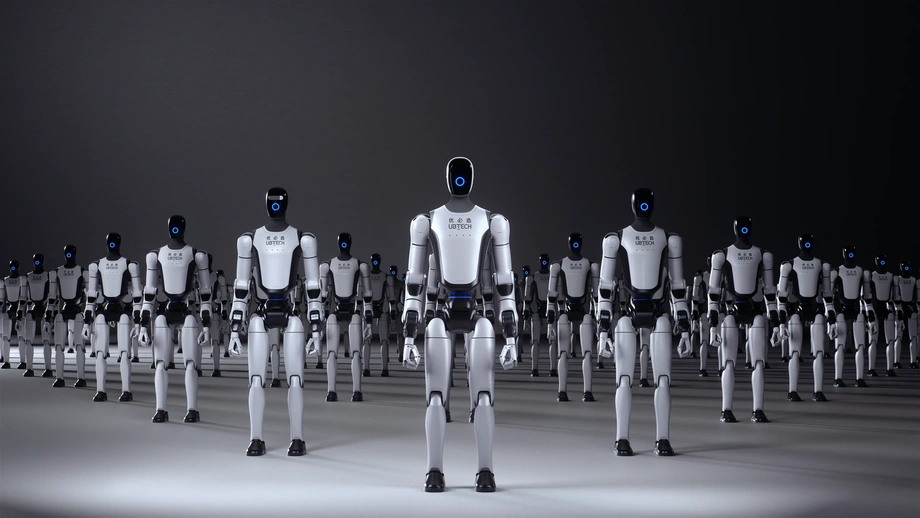
A Humanoid Sized for the Factory Floor
UBTECH Robotics introduced the Walker S3 on November 29, 2026, as its next generation industrial humanoid, and the first numbers describe a machine built to spend a shift on its feet. The robot stands 1.74 meters tall and weighs 59.3 kilograms. It carries 51 degrees of freedom, a count of the joints it can move independently, walks at up to 2 meters per second and works for up to eight hours on a charge.
Contents
- A Humanoid Sized for the Factory Floor
- Fast Repairs Decide Whether a Fleet Stays Running
- Inside the Brain: 2,070 TOPS and a Model That Sees, Reads and Acts
- Nine Cameras, No Laser Scanner
- Where UBTECH Wants the Robot to Work
- The Money Behind the Launch
- What the Earlier Walkers Establish
- Rappelling Came Before the Sales Pitch
- Why 93% Domestic Content Counts
- A Crowded Field With High Expectations
- Key Points
Two batteries make that eight hours practical. The Shenzhen company says the packs swap in about 30 seconds, so a unit returns to work instead of waiting at a charger. UBTECH describes the S3 as 'lighter, faster, stronger and smarter' than the Walker S2 that came before it, and part of that claim can be measured: 59.3 kilograms is 14.29% less than the earlier model, with aerospace grade lightweight materials in place of heavier structure.
Simplification runs through the body. UBTECH cut wiring harnesses by 66% and screws by 50%, and split the legs and torso into modules. Those changes rarely appear in a promotional video, and they decide how quickly a line can assemble the robot and how often a cable or a fastener fails in service.
Fast Repairs Decide Whether a Fleet Stays Running
A factory that buys one robot can tolerate a slow repair. A factory that buys fifty cannot, and UBTECH designed the S3 around that arithmetic. The arms and the end effectors, the hands or tools at the end of each arm, release on quick change fittings, and the company says fault repair time falls by 76%. Final assembly complexity drops by 40% under automotive grade component standards.
The lower body received its own attention. A redesigned hip joint gives the robot 332 degrees of waist rotation, and the machine can kneel on one knee to work in a space too narrow to stand in. High rigidity cross axis joints in the wrists, together with a rebuilt dexterous hand, lift motion precision by 22%, according to UBTECH. Precision at the wrist is what separates a robot that touches a part from one that can seat it, turn a fastener or place a component inside a housing.
Inside the Brain: 2,070 TOPS and a Model That Sees, Reads and Acts
The S3 carries 2,070 TOPS of edge computing, a measure of how many trillion simple arithmetic operations its onboard chips can perform each second. UBTECH puts the increase at 500% over the previous generation, while Chinese language accounts of the launch described the jump as five to six times. The compute runs the company's Thinker system, paired with a framework it calls ROSA 2.0, which ties perception, reasoning and action into one chain.
That chain runs on a vision language action model, usually shortened to VLA. A model of this kind takes camera images and spoken or written instructions and produces movement directly, so a worker can describe a task instead of writing code for it. UBTECH says the S3 supports zero code deployment, that adapting the robot to a new task is more than 50% faster than before, and that deployment efficiency rises 38%.
A second mechanism handles the exceptions that factories generate all day. UBTECH calls it Thinker RSI, a self evolution loop that collects data from the field, uses it to work through unusual conditions and refines the skill involved. A robot that struggles with an oddly placed crate feeds that case back into the system instead of waiting for an engineer to rewrite the program.
Coordinating several machines is the job of Co-Agent Swarm Brain Network 3.0. The system breaks a job into smaller tasks, assigns them across a fleet and keeps the robots in step to millisecond accuracy, the company says. UBTECH introduced Co-Agent with the earlier Walker S2 and described the software then as a closed loop of abilities:
This system empowers the robot with closed-loop operational capabilities, including intention understanding, task planning, tool usage, and autonomous anomaly detection and handling.
A development platform accompanies the hardware, covering data collection, model training, simulation testing and deployment on the physical robot. That pipeline matters for buyers who need a machine to handle their own parts and their own process rather than a rehearsed routine.
Nine Cameras, No Laser Scanner
UBTECH built the S3 around what it calls the first pure vision spatial intelligence system for an industrial humanoid, a design that reads a room with cameras instead of the spinning laser scanners, known as lidar, used on self driving cars and many mobile robots. Nine cameras form a panoramic array, and a binocular stereo rig built in house captures 3 megapixel images from two viewpoints, the way human eyes judge distance.
Combined with a visual memory of where objects were and a knowledge graph of what spaces mean, the system lets the robot find a specific item and act on it. UBTECH reports a 46% gain in recognition accuracy and says the cameras hold up better against strong backlight. The array also supports 360 degree active obstacle avoidance, which lets the machine move around people and equipment that shift position during a shift.
Where UBTECH Wants the Robot to Work
Manufacturing and logistics are the stated targets, with precision material handling and complex tasks at the center. UBTECH's robot AI education account described the S3 on November 27, 2026 as a machine that builds on the company's industrial platforms and points at factory and warehouse work rather than stage performance.
An open software development kit, or SDK, is the bridge to those customers. An SDK is a set of tools and interfaces that lets an outside team connect its own software to a machine. UBTECH presents the open ecosystem as a basis for deployment, customization and scaling, which is the difference between selling a robot and selling a platform that a car plant can adapt to its own stations. The company's posts do not say what interfaces, functions or licensing terms the kit includes.
UBTECH is also testing harsher settings. It has shown the S3 descending on a rope and crawling on its front, movements that point toward mining and energy sites where people face heat, dust and heights. No customer in either sector has been named.
The Money Behind the Launch
UBTECH's interim results, published on August 28, 2026, show why the company is courting industrial buyers. Revenue from full size humanoids reached 590.3 million yuan in the first half of the year, up 1,445% from 38.2 million yuan a year earlier, on 921 units sold. That line accounted for 46.5% of group revenue of 1.269 billion yuan.
Orders for the Walker line have passed 800 million yuan. UBTECH signed a 250 million yuan contract in September 2026 and a 159 million yuan agreement to deploy Walker S2 robots at a data collection center in Zigong. Named customers include BYD, Dongfeng Liuzhou Motor, Geely Auto, FAW Volkswagen Qingdao, Audi FAW, BAIC New Energy, Foxconn and SF Express, concentrated in automotive plants, logistics hubs and data collection facilities.
Capacity is the next test. UBTECH has targets of 5,000 humanoids a year by 2026 and 10,000 by 2027, and it aimed to deliver 500 units across China by the end of this year. Mass production of the S2 began in November 2025. The first half figure of 921 units shows a ramp that has started and a gap that remains, since 5,000 units a year works out to 2,500 in six months.
What the Earlier Walkers Establish
The S2 documentation offers concrete numbers for the generation the S3 replaces. UBTECH rates the S2 for a 15 kilogram payload, waist rotation of plus or minus 162 degrees, a 125 degree pitch and a working range from the floor to 1.8 meters. The S2 changes its own battery in three minutes, balancing two packs and using both arms, and it can run on one battery or two, choosing between charging and swapping according to the task queue. BrainNet 2.0 and Co-Agent formed its dual loop AI system, and its perception paired RGB binocular cameras with stereo depth estimation by deep learning.
Older still is the Walker listed on UBTECH's Walker product page, a 145 centimeter machine of 77 kilograms with 36 degrees of freedom, a 1.5 kilogram load in each extended arm and a 54.6 volt, 10 amp hour lithium iron phosphate battery that gives two hours of use and takes two hours to charge. The page describes navigation by U SLAM, recognition of faces, objects and scenes, and control of lights, appliances and sockets in a home. That machine was built to show a humanoid could move and serve in offices and homes. The S3 sheet is about throughput, uptime and repair time.
Several details of the S3 remain open. UBTECH has not published a price, has not named a customer for the new model and has not given a delivery date. Every performance figure in the launch comes from the company, and no independent test results have been published. The S3 announcements list height, weight, degrees of freedom, speed, compute, battery time and camera hardware, while the payload, waist range and battery swap specification published for the S2 belong to the earlier machine.
Rappelling Came Before the Sales Pitch
UBTECH staged the reveal in two parts. On November 26, 2026, it posted a demonstration on X in which the Walker S3 rappelled, sprinted, crawled, vaulted an obstacle and moved in coordination with other units. The company called it the first humanoid robot in the world able to rappel, a claim no outside party has tested against rival machines.
The industrial framing arrived three days later. A November 27 post from UBTECH's robot AI education account set out manufacturing and logistics as the destination, and the November 29 launch on Weibo organized the changes into four areas: a lighter structure and movement, higher speed and responsiveness, steadier task execution, and more advanced intelligence for decisions. A follow up presentation described the work as an evolution from cost to intelligence, without giving a price or the size of any saving.
- November 26, 2026: UBTECH posts footage of the S3 rappelling, running, crawling and vaulting on X.
- November 27, 2026: the robot AI education account names manufacturing and logistics, plus an open SDK ecosystem.
- November 29, 2026: the industrial launch on Weibo adds the four upgrade areas and the specifications above.
Why 93% Domestic Content Counts
More than 93% of the S3 supply chain is sourced inside China, according to UBTECH. For a product aimed at Chinese carmakers and factories, that share keeps the bill of materials clear of export controls and keeps unit costs inside the country's price competition.
The company is also moving into silicon. UBTECH runs a robot chip venture with MetaX called Xilect, intended to design processors around robot workloads instead of adapting chips made for cars. Compute is the part of the S3 that grew fastest: 2,070 TOPS at the edge is a large budget for a machine that must decide where to put its hands while standing on a factory floor.
A Crowded Field With High Expectations
The launch lands in a market analysts are still pricing. Goldman Sachs published a research guide on physical AI forecasting Chinese shipments rising from about 54,000 humanoid units in 2026 to roughly 3.33 million in 2035, a 51% share of a global market of 6.48 million units a year. The same bank began coverage of Unitree, UBTECH's most visible domestic rival, with a sell rating, a sign that at least one major investor believes valuations have run ahead of deliveries.
UBTECH is not competing on price alone. Airbus has taken Walker S2 robots into its aircraft manufacturing programme, and the company's machines are heading for border crossings in Guangxi under a 264 million yuan agreement due to start deliveries in December 2025. Those deployments spread one platform across aerospace, public services and factories, and each produces the field data the company's self evolution loop is built to consume.
Rivals are moving at the same time. Samsung is preparing its first humanoid for CES, and XPeng says its IRON robot could cost about as much as an electric car. Chinese humanoids have already shown what coordinated movement looks like in public, from the Chengdu concert backflips in December 2025 to the factory trials that followed. UBTECH's own test is arithmetic: a price tag and named S3 customers will show how far an eight hour shift and a 30 second battery swap carry the 1,445% growth rate of the first half into the second.
Key Points
- UBTECH unveiled the Walker S3 on November 29, 2026, at 1.74 meters, 59.3 kilograms, 51 degrees of freedom and a top walking speed of 2 meters per second.
- The robot runs eight hours on two batteries that swap in about 30 seconds, and weighs 14.29% less than the Walker S2.
- Onboard compute reaches 2,070 TOPS, which UBTECH calls a 500% gain, running a vision language action model with zero code deployment.
- Nine cameras plus a 3 megapixel binocular rig replace lidar, with the company reporting a 46% gain in recognition accuracy.
- Fault repair time falls 76% and final assembly complexity 40%, helped by modular legs, torso and quick release arms.
- Humanoid revenue hit 590.3 million yuan in the first half of 2026, up 1,445%, on 921 units, or 46.5% of group revenue.
- UBTECH has not disclosed a price, a named S3 customer or a delivery date, and no independent performance testing has been published.
- The company targets 5,000 humanoids a year in 2026 and 10,000 in 2027, against a goal of 500 units delivered by the end of this year.