Ten minutes inside a 1,000°C test fire
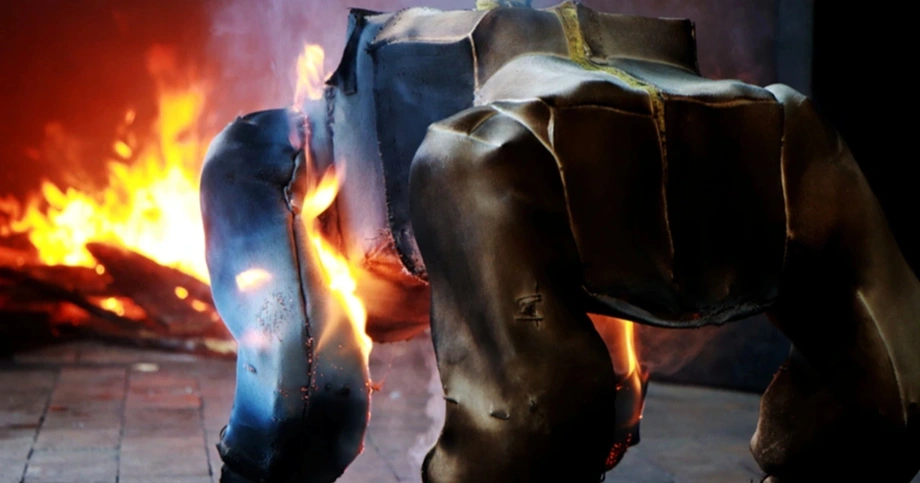
A robot dog wearing a silver grey protective suit walked through flames reaching 1,000°C, changed direction, stopped when instructed and emerged after 10 minutes with sparks still clinging to its clothing. Its gait remained steady, while readings on the control terminal showed that its lithium battery had stayed at roughly 43°C to 45°C and its joint motors at about 70°C. Critical components remained below 80°C.
Contents
- Ten minutes inside a 1,000°C test fire
- Why fire crews want a machine to go first
- How rocket protection became a flexible suit
- Burning rubber feet forced a redesign
- Seeing through smoke and keeping a control link
- What the Suzhou exercises measured
- What a robotic scout could change for rescue teams
- Production plans and possible uses beyond fires
- Key Points
The demonstration took place on 25 November 2026 at the Fengyang Road Special Service Station of the Suzhou Fire and Rescue Detachment in Jiangsu province, eastern China. Researchers built the controlled fire with straw, charcoal and gasoline, producing flames that rose higher than a person. The outer suit blackened during the exposure, but the machine continued to respond to commands and left the area under its own power.
The developers describe it as China's first firefighting reconnaissance robot dog designed to operate at 1,000°C. They say it can work continuously for 10 minutes at that temperature and could support searches in about 95% of fire scenarios. That coverage figure is the project team's estimate and has not been independently verified.
Three organisations developed the system: Harbin Institute of Technology's Suzhou Research Institute, the Jiangsu Provincial Intelligent Robotics Technology Innovation Center and Sichuan Longjia Aerospace Materials Technology, a company incubated by the institute. The university announced the results on 26 November.
Why fire crews want a machine to go first
A building fire can become especially dangerous during flashover, the point at which heat and flammable gases cause much of a room's contents to ignite almost simultaneously. Temperatures inside can then range from 300°C to 1,100°C. Smoke containing carbon monoxide, cyanide and other toxic substances can make it difficult to identify directions or objects only a few steps away.
Firefighters approaching such an area may carry about 20 kilograms of protective equipment. A robot sent ahead could provide information about flames, obstacles and trapped occupants before crews commit themselves to a route through the building.
Temperature also limits the usefulness of existing machines. Fire reconnaissance robots currently used in China generally tolerate environments of around 300°C, according to the project team. Lithium batteries can become an explosion risk at about 200°C through runaway heating, so an inadequately protected robot could introduce another danger instead of removing one.
The Suzhou machine addresses a narrow but important interval. Its 10 minute operating window is intended for reconnaissance, allowing operators to look for fire sources and people while the machine remains within its thermal limits. It is not designed to replace an entire firefighting crew or extinguish a large building fire by itself.
How rocket protection became a flexible suit
The robot underneath the covering is not inherently resistant to fire. Its survival depends on a flexible composite suit measuring 5 to 6 millimetres thick and weighing approximately 4 to 5 kilograms. The material was adapted from thermal protection technology used in aerospace, including work associated with three launches of China's Long March 5 rocket.
The outer layer resists flames and abrasion. Inner layers provide insulation, absorb heat and reflect thermal energy away from the machinery. Descriptions of the material also refer to a carbonisation barrier, meaning that part of the material chars in a controlled way to help resist further heat transfer. The suit must manage heat generated by the robot's own motors as well as energy coming from the fire.
Guo Shuai, an associate researcher with the Autonomous Unmanned Systems and Intelligent Equipment team at the Suzhou institute, led development of the protective covering. He explained the central idea by describing a transfer of technology from space launchers to emergency equipment.
Our approach to solving the problem was to take aerospace thermal protection technology off the rockets and put it on the robot dog.
Guo said the material had supported three Long March 5 launches and described its combined, multifunctional use in this system as a world first. Ma Xiaoliang, general manager of Sichuan Longjia Aerospace Materials Technology and a postdoctoral researcher at Harbin Institute of Technology, said the different layers keep external heat away from the machinery while absorbing warmth produced inside.
The temperature readings illustrate the scale of that insulation. Outside heat approached 1,000°C, equivalent to 1,832°F, while the battery compartment remained near 45°C and the motors near 70°C. Those measurements came from the controlled demonstration rather than an uncontrolled fire in an occupied building.
Burning rubber feet forced a redesign
The protective suit initially solved only part of the engineering problem. During an earlier trial, the covering shielded the body, but the robot's four rubber feet ignited. The team discovered that ordinary rubber could burn in much the same way as a tyre, leaving the machine vulnerable even when its electronics remained cool.
Guo recalled that first failure in direct terms.
During the first test, all four feet were on fire when it came out.
Engineers responded by making new feet from rubber mixed with materials that inhibit flames, tolerate high temperatures and reflect heat. The redesign was intended to prevent ignition while limiting the transfer of thermal energy through the feet and into the legs.
The episode shows why protecting a robot involves more than wrapping its main body in insulation. Feet, joints, cameras, cables and communication equipment all need to function while the machine moves across hot surfaces. The project team did not give a date for the failed trial or say how many intermediate versions were tested.
Seeing through smoke and keeping a control link
The reconnaissance system combines visible light cameras, infrared thermal imaging and recognition software assisted by artificial intelligence. Thermal imaging can reveal temperature differences associated with flames or a person's body heat, while the recognition software is intended to help operators identify possible fire sources and occupants.
Gated laser imaging provides another way to examine a smoke filled space. In simple terms, the system uses laser illumination and precisely timed camera exposure to reduce the effect of scattered light. Its purpose is to produce a more useful view through dense smoke than an ordinary camera could provide on its own.
Communications use two separate channels, a 5G connection and a dedicated video transmission link. This redundancy gives operators another path if one connection deteriorates. The video system can also adjust its bitrate, or the amount of data sent each second, as network conditions change.
The developers say the robot can remain under stable remote control and send HD video from inside buildings taller than 30 storeys. They also envision it climbing stairs, reporting the location of flames and transmitting information about trapped people in real time. Those functions matter because a machine that survives the heat but loses contact or produces unusable pictures would offer little guidance to a crew waiting outside.
What the Suzhou exercises measured
The demonstration comprised different tasks. The open flame exercise concentrated on movement, thermal protection, component temperatures and control systems. A separate building exercise examined stair climbing, simulated searches for personnel, reporting of fire sources and remote imaging. During that part of the demonstration, the robot climbed stairs and transmitted information about the location of the flames.
A working fire would require these abilities to operate together. The robot would need to enter extreme heat, cross debris, maintain its communications, locate a target and return usable information before its suit or batteries reached their limits. Water from hoses, collapsing material and rapidly changing smoke could add further complications.
Other robotics results help explain why completing a sequence of emergency tasks can be difficult. Only three of 12 teams finished a simulated firefighting mission within 30 minutes at an August competition in Beijing, although that event involved humanoid machines rather than quadrupeds. The tasks and designs were different, but the result illustrates the challenge of linking mobility, perception and decision making.
Routine industrial operation offers another point of comparison. Boston Dynamics and GlobalFoundries reported that two Spot robots in Singapore completed more than 90,000 inspections from April to November 2026, with a 99% mission success rate. Those company figures concern repeated industrial inspections, not exposure to fire, but they show the volume of operating evidence that can accumulate once robots enter regular service.
The published Suzhou results come from the developers, and independent verification has not been announced. For fire services, the next useful evidence would include repeated entries in combined heat and smoke, with target detection, movement and video transmission assessed together.
What a robotic scout could change for rescue teams
The immediate value would be information. A scout could identify a hotter part of a building, reveal whether a corridor is passable or help locate someone before firefighters enter carrying heavy equipment. Commanders could then choose a route with a clearer picture of the conditions beyond a doorway or stairwell.
The researchers are also considering coordinated operations involving one group or several groups of robots. Future equipment could include oxygen masks for trapped occupants and charges for extinguishing small fires. Those additions remain proposals, while the demonstrated machine is primarily a reconnaissance platform.
The project occupies a very different place in China's emergency equipment programme from the AG600 Kunlong amphibious aircraft. In 2025, the AG600 entered mass production after more than 15 years of development. With a maximum takeoff weight of 60 tonnes, it can collect 12 tonnes of water for firefighting in 20 seconds or carry up to 50 people during a maritime search and rescue mission.
The aircraft is designed to reach fires and emergencies across large areas of land and water. The Suzhou robot has a much more confined job: entering a hazardous structure and telling rescuers what lies inside. Both approaches reflect the same practical priority, gaining access to places where people face considerable danger.
Production plans and possible uses beyond fires
Ma said the fireproof material is approaching mass production and could eventually be woven into protective clothing worn by firefighters. Clothing would require its own safety certification and fit testing, since a flexible garment must protect a moving person rather than a machine with a battery compartment and joint motors.
The robot's suit is still being optimised, with completion targeted by the end of 2026. The project team has not disclosed a commercial price, a manufacturing volume for complete robots or a date for operational deployment with a fire service. Mass production of the fabric and deployment of the finished robot are separate steps.
The programme has progressed through several stages:
- An earlier trial ended with all four rubber feet burning, prompting their redesign. No date was given for that test.
- On 25 November 2026, the robot completed the controlled flame exposure and separate building exercises in Suzhou.
- On 26 November, the developers announced the results and released technical details.
- By the end of 2026, the team aims to finalise the suit, while preparing the underlying material for mass production.
Possible applications extend to accidents at hazardous industrial sites, underground structures and other emergencies where heat makes human entry difficult. Developers have also discussed adapting the fabric for drones, ground vehicles and other unmanned platforms.
Military uses mentioned include reconnaissance in burning urban areas, delivery of supplies and retrieval of casualties. China's armed forces have already trained with robot dogs for reconnaissance, logistics, obstacle clearance and armed operations. Heat protection could address one vulnerability in such machines, although no deployment of this particular suit for military purposes has been announced.
The immediate next step is therefore technical validation rather than a confirmed purchase or rollout. Repeated trials, independent measurements and evidence that the sensors and communications work during thermal exposure would show how the controlled Suzhou performance translates into routine emergency work.
Key Points
- A Chinese robot dog completed a 10 minute controlled test in flames reaching 1,000°C in Suzhou on 25 November 2026.
- Its battery compartment stayed at about 43°C to 45°C, while joint motors reached approximately 70°C.
- The flexible composite suit is 5 to 6 millimetres thick, weighs 4 to 5 kilograms and uses technology associated with Long March 5 rocket launches.
- An earlier trial failed when the robot's rubber feet caught fire, leading engineers to rebuild them with materials resistant to heat and flames.
- Cameras, infrared imaging, recognition software and gated laser imaging are intended to locate fires and people in smoke.
- Separate 5G and video links provide redundant control and HD image transmission, including inside buildings taller than 30 storeys.
- The developers estimate coverage of about 95% of fire scenarios, but independent verification has not been announced.
- The suit is targeted for finalisation by the end of 2026, with no commercial price or operational deployment date disclosed.