A rescue ended by a car using cruise control
On a stretch of the Lianhang Expressway in Huzhou in May 2026, a van burst a tyre and rolled onto its side. The driver, identified as Yang, was trapped. Li Jianwei stopped in the emergency lane, broke a window and pulled Yang out. They had just reached the barrier beside the road when another car came straight at them.
Contents
- A rescue ended by a car using cruise control
- Suzhou showed the same blind spot
- What Level 2 means in plain language
- The warning signs appeared before the deaths
- Why an overturned car can look like a wall
- Three versions of the same feature
- The launch stage claim that had to be corrected
- The law keeps the driver at the centre of Level 2
- Standards turn warnings into product rules
- Millions of cars sit outside the new rule
- Who should pay for a feature sold as safety
- What would close the gap
- Key Points
The car was using assisted cruise control set at 110 km/h. Wang Mouwen, the driver, was looking down at a phone and his eyes were off the road. The car hit Li at 106 km/h, then struck the overturned van. The case became public on November 21. Wang was sentenced to one year and nine months in prison for causing a traffic accident and ordered to pay more than 2 million yuan. Prosecutors and courts also applied for 130,000 yuan in judicial aid for Li's family. Li's rescue was recognised as a brave act for a just cause, a formal description for someone who risks personal safety to help another person.
Suzhou showed the same blind spot
Nine days earlier, on November 12, the Suzhou Industrial Park Court made public a judgment from March 2025. A man surnamed Li had a tyre blowout, stopped by the road and called police. He walked about 50 metres behind the car to place a warning triangle. Another driver, surnamed Liang, was using navigation assistance. The car struck Li, who died at the scene.
The judgment said the Level 2 system could not identify or avoid a static object on the road. The court used camera footage, pedal and steering wheel data and driver assistance logs to confirm that the car was in Level 2 mode. Liang received 11 months in prison with a one year suspension and was ordered to pay more than 600,000 yuan beyond insurance.
The court found that Liang trusted the system too much and failed in his duty to pay attention. For a reader, the key point is simple: the car helped with driving, but the person behind the wheel remained responsible.
What Level 2 means in plain language
GB/T 40429-2021 divides driving automation into levels 0 to 5. Levels 0 through 2 are driver assistance. Levels 3 through 5 are automated driving. At Level 2, the car can steer and control speed at the same time. It may hold a lane, follow traffic and change lanes on a motorway. It cannot replace the driver's eyes and judgement.
Automatic emergency braking, often shortened to AEB, is meant to brake when a crash risk appears. For static targets, effective stopping speeds in mainstream systems are usually 80 to 100 km/h. Above that, even a correct detection may leave too little road to stop. Physics sets the limit, not a marketing label.
The warning signs appeared before the deaths
Since June 2025, six or seven public cases have shown a similar shape. The objects were stopped or slow vehicles, cars in odd positions, irregular obstacles or items hanging above the road. Most happened at motorway speeds.
- From June 2025: cases involved a static obstacle in Suzhou, the overturned van on the Lianhang Expressway, a broken down lorry in a fast lane on the Jiguang Expressway, a rear collision with an overturned vehicle in Fuzhou, a 108 km/h collision with a stationary repair vehicle in Henan, a Hyptec collision with a works vehicle and an Anji case with a suspended utility pole.
- February 2026: the Supreme People's Court issued guiding criminal case 271, saying an assistance system cannot replace the driver as the driving subject.
- November 2026: two court cases and a launch stage remark brought the issue into public debate.
Why an overturned car can look like a wall
Millimetre wave radar measures distance by bouncing electromagnetic waves off objects. Metal gives a strong signal. Road signs, overpasses and guardrails also reflect strongly. Engineers filter some stationary reflections so a car does not brake for no reason on an empty road. A stopped, overturned vehicle can then fall into the same ignored group as road markings or an asphalt patch.
Cameras have another weakness. Visual recognition learns from labelled images. Most training examples show cars in normal positions. When a car lies on its side, its outline changes. To the system, the overturned body may look more like a wall than a vehicle.
The industry has known the problem for about a decade. A 2016 Tesla statement said neither Autopilot nor the driver identified a white trailer against the sky. Ten years later, overturned vehicles and suspended poles still sit in the same blind zone. Engineers call these uncommon cases long tail scenarios. They can be added bit by bit, but a long tail does not vanish.
Three versions of the same feature
Companies, manuals and courts tell three different stories about Level 2. The gap has grown as the feature has entered everyday cars.
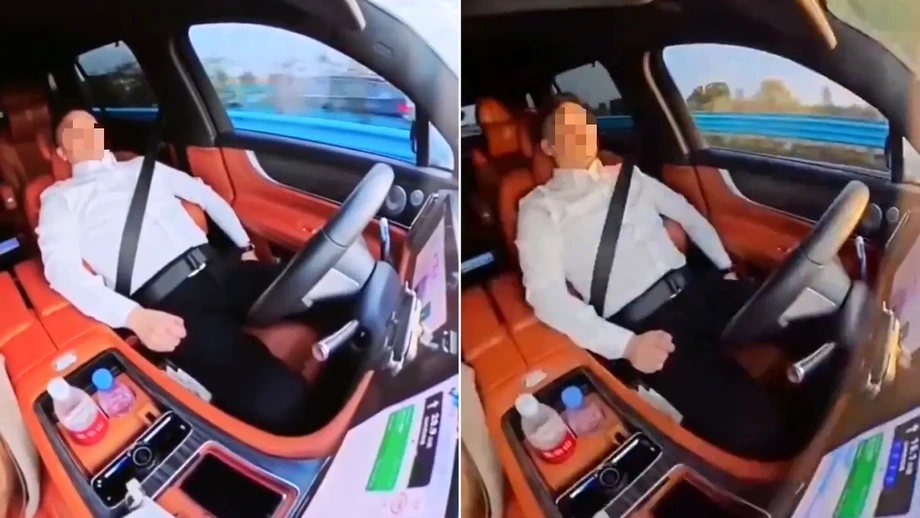
At launch events, companies have used phrases such as all scenario, all speed range and hands free. Some promotions invented a gear that does not exist, L2.999. Some executives demonstrated taking hands off the wheel or closing their eyes. Some materials presented hardware that could support a function as if the function were already available.
Manuals are quieter. One manufacturer's manual says forward collision assistance may fail to identify overturned, tilted, sideways or damaged irregular vehicles. It also lists water barriers, cones, fallen rocks and guardrails. Hyptec said a works vehicle in a similar crash was an irregular obstacle named in its manual. Leapmotor gave a similar warning: the system may fail to identify stationary objects or irregular items.
The China Automotive Technology and Research Center's Intelligent Driving Safety White Paper says crashes linked to overreliance on assistance and neglect of driver duties rose by more than 200 percent in 2025 from 2022. That explains why language matters. A driver who believes the car is almost autonomous may stop watching the exact hazards the system cannot see.
The launch stage claim that had to be corrected
In mid November, a launch event line about Level 3 drew wide attention. Yu Chengdong, the executive who made the claim, said that once Level 3 arrives, drivers would not need to hold the steering wheel and could sleep while the car woke them. On November 20, Yu corrected himself in a public post. He said the Xiangjie V8 used Level 2 assistance. Level 3 hardware existed, he said, but the function was not open.
Yu's correction, in Chinese, said:
今天发布会上,有几句话讲得不准确,要纠正一下。享界V8现在给大家用的是L2辅助驾驶,L3的硬件能力已具备,但还没有开放。大家用辅助驾驶要专心开车、按要求握好方向盘。现在还是L2时代,大家一定要注意安全,开车不能睡觉。
His point in English was direct. The car on sale used assistance, not automation. Hardware is not the same as an enabled function, and drivers had to hold the wheel and stay awake.
The law keeps the driver at the centre of Level 2
The Sichuan Emergency Management Department statement followed a video of an M9 owner sleeping while assistance was engaged. It said intelligent driving is not autonomous driving. It said levels 0 through 2 are assistance, levels 3 through 5 are automation, and current systems in cars sold in China do not provide autonomous driving. The driver is always the first person responsible for safety.
Jiang Guokai, chief expert at the China Automotive Technology and Research Center, made the same practical point. He said that when Level 2 functions are active, drivers must keep attention and cannot take their hands off the wheel.
The Road Traffic Safety Law revision draft went to its first reading at the National People's Congress Standing Committee session from August 25 to 28, 2026. It adds a chapter on autonomous vehicles, defines autonomous driving and assistance functions, and sets conditions, violation rules and insurance arrangements. Cars with only assistance functions, and autonomous vehicles running with the function off, are treated as ordinary motor vehicles. Violations during an active autonomous function are handled by the maker or importer. The draft also bars false or exaggerated publicity and blind driving, meaning driving with eyes away from the road.
The current law took effect in 2004 and was amended in 2007, 2011 and 2021. The draft also raises the electric bicycle speed limit in non motorized lanes from 15 to 20 km/h and bans handheld calls and video watching while driving. No final passage date was given.
A liability regimes study recommends matching responsibility to automation level: driver liability at levels 0 through 2, shared responsibility at level 3, and maker, operator or system supplier responsibility at levels 4 and 5. It notes that Germany requires a black box and shifts liability to makers during system operation or system failure. France places responsibility on the maker or system operator in an approved automated mode. Britain uses an insurer framework and an authorised self driving entity system.
Standards turn warnings into product rules
On September 17, 2025, the Ministry of Industry and Information Technology released a draft mandatory standard for combined driver assistance and opened it for comment. The draft required makers to state usable speeds and road types, barred activation outside those conditions, required hands off and gaze off detection, and allowed at least a 30 minute disable after repeated disengagement. It also added in vehicle data recording for crash investigation and split Level 2 systems into basic single lane, basic multilane and navigation based types.
Gong Jinfeng, deputy general manager of the China Automotive Technology and Research Center, said the draft followed UN Regulation No 171 from 2024 while adding local road tests and China specific scenarios. He described its safety value this way:
This provides comprehensive safeguards for road safety as well as the life and property safety of the people.
Li Chuanhai, vice president of Geely Auto Group and president of Geely's research institute, said rules would change system naming, performance measures and safety mechanisms. He called for baseline standards first, then tighter rules later. He said:
Establishing baseline standards first, followed by phased tightening, will allow enterprises to transition smoothly while driving steady progress toward higher safety levels.
The mandatory Level 2 standard, GB 47955-2026, was approved on June 27, 2026 and takes effect on January 1, 2027. It requires hand release and gaze release detection and downgrade or disable when conditions are met. A public post named GB 44721-2026 for automated driving systems and a July 2027 start. New rules also push names such as L2.5 and L2.9 out of marketing and bar claims that confuse assistance with automation.
Millions of cars sit outside the new rule
The Ministry of Industry and Information Technology put Level 2 combined assistance penetration in passenger vehicles at 70.5 percent in 2026. From January to July, 7.76 million such vehicles were sold, up 21.3 percent from a year earlier, with penetration at 62.6 percent. The feature is no longer rare.
The Level 2 standard has a transition period of about one and a half years and governs new model approval. Many cars already sold will not automatically gain its protections. No clear tracing or retrofitting plan has been set out for them.
Scale matters. By the end of June 2026, China had 476 million registered motor vehicles and 567 million licensed drivers. New energy vehicles were 13.19 percent of the car fleet, against a 2030 target of about 30 percent. More than 57,000 km of roads had opened for autonomous driving tests and demonstrations, with more than 220 million km of accumulated mileage. At the end of 2025, an academic analysis recorded 17 national test zones, more than 32,000 km of test roads, over 7,700 test licences and more than 120 million km of driving.
Regulators had already pressed carmakers through smart vehicle recalls covering 20,393,800 intelligent connected vehicles in the first nine months of 2026. By the end of 2024, 89 intelligent connected vehicle recalls covered 4.491 million units, while 19 recalls delivered through over the air updates covered 4.068 million vehicles. An over the air update sends fixes over the internet. That can solve problems quickly, but crash investigators still need clear records of which software version was active.
Fu Bingfeng, executive vice president and secretary general of the China Association of Automobile Manufacturers, said China's intelligent connected vehicle industry had become an international front runner through policy support, technology, cross sector cooperation and strong demand. The first batch of Level 3 conditional vehicles has already begun running on public roads in designated areas.
Who should pay for a feature sold as safety
Driver assistance is not usually free. Tesla and Huawei sell high level assistance by subscription. Even when no separate fee is charged, assistance value is built into the car price. Smart driving editions became a common way to add margin and draw buyers.
That sales model raises an ethical question. Companies gain orders and price premiums from the feature. Drivers face the road risk when the system reaches a limit. A company earning money from a tool that helps driving but cannot complete driving has a duty to explain the boundary throughout the product's life, not hide it deep in a manual.
Li Bin, founder, chair and chief executive of Nio, offered one test of value on November 25. He said two measures mattered: whether users subscribe and whether insurers accept the safety record. He put it this way:
一个是订阅率,还有一个就是事故率,就这两个标准就够了。
Nio said users had driven 9.6 billion km with assistance and 1.2 billion hours in driving time. It said active safety had avoided or reduced more than 9 million crashes or risks, and four insurers jointly certified a 38.43 percent reduction in accident safety loss. XPeng announced on the same day that it would start a subscription service. Public comments after the fatal crash also called for stricter or more strictly enforced conditions for switching assistance on.
What would close the gap
One fix is to bind marketing claims to the approved design running domain, often shortened to ODD. An ODD is the set of conditions where a system may work, such as speed range, road type and weather. If a company says a system works at 120 km/h, approval papers should contain validation at that speed. If it says the system handles a type of scene, that scene should be in the declared ODD.
Delivery is the second place to act. Dealers could demonstrate each limit at handover and keep signed records. Buyers should be told what makes the system exit, which functions exist in the delivered car and how the system returns after repeated non response. Over the air updates should be explained in the same clear way.
Old cars need attention. A rule for new approvals will not reach the large fleet already on Chinese roads. Regulators and makers need to check whether earlier vehicles can receive clearer warnings, stronger driver monitoring or software changes.
The driver remains the last line of defence under Level 2 rules. That means watching the road every time, even after 10,000 km without an accident. Cruise control, navigation assistance and lane keeping are helpers. They do not remove the duty to see a person beside a disabled car, a warning triangle or an overturned vehicle. Laws, marketing and daily habits all have to point in that direction.
Key Points
- A car using assisted cruise control hit Li Jianwei at 106 km/h after he rescued a trapped driver on the Lianhang Expressway in May 2026.
- A Suzhou case disclosed on November 12 showed the same blind spot when navigation assistance failed to identify a man placing a warning triangle.
- Static, overturned and irregular objects remain hard for radar and cameras to recognise, especially at motorway speeds.
- Courts and the national grading standard keep the driver responsible at Level 2.
- New standards require driver monitoring, clear operating limits and data recording, but cars already sold need a clearer path.
- Companies selling assistance as a premium feature have a duty to describe both what the system can do and what it cannot do.