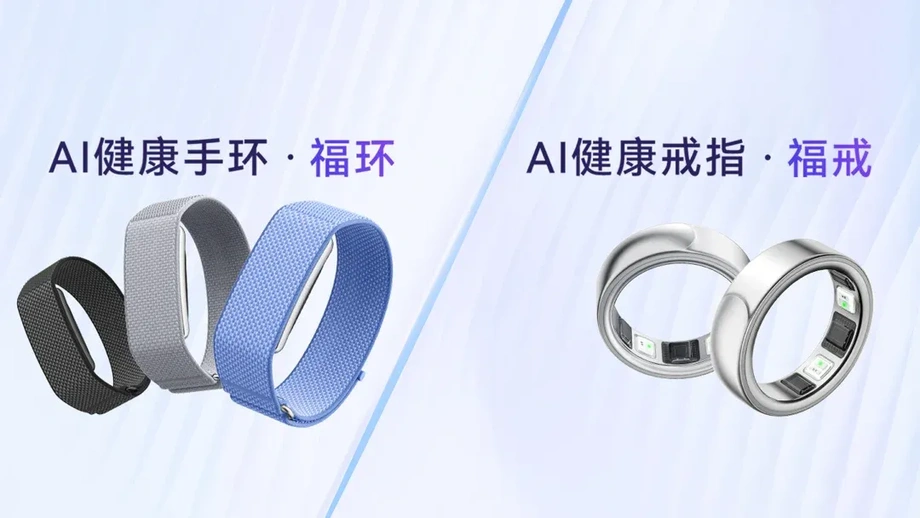
Ant Group showed two pieces of wearable hardware for its health service Afu in Guangzhou on 23 November: an AI health band called Fuhuan and an AI health ring called Fujie. The launch came at the first medical and health ecosystem conference Ant has held for Afu, a two day event that also carried a rebuilt version of the app, a family of medical AI models released for public use and a plan to take the service to more than 170 countries and regions.
Contents
- Wrist or finger: how the two devices differ
- The numbers the hardware plugs into
- Talking to a camera instead of typing a symptom
- The doctor who can join the call
- Four models released for anyone to use
- Eighteen brands and an open door
- Hong Kong first, then 170 countries and regions
- What changes for a household in Guangzhou
- The dates that shaped the announcement
- What Ant has not said
- Key Points
The band comes in a version with a small screen and a version without. The ring is a plain silver white band of titanium alloy, 2.5 millimetres thin, with no display. Both record heart rate, heart rate variability, blood oxygen, breathing, sleep, exercise and the menstrual cycle, which Ant counts as 16 health data items in all. Readings pass to the phone, where Afu's AI writes a health report and suggests what to change.
Battery life is the second headline claim after monitoring. Material published with the products gives 14 days of use for the band and about a week for the ring. Ant disclosed no battery capacity, no charging details, no retail price and no release date at the announcement, and said both products will be open to cooperation with partners.
Wrist or finger: how the two devices differ
Both devices read heart rate and blood oxygen the way most wrist wearables do, by shining light into skin and watching how blood flow changes the reflection. The band puts the sensor against the wrist. The ring puts it against the base of the finger. Ant's guidance places the ring first for people who want body temperature and cycle tracking alongside sleep, and the screen free band first for people who want nothing glowing on their wrist at night and the longest gap between charges.
Habit matters more than specification in that choice. Anyone already wearing a watch may find a ring the lighter addition, while people who dislike stacking devices on one wrist, or who play instruments or lift weights, get a shape that stays out of the way. The analysis behind both is the same software, so the real differences are where the device sits, how the numbers are read and how often it needs a charger. Ant has published no medical certification for either product.
A model learns more from a stream than from a question. A person who asks about a headache once hands the system a sentence. A person who wears a ring for a month hands it sleep, pulse and temperature history, which is how a service that answers questions becomes a service that watches for changes.
The numbers the hardware plugs into
Afu reached 150 million users and was handling nearly 20 million health inquiries a day as of September 2026. Ant calls it the largest AI health app in the world. At the conference, Afu vice president Yang Meng described the audience behind those figures: 55 percent of users live in cities at tier three or below, a quarter are elderly, and 16 percent of consultations arrive between midnight and six in the morning.
Afu's reach rests on Alipay, the payments and lifestyle app Ant operates, which connects more than a billion users to over 10,000 kinds of consumer service. A health app already sitting on the phone of someone who pays bills with it does not have to find an audience. It has to keep one, and a wearable is a reason to open the app on a day when nothing hurts.
Han Xinyi, Ant Group's chief executive, offered a figure at the conference that frames the company's bet. More than 80 percent of venture funding for AI startups goes to medicine, he said, while health management attracts about 6 percent. Afu is aimed squarely at that thinner slice.
Talking to a camera instead of typing a symptom
The rebuilt app, presented on the same day, adds a live video consultation that Ant describes as a health check by camera. A user points the phone at a rash, a medicine box or a laboratory report and the model describes what it sees, then asks follow up questions: is the rash one patch or scattered spots, does it itch, does it hurt. The service understands more than 10 regional dialects, including Shanghainese, Cantonese, Hunan and Sichuan speech.
Video carries a second signal. By tracking small changes in blood flow across the face, a technique known as remote photoplethysmography, Afu estimates heart rate and breathing rate from the camera image alone. The app can walk a user through simple movements to test a joint, and it can fold in readings from a linked band or ring. Text makes some complaints hard to describe, and a picture plus a set of measurements is closer to what a doctor sees across a consulting room desk.
The doctor who can join the call
Afu's doctor review service covers 16 medical specialties, and Ant says the app is the first and currently the only health AI in China to run an integrated model in which a person and an algorithm work within the same consultation. A user who wants reassurance can ask for a licensed doctor to join the video call. Ant frames the design around two kinds of case: the everyday complaint that does not need a hospital visit, and the one that does.
Zhong Nanshan, a respiratory specialist and academician of the Chinese Academy of Engineering, addressed the conference by video. He set out the standard he expects from medical AI.
Medical care does not tolerate 'roughly right'. The medical and health field must have professional AI, and every answer from medical health AI must be evidence based, traceable and responsible.
Zhong drew the line at the consulting room door. "AI cannot replace the communication and trust between doctors and patients. The final decision maker is always the doctor. No technology can replace that," he said. He argued that AI can help with uneven distribution of medical resources, with ageing and with chronic disease, and can give younger doctors in small hospitals a route to expert reasoning on difficult cases.
Four models released for anyone to use
Behind the app sits the LingSante family of medical models, and Ant published the source code for four of them on 23 November. LingSante-3.1-air-VL reads text, images and video together, which is what allows a photo of a skin problem or a meal to become part of an answer. LingSante-3.1-flash handles complex medical reasoning with a context window of up to one million tokens and can search and check the evidence behind a response. LingSante Pulse predicts risk for more than 150 diseases over the next six years. LingSante MedGuard screens for safety, compliance and ethical risk.
Zhang Junjie, president of Ant's health business group, described the teams behind that work: a medical team of close to 100 people, more than 20 of whom have worked as doctors in hospitals, and a fixed annotation team of more than 1,000 people that includes medical students. He set out four directions for Afu, from stronger models and a mass market app to a workstation for doctors and work with city health systems.
He Zhengyu, Ant Group's chief technology officer, explained why the company is not chasing the largest model it can build. "Not all user needs require calling ultra-large-parameter models," he said, describing the approach as matching the right size of model to each task. Medical and financial work both leave little room for error, he added, and general models struggle there without specialised knowledge.
Eighteen brands and an open door
Afu already works with 18 hardware brands, among them Huawei, Xiaomi, Apple and the medical device maker Yuwell, across glucometers, ventilators, body fat scales, bands, sports watches and blood pressure monitors. The app can bind devices from eight categories. In Guangzhou, Ant said it would open four sets of capabilities to partners: hardware, algorithms, AI and services.
The ring and band are Ant's own entry into a market where several of its partners already sell. That arrangement is unusual, and Ant presents it as an ecosystem rather than a contest, with the app as the place where readings from many brands are read together. Ant also points to its history for the argument that cheap, widespread tools beat expensive, narrow ones, a comparison its technology chief drew with the payment QR code, which he described as the lowest cost cash register and the cheapest card terminal for small shops.
Hong Kong first, then 170 countries and regions
An international version of Afu will go live in more than 170 countries and regions, Ant said, with Hong Kong as the first stop. The Hong Kong app handles simplified Chinese, traditional Chinese including Cantonese, and English, and will lead with two services built for the border: help finding hospitals and doctors in mainland China, and direct billing of commercial insurance at hospitals in Ant's network, so a policyholder does not pay first and claim a refund later.
Han Xinyi described the overseas method as "Copy-China-to", in which capabilities built in China are broken into parts and reassembled with local resources and local talent rather than copied whole. Health data rules push in the same direction. Many countries require health data to be stored and processed inside their own borders, so a model trained in China can travel while the records stay home. Features tied to local populations, such as the skin photo tool, would also need local medical input.
He Zhengyu said Afu keeps its data isolated and has deployed privacy computing, including confidential computing, and that the company's years of security and risk control work support the health business. On the question of whether AI replaces doctors, he said the assistant role is the realistic one.
What changes for a household in Guangzhou
Ant signed a partnership with the Guangzhou Women and Children's Medical Center to build what the two sides call an AI pediatric hospital, drawing on resources from the National Center for Children's Medical Care and allowing the hospital's doctors to review Afu's answers. Parents can record a baby's age, height, weight and head circumference, and the app returns a plan with reminders for weight checks, examinations and vaccinations.
For clinicians, Ant released a desktop version of an Afu workstation that connects to UpToDate, the clinical decision tool written and reviewed by more than 7,600 clinicians. Ant says it is the first AI platform in China to carry those functions. The desktop offers 12 medical skills including case organisation and research writing, while the phone version handles patient contact before, during and after a visit.
A weight campaign Ant ran from June with a co-branded body fat scale has produced more than 7.5 million jin of weight lost among users, against a stated goal of 100 million jin. Ant also said the conference will be held in Guangzhou permanently, citing the region's medical industry.
The dates that shaped the announcement
- 16 November 2026: Han Xinyi publishes a signed article in China Daily arguing for open technology and inclusiveness, days before the 33rd APEC Economic Leaders' Meeting.
- 22 November: the Afu medical and health ecosystem conference opens in Guangzhou, the first Ant has held for the service.
- 23 November: Ant presents the rebuilt app, the LingSante model family, the Fuhuan band, the Fujie ring and the international rollout, and publishes the code for four models.
- September 2026: the date behind the disclosed user count of 150 million and nearly 20 million health inquiries a day.
What Ant has not said
Price is the question readers keep asking under Ant's own posts about the two devices. Neither Fuhuan nor Fujie has a retail price, a release date or a confirmed market. The international announcement covers the app only, with no date for selling hardware outside China. Ant has named no manufacturer for the devices and no regulator has been identified as reviewing them.
Ant's partners include Apple and Xiaomi, the same companies whose watches and bands the new devices will sit beside on a shop shelf, and Afu will keep reading their sensors as well as its own. The ring and the band arrive into a crowded category where sleep scores and step counts are already sold by phone makers, and where the persuasive argument is not measurement but what the software says about the measurements.
Key Points
- Ant Group's health service Afu unveiled an AI health band, Fuhuan, in screen and screen free versions, and an AI health ring, Fujie, made of titanium alloy and 2.5 millimetres thin.
- Both track 16 health data items including heart rate, heart rate variability, blood oxygen, sleep, exercise and the menstrual cycle, with reports and advice generated in the app.
- Product material gives 14 days of battery for the band and about a week for the ring. Ant released no price, battery capacity or launch date.
- Afu had 150 million users and nearly 20 million health inquiries a day as of September 2026, with 55 percent of users in cities at tier three or below and 16 percent of consultations between midnight and six in the morning.
- The rebuilt app adds live video health checks, support for more than 10 dialects, estimates of heart rate and breathing from facial blood flow, and a licensed doctor who can join the call across 16 specialties.
- Ant published the code for four LingSante models on 23 November, including one that predicts risk for more than 150 diseases over six years.
- The service works with 18 hardware brands including Huawei, Xiaomi, Apple and Yuwell, and Ant opened hardware, algorithms, AI and services to partners.
- An international app is planned for more than 170 countries and regions, starting with Hong Kong, where cross border insurance direct billing will be offered first.