A Robot Priced Like a Car
Xpeng has put a number on its humanoid robot, and it is the sort of number car buyers recognise. IRON will sell for roughly the median price of an Xpeng electric vehicle when it reaches customers in the second quarter of 2027, vice chairman and co-president Brian Gu said in an interview with Bloomberg Television.
Contents
Xpeng's cars retail from 119,800 yuan to 309,800 yuan, about US$18,000 to US$44,000. Gu did not commit to a sticker price, presenting the comparison as a guide to where the machine sits in the market. The benchmark places a walking, talking humanoid in the same bracket as a compact family car rather than the prices quoted for factory robots.
The first customer will be Xpeng itself. IRON is due to spend the first quarter of 2027 in training as a store assistant, greeting buyers and explaining products in the company's own showrooms before any public release. Xpeng aims to sell tens of thousands of the machines in 2027, the year Gu called critical for scaling up and commercialising the business.
Money is meant to keep arriving after the sale. Xpeng expects recurring revenue from software upgrades, from training and from the data infrastructure that keeps machines in the field learning, a departure from selling a car once and moving on.
The pricing claim lands as Chinese carmakers hunt for growth outside the car. Electric vehicle sales at home have stalled, export plans face protectionist barriers in several markets, and a price war has compressed margins across the industry.
He Xiaopeng, the chairman and chief executive, has described the product in deliberately unglamorous terms.
It needs to become a qualified work partner capable of holding down a job and getting things done. Not a big toy, or a big display.
That framing shapes everything from the robot's height to the way it is sold.
What US$18,000 to US$44,000 Buys
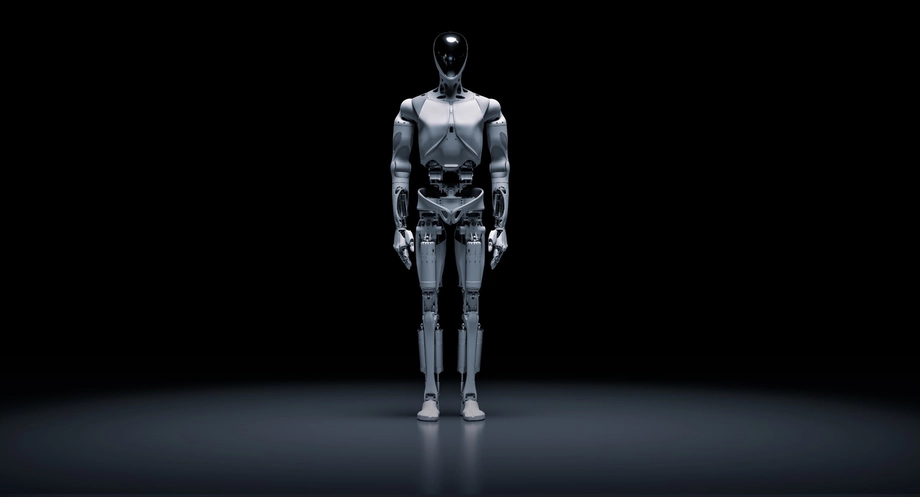
IRON stands 170 centimetres tall and weighs 62 kg, proportions the company chose after a chart of human interaction suggested they were the least intimidating for conversation and movement. Its body carries 76 degrees of freedom, meaning 76 independently driven joints, including a dexterous hand with 21 joints that can pinch, twist, flick and insert across 33 kinds of manipulation. A degree of freedom is one axis of movement, so a human shoulder alone accounts for several.
Touch is where the design departs from the machines that dominate trade fairs. More than 1,500 tactile sensing points cover the body, with coverage above 80% of key areas and a resolution of one millimetre. The sensors read pressure, friction, contact position, slip and impact, the signals that let a robot grip a cup without crushing it or lower itself onto a chair without dropping into it.
Vision comes from four cameras and an ultrasonic sensor arranged for 720-degree perception of the surroundings, and nine microphones locate the source of a voice. Three Turing AI chips designed in house deliver 2,250 TOPS, or trillions of operations per second, from inside the chest rather than a backpack, which keeps the processing local and lets the robot work without an internet connection.
Power comes from a solid-state battery with energy density above 300 watt-hours per kilogram, the first such pack the company says has reached mass production in a humanoid. Xpeng claims 30% more power than a conventional lithium battery of the same weight, 1.5 hours of work after a 20-minute charge, and the ability to find its own charger and return to the job.
Gu has rejected the idea that the machine needs to look alluring to sell.
It doesn't require a catwalk, or a curvy body. It needs to be something that can be more plainly put into offices, stores, and lobbies.
Three Brains Inside One Body
Xpeng unveiled the robot's software stack at its eighth AI Day on November 25, 2026, held at South China University of Technology in Guangzhou, the chairman's alma mater. The centrepiece is the Turing Physical AI Architecture, also called VLA 3.0, a three-part system built on the way a nervous system splits work between reflex and reflection.
System 0 handles the body, running power, communication and the execution of movement while reporting the machine's physical state back into the loop. System 1, built on Xpeng's VLA 2.0 model, reads the surroundings and turns them into fast action, the role a cerebellum plays in a person. System 2 does the slower work of reasoning, breaking a spoken instruction into tasks and coordinating them.
Version 6.4.0 of the VLA 2.0 model supports training loops run by AI agents, which the company says lifts training speed by 10 to 12 times. Because the chips, the model and the operating system are all built in house, and a security key sits on the device, Xpeng argues that private data can stay inside the robot.
He frames the architecture as a correction to years of work done mostly in software.
I believe Physical AI must evolve in the same way. Origin is about returning to that fundamental truth. The brain and body must evolve together.
Origin was the theme of the event, and it is a marketing word wrapped around a technical claim: a machine that learns by moving through the world needs its hardware and its models trained together, not stitched together afterwards.
A Production Line Built Like a Car Plant
Xpeng set out the schedule in its AI Day 2026 announcement: hardware mass production begins in January 2027, store training follows in the first quarter and deliveries in the second. The machinery to do it is already standing.
The humanoid assembly line went into operation in September 2026 with automation above 80% on the main processes, and at full capacity it is designed to finish one IRON every 2.5 minutes. Quality control borrows from vehicle assembly. More than 600 AI holographic inspection checkpoints sit along the line, and every unit passes more than 1,000 automotive-grade tests covering the complete robot and its key components. Legs, feet and hands are tested more than 10 million times in total before a design is signed off.
Training data comes from a Robot Data Factory of 50,000 sq m that covers more than 250 scenarios and 15 job categories. Xpeng reuses the data tools built for its cars, letting real tasks train grasping, manipulation and whole-body control. Retail work in its own stores becomes the next source of that data, which the company calls its flywheel.
Spending reflects the ambition. Robotics research and development will consume close to 3 billion yuan this year, supported by nearly 10,000 people. Group-wide research and development reached 8.67 billion yuan in the first nine months of 2026, 31% more than a year earlier.
The road from demonstration to delivery has several fixed points.
- November 5, 2025: Xpeng shows the next generation of IRON at its AI Day, then cuts open the robot's leg on stage to prove no person is inside.
- The weekend before February 4, 2026: an IRON unit falls while standing still at a mall in Shenzhen during its first public appearance outside company events.
- August 2026: the robotics subsidiary raises more than US$900 million at a valuation above US$6.3 billion, led by IDG Capital.
- September 2026: the automated humanoid assembly line starts running.
- October 2026: Xpeng receives approval for Level 4 demonstration operations across all of Guangzhou for its robotaxi.
- November 25, 2026: IRON walks on stage unaided at AI Day, holds a live conversation and takes questions from the audience.
- November 27, 2026: the robot is due to host Xpeng's press conference at the Guangzhou Auto Show.
- January 2027: hardware mass production begins.
- First quarter of 2027: store training as a retail assistant.
- Second quarter of 2027: public launch, sales and first deliveries.
The Robot as a Subscription
Xpeng's commercial model is not a single purchase. The company describes four revenue channels: hardware sales, software subscriptions that add capabilities and updates, token subscriptions that let a robot keep accumulating job-specific skills after delivery, and an open robotics ecosystem where partners download capability packages, customise functions and sell their own skills through what Xpeng calls a Skills Store.
Token billing is the unusual part. A customer buys a robot, then buys units of machine work, a little like buying minutes on a phone plan, with the price tied to the task and the amount of capability the machine draws on. Xpeng is also exploring scenario-based services, in which a robot is charged by the job it performs rather than by the hour of ownership.
Gu told Bloomberg Television that software upgrades, training and data infrastructure would generate recurring income alongside hardware. A robot that keeps learning gives a customer a reason to keep paying.
The case for the business rests on more than the machine. Gu argues that Xpeng stands out because it combines hardware, software and practical use cases in one company, and he expects robotics to become a meaningful part of the business within two to three years, with profitability possible as soon as next year.
The Numbers Behind the Pitch
Cars still pay the bills, and the car business carries both the funding and the pressure. Xpeng reported a loss in the quarter it announced this week, even as revenue rose 19% from a year earlier. Twelve months earlier the trajectory was steeper: the third quarter 2025 results showed revenue of RMB20.38 billion (US$2.86 billion), up 101.8% year on year, on deliveries of 116,007 cars, an increase of 149.3%.
Margins improved with the volume. Gross margin reached 20.1% in that quarter against 15.3% a year earlier, and the net loss narrowed to RMB0.38 billion from RMB1.81 billion. Deliveries reached 42,013 in October 2025 and 355,209 for the year to that point, and the company guided the fourth quarter to between 125,000 and 132,000 cars and revenue of RMB21.5 billion to RMB23.0 billion. Cash and short-term investments stood at RMB48.33 billion.
The balance sheet buys time. The share price does not. Xpeng's stock, listed in New York and Hong Kong, has fallen more than 55% this year, weighed down by a weak Chinese auto market and by investor caution across the humanoid sector. Financing across China's robotics industry has come under closer scrutiny since Unitree's widely watched listing, the slump in its shares that followed and the wave of capital that flooded the field.
The robotics subsidiary has money of its own. Its first funding round, completed in August 2026, raised more than US$900 million at a valuation above US$6.3 billion, led by IDG Capital.
With effective cost control and technology-related revenue streams unlocking greater potential, our gross margin exceeded 20% for the first time in the third quarter.
That was Gu's summary of the 2025 quarter, and it names the two levers Xpeng is pulling: cheaper production and software revenue that carries higher margins than metal.
From the Showroom to the Living Room
Retail work is a proving ground, and the company is open about the sequence. Gu said household use could follow one to two years after the robot proves itself in commercial settings, which would put a home version around 2028 or 2029 if the store trials hold up.
The bar at home is higher. Gu said a domestic robot has to work reliably around elderly people, children and pets, respond properly in an emergency and keep performance steady across long shifts, all of which asks more of the battery and of consistency in behaviour. A showroom has staff on hand. A living room does not.
He has been careful about timing while predicting the size of the prize. He described his view of the robotics business as "extremely optimistic in the long term and cautious in the short term", and said the medium to long term scale of the industry will surpass that of automobiles. The global market today, he said, numbers only in the tens of thousands of units.
What IRON Cannot Do Yet
Xpeng has not sold a single robot. This is the company's ninth generation of machine and its fourth humanoid design, and it reaches buyers only in the second quarter of 2027. The specification sheet still has gaps. IRON is not weatherproof, which rules out outdoor work in rain. Its hands are at an early stage, with limited use of tools, and further capabilities will arrive over the air after delivery.
The chairman lists the hard problems himself. Regulations, safety rules, cost, the physical body and the power supply cannot be solved by making models bigger, he said at the November event, and the core challenge is building a robot that needs little human assistance while earning a return on what it costs.
Public performance has been uneven. An IRON unit fell while standing still at a Shenzhen shopping mall on the weekend before February 4, 2026, after crossing the stage several times, and had to be carried away for repairs. That machine stood 178 cm and weighed 70 kg; the production version is shorter and lighter. He compared the fall to a toddler learning to walk, and a year later told the AI Day audience he hoped it would be the last time the robot had to prove it was not a person in a suit.
Robotaxis, Flying Cars and One Bet on Physical AI
The humanoid is one piece of a strategy Xpeng calls physical AI, in which cars, robots and aircraft share chips, models and safety systems so the cost of each is spread across all three. The first purpose-built robotaxi, the YOYO-01, is scheduled for release in 2027, and the company intends to supply hardware and software to operators rather than run services itself.
Progress there has been quicker than on robots. Xpeng moved from staffed testing to driverless road tests in eight months and received approval in October 2026 for Level 4 demonstration operations across all of Guangzhou, 11 months after announcing the business. Driverless passenger testing has begun, with demonstration operations in selected areas planned by the end of 2026.
In cars, the company is monetising software. Turing AI assisted driving becomes a paid subscription for new global buyers from the second quarter of 2027, while customers who order beforehand keep lifetime access. Xpeng says assisted driving accounted for more than half of total mileage in the first month after VLA 2.0 began rolling out in March, and that accident claim rates in China fell 13.93%. A feature that adjusts braking and energy recovery when a driver lifts off the accelerator raised usable range by 12.4% in congested city tests and reaches cars in December.
In the air, Xpeng's ARIDGE unit has received Type Inspection Authorization and completed certification flight tests for a piloted electric aircraft that takes off and lands without a runway, and is working with partners in the United Arab Emirates on a regulatory sandbox for low altitude flight.
Key Points
- Xpeng vice chairman Brian Gu said IRON will be priced near the median price of an Xpeng car, between 119,800 and 309,800 yuan (about US$18,000 to US$44,000).
- IRON trains as a retail assistant in Xpeng stores in the first quarter of 2027 and goes on sale in the second quarter, with a target of tens of thousands of units that year.
- The robot stands 170 cm, weighs 62 kg and has 76 degrees of freedom, more than 1,500 tactile sensing points and three in-house Turing AI chips delivering 2,250 TOPS.
- Hardware mass production starts in January 2027 on a line designed to finish one robot every 2.5 minutes at full capacity.
- Revenue is meant to come from hardware sales, software and token subscriptions, a partner ecosystem and a skills store.
- The robotics unit raised more than US$900 million at a valuation above US$6.3 billion, while Xpeng shares are down more than 55% this year.
- Gu said home use could follow one to two years after commercial deployment and expects robotics to become a meaningful part of the business within two to three years.