A Robot Walks Onstage, Then Onto the Shop Floor
Xpeng plans to begin hardware mass production of its IRON humanoid robot in January 2027, the company said in its AI Day announcement at the eighth edition of the event in Guangzhou on November 25, 2026. The first units will spend the first quarter of 2027 training as sales assistants and tour guides inside Xpeng's own retail stores, and the company is targeting an official public release in the second quarter of 2027.
Contents
- A Robot Walks Onstage, Then Onto the Shop Floor
- What IRON Is, in Numbers
- One Brain Shared by Cars and Robots
- From Catwalk to Shop Counter
- Keeping a 62 kg Machine Safe Among Shoppers
- The Line That Finishes One Robot Every 2.5 Minutes
- US$900 Million Behind the Robot
- A Year of Moving Targets
- What Is Still Undecided
- Cars, Robotaxis and the Rest of AI Day
- Who Else Is Clocking In
- Key Points
IRON walked onto the stage at the South China University of Technology, the Guangzhou campus where chairman and chief executive He Xiaopeng studied, with no handler beside it. It introduced itself in Chinese and English, fielded unscripted questions from an audience of more than 2,000 people, and returned to its charging dock by itself. Xpeng says no remote operator was involved at any point.
The robot opened with a joke about its own hardware, then talked with He about the past year.
This is my first time on a stage in front of more than 2,000 people, and I am a little nervous. You probably would not be able to tell, because I do not have a blushing function yet.
He Xiaopeng used the event, held under the theme ORIGIN, to argue that making machines cleverer is not enough on its own.
For years, the AI industry has focused on making the brain smarter. But humans do not learn through the brain alone. We learn by touching, moving, trying, failing and trying again.
In the same announcement he said "the brain and body must evolve together", and described IRON as a work partner rather than a toy or a companion. The first paid work will be in Xpeng's own showrooms, where the company controls the floor, the lighting and the crowds.
What IRON Is, in Numbers
IRON stands 170 cm tall and weighs 62 kg, roughly the size of a short adult. Its body has 76 degrees of freedom, a count of the independent ways it can bend or turn, including 21 in each hand. Each hand carries 375 touch sensors, and more than 1,500 sensing points cover over 80% of the key areas of its body.
Three of Xpeng's own Turing AI chips sit inside the robot and together deliver up to 2,250 TOPS, or trillion operations per second, of computing power. Each chip reaches 750 TOPS through a 40 core processor with two neural network units of its own design, and can run models of up to 30 billion parameters. Xpeng says that power runs its physical AI model on the robot itself, so IRON can see, plan and move without a live connection to cloud servers.
Sensing runs to what the company calls 720 degree awareness: four cameras, an ultrasonic sensor and nine microphones that locate the direction of a voice. A solid-state battery pack rated above 300 Wh per kg gives about 1.5 hours of work from a 20 minute charge, and the robot finds its own dock. Xpeng says the pack resists penetration by objects up to 8 mm, tolerates 200 degrees Celsius and holds off 1,000 volts. The electrolyte chemistry has not been disclosed, and earlier questions over whether the cells are fully solid or a semi-solid hybrid remain open.
Smaller details point at the same aim of fitting into human spaces. Animated eyes on a curved visor make expressions legible. The palms warm to between 25 and 40 degrees Celsius so a handshake does not feel cold. Nine degrees of freedom across the hip and waist let the pelvis shift as it steps, and bionic shoes with underfoot sensors adjust the gait for slopes, stairs and different floors.
One Brain Shared by Cars and Robots
Behind IRON sits the Turing Physical AI Architecture, which Xpeng calls VLA 3.0. It splits control into three loops that run at different speeds, and the same stack is meant to drive the company's cars, robotaxis and flying vehicles as well.
System 0 is the reflex layer. It handles power, energy, communication and the motors directly, and reports back on what the body can safely do right now. System 1 is the fast reactor, built on Xpeng's VLA 2.0 model, which turns what the cameras and sensors see into movement in the moment. System 2 is the planner: a vision and language model works with what the company calls an Agent Runtime state machine to break a goal such as fetching a brochure into steps.
Xpeng says version 6.4.0 of VLA 2.0 supports training in a closed loop run by an AI agent, lifting training speed 10 to 12 times, and that the method allows recursive self-improvement and model self-distillation, in which one version of the model teaches the next. No outside benchmark has been published for those gains.
The cars contribute more than code. Xpeng reuses the data processing and evaluation tools it built for vehicles in robot training, and both products share chips, control systems and safety work. That shared foundation spreads the cost of silicon and models across two product lines, which is why the robot carries the same class of chip as the company's flagship cars.
From Catwalk to Shop Counter
A year ago Xpeng showed IRON in two body styles, one male and one female, and the walk of the feminine version was so fluid that viewers accused the company of hiding a person inside; engineers cut open a leg casing on stage to prove otherwise during the lifelike stage walk. The gendered versions are now gone. He Xiaopeng and vice chairman and president Brian Gu confirmed to reporters after the keynote that a single neutral body is the design going into production, which Xpeng says lets the machine blend into more workplaces.
Gu put the reasoning in one sentence.
doesn't require a catwalk, or a curvy body. It needs to be something that can be more plainly put into offices, stores, and lobbies.
Covering the robot had practical costs as well. He Xiaopeng said clothing would "block sensors, cancel out some tactile capabilities, and damage thermal management."
The production body also carries fixes learned from public appearances, including the Shenzhen mall fall in February 2026, when a prototype toppled while standing still in front of shoppers. The new machine has rear facing sensors, enclosed shells and a designed response to losing its balance.
Keeping a 62 kg Machine Safe Among Shoppers
A robot of that weight moving through a store full of children sets the safety bar high. Xpeng describes protection built in five layers, with duplicate communications channels and a backup balance controller that keeps the machine upright if the main computer fails.
If contact force passes 50 newtons, the drive system cuts out within milliseconds. Pinch protection and enclosed shells cover the body, rear sensors watch for people approaching from behind, and a stop button that needs a single touch sits at the back of the neck. When a fall cannot be avoided, Xpeng says IRON bends its knees to soften the landing, keeps hold of whatever it is carrying so the object is not dropped on a bystander, runs a self check on the floor and then either stands back up or cuts power. None of those claims has been independently tested.
He Xiaopeng set limits on the first jobs in plain terms: IRON is splash proof but not rain proof, and its hands are still early, so the first roles are stable, repetitive indoor work. Gu said home use could be considered one to two years after commercial deployment. Xpeng staff at the event noted that a machine over 60 kg cannot yet twist away from a person as it falls, a problem in a cluttered living room.
In the stage demo, IRON walked and talked and did no heavy lifting, a reminder that greeting customers is a gentler test than moving stock.
The Line That Finishes One Robot Every 2.5 Minutes
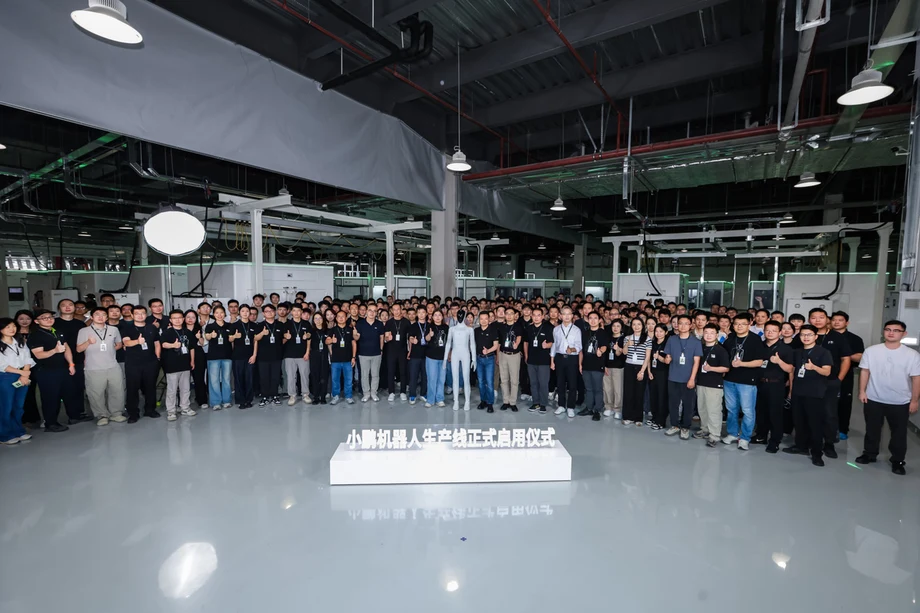
Xpeng commissioned its humanoid production line in Guangzhou on September 8, 2026, when the first IRON completed assembly and walked off by itself, according to the production line release. More than 80% of core processes are automated, and at full capacity the line is designed to finish one robot every 2.5 minutes.
Quality control leans on car making. Each unit passes more than 600 AI inspection checkpoints and over 1,000 tests built to car industry standards on the complete robot and its key parts. The first machine to come off the line did so without being carried, a symbolic detail the company treated as proof that the process had moved beyond prototype assembly.
The training ground is a Robot Data Factory covering about 50,000 square meters, where data is collected and models validated across more than 250 scenarios and 15 job categories, from reception to guided tours and front desk work. Xpeng uses the same evaluation tools it built for its cars, and says real tasks performed by real robots feed back into the models.
He Xiaopeng framed the factory as the point of the exercise.
The robot production lines were created from scratch with no precedent to follow. Today's step is small, but XPENG is building the production lines for an entirely new product category.
Company statements describe volume production as the step that spins the data flywheel, since robots doing paid work generate the footage and feedback that make the next version better. Xpeng has not said how many units the line will build in its first year.
US$900 Million Behind the Robot
On August 24, 2026 Xpeng's robotics business signed share purchase agreements with investors for more than US$900 million, at a post-money valuation above US$6.3 billion once the equity incentive pool is fully used. The company describes it as the largest single private funding round in China's embodied AI industry to date. IDG Capital led the round, Gaorong Ventures took part, and Alibaba and Tencent joined as strategic investors. Xpeng keeps control of the unit and will continue to consolidate its results.
That money shapes the selling model. Xpeng expects gross margin on each robot to be far above its electric cars, given high technical barriers and thin supply of advanced humanoids, though it gave no forecast. Buyers would pay for hardware, for software subscriptions and for access to an open platform, with token based subscriptions and services billed by scenario still under study. A development environment is meant to let a business roll out a new task within 48 hours using ready made skill packs, and partners can build their own skills for a specific job.
Gu told Bloomberg the price could land near the median electric vehicle price, which leaves the figure undisclosed while setting expectations. He also said Xpeng had not yet decided whether customers could run their own AI models on the robot's local computing power.
The financing gives the robotics unit its own source of capital, separate from the car business that funds it today.
A Year of Moving Targets
Xpeng's own announcements show how the machine changed between showcase and production unit.
- November 2025: the next generation IRON was shown with 82 degrees of freedom, 22 in each hand, and three Turing chips quoted at 3,000 TOPS. He Xiaopeng named volume production of advanced humanoids by the end of 2026 as the goal.
- September 8, 2026: the first unit walked off the new line with 76 degrees of freedom, 21 per hand and up to 2,250 TOPS in the September 8 announcement, and the company still pointed to mass production by the end of 2026.
- November 25, 2026: hardware mass production moved to January 2027, with store training in the first quarter of 2027 and a public release in the second quarter.
That is six fewer joints and a quarter less quoted compute than the 2025 machine, and the 2026 date for volume production has quietly left the schedule. Xpeng has not explained the reductions. Trimming a prototype on the way to a production unit is common in robotics, and the 2025 figure of 3,000 TOPS came from a machine that was never built in series.
The company has made smaller prototypes before: the ET1 prototype, finished to automotive standards in January 2026, was the first unit Xpeng said could be manufactured rather than demonstrated.
Work on interaction continued in parallel. Xpeng said in October 2026 that IRON could predict human movement six seconds ahead, updating its estimate five times a second, the result of predicting movement six seconds ahead with its second generation VLA model.
What Is Still Undecided
No price, production volume or named outside customer has been published. The robot is not for sale, and Xpeng's own showrooms are the only workplace named so far.
Selling in Europe will take more than a shipping container. IRON would need CE marking, compliance with the European Machinery Regulation and assessment as a high risk system under the EU AI Act, the same approval path that has slowed Xpeng's driver assistance rollout on the continent. The company plans a European rollout in the second half of 2027.
Rules at home are forming at the same time. China's industry ministry issued five humanoid robot standards on November 16, 2026, including a six level scale from L0 to L5 for rating a robot's capability, alongside rules on training sites, training data, drive joints and dexterous hands.
The next public appearance is close: Xpeng says IRON will host its press conference at the Guangzhou Auto Show on November 27, 2026. He Xiaopeng described it as possibly the first time a robot has launched a car at a motor show.
Cars, Robotaxis and the Rest of AI Day
The robot shared the stage with the vehicle business that pays for it. Xpeng said a feature called VLA Adaptive Deceleration, which adjusts braking and energy recovery when a driver lifts off the accelerator, added 12.4% usable range in congested city tests compared with energy recovery switched off. The comparison uses that baseline, so everyday gains will be smaller. The first over-the-air update is scheduled for December 2026, starting with the G9L and Mona L05.
The company also reports 13.93% fewer accident claims in China since VLA 2.0 began rolling out in March 2026, a figure it published without a method.
Its robotaxi arm has an L4 demonstration operation qualification across Guangzhou, granted in October 2026, 11 months after the business was announced, and has begun passenger tests without a safety driver in the seat. Demonstration service in selected areas is planned by the end of 2026. Xpeng intends to supply the vehicle platform and driving system to operating partners rather than run fleets itself, with the first purpose built robotaxi, the YOYO-01, due in 2027.
Software billing is coming to the car as well: Turing AI driving assistance becomes a paid subscription for new buyers globally in the second quarter of 2027, while customers who order before then keep lifetime access. Xpeng aims for its first global rollout of NGP in the first half of 2027, after testing in Germany, the Netherlands and France and public test rides at its Paris store.
Who Else Is Clocking In
The same week showed how quickly humanoids have moved from videos to shift work. AgiBot's G2 began loading and sorting chips around the clock at JCET's automotive electronics plant in Shanghai's Lingang area, with a reported 99.999% success rate. Boston Dynamics will test its Atlas robot in GlobalFoundries chip factories from early 2027. Elon Musk said Tesla's next AI5 chip will power its Optimus robot before its cars, reversing the usual order.
Xpeng's choice of first job sets it apart. Western builders such as Figure AI and Agility Robotics have aimed at warehouses and factories, where tasks repeat and the floor is fenced off. Xpeng starts with customers instead, in shops where people wander, children run and questions arrive in dialect or in English. Public spaces are far less predictable than a factory, which is why the stage demonstration involved walking and conversation.
For shop staff, the near term change is a colleague who can guide a customer to a model, repeat the same welcome two hundred times a day and never takes a break, while harder conversations stay with people. For rival robot makers, the test arrives when Xpeng reports how many machines are doing paid work outside its own buildings.
Key Points
- Xpeng will start hardware mass production of IRON in January 2027, after an earlier target of the end of 2026.
- The first units train as sales assistants and guides in Xpeng stores in the first quarter of 2027, with a public release targeted for the second quarter.
- IRON is 170 cm tall, weighs 62 kg, has 76 degrees of freedom and runs three Turing AI chips delivering up to 2,250 TOPS on the robot.
- More than 1,500 touch sensing points cover over 80% of key body areas, and a solid-state battery gives about 1.5 hours of work from a 20 minute charge.
- The automated Guangzhou line, commissioned on September 8, 2026, is designed to finish one robot every 2.5 minutes with more than 600 AI inspection points per unit.
- Xpeng's robotics business raised over US$900 million on August 24, 2026 at a valuation above US$6.3 billion.
- No price, volume or outside customer has been named; Europe would require CE marking, Machinery Regulation compliance and EU AI Act review.
- IRON hosts Xpeng's press conference at the Guangzhou Auto Show on November 27, 2026.