A Standards Group in Wuhan, a Trial Approval in the United States
On November 25, 2026, the brain-computer interface standards technical committee of China's Ministry of Industry and Information Technology established its working group at the 2026 Standards Week in Wuhan. The same meeting released the Brain-Computer Interface Decoding Algorithm Evaluation Research Report (2026 edition), a document about how the software that reads neural signals should be measured and compared.
Contents
- A Standards Group in Wuhan, a Trial Approval in the United States
- What a Standard Actually Fixes
- The Hard Part Is the Noise
- China Takes the Chair of the ISO and IEC Subcommittee
- The Plan Behind the Standards Push
- How the Push Unfolded
- More Than 250 Companies, and Devices Already in Hospitals
- Fixed Prices Turn Implants Into a Public Service
- The Gap China Has Not Closed
- Key Points
On the same day, Neuralink, the company led by Elon Musk, said the US Food and Drug Administration had approved its LINK clinical trial. The study is the first large trial of an implanted brain-computer interface cleared in the United States, and it is designed for adults with severe paralysis caused by ALS, or amyotrophic lateral sclerosis, a disease that progressively destroys the nerve cells controlling muscles.
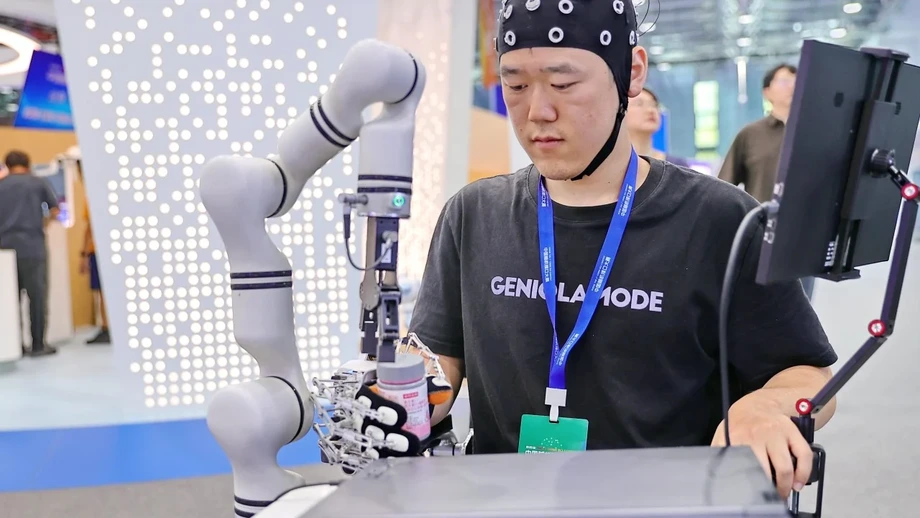
A brain-computer interface, usually shortened to BCI, records the electrical activity of the brain and translates it into instructions. Those instructions can move a robotic arm, type words on a screen, or let someone who cannot speak build sentences. The technology sits where neuroscience, semiconductor design and artificial intelligence meet, which is why a standards meeting in central China and a regulatory decision in California belong to the same story.
The working group handles the part of the effort that decides how devices are described, tested and compared. China's BCI sector is moving from single experiments in laboratories toward high volume signal collection, decoding in real time, closed loop interaction between brain and machine, and use in ordinary clinical settings. The industrial chain around it is shifting toward making components to engineering specifications, integrating those parts into working systems, and turning prototypes into products hospitals can buy.
Standards are the key bridge that carries brain-computer interface innovations toward large scale application.
The ministry framed the point in those terms when it announced the group. The logic is familiar from other industries: a device nobody can test against a shared rule stays a demonstration, while a device that meets a published standard can be bought, insured and exported.
What a Standard Actually Fixes
For a device that reads the brain, a standard can settle a long list of practical questions. How many electrodes must a sensor carry, and how much data must it collect each second? How quickly must a decoder respond before the user notices a delay? How is electrical safety checked for something placed beneath the skull? How is a claim of accuracy verified, and against which group of patients?
Answers shape design and cost. A company that builds to a published rule can sell into hospitals across many provinces without repeating every validation. Regulators gain a common yardstick. Hospital purchasing departments gain a way to compare products that otherwise arrive with claims no outsider can check.
Timing matters because the sector is young. Officials involved in the effort have argued that China should write the rules before the industry consolidates, at a stage when a small number of large suppliers would otherwise set practice on their own. The working group was formed while the firms it will affect still number in the hundreds, not the dozens.
The Hard Part Is the Noise
Electrodes do not deliver neat messages. They pick up a flood of electrical activity from millions of neurons at once, mixed with interference from muscles, movement and the equipment itself. Separating an intention, such as move the cursor left, from that noise is the central engineering task. Artificial intelligence models are trained on recorded brain activity so they learn which patterns accompany which intentions, and then predict the command a person means to give.
That decoding layer sits between the raw signal and any useful output, whether the sensor is an implant inside the skull or a headset worn outside it. Chinese firms are drawing on domestic AI models and on the country's semiconductor and medical hardware manufacturing base to shorten the time between a recorded signal and a working command.
A report devoted to evaluating decoding algorithms addresses a problem that becomes urgent as more devices reach patients. Two teams can claim the same accuracy while using different tasks, different patients and different definitions of success, which makes their results impossible to compare. Issuing the 2026 edition of the report at the same meeting where the working group was formed puts the measurement question in front of the industry early, before competing products have settled into fixed claims.
China Takes the Chair of the ISO and IEC Subcommittee
In October 2026, China took the chairmanship of the joint brain-computer interface subcommittee run by the International Organization for Standardization and the International Electrotechnical Commission. The two bodies publish the standards that national regulators and manufacturers often adopt as reference points, so the chair of a subcommittee sets agendas, proposes work items and influences which tests become international benchmarks.
Holding the chair does not give a country the power to write rules alone, since drafts are negotiated among member bodies. It does place the drafting sequence and the secretariat work in Chinese hands at the moment the technology is still being defined. In a field where the United States has the more advanced implants and China has the larger manufacturing base and patient population, control of the rulebook is an area where Beijing can move first.
The Wuhan group and the international chairmanship are designed to work together. A national working group can convert domestic testing practice into proposals, and a subcommittee chair can carry those proposals into international discussion. For device makers in either country, the practical question is which set of tests a regulator will accept when a product crosses a border.
The Plan Behind the Standards Push
Standards work sits inside a broader program. China's 15th Five-Year Development Plan lists brain-computer interfaces among six industries of the future. A national roadmap published in August 2025 sets technical milestones for 2027 and a complete supply chain for 2030. An 11.6 billion yuan fund, about $165 million, was announced to carry companies from research through market entry.
Market estimates value China's BCI sector at 3.8 billion yuan in 2025 and project more than 120 billion yuan by 2040. Those projections depend on devices reaching patients at scale, which is where standards and pricing meet. A hospital that cannot compare two implants on a common test, or cannot bill an insurer for either, has little reason to buy.
The demographic pressure behind the spending is straightforward. An aging population increases the number of people who need help recovering movement or cognition after stroke, spinal injury or degenerative disease, and each of those cases is a potential customer for a device that restores some function.
How the Push Unfolded
- August 2025: a national roadmap is published, with technical milestones set for 2027 and a complete supply chain targeted for 2030.
- By mid 2025: Chinese firms have run more than 50 clinical trials of flexible implantable brain-computer interfaces, according to Phoenix Peng, co-founder of implant maker NeuroXess and ultrasound startup Gestala.
- July 2026: a Chinese company completes what is described as the world's first commercial BCI implant.
- October 2026: China takes the chair of the joint ISO and IEC subcommittee on brain-computer interfaces.
- November 25, 2026: the MIIT working group is established in Wuhan and the decoding algorithm report is released, while the FDA approves Neuralink's LINK trial.
More Than 250 Companies, and Devices Already in Hospitals
More than 250 Chinese firms now work on brain-computer interfaces, and several have reached patients. Neuracle Technology received approval for a brain implant intended for adults with partial paralysis. The Beinao No 1 system, developed with the China Institute for Brain Research and NeuCyber NeuroTech, is a semi-invasive design that has allowed paralyzed patients to control robotic limbs and people with speech impairments to communicate through neural signals.
Chinese researchers also completed the country's first fully implanted, wireless BCI trial, only the second of its kind in the world, in which a paralyzed patient controlled devices without any external hardware. A firm backed by the state has acknowledged that its technology remains about three years behind Neuralink.
Private money is arriving alongside state funding. Shanghai-based StairMed raised $48 million, and BrainCo raised roughly $287 million before filing for a Hong Kong initial public offering. In Hangzhou, BrainCo has demonstrated a bionic arm an amputee can attach without surgery and a headset that pumps low amplitude electrical currents into the frontal lobe, sold as a way to relax, a sign that Chinese firms are pushing past clinical markets into consumer products.
Fixed Prices Turn Implants Into a Public Service
Hubei province published surgical guidelines capping the fee for an invasive implant operation at 6,552 yuan, about $902, with removal at 3,139 yuan, about $432, and the application fee for non-invasive products at 966 yuan, about $133. Sichuan and Zhejiang have also set official prices for BCI medical services.
Phoenix Peng points to four forces behind the pace of Chinese development. Provincial governments in Sichuan, Hubei and Zhejiang have set official prices, which speeds inclusion in national health insurance. Large patient pools and lower research costs shorten trials. Manufacturing strength in semiconductors, AI and medical hardware allows fast prototyping. State funds and private investors are both putting money in.
Insurance coverage is the hinge. A capped procedure fee tells hospitals what a treatment costs and tells insurers what they would pay, which turns an experimental operation into a service that can be scheduled and reimbursed. Cheap surgery, a deep pool of patients and rapid standards work together form the argument Chinese officials make about market advantage, though the implants themselves still have to prove they work as well as competing devices.
The Gap China Has Not Closed
Neuralink's earlier feasibility studies enrolled more than 30 participants across the United States, Canada and Britain and produced thousands of hours of data on how the devices performed in daily use. One participant with paralysis has been shown controlling popular video games using thought alone. The LINK trial will test the N1 chip and the R1 surgical robot, the machine that places the implant, in a wider population, and signal quality and surgical precision are the deciding factors for commercial approval.
China's advantage runs through prices, patient numbers and speed of rulemaking rather than through the maturity of its implants. Whether regulatory speed and manufacturing scale can close the technology gap before the 2027 milestones in its own roadmap is not yet settled, and the state backed firm that put the gap at about three years offered no timetable for closing it.
No date has been given for the first standards the Wuhan working group will publish, and no completion date has been set for the LINK trial. Both calendars now run at once, one measuring devices in patients and the other measuring the documents that decide which devices can be sold, tested and paid for.
Key Points
- The MIIT brain-computer interface standards technical committee established its working group in Wuhan on November 25, 2026, during the 2026 Standards Week.
- The same event released the Brain-Computer Interface Decoding Algorithm Evaluation Research Report (2026 edition).
- Neuralink received FDA approval for its LINK trial in adults with severe paralysis from ALS on the same day, its first large implant trial cleared in the United States.
- China took the chair of the joint ISO and IEC subcommittee on brain-computer interfaces in October 2026 and lists the field among six industries of the future in its 15th Five-Year Development Plan.
- A national roadmap targets technical milestones for 2027 and a complete supply chain by 2030, backed by an 11.6 billion yuan fund.
- More than 250 Chinese firms work in the sector, with approvals including Neuracle Technology's implant for partial paralysis and the semi-invasive Beinao No 1 system.
- Hubei capped invasive implant surgery at 6,552 yuan, about $902, with Sichuan and Zhejiang also setting official service prices.
- Market estimates put the Chinese sector at 3.8 billion yuan in 2025 and above 120 billion yuan by 2040.