A 0.2% Success Rate Changes the Math
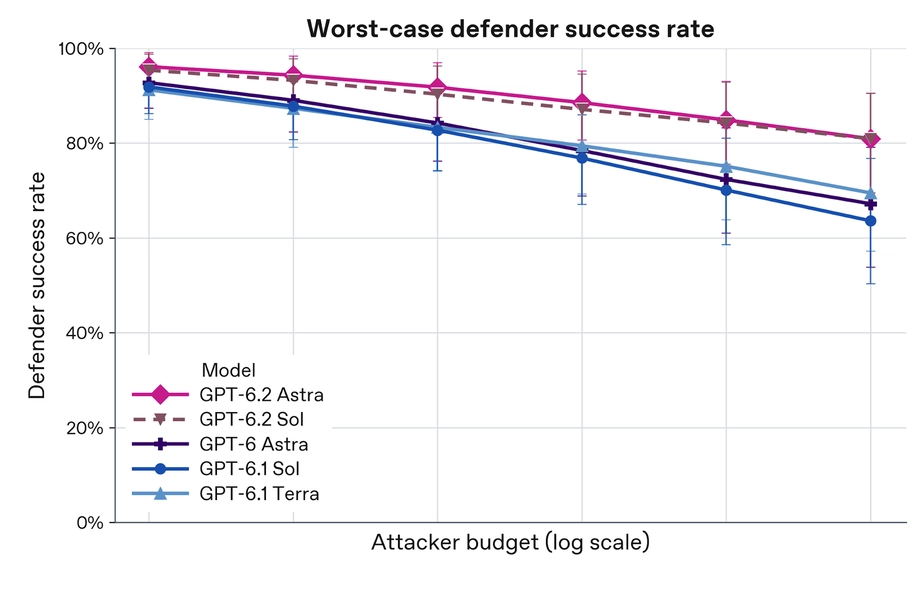
OpenAI's internal tests now put the success rate for retrieving hidden reasoning the model had produced earlier at 0.2%, down from 54% under the guardrails on GPT-6 Astra. For reasoning behind a current request, the rate fell from 22.9% to 0.9%. The figures, released on November 20, describe the protections on OpenAI's GPT-6.2 Astra and Sol models.
Contents
- A 0.2% Success Rate Changes the Math
- What Distillation Does, and Why It Is Contested
- How the Companies Detect and Block It
- DeepSeek's Nine Month Estimate
- A Researcher's Ten Attempts
- When an Accusation Lands in Your Inbox
- Beijing's Response and the Legal Question
- A Timeline of the Dispute
- What Changes for Chinese Labs
- Key Points
On October 12, Anthropic said early evidence showed its new defenses cut the volume of data that unauthorized distillers pulled from Claude by about 90% to 99%. Both companies cite safety risks. The figures come from company tests and estimates, and they describe the specific models and methods tested. The effect on Chinese developers is practical: a researcher at a large Chinese technology company said training data that once came from a single distillation attempt may now require 10 attempts, followed by filtering and cleaning. The researcher was not named.
DeepSeek researchers estimated internally in October that the gap between their models and the best US systems could widen from three to six months to nine months if distillation disappeared completely. Moonshot AI has canceled a $150 million order for Nvidia Blackwell chips in Indonesia, with no reason given. Projects at DeepSeek, Moonshot AI, Alibaba and other Chinese developers have faced delays since September, when limits on remote access to advanced Nvidia chips in foreign data centers arrived alongside the anti-distillation measures.
A worker in the AI data industry said the anti-distillation measures could affect Chinese model development more than chip restrictions. The comparison puts the dispute over model outputs alongside hardware access as a constraint on Chinese labs.
What Distillation Does, and Why It Is Contested
Model distillation uses a stronger teacher model to produce answers or reasoning traces that train a smaller student model. The student can pick up skills without matching the teacher's full range. The technique has legitimate uses. In 2015, Geoffrey Hinton, Oriol Vinyals and Jeff Dean described knowledge distillation as a way to compress an ensemble of models into one that is easier to deploy. Companies routinely distill their own systems. When DeepSeek published its R1 reasoning model in January 2025, it released six smaller models distilled from R1 onto Qwen and Llama bases.
Anthropic and the White House Office of Science and Technology Policy have both described distillation as legitimate. Developers use the term distillation attack, adversarial distillation or illicit distillation for training a model on a rival's outputs in breach of terms of service or access restrictions. Security researchers showed in 2016 that a model could be copied through its outputs. In 2024, a team recovered part of OpenAI's Ada and Babbage models for under $20 in queries.
Open research made the method visible in 2023. Stanford's Alpaca fine-tuned Meta's LLaMA 7B on 52,000 instruction demonstrations generated with OpenAI's text-davinci-003 for under $500. A group from UC Berkeley, Carnegie Mellon, Stanford and UC San Diego released Vicuna after training a LLaMA model on about 70,000 ChatGPT conversations for about $300. A May 2023 study found that such imitation models copied ChatGPT's style but not its factuality, closing little or none of the gap on tasks outside their training data.
How the Companies Detect and Block It
The companies describe a repeated pattern: many fraudulent accounts query a teacher model through proxies, and the outputs are collected to train a student. Anthropic's February report named DeepSeek, Moonshot AI and MiniMax and described more than 150,000 exchanges. It put the three campaigns it reported at about 24,000 accounts, most opened through its educational, security research and startup programs.
Anthropic's September report described an Alibaba campaign of 151 million exchanges, or requests and responses. OpenAI named DeepSeek in a February memo to the House Select Committee on China. Google reported attacks on its models without naming anyone. Anthropic later accused Alibaba, Xiaomi and Zhipu AI, among others. The FBI, the National Security Agency and the Cybersecurity and Infrastructure Security Agency issued joint advisory AA26-251A in September, saying six companies in China had extracted billions of tokens. A token is a unit of text, roughly a word or part of a word, that a model processes.
The White House memorandum NSTM-4, signed by Michael Kratsios on April 23, 2026, is titled Adversarial Distillation of American AI Models. It describes unauthorized distillation on an industrial scale. The memorandum also described distillation as a vital part of the AI ecosystem, a phrase that captures the tension: the practice is routine inside companies and forbidden across competitors. The companies have answered with account bans, detection systems and limits on how much of a model's reasoning is shown.
DeepSeek's Nine Month Estimate
DeepSeek has not published the figure, and its estimate is conditional. It assumes distillation disappears completely, a high bar that no one has said they expect to be met. The estimate is a forecast of a gap that could open.
Some Chinese firms are trying to rent computing power through third parties outside China. MiniMax, Mihoyo and Alibaba are leaning more heavily on domestic chips and investing more in training data for their own reinforcement learning. The workarounds are under way, and no results have been published.
Moonshot AI's canceled order for Nvidia Blackwell chips in Indonesia stands next to the delays without a stated link. The projects that slipped are not identified, and no count or duration was given. What is clear is direction: the two pressures arrived together, and Chinese labs are adjusting their plans.
A Researcher's Ten Attempts
At a large Chinese technology company, the researcher described a changed workflow. Distillation once gave a model team usable data quickly. Now a team may need repeated attempts, and the data that arrives still needs selection, filtering and cleaning. The extra cycles add cost and time.
An account on X, @owmio39659, argued that Chinese model teams had spent too much money and time on distillation, and that blocked routes might expose lag in other parts of development. The account said China's market pays too little for expert data, and that many mathematics PhDs and competition contestants sell data to American companies that pay more. It argued that fewer foundation model developers could reduce price competition and duplicate research.
Chinese labs that relied on outputs from American models now face higher costs on two fronts: obtaining expert data and retaining the people who can produce it.
When an Accusation Lands in Your Inbox
Anthropic gave one API customer 24 hours to prove it was not using the Claude API to distill models. A developer posting as weli, who said he ran a company that used the API, denied the claim. He said the only usage he could imagine as a trigger was automated regression benchmarks run when changing AI settings.
"Anthropic is accusing me and my company of using their API for distillation. We are not. We do not train our own models," the developer wrote.
Commenter anigbrowl focused on the difficulty of proving a negative.
"I can't imagine how you can prove a negative in this situation," anigbrowl wrote.
Others advised routers that can switch between providers or moving to Amazon's AWS Bedrock. Commenter Bulk70 said a similar notice from OpenAI had turned out to involve a compromised API key and actual distillation. The developer did not quote Anthropic's notice or say what evidence the company cited, and Anthropic did not corroborate the account at the time.
The episode shows how enforcement reaches beyond the largest labs. A company that builds on a single proprietary API can face an outage of a single day over an accusation it may struggle to disprove. A router that can move traffic between providers, or a move to a cloud platform with its own terms, becomes a form of insurance.
Beijing's Response and the Legal Question
China's Ministry of Commerce responded on July 27, 2026, after Washington signaled it was considering investigating and sanctioning Chinese AI companies. The ministry said the accusations lacked factual and legal basis. It said Chinese companies had invested in basic research for years and that some models had advantages in particular capabilities. It also said American companies had used Chinese models for distillation.
The ministry had earlier threatened countermeasures against restrictions targeting Chinese AI businesses. No claim in the dispute has been tested in court. Copyright is an unlikely basis for a case, the developers' terms of service are the clearest, and the Computer Fraud and Abuse Act could apply where fraudulent accounts are involved. Google states that distilling its Gemini models without permission violates its terms and may lead to takedowns and legal action. Anthropic does not offer commercial access to Claude in China or to subsidiaries of Chinese companies abroad.
Two bills before Congress define a model extraction attack as querying a closed model to train another in a way that circumvents access controls, uses fraudulent credentials or breaks terms that forbid such use. Bills to sanction the companies responsible were introduced in both houses. No hearing or vote date has been announced.
The White House said Moonshot AI had distilled Anthropic's models to build its Kimi K3 model. Moonshot denied the claim, and independent researchers doubted it. Asked under oath in April 2026 whether xAI had distilled OpenAI's models, Elon Musk answered "Partly." Nvidia, Microsoft and Meta have argued that distillation is ordinary competition. The scale of the advantage Chinese labs gained from the practice is disputed.
A Timeline of the Dispute
- January 2025: OpenAI and Microsoft begin investigating DeepSeek.
- February 2026: OpenAI names DeepSeek in a memo to the House Select Committee on China. Anthropic names DeepSeek, Moonshot AI and MiniMax and describes more than 150,000 exchanges.
- April 23, 2026: The White House signs memorandum NSTM-4 on adversarial distillation.
- July 27, 2026: China's Ministry of Commerce rejects the accusations.
- September 2026: FBI, NSA and CISA issue joint advisory AA26-251A naming six companies in China. Anthropic describes an Alibaba campaign of 151 million exchanges.
- October 12, 2026: Anthropic reports a 90% to 99% reduction in data extracted by unauthorized distillers.
- November 20, 2026: OpenAI reports retrieval success of 0.2% for earlier hidden reasoning and 0.9% for current reasoning.
- November 24, 2026: A Chinese researcher says effective data may now take 10 attempts.
- November 25, 2026: A developer says Anthropic gave his company 24 hours to disprove distillation.
What Changes for Chinese Labs
China's AI distillation push has already moved from experiments to industrial use, according to a review of more than 300 Chinese academic papers, patents, corporate disclosures, recruitment notices and government documents. The review described software to automate collection of model outputs and specialist workers who prepare the material. The new defenses raise the price of that pipeline.
Chinese labs still have options. DeepSeek's R1 release shows that distilling a company's own models remains standard. Workarounds include renting compute abroad, using more domestic chips and spending more on reinforcement learning data. Each path costs money and time. If the estimate of nine months materializes, the frontier would sit farther away than the three to six months DeepSeek researchers saw before.
For American API customers, the risk is different but immediate. A notice can arrive with a deadline of a single day and little detail. For Chinese labs, the risk is a slower build: fewer cheap examples, more filtering, more attempts and a wider gap to the best American systems. For the data workers and mathematicians in the middle, the price of expertise is rising, and the buyer is often abroad.
Key Points
- OpenAI cut hidden reasoning retrieval to 0.2% from 54% in internal tests, and current request retrieval to 0.9% from 22.9%.
- Anthropic says its new defenses reduce data taken by unauthorized distillers by about 90% to 99%.
- A Chinese researcher says effective training data may now take 10 attempts.
- DeepSeek researchers estimated the gap to top US models could widen from three to six months to nine months if distillation disappears completely.
- Moonshot AI canceled a $150 million order for Nvidia Blackwell chips in Indonesia.
- White House memorandum NSTM-4 and joint advisory AA26-251A put official weight behind the enforcement push.
- China's Ministry of Commerce rejects the accusations as lacking factual and legal basis.
- No claim has been tested in court, and Congress has not voted on the bills.