A car rises without wings or a runway
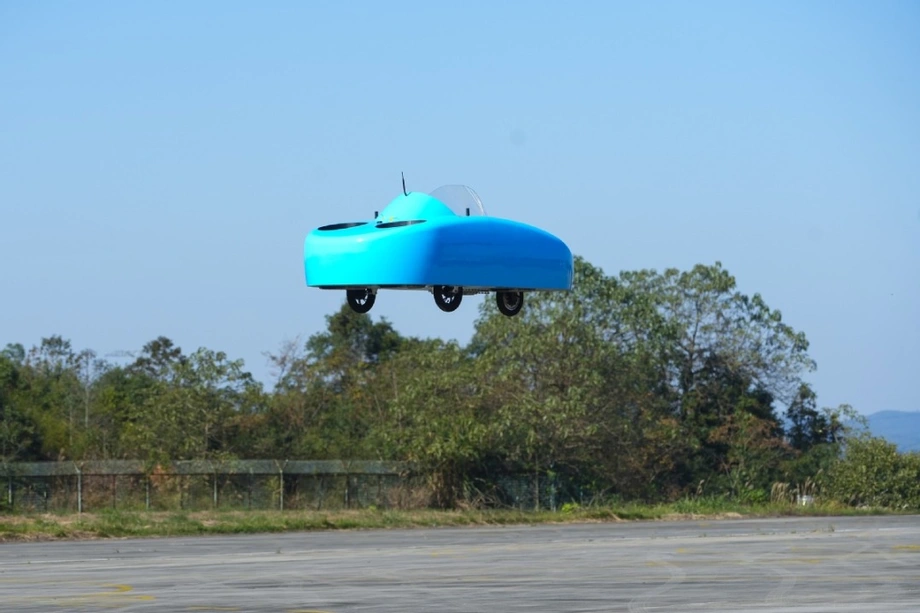
On Saturday, November 21, 2026, a blue aircraft with one seat rose vertically from Kaihui Airport, a general aviation airport in Changsha, Hunan, without wings, a runway or any exposed propeller. The prototype hovered, changed position and descended in a short demonstration. Its developer, Zhongfei Chuangzhi Manufacturing (Shenzhen) Co., Ltd., says the vehicle can also drive on roads after landing.
Contents
- A car rises without wings or a runway
- What the prototype is designed to do
- How three layers of hidden fans provide lift
- Ten years and four complete iterations
- Why rescue work comes before private commuting
- Certification, larger cabins and production targets
- Why Hunan wants to build the aircraft
- Why the Tesla Roadster comparison is misleading
- A different technical route from other Chinese flying cars
- The next tests and the missing dates
- The Essentials
The aircraft has a maximum takeoff weight of 280 kilograms and a stated payload of 120 kilograms. Zhongfei describes it as the world's first piloted aircraft prototype to use a multistage vector ducted fan propulsion system. The footage released from the demonstration showed the vehicle being operated by remote control, lifting almost immediately after startup rather than accelerating along the ground like a conventional plane.
The following day, the prototype was taken to a civil uncrewed aircraft test base in Yiyang, also in Hunan, for tests across several scenarios. Footage spread widely online, helped by a post on X from Xu Feihong, China's ambassador to India. Viewers compared the unusual vehicle with a Grand Theft Auto cheat, the flying car in Harry Potter and a gadget from Doraemon. Others joked that wingless cars had arrived before GTA 7.
What the prototype is designed to do
Zhongfei's detailed technical description gives a maximum flight speed of 150 kilometers per hour, while another published design figure is 180 kilometers per hour. The top speed on the ground is 80 kilometers per hour. The stated range is 300 kilometers, with a designed maximum altitude of 3,000 meters and a typical operating altitude of about 100 meters.
A hybrid power system combining fuel and electricity drives the aircraft. Yang Yang, the company's technical director, says it can fly for two to three hours. He contrasts that endurance with the 10 or 20 minutes available from many aircraft at low altitudes that rely entirely on batteries. The airport demonstration was short, so the range, endurance, speed and altitude figures remain company specifications for the design rather than distances and heights covered in the released video.
The vehicle occupies roughly the area of an ordinary parking space. That compact footprint is central to the idea of taking off where a car is parked, without needing a runway or a large landing field. Its 120 kilogram payload is equal to about 43 percent of its 280 kilogram maximum takeoff weight, although the latter figure also includes the vehicle itself.
How three layers of hidden fans provide lift
A ducted fan is a fan surrounded by a tube or shroud. The enclosure guides the air and keeps the blades inside the body. Zhongfei's design stacks three fan stages inside each duct, allowing the system to increase thrust without enlarging the duct's area. The fans push air directly downward, producing the lift needed for vertical takeoff, hovering and landing.
Thrust vectoring means changing the direction of that push. Directing the thrust allows the aircraft to climb and adjust its attitude, rather than relying only on differences in speed among exposed rotors. This explains how the prototype can look like a car with no visible means of flight while still behaving like a helicopter during takeoff.
Company testing produced about 50 kilograms of thrust from a ducted fan unit weighing approximately 5 kilograms, according to Yang. That is 10 times the component's own weight. The figure describes the tested fan unit, while lifting the complete vehicle requires the propulsion system to support its entire takeoff weight.
Yang says enclosing every rotating part removes the danger of someone being struck by an exposed rotor and allows test personnel to work close to the aircraft. He also says the ducts reduce disturbance from crosswinds and gusts compared with open multirotor designs. The company additionally claims less noise and lower energy consumption while cruising. Independent measurements of noise, wind resistance and energy use were not released with the maiden flight figures.
Ten years and four complete iterations
The brief flight in Changsha followed a development process that began more than a decade ago and changed shape several times. Yang's account shows that the current vehicle did not emerge directly as a finished car.
- 2015: Zhongfei's team began developing the concept for multistage vector ducted fan propulsion.
- 2017: The project obtained an invention patent and successfully tested a prototype engine.
- 2020: A verification aircraft shaped like a flying saucer completed its first test flight.
- 2022: The team produced its first design in the form of a flying car.
- August 2026: An introduction arranged through the Hunan provincial government's office in Guangdong connected the Shenzhen company with Hunan's aviation policies, airspace conditions and manufacturing suppliers.
- November 21 and 22, 2026: The latest prototype flew in Changsha and then underwent further scenario testing in Yiyang.
Yang says roughly three months elapsed from the first discussions in Hunan to the public debut. The aircraft that flew in November is the fourth complete iteration and an initial version intended to lead toward production. Testing has included complex urban settings, simulated adverse weather and different operating scenarios.
Professor Shen Guanqing, who led the development and serves as Zhongfei's chief engineer, says the present prototype will be followed by a family of larger aircraft. That plan explains why the company is treating the Changsha flight as the start of an extensive test program rather than a finished product launch.
Why rescue work comes before private commuting
The company's first intended customers are organizations fighting fires, responding to emergencies and carrying out disaster relief. A vehicle that can travel on a road and then take off vertically could be useful when floodwater, an earthquake or a mudslide cuts the route ahead. The same capability could support medical emergencies and deliveries to mountain communities.
Yang Yang, speaking in his role as technical director, described how rescue teams could use the ability to switch between driving and flying.
In situations like earthquakes, floods, or mudslides, rescue teams could drive the vehicle to the affected area and take off vertically if roads are impassable.
Zhongfei has also identified police patrols, aerial surveying, transport across stretches of sea, deliveries over the final leg of a journey and passenger travel over short distances as possible uses. Personal transport remains part of the longer vision, but the initial product plan concentrates on special equipment for professional missions. The company has not announced any operating rescue routes or passenger services.
For emergency agencies, the attraction is straightforward. A helicopter can hover and reach isolated places, but it normally needs trained aviation support and suitable operating infrastructure. Zhongfei wants its vehicle to drive close to an incident before becoming an aircraft, although its real rescue performance will depend on the coming trials and certification.
Certification, larger cabins and production targets
Yang outlined two regulatory routes. Certification as special equipment for missions such as fighting fires in tall buildings, emergency rescue and police patrols could take six to 12 months, according to his estimate. Civil aviation airworthiness certification for ordinary consumers would generally require another two to three years. Sales under the initial plan would follow the relevant certification, and no approval date from an aviation regulator has been announced.
The production schedule names a version with two to four seats for 2027. A version with six seats and a model for heavy work are planned for 2029. The broader range also includes designs for six to eight people and 12 to 15 people.
Yang also addressed the engineering work already completed on a much larger aircraft.
Our development team has also finalized the technical design for a larger model.
The completed design has a maximum takeoff weight of 5.5 metric tons and a payload of 2 metric tons. In the same units used for the current prototype, those figures are 5,500 kilograms and 2,000 kilograms. The proposed takeoff weight is therefore nearly 20 times the present 280 kilograms, while the proposed payload is more than 16 times the current 120 kilograms.
Why Hunan wants to build the aircraft
Zhongfei has its headquarters in Shenzhen and previously based the project's research center in Beijing. It now intends to locate mass production in Changsha. A pilot base in the Changsha Economic Development Zone is expected to support work with local suppliers of composite materials, precision machining, avionics and automotive manufacturing.
Hunan has made general aviation and equipment for operations at low altitudes priority industries. The province's output from this economic category exceeded 160 billion yuan in 2025, approximately $24 billion, with more than 2,200 companies in its industrial chain. The category includes aircraft manufacturing and services such as logistics, emergency operations and passenger transport at low heights.
China's national government work reports have also highlighted this sector for several consecutive years. For Changsha, attracting Zhongfei means more than hosting an eye-catching demonstration. It offers the possibility of prototype construction, testing and eventually manufacturing within an existing automotive and aviation supply base.
Why the Tesla Roadster comparison is misleading
The Chinese prototype has frequently been compared with Elon Musk's proposed flying Tesla Roadster because both demonstrations involve fans and a car leaving the ground. Their propulsion systems perform different jobs.
Zhongfei's enclosed fans push air downward and provide the direct power for flight. They support vertical takeoff and sustained hovering, while thrust vectoring controls movement. The ducted fans are therefore the aircraft's lifting system.
Tesla unveiled the redesigned second generation of the Roadster on October 15, 2026, with technology developed alongside SpaceX. Its demonstration combined a fan and suction system with thrusters powered by cold gas. The fans create negative pressure beneath the car, producing downforce that presses it toward the surface and increases grip. Bursts of compressed gas provide thrust for brief airborne maneuvers and stabilization. The Roadster's fans are not intended to supply its main flight propulsion.
Tesla has said Roadster production is expected to begin in 2028. Both vehicles consequently remain some distance from regular customer availability, but only the Chinese design uses its ducted fans as the direct source of lift.
A different technical route from other Chinese flying cars
One day after the Changsha flight, Xpeng Aeroht announced that its A868 aircraft with six seats had completed a tilt transition test. That maneuver shifts an aircraft from vertical lift to cruise supported by its wings. The A868 uses six rotors that tilt, has a design range exceeding 500 kilometers and targets a maximum speed above 360 kilometers per hour. Zhongfei instead hides its lifting fans inside a compact vehicle with a stated 300 kilometer range.
Xpeng's Land Aircraft Carrier takes another approach again. A large road vehicle transports and recharges a detachable aircraft with two seats, rather than using the same machine for the entire journey. Executives have discussed recreational and emergency operations in the second half of 2027 under the 2027 passenger plan, without giving an exact date for customer flights.
These projects show that the phrase flying car covers several different machines. Zhongfei is pursuing enclosed fans and direct road driving after landing. Xpeng's A868 uses wings and tilting propulsion for longer travel, while its Land Aircraft Carrier separates the road and air components.
The next tests and the missing dates
Between 10 and 20 prototypes of different types are scheduled for testing at the Changsha pilot base. The program has moved beyond initial small tests into verification with small batches, including stability and adaptability checks under different conditions. That work must turn an eye-catching vertical takeoff into repeatable performance across road travel, flight, hovering and landing.
Zhongfei has not published a price, a firm start date for mass production or a customer delivery date. Its nearest stated regulatory window is the six to 12 month estimate for special equipment certification. The next product dates are 2027 for the version with two to four seats and 2029 for the larger work aircraft.
Yang ultimately imagines an ordinary user taking off from a home parking space when traffic blocks the road. The company's actual sequence places firefighting, rescue and patrol equipment first, consumer airworthiness work later and extensive prototype testing in Changsha now.
The Essentials
- Zhongfei's wingless prototype made its maiden flight at Kaihui Airport in Changsha on November 21, 2026, followed by testing in Yiyang.
- The aircraft has a maximum takeoff weight of 280 kilograms, a payload of 120 kilograms and a stated range of 300 kilometers.
- Three stages of enclosed ducted fans provide direct lift, with thrust vectoring controlling the aircraft in the air.
- The prototype is designed to take off vertically, hover and drive on roads after landing, with a top road speed of 80 kilometers per hour.
- The design followed more than 10 years of work and four complete iterations, beginning with the propulsion concept in 2015.
- Firefighting, emergency response and disaster relief are the initial targets, ahead of consumer transport.
- Zhongfei plans to test 10 to 20 prototypes in Changsha and wants eventual mass production there.
- A version with two to four seats is planned for 2027, while larger work aircraft and a version with six seats are targeted for 2029.
- The company has completed the technical design for a much larger aircraft with a takeoff weight of 5.5 metric tons and a payload of 2 metric tons.
- No price, firm production start or customer delivery date has been announced.