Malaysia Told to Predict Cyber Attacks, Not Just Respond to Them
Malaysia must stop waiting for cyber attacks to land and start working out where the next one will come from, the country's most senior communications civil servant said on 26 November 2026, as a two day national cybersecurity conference closed in Kuala Lumpur.
Contents
- Malaysia Told to Predict Cyber Attacks, Not Just Respond to Them
- Deepfakes and Software That Attacks on Its Own
- Why Cybersecurity Is Now a Question of Sovereignty
- The Quantum Threat That Has Not Arrived Yet
- Two 5G Networks, and the Reason Malaysia Is Keeping Both
- The Price of Scams: RM19.7 Billion a Year
- MCMC and NACSA Sign an Intelligence Sharing Agreement
- From 250 Participants to 1,500
- Inside the Capture the Flag Contest Where AI Was Banned
- CyberScout AR and Two Other Student Projects
- Building the People Who Will Defend the Networks
- Key Points
Datuk Abdul Halim Hamzah, secretary general of the Communications Ministry, told the closing session of NEXSEC 2026 at the Malaysia International Trade and Exhibition Centre that intelligence, analytics and forecasting should replace the habit of reacting once damage is done. Spotting a threat early and moving fast, he said, is what keeps critical infrastructure and the country's digital systems intact.
His argument rests on a simple point about speed. A ransomware gang that encrypts a hospital's records has already won if defenders only learn about the break in after the files lock. Abdul Halim said Malaysia cannot afford to stay one step behind cybercriminals, and pressed government agencies and industry to keep strengthening research and development so the country becomes a maker of regional security tools, not only a buyer of them.
"The emergence of AI has changed the cybersecurity landscape considerably. Therefore, government agencies and industry are encouraged to continue strengthening research and development so that Malaysia does not remain merely a technology user and is able to become a creator of regional solutions," he said.
Deepfakes and Software That Attacks on Its Own
Artificial intelligence has become the theme running through almost every conversation about digital defence because the same tools work in both directions. Abdul Halim noted that AI can scan networks for odd behaviour and hidden weaknesses, which helps defenders. It can also be turned against them.
A deepfake is a video or audio clip generated or altered by AI so that a real person appears to say or do something they never did. A cloned voice can imitate a company director well enough to authorise a transfer over the phone. Automated attacks mean software, rather than a person at a keyboard, does the probing and the breaking, at a scale no team of humans could match.
"However, it can also be exploited to produce more sophisticated attacks, including deepfake fraud and automated attacks," he said.
The practical consequence for an ordinary internet user is that familiarity is no longer proof. A video call, a voice note or a message that looks like it comes from a bank, a colleague or a family member can be manufactured. The push for closer cooperation on scams and impersonation follows a year in which fraudsters posed as the communications regulator itself, and the government is now studying WhatsApp identity checks after police arrested 61 suspects accused of impersonating commission staff.
Why Cybersecurity Is Now a Question of Sovereignty
Abdul Halim rejected the idea that keeping systems safe is a matter for an organisation's information technology department. In his account, an intrusion into a power grid, a payment network or a government portal is a national security event, and the language he used was about sovereignty, economic confidence and public wellbeing.
The list of threats he named is familiar to anyone who runs a network: ransomware that locks files and demands payment, phishing messages that harvest passwords, identity theft, data leaks and attacks aimed at critical infrastructure. Each one crosses institutional boundaries, which is why he called for closer ties between ministries and government agencies, the private sector, digital service providers, universities and international partners.
"Instead, the cooperation must be translated into concrete action through threat intelligence sharing, incident response coordination, simulation exercises, the development of security standards and effective recovery mechanisms," he said.
Threat intelligence sharing means one organisation's discovery of a new attack method reaches the others quickly enough to matter. Simulation exercises mean practising the response before the real incident, much as fire drills rehearse an evacuation.
The Quantum Threat That Has Not Arrived Yet
Communications Minister Datuk Seri Fahmi Fadzil used the opening of the conference on 25 November to set out a threat with a longer fuse. Quantum computers, still short of commercial maturity, are expected to break the encryption that protects much of today's internet traffic. Data copied today could be stored and decrypted later, a surveillance technique known as harvest now, decrypt later.
Fahmi said the government is prioritising quantum migration and post-quantum cryptography. Quantum migration means replacing old encryption protocols and security architecture with algorithms designed to resist a quantum machine, and retrofitting national telecommunications backbones and cloud routing systems so that intercepted traffic stays useless.
"This is why I have tasked the Malaysian Communications and Multimedia Commission with convening research and development discussions on quantum migration and quantum-safe communications involving telecommunications companies and infrastructure providers," he said.
The shift towards quantum-safe communications is increasingly important to ensure data transmitted through telecommunications networks remains protected against interception, theft and hacking by cybercriminals.
The commission will run a roundtable with mobile network operators, telecom infrastructure companies and tower companies to assess how ready the industry is, with follow up work to come. No date has been given for that first meeting, and Fahmi set no deadline for the migration itself.
He also made an argument about money. Fibre links and data centres built to world standards count for little, in his words, if sovereign data remains exposed to intrusion. He acknowledged that the shift carries substantial capital costs and asked operators and infrastructure concessionaires to balance capacity expansion against targeted security spending, rather than treating one as optional.
Two 5G Networks, and the Reason Malaysia Is Keeping Both
Alongside the quantum directive, Fahmi confirmed that Malaysia will keep its dual 5G network policy, under which two operators run competing networks instead of one. The purpose he gave is redundancy: if one network fails, the other can carry traffic.
"The dual network policy also provides what is known as redundancy. Should anything happen to one network, the second network can be activated," he said.
Both operators have been asked to discuss arrangements that would let customers keep receiving service through the alternative network during an emergency or disruption. For a subscriber, that translates into fewer dropped connections when a fault or an attack takes out part of the system.
The minister put the infrastructure question bluntly when he spoke about the cost of building networks without securing them.
There's no point in having first-class, first-world information infrastructure or information architecture if it's not also coupled with first-class cybersecurity.
The Price of Scams: RM19.7 Billion a Year
Behind the policy language sits a number that explains the urgency. A report by the Global Anti-Scam Alliance, presented to Fahmi, estimated losses from fraud in Malaysia at RM19.7 billion, or about USD 4.2 billion, over a one year period.
The alliance's findings were given a dedicated slot on the second morning of the conference. Rajeshpal Singh Sandhu, the alliance's adviser for South-east Asia, led a session titled "The State of Scams 2026: Trends, Impact and Lessons for Malaysia" from 10.30am to 11am, covering how scam tactics are shifting, who is being hit and what other countries have tried.
The commission said the estimate underlines why prevention and consumer protection need strengthening, and it grouped online fraud with AI and quantum computing as pressures that demand a more proactive stance. Scam losses of that size also put the prize money at the student competitions in context: the largest cheque handed out at the conference was RM3,000.
MCMC and NACSA Sign an Intelligence Sharing Agreement
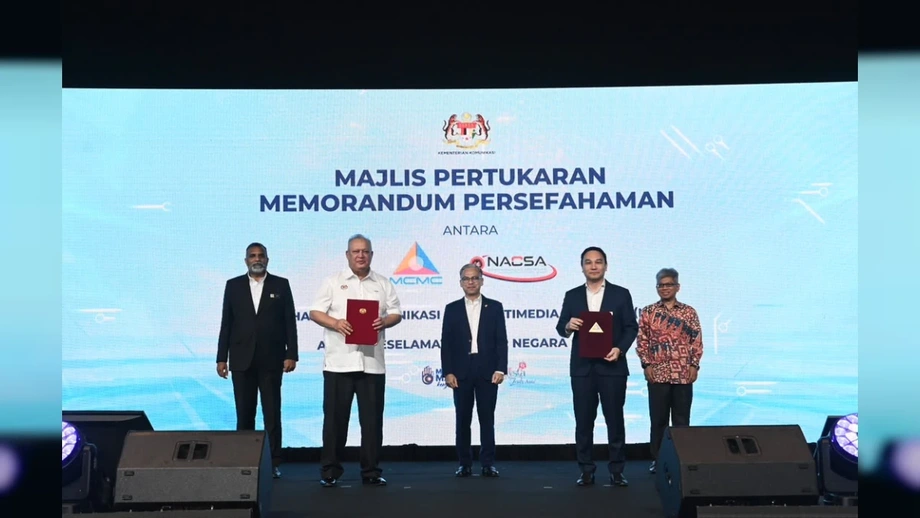
The conference also produced a formal document. The Malaysian Communications and Multimedia Commission signed a memorandum of understanding with the National Cyber Security Agency, the body known as NACSA, to improve how the two agencies share information about cyber threats, coordinate responses and build capability, each within its own legal remit.
The two bodies split the work in different ways. NACSA leads national cyber security policy and coordination, while the commission regulates the communications and multimedia industry and the networks that carry traffic. An agreement between them means a threat spotted on a telecoms network can reach the agency handling a national incident, and guidance from the agency can reach the operators.
From 250 Participants to 1,500
The commission said about 1,500 people from Malaysia and ASEAN member states took part in NEXSEC 2026, six times the 250 who attended the previous edition. The theme was "Advancing Cyber Resilience Through Collaboration, Innovation and Talent", and the programme included a technology sharing symposium, a roundtable for chief information security officers, a technology and talent exhibition and the student contests.
- 24 November: the commission previews the event, listing AI, quantum technology, digital scams and talent as the four focus areas.
- 25 November: Fahmi opens NEXSEC 2026 and directs the commission to convene talks on quantum migration and quantum-safe communications.
- 26 November, morning: the Global Anti-Scam Alliance presents its findings on scam trends and losses.
- 26 November, evening: Abdul Halim closes the conference and hands out the competition prizes.
The commission described the gathering as a place for industry players, security specialists, academics and young talent to exchange views and explore solutions, and said the competitions reflect its commitment to developing high skilled workers for the digital economy.
Inside the Capture the Flag Contest Where AI Was Banned
The loudest applause of the closing ceremony went to a team of three students. Perisai+, from the International Islamic University Malaysia, took first place in the university category of the Capture the Flag competition, collecting RM3,000, a plaque and a certificate from the training body EC-Council.
A capture the flag contest is a legal hacking exercise. Teams are given systems to break into and must find hidden pieces of text, the flags, by spotting flaws the way an intruder would. The skills transfer directly: a weakness found in a practice network is the same kind of weakness an attacker finds in a real one.
The runners up were PWNcookies from the Asia Pacific University of Technology and Innovation, which received RM2,500, and iphonekupi from Kuala Lumpur University, which took RM2,000. All five top teams received plaques and certificates. Perisai+ finished third at the previous edition, which makes this year's win a step up.
This year the organisers barred competitors from using AI tools. Team member Mohammad Danish Hakim Mohd Nasir, 22, who competed alongside Muhammad Muhaimin Ridzuan and Muhammad Afiq Danial Mohd Bacho, said the rule forced players to rely on their own ability.
"The main challenge this time was the ban on using AI because this is to hone each player's natural talent, but the experience of taking part in various competitions at university and ASEAN level before this helped us a lot, and we managed to win first place today," he said.
Danish said such events should be held more often so that more young people can show what they can do in cybersecurity.
CyberScout AR and Two Other Student Projects
A separate competition asked students to build something rather than break something. In the Technology Innovation Exhibition, first place went to CyberScout AR, a mobile application for cybersecurity awareness from the Islamic Science University of Malaysia, which won RM1,000, a trophy, a plaque and an EC-Council certificate.
Second place and RM750 went to Pentree, a project from the Asia Pacific University of Technology and Innovation that uses AI to run automated penetration testing, the process of probing a system for weaknesses on purpose so they can be fixed before someone exploits them. Third place and RM500 went to Ruang Aman, an AI tool from University of Malaya that detects hate speech online.
Building the People Who Will Defend the Networks
Abdul Halim ended where he began, with people. Strong technology, he said, depends on continuous commitment and close cooperation between government, industry and universities, and on having the expertise and readiness to face a threat picture that keeps changing.
He also placed human capital and a culture of security among the public at the front line, arguing that a country's systems recover faster from disruption when institutions and citizens know what to do. That includes habits that cost nothing: checking who is really on the other end of a call, being careful about what personal data is shared, and reporting suspected fraud rather than staying silent.
The commission said the contests and innovation pitches are part of how it spots young talent and supports the development of a skilled workforce. What remains open is how the quantum roundtable will translate into spending, whether the push for local security products produces tools that reach the market, and when the next edition of the conference will be held.
Key Points
- Communications Ministry secretary general Datuk Abdul Halim Hamzah called for intelligence led, predictive cyber defence instead of reactive responses, speaking at the close of NEXSEC 2026 at MITEC on 26 November.
- He said AI can find system weaknesses but is also being used for deepfake fraud and automated attacks.
- Communications Minister Datuk Seri Fahmi Fadzil directed MCMC to convene talks with telecoms and infrastructure companies on quantum migration and post-quantum cryptography, warning about harvest now, decrypt later interception.
- Malaysia will keep its dual 5G network policy for redundancy, and both operators have been asked to discuss continuity arrangements.
- A Global Anti-Scam Alliance report put Malaysian scam losses at RM19.7 billion, about USD 4.2 billion, over one year.
- MCMC signed a memorandum of understanding with the National Cyber Security Agency on threat information sharing, response coordination and capacity building.
- About 1,500 participants attended, six times the 250 at the previous edition.
- Perisai+ of the International Islamic University Malaysia won the Capture the Flag contest and RM3,000, with AI tools banned from the competition.
- CyberScout AR from the Islamic Science University of Malaysia won the innovation exhibition and RM1,000.