Eleven countries sign a common framework for digital trade
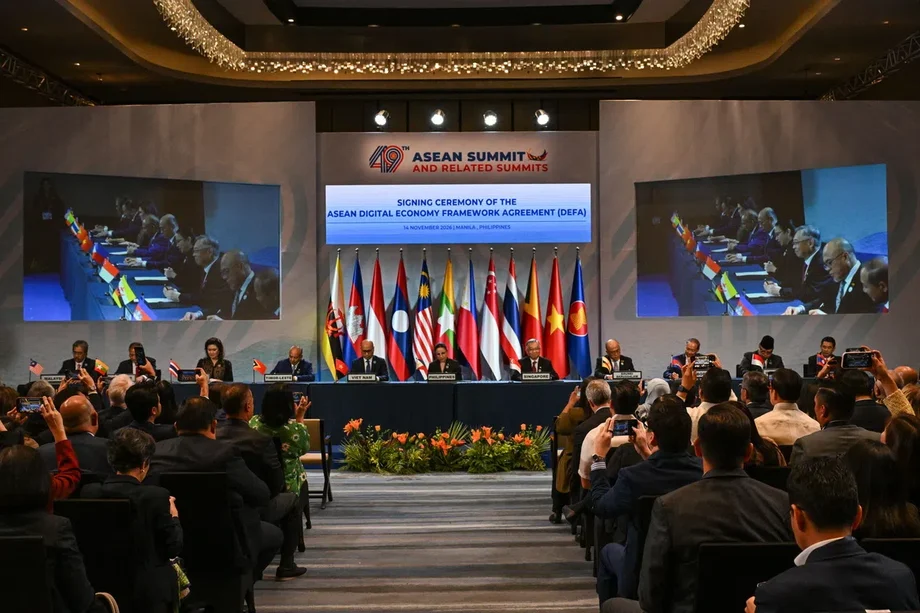
Trade ministers from all 11 ASEAN member states signed the Digital Economy Framework Agreement in Manila on November 14, 2026, setting common rules for electronic payments, business identities, trade documents and data moving across borders. Governments are preparing initial projects aimed at making regional commerce faster and less costly, with Singapore Deputy Prime Minister Gan Kim Yong targeting practical benefits in early 2027.
Contents
- Eleven countries sign a common framework for digital trade
- What the agreement would change for a transaction
- Business identities would help establish trust
- Data rules balance regional access with national safeguards
- Countries can advance at different speeds
- Smaller businesses want results they can use
- Large growth forecasts describe different expectations
- From negotiations to the next deadlines
- Singapore links digital integration to wider trade
- Haze cooperation faces its own implementation task
- Key Points
The agreement, known as DEFA, is ASEAN's first standalone, legally binding digital economy pact. It covers activities stretching from ordering goods online to verifying a trading partner, transferring payment and handling documents needed to move a shipment. Malaysia's Investment, Trade and Industry Minister Datuk Seri Johari Abdul Ghani was among the signatories.
Businesses could eventually spend less time submitting paper forms, checking unfamiliar overseas partners and navigating incompatible payment systems. Consumers could find purchases from neighbouring countries easier, supported by stronger cooperation on data protection, cybersecurity and online scams.
The timetable contains an unresolved inconsistency. Gan said he hoped the agreement would take effect early in 2027, while Singapore's Ministry of Energy, Trade and Industry said it would enter into force 180 days after signing and replace the 2019 ASEAN Electronic Commerce Agreement. Counting 180 days from November 14 points to May 2027. A reconciled commencement date and a confirmed list of initial projects have not been announced.
Philippine Trade and Industry Secretary Cristina Roque described the signing as a defining moment in regional economic integration. Her message to governments and companies was that the next stage would require infrastructure, investment and practical changes that smaller businesses could use.
What the agreement would change for a transaction
DEFA seeks to make national digital systems work together across technology, electronic commerce, payments, logistics and supply chains. Officials describe this as interoperability. In simple terms, a system used in one country should be able to exchange information or conduct a transaction with a system in another.
Electronic trade documents are an early priority. The agreement promotes wider use of electronic signatures and invoices, alongside digital alternatives to paper trade records. Gan said this could reduce paperwork, speed transactions and lower administrative costs.
A company selling goods across a border needs more than an online storefront. It must establish who is buying, record the sale, receive payment and provide the documents required for the goods to move. DEFA brings those connected tasks into a common regional framework.
Digital payments could serve consumers buying from another ASEAN country and companies paying overseas suppliers. Gan said the opportunity extends to wholesale transactions between businesses, where digital payment arrangements could provide an alternative to traditional bank transfers.
Business identities would help establish trust
Digital identities for companies are another possible early project. A business identity system would help a seller or buyer check the organisation on the other side of a transaction. Gan raised the possibility of a regional system for identifying businesses.
Verification matters because expanding into a neighbouring market often means dealing with companies a business has never encountered. A recognised digital identity could make that checking process easier, while common authentication arrangements would help companies demonstrate who they are.
DEFA also strengthens cooperation against online scams. Identity checks, payment arrangements and cybersecurity are closely connected in daily commerce: businesses need confidence about whom they are paying and how their information is handled.
Officials are considering these tools together rather than treating digital trade as online shopping alone. The framework covers nine areas, including digital trade, electronic commerce across borders, digital identity and authentication, electronic payments, data protection and privacy.
Data rules balance regional access with national safeguards
DEFA establishes basic rules for moving data between ASEAN countries. Companies operating in several markets may need to transfer information to process orders, organise deliveries or manage regional operations. Clearer rules could make expansion easier by giving businesses a more predictable framework.
National concerns will continue to shape how those transfers work. Gan said the agreement allows exceptions relating to privacy, confidential business information and national security. Countries ready to cooperate in particular sectors could move ahead together, subject to those safeguards.
The agreement also covers protection of source code, the instructions programmers write to make software function. For technology businesses, those instructions can be a valuable part of a product. Including source code extends the agreement's reach beyond payments and trade paperwork into the rules affecting software.
Artificial intelligence and cybersecurity are further areas for cooperation. Gan said progress in both requires collective effort. Their inclusion gives ASEAN a framework for addressing technologies and risks that operate across national boundaries, alongside the immediate work of making transactions easier.
Countries can advance at different speeds
ASEAN members have different levels of digital infrastructure, regulation and business readiness. Gan acknowledged that those differences would make implementation challenging. DEFA allows countries prepared for a particular initiative to proceed while others join when ready.
Flexibility could allow a group of members to develop arrangements for data transfers in a specific sector before every country participates. Governments would still need to help members with fewer resources build their capacity to join.
Indonesia's Coordinating Minister for Economic Affairs Airlangga Hartarto called for faster preparation of the implementation plan, with national readiness taken into account. He also sought alignment with the ASEAN Economic Community Strategic Plan for 2026 to 2030.
At the 28th ASEAN Economic Community Council meeting, Hartarto urged governments to address industry needs, involve the private sector and strengthen the capabilities of micro, small and medium enterprises. Singapore similarly stressed business engagement and training so that companies and workers could use the agreement.
The wider regional programme illustrates the scale of the delivery task. ASEAN sectoral bodies set 391 Annual Milestone Deliverables for 2026: 92 were complete, 246 were in progress and 53 had yet to begin. That means about 24 percent were finished and about 63 percent were underway. These figures cover the broader economic strategic plan, including work beyond DEFA.
Smaller businesses want results they can use
Singapore Business Federation chief executive Kok Ping Soon welcomed the agreement while identifying a practical standard for judging it. Companies, he said, would look for less border paperwork, smoother digital payments and trusted data flows.
"The key measure of success will be what businesses experience on the ground," said Kok.
Roque called for infrastructure investment and implementation shaped around smaller businesses. She urged companies to invest in digital solutions, strengthen partnerships across the region and include micro, small and medium enterprises in those opportunities.
Speaking at the signing ceremony, the Philippine trade secretary set out the task following the negotiations:
"Our real task now is to translate these commitments into practical outcomes," she said.
Gan acknowledged concerns that Singapore's smaller businesses could face stronger competition from regional counterparts. He argued that ASEAN economies complement one another in many areas and that companies also face substantial competition from outside Southeast Asia.
Food imports were one example he gave. Singapore produces little of its own food and wants to buy more from the region. Faster documentation and easier payments could help importers obtain supplies more conveniently and at lower cost, connecting regional producers with Singapore buyers.
Large growth forecasts describe different expectations
Singapore's Ministry of Energy, Trade and Industry cited research by Google, Temasek and Bain & Company projecting ASEAN's digital economy at US$368 billion in 2026 and more than US$1 trillion by 2035. Roque gave a different projection, saying DEFA could help expand the digital economy from an estimated US$1 trillion to US$2 trillion by 2030.
The figures frame the opportunity in different ways and on different timelines. Within Roque's projection, US$2 trillion is twice US$1 trillion. Within the projection cited by Singapore's ministry, a value above US$1 trillion in 2035 would be more than 2.7 times the US$368 billion estimated for 2026.
For individual firms, the benefits officials described are more immediate and concrete than those regional totals: fewer forms, quicker transactions and easier entry into neighbouring markets. Delivering those changes requires government commitments to be matched by working systems and businesses able to use them.
From negotiations to the next deadlines
DEFA took roughly three years to negotiate. Talks began in September 2023, and senior economic officials resolved the remaining issues at a Manila meeting from May 27 to 29, 2026. Ministers signed the agreement in November.
The next steps sit within a wider ASEAN economic calendar:
- September 2023: Negotiations on DEFA began.
- May 27 to 29, 2026: Senior economic officials resolved outstanding issues in Manila, concluding negotiations.
- November 14, 2026: Ministers from all 11 member states signed DEFA.
- End of 2026: ASEAN aims to bring its upgraded Trade in Goods Agreement into force, earlier than initially planned.
- 2027: Singapore takes over the ASEAN chairmanship, with DEFA implementation among its economic priorities.
- 2027: ASEAN targets signing its trade agreement with Canada and identifying possible negotiating areas for a green economy agreement.
The ASEAN Economic Community Council and relevant sectoral bodies are preparing implementation plans and examining priority projects. Gan wants initiatives ready when DEFA becomes operational, so businesses can begin benefiting rather than waiting for an extended period after legal commitments take effect.
Singapore links digital integration to wider trade
Singapore has set two broad economic priorities for its 2027 ASEAN chairmanship: closer integration among the grouping's 11 members and stronger cooperation with outside partners. The chairmanship coincides with ASEAN's 60th anniversary.
Gan said negotiations with Canada were progressing towards a substantial conclusion, with signing targeted for 2027. That would coincide with 50 years of ASEAN dialogue relations with Canada and would create ASEAN's first free trade agreement with a North American partner.
The latest progress follows Canada's Manila trade push, when Canadian Prime Minister Mark Carney prepared to attend the summit with regional negotiations approaching a November deadline. Ministers had previously urged officials to finish negotiations before the planned signing the following year.
ASEAN is also reviewing and upgrading its trade agreements with South Korea and India, while exploring a new agreement with the Gulf Cooperation Council. Singapore wants stronger ties with the European Union and members of the Comprehensive and Progressive Agreement for Trans-Pacific Partnership.
Alongside digital commerce, ministers reviewed preliminary findings from a feasibility study for an ASEAN Green Economy Framework Agreement. The aim is to complete the study and identify possible areas for negotiations in 2027. ASEAN also formalised an upgraded memorandum on cooperation for its regional power grid, connecting the integration agenda with energy infrastructure.
Haze cooperation faces its own implementation task
ASEAN foreign ministers separately discussed pollution from land and forest fires in Indonesia that affects neighbouring countries, including Singapore and Malaysia. Philippine Foreign Secretary Ma. Theresa Lazaro said Indonesia outlined its efforts to address the problem and that Singapore and Malaysia responded cordially.
Ministers called for faster action to make the ASEAN Coordinating Centre for Transboundary Haze Pollution Control in Indonesia operational. Its establishment agreement requires ratification by at least six member states. Ratification is the formal national approval needed for a country to accept an agreement.
Singapore has pledged to prioritise the centre's establishment during its 2027 chairmanship. Like the digital pact, the haze initiative requires regional commitments to be followed by national procedures and operational arrangements before people can receive the intended benefits.
Indonesia also backed stronger energy security and more resilient supply chains, alongside ASEAN programmes on carbon neutrality, the circular economy and the blue economy. Those programmes address emissions, keeping materials in use and sustainable economic activity connected with seas and oceans.
Key Points
- All 11 ASEAN member states signed DEFA in Manila on November 14, 2026.
- Potential early projects include digital payments, business identities and electronic trade documents.
- Gan's early 2027 target differs from the ministry's stated commencement rule of 180 days after signing, which points to May.
- The pact covers data flows, source code protection, cybersecurity and artificial intelligence, alongside digital commerce.
- Countries ready for specific initiatives can proceed, with other members able to join later.
- Business groups want measurable improvements in paperwork, payments and trusted data transfers.
- Singapore's 2027 chairmanship will also pursue wider trade ties, green economy cooperation and the regional haze centre.