A small concrete block with a new safety role
Filipino structural engineer Aldrei Ong has won the 2026 James Dyson Award Global Sustainability prize for Sentinel, a system that turns an ordinary concrete spacer block into a sensor for possible structural damage. Its project profile lists a manufacturing cost of P10 per block, while the invention uses changes in electrical resistance to alert engineers to cracks that may be hidden inside concrete.
Contents
- A small concrete block with a new safety role
- How concrete becomes a sensor
- What the P10 price covers
- From teenage curiosity to laboratory testing
- Building tests and the challenge of older structures
- Why engineers remain central
- Earthquake safety and the sustainability case
- What the prize will fund next
- A Philippine invention on a global stage
- Key Points
The James Dyson Foundation announced the award on November 4, 2026. Its global winners announcement says Ong will receive £30,000, approximately P2.4 million, to continue developing the technology. The 25-year-old De La Salle University graduate tested more than 125 concrete samples over more than a year before taking the system into a Philippine building for monitoring.
Sentinel addresses a difficult moment after an earthquake: many buildings need inspection at once, while damage inside concrete can be difficult to see. A sensor that flags a change could help engineers decide where further examination is needed, giving them information between visits as well as after strong shaking.
Ong described the purpose of the invention in practical terms:
"By having a sensor like Sentinel, we can know when there is damage in a building and we can intercept it. We can intervene early, so the damage doesn't accumulate into costly, dangerous failures," Ong said.
Engineers still make the safety assessment. Sentinel provides an alert about possible damage; its current role is to direct attention to a problem so that people with the right training can investigate it.
How concrete becomes a sensor
A conventional concrete spacer block holds reinforcing steel in position before concrete is poured. The steel strengthens the finished structure, and the spacer helps keep it where the design requires. Sentinel preserves that ordinary construction function while adding a way to take electrical measurements.
Conductive materials mixed into the block create tiny pathways through which electricity can travel. Embedded electrodes connect the concrete to an electronic module. The module sends a controlled electrical signal through the block, measures its resistance and compares that measurement with an original reading, called the baseline.
Electrical resistance describes how much a material opposes the flow of electricity. When loading or cracking changes the pathways inside Sentinel, the resistance changes too. A large enough shift prompts the system to flag possible damage and transmit readings wirelessly to a monitoring dashboard.
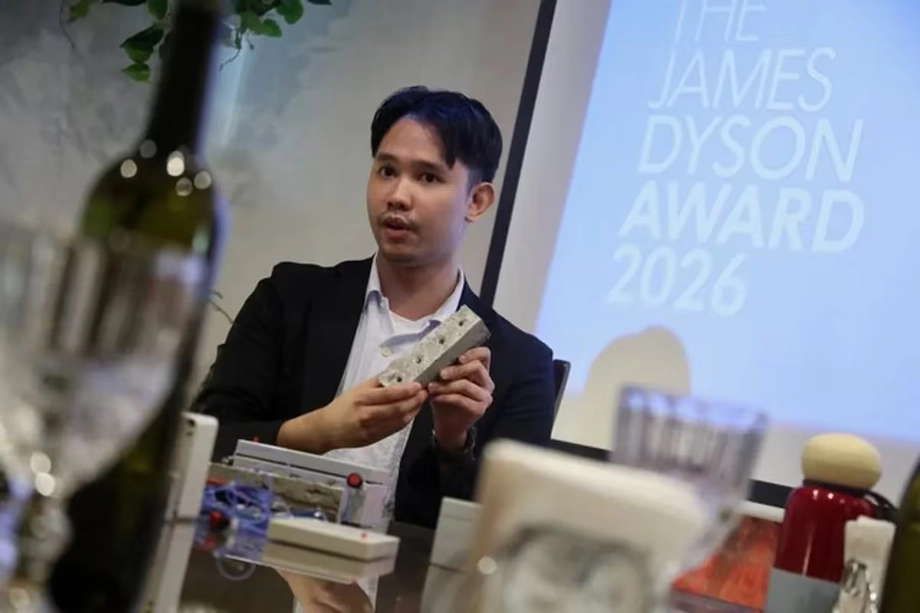
During a prototype demonstration, Ong broke a block in two, interrupting the electrical flow. A prolonged red light indicated a possible crack. The demonstration made the basic idea visible: damage to the material changes the electrical signal that the device measures.
What the P10 price covers
The official Sentinel project profile gives a manufactured cost of P10, or about $0.15, per concrete block. The system also requires electrodes, an electronic module and a way to collect and display readings. A complete installation price has not been published.
Ong chose a spacer block because builders already use it. Incorporating sensing into that component allows the block to do two jobs without adding a separate structural element. Keeping the material inexpensive was a priority alongside making it sensitive enough to respond to damage.
The cost of checking buildings also shaped the idea. Ong's work involved visiting construction sites and inspecting structures, tasks he found demanding in both time and resources. His project profile describes clients seeking inspections after earthquakes and repeatedly during a building's life, with late repairs potentially costing millions and displacing occupants for weeks or months.
From teenage curiosity to laboratory testing
Ong first encountered research on concrete that senses damage when he was 17, reading publications and academic journals. He later developed the subject into his Master of Science in Civil Engineering thesis at De La Salle University in Manila.
His early interest became hands on experimentation. Ong recalled buying gravel and mixing concrete in his room because he wanted to pursue the idea. His parents worked in the same field, helping shape his interest in structural safety.
The research required balancing two needs: the material had to remain useful as concrete and produce a measurable response to loading and cracking. Over more than a year, Ong mixed, cured and tested more than 125 samples. Later prototypes refined the block's shape, electrode placement, measurement stability and connection to the monitoring electronics.
The project's development has included several milestones:
- At age 17, Ong began reading about concrete capable of sensing changes within itself.
- His master's research at De La Salle University became the foundation for Sentinel.
- The research was presented at the STRUCTURES24 Congress in South Korea and the 2025 IABSE Symposium in Tokyo.
- In September 2026, two Philippine entries reached the award's global Top 20, a first for the country.
- On November 4, 2026, Sentinel was named the Global Sustainability Winner.
Building tests and the challenge of older structures
Ong tested Sentinel at the National Shrine of the Sacred Heart in Makati City. The foundation also confirms that sensors have been embedded in a Philippine building for monitoring under actual conditions.
Ong describes the current spacer block design as intended for new buildings and structures under construction because it must be embedded in concrete. The project profile also says blocks have been embedded in existing buildings, without explaining how those installations were carried out. Modules specifically designed for older structures remain part of his development plans.
The next testing stage will compare sensor readings with damage actually found in buildings and track performance over time. That work will help establish how the system performs beyond laboratory samples, where engineers can control loading and observe cracking directly.
Why engineers remain central
Sentinel cannot independently determine whether an entire building is safe or give an exact diagnosis of its condition. An alert tells engineers that a measurement has changed and that further inspection may be needed.
Traditional assessment methods described in the project profile include checking visible cracks, drilling concrete cores and using rebound hammers. A concrete core is a sample removed for examination. A rebound hammer measures the response of a concrete surface to a controlled impact. Engineers use such observations and tests to build a fuller picture of a structure.
A dashboard could give engineers another stream of information, especially when many buildings need attention after an earthquake. Repeated measurements would also let them follow changes over time instead of relying entirely on what they find during an occasional visit.
Dr Bernardo Lejano, a professor of structural engineering in De La Salle University's Department of Civil Engineering, welcomed Ong's decision to continue the research beyond his degree. He expressed the following hope for its effect on other engineers:
I hope Aldrei's achievement will inspire many young engineers to think outside the box.
Earthquake safety and the sustainability case
Greater Metro Manila is one of the places Ong has considered when thinking about Sentinel's potential use. Award organizers cited estimates that an earthquake of magnitude 7.2 could cause 48,000 deaths and $48 billion in economic losses across the area. Those figures describe a disaster scenario that would put intense pressure on building assessments and emergency decisions.
Ong also cited a magnitude 7.8 earthquake in Southern Mindanao in June, referring to a United Nations High Commissioner for Refugees figure of almost 95,000 people still displaced in September. He said the event prompted him to consider the infrastructure damage a major earthquake could cause in Metro Manila.
The sustainability argument concerns what happens after damage develops. Ong points to greenhouse gas emissions from cement production and argues that finding problems early can help avoid more extensive rebuilding. Sentinel's planned field testing will focus on its sensing performance; figures for repair savings or emissions reductions have not been published.
For building owners and occupants, the practical aim is earlier action. If an engineer can identify developing damage before it becomes a larger failure, the work may be more manageable and disruption may be shorter.
What the prize will fund next
Ong plans to use the award money for further validation and design improvements. A priority is replacing the current electronics, soldered by hand, with a custom printed circuit board. That board would organize the electronic components into a unit intended to be smaller, more reliable and easier to reproduce.
Further testing will examine how closely electrical changes correspond to actual damage. Monitoring installed blocks over an extended period is another priority, alongside developing modules compatible with buildings already standing. The announcements give no commercial launch date or timetable for those versions.
Ong also envisions a centralized damage detection system, drawing inspiration from the way smoke detectors provide alerts throughout buildings. Wireless transmission to an online dashboard is already part of the described prototype. Broader internet connectivity and a mobile application for users are among the possibilities he wants to explore.
Bridges and roads are longer term interests. Ong has mentioned research into asphalt that can sense changes within itself as a possible basis for future road applications. His current work centers on the concrete system and the testing needed to develop it further.
A Philippine invention on a global stage
The 2026 James Dyson Award received 2,294 entries from 28 countries and regions. Sentinel's recognition gives the Philippines another sustainability victory six years after Carvey Ehren Maigue won in 2020 with AuREUS, a technology using materials derived from discarded crop waste to convert ultraviolet light into renewable electricity.
The foundation named Rumble Rims as its Medical Winner, alongside Sentinel as Sustainability Winner. Developed by Harvard University students Radhika Saran, Cleo Pontone and Sophia DeVito, Rumble Rims uses infrared tracking of eye movements to help screen athletes for possible concussion. Both global winners receive £30,000.
Ong described his award as both a personal achievement and a shared victory for those who supported the research. He hopes it encourages young Filipino engineers to keep developing ideas that address problems at home and can find uses internationally.
His next task is concrete: gather longer records from installed sensors, improve the electronics and compare alerts with damage found by engineers. The prize provides money to pursue that work after years of experiments that began with curiosity about an unfamiliar research paper.
Key Points
- Aldrei Ong won the 2026 James Dyson Award Global Sustainability prize for Sentinel, receiving £30,000 for further development.
- The sensor uses changes in a concrete block's electrical resistance to flag possible damage and send readings to a dashboard.
- The listed P10 manufacturing cost applies to the block; a complete installation price has not been published.
- Ong tested more than 125 concrete samples, and sensors have been installed in a Philippine building for monitoring.
- Engineers remain responsible for assessing building safety. Further field testing, improved electronics and versions for older buildings are planned.