SoftBank to Lead Sarawak's AI Infrastructure Venture
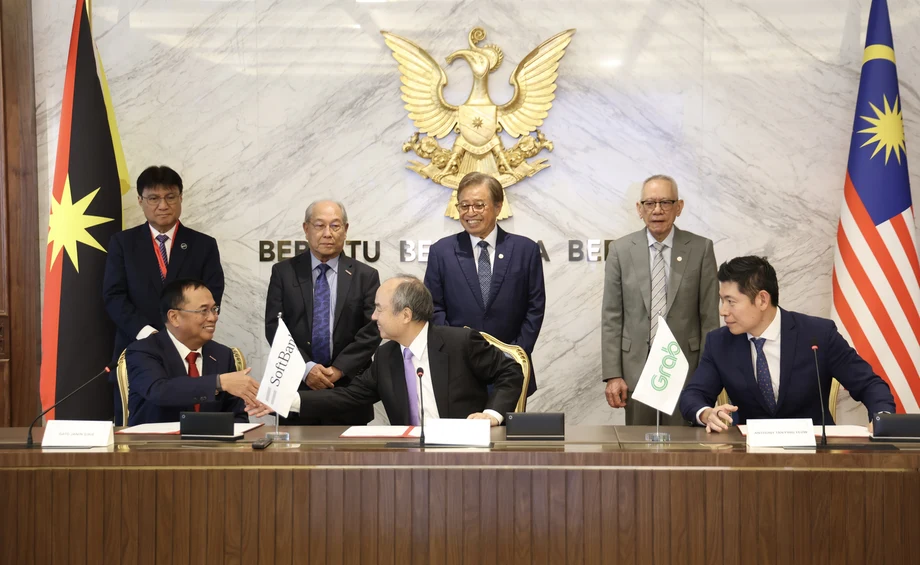
SoftBank Group, Grab and Petroleum Sarawak Bhd (PETROS) announced on November 9, 2026, a joint development agreement for a proposed US$1 billion investment in artificial intelligence infrastructure in Sarawak. SoftBank would contribute US$800 million and hold majority ownership, with Grab and PETROS each providing US$100 million.
Contents
- SoftBank to Lead Sarawak's AI Infrastructure Venture
- How the Two Malaysian Projects Fit Together
- What the Agreement Changes
- Why the US$50 Billion Figure Is Different
- What Five Gigawatts Means for an AI Project
- Energy and Tanjung Embang Shape Sarawak's Plans
- Power Supply, Water and Approvals Are Critical
- Who Will Run the Ventures?
- What Sarawakians Could Gain
- Key Points
The initial funding, equivalent to approximately RM4.07 billion, would be released in stages as development work and customer contracts meet agreed milestones. The partners have a long term target of five gigawatts of AI infrastructure capacity in Sarawak and plan to seek more investors and major computing customers to support expansion.
The joint Sarawak announcement describes binding development and funding obligations. Detailed investment terms and the operating arrangements for the joint ventures still require definitive agreements and other conditions to be met.
Sarawak is also part of a wider Malaysian initiative. A second announcement on the same day set out US$1.85 billion in proposed initial capital across Sarawak and Peninsular Malaysia, where Grab would lead a separate US$850 million project.
For Sarawak, the proposal connects its energy industry with an effort to build new sources of income, skilled employment and computing services. Governments, multinational companies and small businesses are among the intended customers. The partners expect the facilities, once fully operational, to rank among the largest of their kind in Asia.
How the Two Malaysian Projects Fit Together
SoftBank and Grab's Malaysia investment announcement sets out different funding and leadership arrangements for the two projects. SoftBank would lead Sarawak, while Grab would lead development in Peninsular Malaysia as its founding shareholder.
The proposed initial contributions are:
- Sarawak: US$800 million from SoftBank, US$100 million from Grab and US$100 million from PETROS, totaling US$1 billion.
- Peninsular Malaysia: US$650 million from Grab and US$200 million from SoftBank, totaling US$850 million.
- Across both projects: US$1 billion from SoftBank, US$750 million from Grab and US$100 million from PETROS, totaling US$1.85 billion.
SoftBank would supply 80% of Sarawak's proposed initial capital. Grab and PETROS would each supply 10%. Sarawak accounts for about 54% of the combined US$1.85 billion proposal, calculated from its US$1 billion share.
Grab has an option to increase its stake in the Sarawak venture, reducing SoftBank's share while leaving SoftBank as the majority owner. Final ownership arrangements will therefore depend on the investment terms and whether that option is exercised.
The Sarawak announcement gives a capacity target of five gigawatts, while the broader announcement describes five gigawatts or more across Malaysia. Both describe a programme developed over several years, with expansion supported by further investment and customer demand.
What the Agreement Changes
The November agreement moves the partnership beyond the framework signed in Kuching on October 8. That earlier framework set out an intention to explore an AI and digital infrastructure platform and prepare a phased development road map. It was nonbinding.
The new joint development agreement creates binding development and funding obligations, while leaving major investment and operating details for later agreements. Money would be deployed as projects reach development and customer contract milestones, giving the partners checkpoints before further funding is released.
The main developments span several dates:
- October 8, 2026: SoftBank, Grab and PETROS signed the Sarawak framework agreement in Kuching.
- October 24, 2026: Prime Minister Anwar Ibrahim discussed proposed technology investments worth US$50 billion following a videoconference with SoftBank chief executive Masayoshi Son.
- November 9, 2026: The companies announced joint development agreements and proposed initial capital of US$1.85 billion across the two Malaysian projects.
- January 2027: Sarawak Premier Abang Johari Tun Openg has said work on a proposed AI grid campus could begin after passage of the state budget.
Abang Johari's January expectation concerns the state's campus plans. The companies gave no confirmed construction or opening date, detailed construction footprint, customer list, final expansion cost or job total. They also left the precise relationship between the initial funding and the wider US$50 billion proposal unspecified.
Why the US$50 Billion Figure Is Different
Anwar has described proposed investments worth US$50 billion associated with Son's interest in Kuching and locations in Peninsular Malaysia. His October comments covered AI, new technology and data centres, a broader set of activities than the US$1 billion Sarawak seed capital.
The companies' November statements specify US$1.85 billion in proposed initial funding across Malaysia, including Sarawak's US$1 billion. They describe additional investors and financing as part of future development. Readers therefore have two figures with different scopes: an initial funding programme announced by the companies and a much larger technology investment ambition discussed by the prime minister.
Anwar welcomed the consortium's November announcement, saying it reflected confidence in Malaysia's capabilities, investment climate and political stability. He said the government would work with the relevant state authorities to support the project and expected opportunities for skilled workers and local suppliers.
The practical spending decisions will follow the projects' development stages. Securing customers, infrastructure and approvals will determine when money can be released and how far the facilities can expand.
What Five Gigawatts Means for an AI Project
AI infrastructure consists of powerful computers, data storage, communications connections and the systems needed to keep them operating. Businesses can use that computing capacity to develop AI models or run services without building an entire facility themselves.
A gigawatt equals 1,000 megawatts, making the Sarawak target equivalent to 5,000 megawatts. In this context, the figure describes the intended scale of infrastructure in power terms. Actual computing performance also depends on the chips, software and equipment installed.
SoftBank and Grab point to demand across Southeast Asia as a reason to build. Their announcement cites the e-Conomy SEA 2026 report by Google, Temasek and Bain & Company, which projects that regional AI usage could grow by up to 60 times by 2030. It says current usage per person across the region's six largest economies is around one tenth of the United States level.
The partners are seeking hyperscaler customers, meaning companies that operate computing services at very large scale. Contracts with such customers could provide a substantial base of demand. The funding conditions tie customer contracts to project progress, making the search for buyers part of the development process.
Energy and Tanjung Embang Shape Sarawak's Plans
PETROS brings experience in energy supply and infrastructure development. Through the Sarawak Gas Roadmap, it is developing gas infrastructure intended to strengthen energy security and support industrial expansion.
As master developer of the Kuching Low-Carbon Hub, PETROS is also assembling an industrial network that includes gas production, carbon capture, electricity generation using liquefied natural gas, processing facilities, industrial parks, gas terminals and port infrastructure. These assets are intended to support industries that need dependable energy and transport connections.
Abang Johari has identified Tanjung Embang as the location for a proposed AI grid campus within a wider site of about 2,000 hectares. His plan places the campus alongside a gas hub designed to limit carbon emissions, a seaport and an airport. He identified PETROS as the campus developer and described the AI grid as a project extending over 20 years.
The premier said the campus would require power, data storage and connectivity. He also mentioned interest from the Asian Development Bank. His description places the computing proposal within a wider development plan involving energy, transport and industrial facilities.
Sarawak's existing energy resources and power generation capacity are central to the companies' investment case. Turning those resources into a dependable supply for computing facilities will require both physical infrastructure and commercial arrangements.
Power Supply, Water and Approvals Are Critical
SoftBank and its partners list suitable land, reliable electricity at competitive prices, communications connections and contracted customer demand among the requirements affecting development. Internal approvals, government permits, financing and technical assessments also feature in their risk statements.
The companies warn that technical, commercial or regulatory assessments could lead to changes in the projects' scale or timing, or prevent them from proceeding. AI demand, service prices, competing technologies and construction economics can also affect the business case.
Anwar said the project must meet federal and state requirements, including those concerning renewable energy use. SoftBank and Grab say the facilities will follow Malaysia's renewable energy guidelines and use efficient infrastructure designed to reduce water consumption and reliance on local electricity grids.
Gas delivery is another practical issue in Sarawak's industrial expansion. During negotiations over gas guarantees, the state sought certainty that PETRONAS could deliver an allocation of 1.2 billion standard cubic feet a day for domestic needs. PETROS and PETRONAS are pursuing a settlement by the end of 2026; Federal Court hearings are scheduled for January 25 to 29, 2027, if their constitutional disputes remain unresolved.
For businesses planning facilities that consume large amounts of electricity, dependable fuel delivery and clear operating responsibilities help shape investment decisions. Sarawak's AI ambitions sit alongside that continuing work on its energy system.
Who Will Run the Ventures?
Grab cofounder, chairman and chief executive Anthony Tan is expected to oversee development of both Malaysian projects. Dedicated management teams would handle daily operations while he continues to lead Grab. Grab's board has reviewed and approved his affiliation with the ventures.
The partners bring different capabilities. SoftBank contributes investment experience and expertise in AI, computing and related technologies. Grab brings applied AI experience and a regional network of users, merchants and drivers. PETROS contributes local energy and infrastructure knowledge.
Grab plans to bring strategic investors into the Peninsular Malaysia project as it expands. Further development there is expected to use outside equity and nonrecourse project financing. Under that type of financing, lenders generally look to the project's own income and assets for repayment.
SoftBank has also agreed in principle to a five year restriction on selling Grab shares held directly by an entity within its group, subject to agreed terms and customary exceptions. This arrangement accompanies the broader partnership between the companies.
What Sarawakians Could Gain
PETROS group chief executive Janin Girie framed the investment as part of Sarawak's effort to build industries beyond oil and gas. He said bringing advanced computing closer to local companies and workers could help them compete and participate more fully in the digital economy.
This is about preparing Sarawak for its next phase of economic transformation beyond oil and gas.
Engineering, design and technical work are among the employment areas identified in the wider Malaysian announcement. The partners also plan to explore robotics, advanced technologies, manufacturing, workforce development and community development. These activities would extend the initiative beyond the construction and operation of computing facilities.
Anwar said he expected the investment to help Malaysians build AI expertise and give local businesses opportunities to supply goods and services. For smaller companies, access to computing services could make advanced tools available without the cost of owning the underlying infrastructure.
SoftBank chairman and chief executive Masayoshi Son described the intended regional benefit in the Sarawak announcement:
Together with Grab and PETROS, we aim to create lasting opportunities in Sarawak and support the development of technology-driven economic activity across Malaysia and the wider region,
The companies say the projects align with the National AI Action Plan 2026–2030, also called AI Nation 2030, and Sarawak's Post COVID-19 Development Strategy 2030. Delivering the promised benefits will depend on converting the development agreements into financed facilities, customer contracts and work that local businesses and employees can undertake.
Key Points
- SoftBank, Grab and PETROS propose US$1 billion in initial capital for Sarawak AI infrastructure, released in stages.
- SoftBank would lead and majority own the Sarawak project, contributing US$800 million.
- A separate US$850 million project in Peninsular Malaysia brings proposed initial Malaysian funding to US$1.85 billion.
- The Sarawak venture targets five gigawatts of capacity over time and will seek more investors and major customers.
- Development depends on agreements, approvals, land, electricity, connectivity, financing and customer demand.
- The partners aim to provide computing access, skilled employment and opportunities for local businesses.