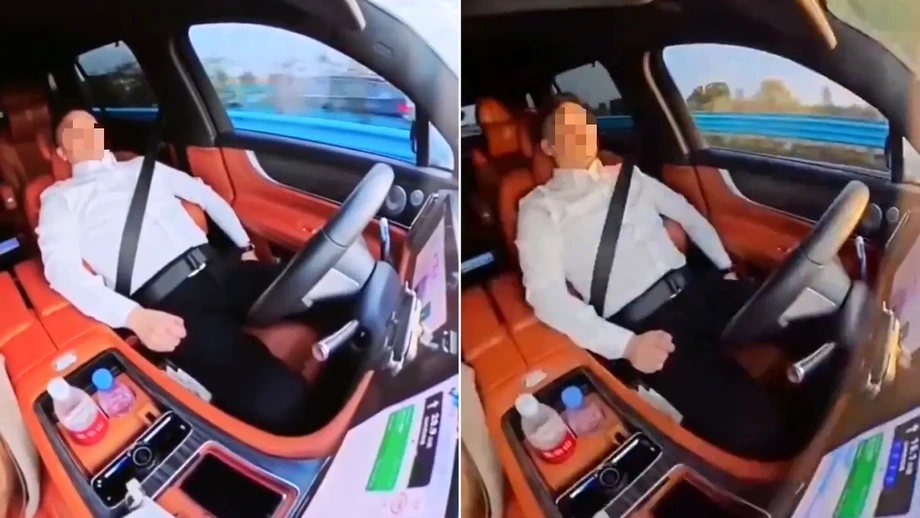
A reclining seat at motorway speed
A man who identified himself as the owner of an Aito M9 posted footage showing him reclining in the driver's seat with his eyes closed while the SUV travelled at speed on a motorway. The assisted driving system was switched on. He appeared to be asleep, with no visible hands on the steering wheel, as the vehicle continued along the road.
Contents
The owner, who posted under the name Tao Ge, presented the episode as an example of technology making his life easier. His caption described his exhaustion after travelling for work:
Technology changes life, full intelligent driving! I was so tired on the way back from a business trip that I fell asleep.
The Chinese caption also said the Huawei Aito M9 had used intelligent driving for the entire journey back to Wuhan. He separately praised Huawei's Qiankun driver assistance technology as better than a motorist with three years of driving experience.
His boldest claim concerned the car's accumulated mileage. He said the M9 had travelled 63,000 km, or 39,146 miles, and that more than 40,000 km, or 24,855 miles, had been completed with driver assistance. If those figures are accurate, assistance was used for at least 63% of the car's total distance. They are cumulative figures, not the length of his business trip, and he did not claim to have been asleep for all 40,000 km. The mileage has not been independently verified.
Online anger and an official check
Weibo users propelled a topic about the sleeping Aito owner onto the platform's hot search list on 21 November 2026. Many commenters called the behaviour selfish and accused him of endangering himself and other road users. A recurring joke asked whether he was afraid of driving to heaven in his sleep. Others defended the technology, arguing that if motorists were not allowed to use the function, it should not be manufactured.
Those arguments concern different activities. Aito permits ADS to assist an attentive driver within its operating rules. Sleeping removes the human supervision that the company says must accompany that assistance. The distinction sits at the centre of both the public anger and Aito's response.
The account named Tao Ge, with the ID Tao186588, and the video later became unsearchable across several platforms. Their disappearance prompted claims that the owner had been banned across the internet. No platform publicly explained the change, however, so the confirmed position is that the account and footage could no longer be found, not who removed them or why.
Wuhan's traffic management department said it had received a complaint from a member of the public and passed it to the relevant authorities. Police are checking the reported behaviour as a possible case of dangerous driving. A response was expected later, but no deadline was supplied. By 23 November, the relevant departments had not published a formal notice announcing their findings, a charge or a penalty.
Aito's boundary between assistance and autonomy
Aito's user care centre said the footage had been recorded and passed to a specialist team for further checks. A customer service representative also set out the operating rule for the system in direct terms:
Aito ADS is designed only to assist the driver. It is not autonomous driving or driverless driving, and it cannot replace the driver's attentive driving and accurate judgment.
The representative said motorists should keep their hands on the steering wheel, watch the road closely and intervene manually whenever necessary. Aito is part of Huawei's Harmony Intelligent Mobility business, and the M9 uses Huawei driver assistance technology. Harmony Intelligent Mobility had not issued a separate public response by 21 November.
The M9 system at issue is Level 2 assistance. At this level, a vehicle can help control steering and speed in supported situations, but the person in the driver's seat must continuously monitor the environment and remain ready to take control. The number therefore describes a division of responsibility, not simply the sophistication of the software. Under Aito's stated rules, a reclining seat and closed eyes are incompatible with using the system safely.
The safeguards Aito has yet to explain
Customer service staff said the vehicle has a detection prompt for drivers who take their hands off the steering wheel. When asked about the settings, staff said they had not verified that this detection function could be switched off. Such a warning is intended to make the driver restore hand contact, but the existence of an alert does not explain how long assistance can continue when the person does not respond.
Fatigue monitoring has a different setting. According to the customer care centre, it can be manually enabled or disabled through the driving scenario assistance section of the central display. Staff did not say whether fatigue monitoring had been active in the M9 shown in the footage, or whether it generated any warning before or during the video.
Aito's representative could not explain why the owner was apparently able to lie back with his eyes closed for so long without the system forcing an end to assistance. The answer given was that the matter required further verification. The company has not released vehicle logs or described the sequence of alerts, driver responses and system commands. It also has not publicly established how long the man was asleep, whether his hands touched the wheel intermittently, or when assisted driving eventually disengaged.
Those details matter because the technical review has a narrower task than the police check. Aito needs to reconstruct what its sensors and software did in this particular vehicle. Police must separately establish the driver's conduct and decide how the law applies to it.
Richard Yu's sleep remark and rapid correction
Huawei executive director Richard Yu, also known as Yu Chengdong, had discussed driving automation at the Xiangjie V8 launch on 20 November, the day before the motorway footage was shared. While talking about the arrival of Level 3 technology, his initial remark was:
You can sleep while driving.
Within an hour, Yu corrected himself and warned motorists about the technology currently available:
You cannot sleep while driving, and your hands cannot leave the steering wheel.
He also clarified that the system presently available in the vehicle was Level 2, not Level 3. Level 3 describes conditional automation: within defined operating conditions, the system can perform the driving task, while the user must respond when asked to take over. Its use still depends on the approved conditions and local rules. Yu's initial comment concerned future Level 3 capability, whereas the Aito M9 footage involved a system that requires continuous human supervision.
The timing intensified scrutiny of Huawei's public messaging. A senior executive had raised the idea of sleeping behind the wheel, corrected it, and then saw an owner publicly praise an assisted journey while apparently doing exactly that. The two episodes nevertheless involved different claims: Yu was discussing a future automation category, while the owner was using technology that Aito says cannot replace an alert driver.
A short timeline of the dispute
Events unfolded over four days, with the corporate correction preceding the viral video:
- 20 November 2026: Richard Yu suggested at the Xiangjie V8 launch that Level 3 technology could eventually allow sleep while driving. Within an hour, he said motorists could not sleep and must keep their hands on the wheel.
- 21 November: The Aito M9 footage was shared online, and the sleeping driver topic reached Weibo's hot search list. The owner claimed an assisted journey back to Wuhan and more than 40,000 km of cumulative assisted driving. Wuhan received a public complaint. Harmony Intelligent Mobility had not issued a public response at that stage.
- 22 November: Aito customer service said the M9 had a detection prompt for hands leaving the wheel and that the footage would receive further specialist verification. The publishing account could no longer be found on multiple platforms.
- 23 November: The account remained unsearchable and traffic officers were still checking the case. No formal departmental bulletin had been published by the time of the latest public updates.
No collision or injury has been announced in connection with the footage. The exact motorway, vehicle speed and duration of the driver's sleep have also not been officially disclosed.
What happens next for the driver and the company
Wuhan investigators still need to establish the basic facts surrounding the journey, including who was driving, where and when the footage was recorded, and whether the behaviour meets the legal threshold for dangerous driving. The traffic management department has not given a date for its next response, so there is currently no announced hearing, decision deadline or penalty.
Aito's specialist team faces the unanswered technical question: how the car's warnings and monitoring behaved while the driver appeared to sleep. The company has not said when its review will finish or whether it will publish the findings. The status of Tao Ge's social media account also remains unexplained by the platforms involved.
For other M9 drivers, Aito's immediate instruction is unchanged. ADS can assist with the driving task, but the motorist must stay awake, hold the wheel, watch the road and be prepared to intervene. The mileage claimed by one owner does not alter that operating level or turn the system into autonomous driving.
A video intended to celebrate Huawei technology has consequently produced two parallel examinations. Police are reviewing the man's conduct, while Aito is being asked to explain the performance of safeguards that its own customer service team described. Until either side publishes findings, the confirmed record consists of the footage, the owner's claims, Aito's operating instructions and an official check whose outcome is pending.
Key Points
- Footage shared on 21 November 2026 showed a self-described Aito M9 owner reclining with his eyes closed while the SUV travelled on a motorway with assistance active.
- He claimed the car had covered 63,000 km in total, including more than 40,000 km using driver assistance, and said it drove him back to Wuhan after he fell asleep.
- Wuhan's traffic management department received a complaint and police are checking possible dangerous driving, with no formal outcome announced by 23 November.
- Aito says ADS is Level 2 assistance, not autonomous driving, and requires an attentive driver with hands on the wheel.
- The M9 has a detection prompt for hands leaving the wheel, while fatigue monitoring can be switched off manually. Aito has not explained why assistance apparently continued.
- Huawei executive Richard Yu corrected his own remark about sleeping while driving within an hour on 20 November and clarified that current technology was Level 2.
- The owner's account and video became unsearchable on several platforms, but no platform publicly explained their disappearance.