A $100 million bet on machines that can do useful work
Simplexity Robotics, a Chinese robot developer registered on July 31, 2025, has raised $100 million in a pre-Series A round led by Ant Group. Chairman Wang Kai, who helped found the company, said the investment gives Simplexity a valuation of $1.6 billion after the new capital arrives, equivalent to about 10.7 billion yuan. Ant also joined as a strategic investor, while existing backers Tencent, HSG and Lanchi Ventures returned.
Contents
- A $100 million bet on machines that can do useful work
- How three former Li Auto executives built a unicorn so quickly
- What can the i7 Pro and iX actually do?
- Why Simplexity builds the software and the body together
- Can robots fill difficult industrial jobs at an acceptable cost?
- Why Ant Group is backing a company that could become a rival
- What the round reveals about China's increasingly selective robot race
- Where the money goes and what investors still need to learn
- Key Points
The financing was announced on November 23, 2026, the same day Simplexity presented iX, its second humanoid robot. The wheeled machine was shown preparing and delivering drinks, collecting and carrying objects, and guiding visitors with spoken commentary. Those demonstrations connect the fundraising to a visible product, although the company has not disclosed an iX delivery schedule or order volume.
Simplexity works on physical artificial intelligence, often called embodied AI. This field gives software a physical body that can perceive its surroundings and act on them. Rather than simply repeating a fixed industrial routine, such a robot is intended to interpret objects, people and changing conditions, then coordinate navigation with movements of its arms and hands.
The valuation also offers a simple way to understand the size of the round. If the entire $100 million purchased new equity, the investors together would have acquired 6.25% of Simplexity, calculated by dividing $100 million by $1.6 billion. The exact ownership terms and each investor's contribution were not published.
How three former Li Auto executives built a unicorn so quickly
Wang Kai, Jia Peng and Wang Jiajia founded Simplexity after holding senior positions at Chinese electric vehicle maker Li Auto. Wang was its chief technology officer. Jia, now Simplexity's chief executive, led research into autonomous driving, while Wang Jiajia, now chief operating officer, worked on moving driver assistance systems into production. Their experience spans the technical direction, software development and manufacturing discipline needed to turn a prototype into a product.
Wang's broader shareholder list includes Vision Plus Capital, HSG, Lanchi Ventures, Tencent, Alibaba, Legend Capital, CAS Star and Gaorong Ventures. HSG is the former Sequoia China, while Lanchi is also known as BlueRun Ventures. Lanchi, Tencent, Legend Capital and HSG have each invested in at least three rounds. Alibaba's participation in the latest transaction remains uncertain: its name appeared in an initial participant list and was later removed in a correction, although it was already described as a strategic shareholder in March.
- July 31, 2025: Simplexity was registered in Hangzhou by the three former Li Auto executives.
- October 2025: Vision Plus Capital was the sole investor in an angel round.
- November 2025: An early round of about $50 million followed.
- March 9, 2026: Simplexity said it had completed five rounds in under six months, raising 2 billion yuan in total, with its valuation above $1 billion.
- July 2026: The company announced delivery of an initial batch of 100 i7 Pro robots at an event in Suzhou.
- November 23, 2026: Ant led the new $100 million round and Simplexity unveiled iX.
The move from above $1 billion in March to $1.6 billion in November represents an increase of no more than 60% from that disclosed threshold. An exact increase cannot be calculated because the precise March valuation was not given. The funding labels are also less informative than they may appear: a November 2025 round had already been called Pre-A, making delivery and customer results better measures of Simplexity's progress.
What can the i7 Pro and iX actually do?
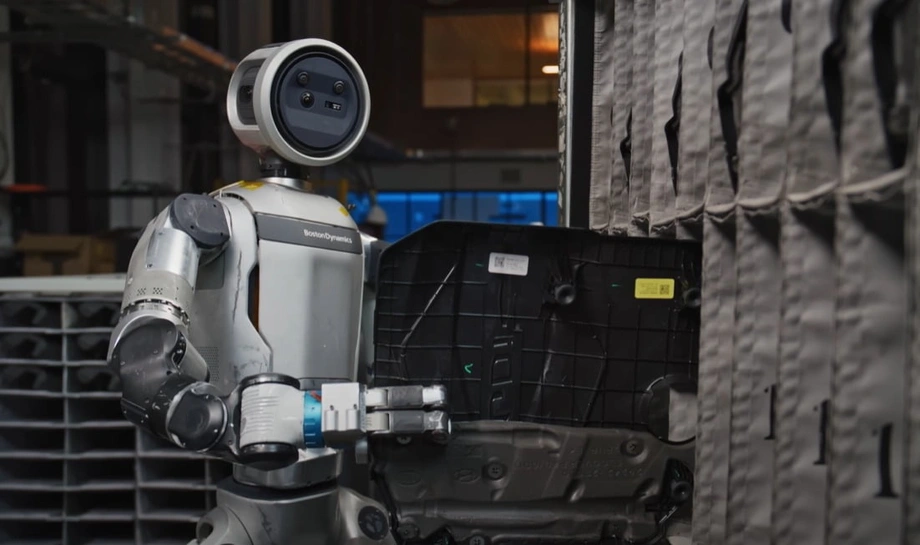
The i7 Pro is Simplexity's industrial machine. Company descriptions place it in manufacturing, warehouse sorting, retail work and pharmaceutical packaging. It can tend computer numerical control machines, commonly called CNC machines, which cut, drill or shape parts according to programmed instructions. A robot performing this work can collect a component, load it into the machine and move it to the next production stage.
The iX applies similar abilities to places where people receive services. Its wheels let it travel around a building while its arms handle drinks and other objects. A wheeled base avoids some of the balance problems faced by a walking robot, but guiding visitors still requires the machine to move safely around people. Preparing a drink adds a different challenge: the robot must identify items, grip them without damaging them and complete several actions in the correct order.
Simplexity says a warehouse sorting production line developed with forklift manufacturer Hangcha Group is already operating. Its other early customers include South Korean robotics startup RLWRLD, Tsinghua University, Suzhou Dongshan Precision Manufacturing and Leaderdrive. Those names describe the company's early business across its products. Simplexity has not said how many iX units have been ordered or delivered, so future shipments will show how far the new machine extends beyond its presentation.
Why Simplexity builds the software and the body together
Simplexity designs its robot hardware and software internally, adapting them to particular jobs and physical forms. Wang Kai, speaking as chairman and cofounder, described this as an effort to connect technical development with manufacturing capacity and buyers.
We bring the foundation models, the data sets, the supply chain and the customers all working together to advance commercial robots.
The company has disclosed several pieces of that software stack. LaST₀ combines a world model with a vision language action architecture. A world model helps software predict how a scene may change when the robot acts, while a vision language action system connects camera images and instructions with physical movements. Simplexity has also open sourced its SimpleWAM world action model, published work on its ManualVLA model for longer tasks at CVPR 2026, and developed TwinRL, a reinforcement learning framework for training on physical robots. Reinforcement learning improves behaviour through feedback from repeated attempts.
The founders' automotive background offers relevant experience in training models, interpreting sensor information and developing software alongside physical hardware. A vehicle and a humanoid nevertheless face different tasks. Experience helping a car interpret a road does not automatically teach a robot to grip a cup or load a machine tool. The new funding can support more joint testing of models and hardware, allowing engineers to find failures before customers depend on the machines.
Can robots fill difficult industrial jobs at an acceptable cost?
China's roughly 3 million CNC machines provide a concrete target for Simplexity. Wang has cited an average operator age of 45 and annual pay of about $20,000. Rising labour costs, a shrinking working population and difficulty attracting younger people to dusty workshops strengthen the case for automation. The commercial calculation still depends on whether a robot can work consistently without requiring so much human assistance that the savings disappear.
Wang Kai, Simplexity's chairman and cofounder, said the company is targeting work that is difficult to staff and unpleasant for people. He linked that goal directly to conditions on factory floors.
Our robots target the work that people don't want to do.
It's a noisy, tough environment, you inhale a lot of dust. We want the robots to conquer that type of work.
For Leaderdrive, Simplexity says it operates an intelligent CNC production line where robots continuously produce parts used to control precision motion. The company calls it the world's first such line. Simplexity is also developing what it describes as China's first modular humanoid robot arm. Its joint modules can be detached and recombined at different lengths, allowing the arm to be adjusted for particular tasks instead of using one fixed configuration.
Wang also argued that China's crowded market could prepare the company for international sales. Speaking as chairman, he presented domestic competition as a demanding commercial test rather than simply a threat.
If we can sell and survive here, we can sell at bigger margins anywhere in the world.
Why Ant Group is backing a company that could become a rival
Ant Group, the fintech company built around Alipay and backed by Alibaba founder Jack Ma, has made roughly a dozen investments connected to humanoid robots since early 2025. Its portfolio includes robot makers Unitree, Astribot, Galaxea and Zeroth, as well as component and software developer Linkerbot. In July, Ant led a 500 million yuan pre-Series A investment in Zeroth, worth about $75 million at the conversion rate used for the transaction. That was described as Ant's 12th investment related to humanoids at the time.
Ant is also developing its own machines. It established the embodied AI unit Robbyant in late 2024 and showed R1, a wheeled humanoid with two arms, on September 11, 2025. Its relationship with Simplexity therefore combines investment with potential competition. Backing several companies gives Ant exposure to different technical approaches while its internal unit gains direct product experience.
The Simplexity deal also arrives during a recovery in Ant's earnings. Its second quarter profit rose 27% to an estimated $1.6 billion, largely because of gains in the value of its investments, according to figures released by Alibaba on November 19. That profit estimate happens to equal Simplexity's new valuation, although the two figures describe entirely different things.
What the round reveals about China's increasingly selective robot race
Chinese suppliers accounted for 97% of humanoid robots shipped worldwide during the first three quarters of 2026. At the same time, fundraising in the sector cooled to about $1.6 billion in October, down from a peak in June. The June figure was not disclosed. Government planners have also warned about bubble risk, making paying customers and dependable operation increasingly important for startups seeking capital.
The current investment wave follows the 2024 funding surge, when 71 Chinese humanoid deals raised 8.45 billion yuan, about $1.2 billion. Public tests during that period exposed the distance between an impressive demonstration and sustained work: only six of 21 humanoids finished one marathon. More recent displays have shown rapid gains in movement, including Unitree's concert backflips, while the Vietnam border trial put UBTech's Walker S2 robots into traveller assistance, queue management and security support under a project worth about 264 million yuan.
Other November developments show competition spreading across complete robots, AI models and components. AgiBot's first batch of Genie G2 machines entered trial operation at JCET's automotive electronics plant in Lingang, Shanghai, where they load and unload chip trays and separate acceptable parts from defective ones. The number of robots was not disclosed. X Square Robot said its WALL-OSS-1.0 model completed 55.1% of 312 physical robot tasks without training for those particular tasks, and it plans to release the model's weights.
Component supplier OYMotion separately closed a Series D round worth several hundred million yuan, its second financing of 2026 after a 150 million yuan round in March. The Shanghai company says it supplies nearly 200 embodied AI businesses and operates a Zhuhai plant with annual capacity above 10,000 units. These investments give Simplexity rivals and potential suppliers as it tries to turn its own technology into repeatable commercial work.
Where the money goes and what investors still need to learn
Simplexity has outlined broad uses for its funding: training foundation models, developing and improving robot bodies, collecting training data and advancing core algorithms. Its initial focus is on controlled settings such as factories, supermarkets and logistics sites, followed by wider manufacturing, service and overseas opportunities. The company has not provided a spending breakdown, a deployment timetable or the amount contributed by each investor.
For prospective buyers, the next meaningful milestone is reliable work at an acceptable operating cost. Useful measurements include how often a robot completes its assigned task, how frequently staff must intervene, how long it remains available and how much servicing costs. Frequent assistance adds labour expense, while breakdowns create repair bills and interrupt surrounding production. These measures will reveal more about daily usefulness than a valuation or a staged demonstration.
China's National Data Administration is also drafting national standards for embodied intelligence data. It expects to issue more than 20 dedicated standards during the 15th Five-Year Plan period from 2026 to 2030, with pilot validation running alongside the drafting. Simplexity has yet to disclose revenue, an iX order book, a shipment total beyond the initial i7 Pro batch or a date for its next product delivery.
Key Points
- Ant Group led Simplexity Robotics' $100 million pre-Series A round, giving the startup a valuation of $1.6 billion after the investment.
- Tencent, HSG and Lanchi Ventures returned; individual contributions and detailed ownership terms were not disclosed.
- Simplexity was registered on July 31, 2025, by former Li Auto executives Wang Kai, Jia Peng and Wang Jiajia.
- The wheeled iX humanoid was unveiled on November 23 with drink service, object delivery and visitor guidance demonstrations.
- The earlier i7 Pro has an initial delivery record of 100 units, and a warehouse sorting line with Hangcha is operating.
- Ant has invested across China's robotics sector while developing its own humanoids through Robbyant.
- Chinese suppliers represented 97% of global humanoid shipments in the first three quarters of 2026, even as sector fundraising cooled.
- Simplexity has not disclosed iX order numbers, revenue or its next delivery date.