Washington Restricts Access to Phone Numbers
The United States Federal Communications Commission voted on Thursday, November 19, 2026, to block China Mobile, China Telecom, and China Unicom from directly accessing American telephone numbering resources. Voice over Internet Protocol, a technology that turns voice signals into digital data and sends them through broad-band connections, relies on these numbers. Direct access allows service providers to acquire numbers straight from administrative bodies rather than routing traffic through intermediary carriers, which reduces operating costs and makes advanced calling features easier to deploy. The vote forms part of a broader regulatory package targeting internet-based providers that use equipment from companies on the national security risk list, including Huawei and ZTE. Federal Communications Commission Chair Brendan Carr spoke about the goals of the regulatory decision in a statement ahead of the formal vote.
Contents
With this decision, the commission will be strengthening our first line of defense against bad actors and illegal robocallers.
Federal officials have raised repeated concerns about foreign cyber operations targeting American telecommunications networks. Authorities previously stated that a Chinese state-sponsored hacking group named Salt Typhoon infiltrated several American network service providers and stole consumer call records and call data. Federal Bureau of Investigation officials reported earlier that the threats from those activities remained ongoing. In July, regulators added Digitalsystem Technology, a California-based company owned by a Chinese citizen, to the national security risk list due to its ties with Chinese telecommunications firms.
Beijing Rejects Regulatory Restrictions
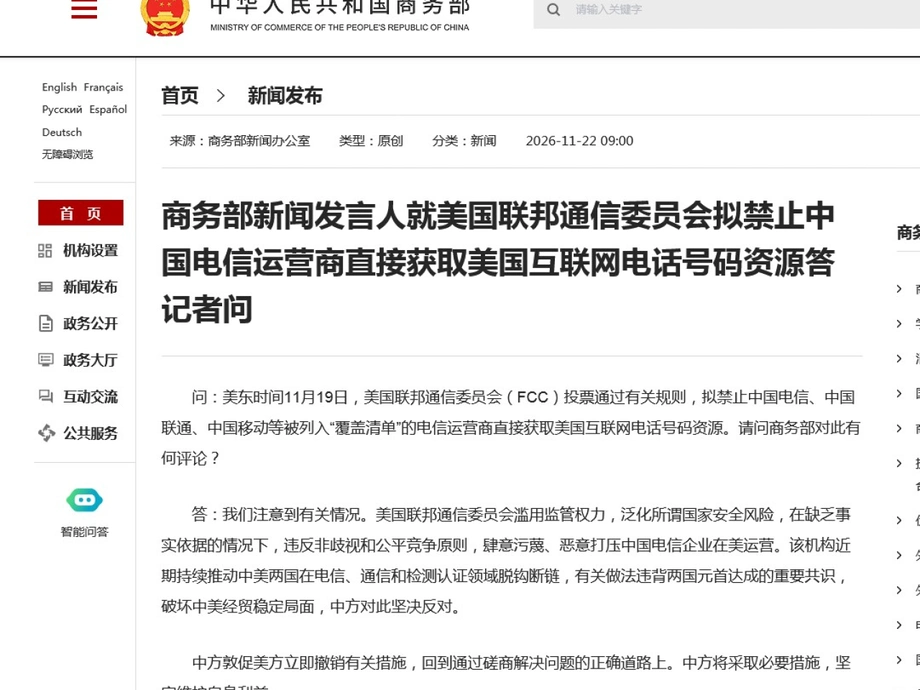
In Beijing, the Ministry of Commerce responded to the vote by issuing a statement criticizing the actions taken by Washington. The ministry accused American regulators of abusing supervisory powers, stretching national security concerns beyond reasonable bounds, and acting without factual evidence. Officials stated that the measures violate principles of fair competition and non-discrimination while targeting Chinese operators unfairly. The ministry pointed out that recent actions by the Federal Communications Commission follow a pattern of pushing for a technological decoupling between the two nations in telecommunications, communications, and testing certification. According to the ministry, these moves run contrary to important consensus points reached by national leaders and damage economic and trade stability. The Chinese government urged American authorities to withdraw the restrictions and return to resolving disputes through consultation while warning that necessary steps would be taken to protect national interests.
Broader Crackdown on Telecom Infrastructure
The restriction on numbering resources represents one layer of a wider campaign by the current American administration to remove Chinese companies from domestic communication systems. Previous regulatory decisions already barred China Mobile, China Telecom, and China Unicom from offering international telecommunications services inside the United States. Regulators are also weighing additional penalties, including proposals to prevent Chinese operators from connecting to American communications networks or running data centers on domestic soil. Further actions target hardware and certification processes across the supply chain. The commission previously approved a rule to ban all Chinese testing laboratories from checking electronic products destined for the American market starting in December 2028. Additionally, regulatory pressure prompted Hong Kong telecommunications carrier HKT, a subsidiary of PCCW Limited with ties to China Unicom, to agree to a settlement ending its domestic and international services by September 1, 2027, as detailed in the settlement ending its services.
Diplomatic Timing and Bilateral Relations
The vote by the Federal Communications Commission coincided with a high-profile diplomatic meeting in Shenzhen on November 19, 2026. The timing drew pointed criticism from observers who noted that the regulatory action unfolded on the same day national leaders met during an Asia-Pacific Economic Cooperation gathering to discuss stabilizing bilateral economic relations and building a constructive strategic framework. The juxtaposition of regulatory crackdowns and diplomatic engagement highlights the friction between security-driven measures and commercial stability. Earlier bilateral talks had established a temporary pause on certain tariff increases and export restrictions, creating expectations of a cooling period in trade friction. The latest telecommunications restriction demonstrates that regulatory agencies continue to advance security-focused rules independently of broader diplomatic agreements.
Timeline of Key Telecommunications Actions
- Late October 2026: The Federal Communications Commission proposes rules to restrict direct numbering access and announces testing laboratory bans.
- October 30, 2026: Hong Kong telecommunications carrier HKT agrees to a settlement to halt operations in the United States by September 1, 2027.
- November 19, 2026: The Federal Communications Commission votes to approve the rule blocking Chinese operators from direct telephone number access on the same day as leaders meet in Shenzhen.
- November 22, 2026: The Ministry of Commerce releases an official response condemning the decision and calling for a reversal of the measures.
What Remains Unresolved
Exact figures regarding the number of enterprise customers and the volume of traffic affected by the numbering restriction have not been publicly disclosed. Federal regulators have not finalized decisions on whether to revoke existing number authorizations already held by targeted firms, nor have they announced specific implementation dates for proposed data center bans. The exact nature and scope of any countermeasures promised by Beijing remain unspecified, though previous disputes involved the use of unreliable entity lists and export controls. The long-term impact on global supply chains for optical modules and internet routing hardware continues to develop as agencies consider further proposals.
The Essentials
- The Federal Communications Commission voted on November 19, 2026, to block China Mobile, China Telecom, and China Unicom from directly acquiring American telephone numbers.
- The regulatory action aims to combat scam robocalls and reduce potential risks from cyber espionage organizations.
- The Ministry of Commerce condemned the move as an abuse of power that violates fair competition and reverses understandings reached by national leaders.
- Affected companies face a growing series of restrictions covering testing laboratories, international operating authority, and data center participation.