Unveiling the Xiaomi Flagship with a Rear Display
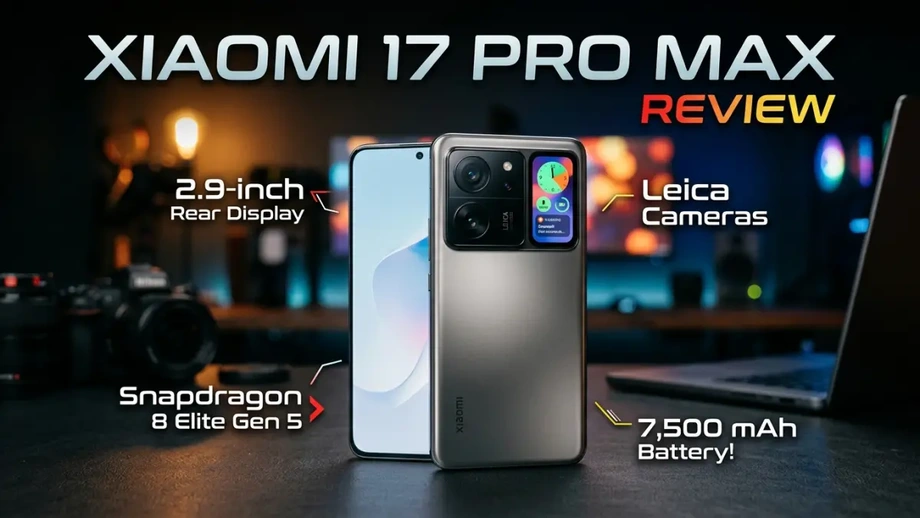
Xiaomi released the Xiaomi 17 Pro Max in September 2025 as a premium smartphone that introduces a unique dual screen layout. The device features a large main display alongside a secondary panel on the back. While secondary screens on phones often raise questions about extra battery drain, this model integrates the back panel for specific tasks like quick notifications and camera framing. The phone starts at 6,299 yuan (approximately Rp15 million) for the China version with 16 GB of RAM and 512 GB of storage.
Contents
Technology channel GadgetIn reviewed the device and noted that its design choices and naming convention draw inspiration from Apple devices. The smartphone comes in green, purple, black, and white color options. It uses a matte finish on the body with a wide camera module on the back. The reviewed unit weighed 219 grams and measured 8 millimeters in thickness, housing high-end hardware inside an IP68-rated aluminum and glass build.
Display Specifications and Secondary Panel Utility
The main screen utilizes a 6.9-inch LTPO AMOLED panel with a resolution of 1200 by 2608 pixels and an adaptive refresh rate up to 120 Hz. Protection is handled by third-generation Xiaomi Dragon Crystal Glass. The back of the device houses a secondary 2.9-inch AMOLED panel that also supports a 120 Hz refresh rate. This rear screen allows users to view custom wallpapers, the time, incoming calls, and music playback controls.
Using the secondary screen as a camera viewfinder represents one of its most practical applications. Users can frame selfies or record videos with the rear cameras while viewing the preview on the back panel. This setup utilizes the higher quality of the main camera sensors instead of relying on a standard front-facing camera. The device relies on Android 16 with HyperOS 3 to manage interactions between the two displays.
Processor Power and Benchmark Performance
Processing tasks are driven by the Snapdragon 8 Elite Gen 5 chipset, paired with UFS 4.1 storage and LPDDR5X RAM. In performance testing using AnTuTu 11, the device achieved a score of around 3.2 million points. The hardware handles daily multitasking smoothly, though demanding games reveal thermal limits during extended sessions. When running heavy software like Genshin Impact, the phone cannot maintain a steady 60 frames per second over long periods.
Thermal management becomes a factor under heavy system loads due to the power output of the chipset. During intense gaming tests, the body temperature of the device reached 48 to 52 degrees Celsius. This heat output can affect sustained performance and user comfort. The internal cooling system works to dissipate warmth, but high workloads still push component temperatures upward.
Battery Capacity and Charging Speeds
Power is supplied by a massive 7,500 mAh silicon-carbon battery designed to deliver extended uptime for heavy users. Charging capabilities include 100W wired charging, 50W wireless charging, and 22.5W reverse wireless charging. Plugging the device into a compatible 100W charger allows the battery to replenish from empty to full in approximately 35 to 40 minutes.
Battery tests conducted by testing laboratories demonstrate the endurance of the 7,500 mAh power cell. A two-hour mixed usage test consumed 11 percent of the charge, leaving 89 percent remaining. Continuous heavy testing showed the device running for 13 hours and 32 minutes under intense workloads, while extreme endurance testing reached 7 hours and 56 minutes. In official video playback tests, the phone achieved over 33 hours of screen-on time.
Camera System and Leica Tuning
Photographic capabilities rely on a triple rear camera setup developed in partnership with Leica. The system consists of three 50-megapixel sensors covering main, periscope telephoto, and ultrawide perspectives. The telephoto lens supports 5x optical zoom, allowing users to capture distant subjects with sharp detail. Leica image tuning introduces a distinct color profile with high contrast and rich saturation.
Video recording options match the high standards of the photography hardware. The rear cameras support video capture up to 8K resolution at 30 frames per second, alongside 4K video at 60 frames per second. The front-facing camera also supports 4K video at 60 frames per second. Combining these video modes with the rear display allows creators to monitor self-recorded videos using the primary camera lenses.
At a Glance
- Released in September 2025 with a starting price of 6,299 yuan for the 16 GB and 512 GB configuration.
- Powered by the Snapdragon 8 Elite Gen 5 processor and Android 16 with HyperOS 3.
- Features a 6.9-inch LTPO AMOLED main display and a 2.9-inch secondary rear AMOLED display.
- Equipped with a Leica-tuned triple 50-megapixel camera system featuring 5x optical zoom.
- Includes a 7,500 mAh silicon-carbon battery supporting 100W wired and 50W wireless charging.