China Enters 3D Printed Medicine Era
China has issued its first national production permit for a drug manufactured using three dimensional printing technology, making the country the second in the world after the United States to achieve industrial scale manufacturing of 3D printed pharmaceuticals. The Jiangsu Medical Products Administration formally granted the license on September 4, 2025, to Nanjing Triastek Biotechnology Company, marking a transition for the pharmaceutical sector from laboratory experimentation to commercial production.
Contents
Three dimensional printing, also known as additive manufacturing, builds objects layer by layer from digital designs. Traditional pill manufacturing has followed the same basic method for more than a century by mixing powders and binders together and compressing them into a standard mold. Every pill comes out identical in dose and composition, relying entirely on exterior coatings to control how quickly the medicine dissolves in the body. The new approach uses a computer guided nozzle to deposit ingredients sequentially, allowing manufacturers to create complex internal architectures that govern the release of active chemical compounds with high precision.
The newly licensed facility is situated in the Jiangning District Life Science Acceleration Zone in Nanjing, serving as the largest commercial manufacturing center for 3D printed pharmaceuticals in the world. The plant includes production, quality control, and storage centers built to Good Manufacturing Practice standards. Officials from the provincial regulatory body established a specialized working group to guide the company through the compliance process, conducting thorough evaluations of equipment parameters and operational stability before issuing the credential.
The Technology Behind Melt Extruded Deposition
The manufacturing method utilized at the Nanjing facility is known as melt extrusion deposition, a technique comparable to squeezing melted chocolate through a precision nozzle. Raw drug powders and pharmaceutical excipients are melted together and layered into specific geometries within minutes. This capability allows engineers to design tablets featuring multiple internal chambers and layers, giving them direct control over the timing, location, and speed at which the active ingredients enter the bloodstream.
Technical director Deng Feihuang explained that the primary advantage of the process lies in its structural versatility. Traditional manufacturing cannot easily combine certain pharmaceutical ingredients because they might chemically interfere with one another before reaching the patient. The layered deposition technique keeps incompatible compounds separated inside different sections of the same tablet, allowing an outer layer to dissolve quickly for immediate symptom relief while an inner core releases medicine slowly over several hours.
The system also addresses long standing difficulties in administering medications to children and elderly patients. Pediatric dosing often requires breaking standard pills by hand, leading to imprecise amounts. The digital manufacturing process can produce customized microgram doses tailored precisely to an individual body weight, alongside porous fast dissolving formulations that make swallowing easier for vulnerable populations.
Advancing Oral Peptide Delivery and Rare Disease Treatments
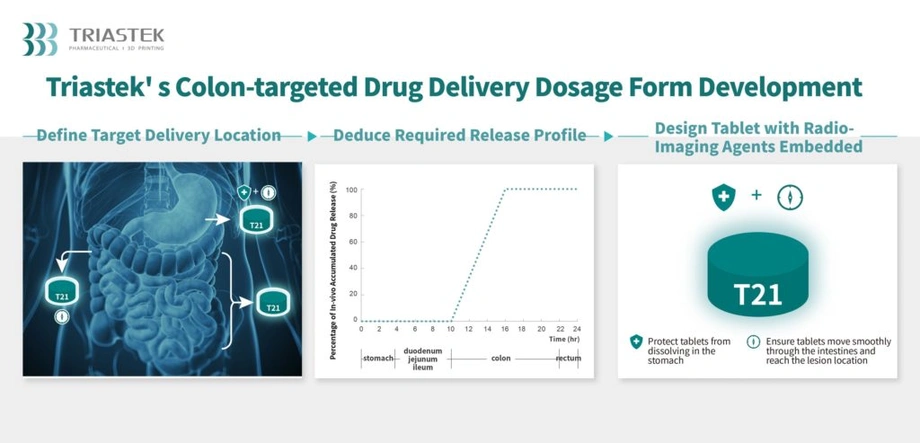
Biological medications such as peptides are notoriously difficult to take orally because digestive acids in the stomach destroy their molecular structures before they can be absorbed. The Jiangsu Medical Products Administration approval allows Triastek to build protective micro environments inside the printed tablets. These specialized exterior chambers shield the biological active ingredients from stomach acid and deliver them intact directly to the intestines.
Company researchers noted that this structural shielding elevates the oral bioavailability of certain complex drugs from a fraction of one percent to between ten and twenty percent. Bioavailability measures the proportion of an administered substance that enters blood circulation when introduced into the body. By improving how efficiently the digestive tract absorbs these delicate molecules, the technology opens the possibility of replacing regular injections with oral alternatives.
The flexibility of additive manufacturing extends to rare disease treatments, commonly known as orphan drugs, which are medications developed specifically to treat rare medical conditions. Traditional pharmaceutical factories require massive production runs to remain economically viable, making small batches prohibitively expensive. The new digital workflow adapts easily to small scale production without requiring costly factory retooling, lowering the financial barriers associated with manufacturing specialized treatments for small patient populations.
Regulatory Approval and Upcoming Market Launch
The first medication slated for commercial release under the new production license is apixaban tablets, marketed under the designation T20j. Company executives confirmed that the medication has completed all necessary pharmaceutical research and clinical trials required for distribution.
Apixaban is an oral anticoagulant medication prescribed to prevent and treat venous thromboembolism, a dangerous condition involving blood clots in the veins. Following the issuance of the manufacturing credential, the enterprise prepared to submit its formal registration application to the Center for Drug Evaluation under the National Medical Products Administration.
The regulatory approval process moved forward rapidly after the company submitted its formal application on July 31, 2025. Provincial regulators established a dedicated task force to review technical dossiers and conduct on-site inspections, completing the entire evaluation and licensing cycle within one month. Officials intend to apply a dynamic tracking mechanism involving early intervention and coordinated reviews to accelerate the path to market for subsequent pharmaceutical products.
Nanjing as a Growing Hub for Biomedical Innovation
The commercialization of 3D printed medicine arrives as Nanjing continues to expand its position as a major center for advanced manufacturing and biomedical research. The city reported a regional gross domestic product reaching 1.94 trillion yuan in 2025, ranking tenth among mainland Chinese cities. Enterprise data from the local science and technology bureau showed that the biomedical industry generated 1,774.6 billion yuan in total business revenue between January and August 2026, representing a twelve point two percent increase over the previous year.
Deputy Director Wang Yuanhua of the Nanjing Science and Technology Bureau emphasized that urban innovation depends on transforming research concepts into tangible products that attract skilled professionals and investment. The city houses more than one thousand high tech biomedical enterprises, supported by fifty four universities, sixty one research institutes, and over one hundred and twenty national level research platforms.
Industrial infrastructure development in the region continues to expand following the establishment of the National Universities Regional Technology Transfer Center for Biomedicine in late 2024. This institutional framework helps bridge the gap between academic laboratories and commercial production lines, supporting municipal efforts to build a robust advanced manufacturing cluster throughout the fifteenth five year planning period.
Timeline of Key Developments
- July 31, 2025: The provincial regulatory agency formally accepts the enterprise application for a drug manufacturing permit.
- September 4, 2025: The Jiangsu Medical Products Administration issues the first national 3D printed medicine production license.
- September 2025: The developer prepares to submit its first commercial product, apixaban tablets, for final marketing approval.
- Late 2026: The third production line dedicated to oral peptide manufacturing nears completion at the Jiangning District facility.
Despite these technological milestones, industry participants acknowledge that widespread adoption of printed pharmaceuticals faces ongoing challenges. Researchers must continue refining the materials science, printer hardware reliability, and quality control standards required for complex internal architectures before the method can replace conventional stamping lines across the wider pharmaceutical industry.
The Essentials
- China issued its first 3D printed drug manufacturing license to Nanjing Triastek Biotechnology Company on September 4, 2025.
- The approved facility in Nanjing features a commercial capacity of up to 300 million printed tablets annually.
- The initial commercial product is an oral anticoagulant named apixaban tablets, designated for venous thromboembolism treatment.
- Melt extrusion deposition technology allows precise control over drug release rates by building complex multi layered tablet structures.
- The innovation significantly improves the oral bioavailability of delicate biological molecules such as therapeutic peptides.