One chip supply chain now supports both making and running Qwen
Alibaba is using processors from its T-Head chip unit to train the next generation of its Qwen artificial intelligence models, Chief Executive Eddie Wu said on November 19. The company is also using Chinese made chips to run models for customers through Bailian, its platform for accessing AI models and building applications.
Contents
- One chip supply chain now supports both making and running Qwen
- What does T-Head bring to the training work?
- Why training and inference need separate attention
- How soon can new chips increase supply?
- What do the earnings say about the AI business?
- What do the new US rules mean for Alibaba?
- What remains undecided?
- Key Points
The announcement brings two demanding jobs under Alibaba's own roof. Training is the process of teaching a model by running it through large amounts of data and adjusting its internal settings. Inference is what happens when a finished model responds to a question or carries out a task. Training generally requires substantial computing power, while inference happens each time a user or application asks the model to do something.
For Alibaba, using T-Head chips for both jobs could reduce reliance on outside processors and help it coordinate hardware, models and cloud services. It also gives the company a way to test its own chips on the complex workloads they are meant to handle. Wu said the link between the company's chips and models could lower computing costs and make it more efficient to develop AI applications.
The shift comes as China faces tighter limits on access to advanced computing. New US rules announced on November 16 require licenses for data centers in countries including Malaysia, Singapore, Thailand, Indonesia and Brazil if they supply substantial computing power to Chinese companies. That means access through overseas data centers, as well as shipments of some chips, faces greater uncertainty.
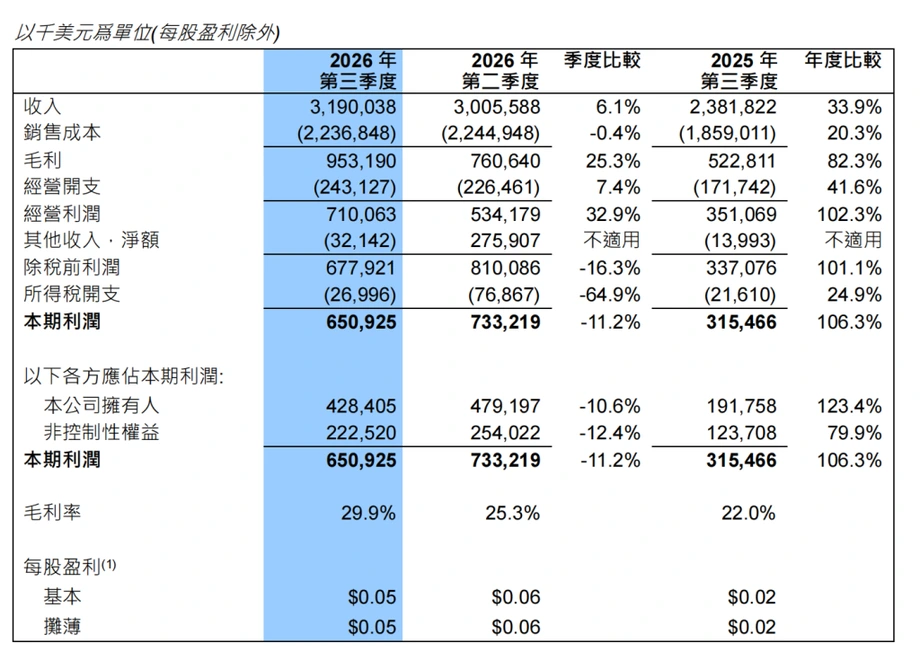
Alibaba's earnings underline the stakes. Revenue for the July to September quarter reached 271.5 billion yuan, up 10% from a year earlier. Its AI cloud and computing services brought in about 61 billion yuan, an increase of 53%. Alibaba expects cloud revenue growth to slow to between 30% and 45% in the next fiscal year, before potentially exceeding 50% in calendar 2028.
What does T-Head bring to the training work?
T-Head is Alibaba's chip design subsidiary. Its Zhenwu M890 processor entered service in August and has moved into large scale sales, according to Wu's earnings call. The company says the M890 delivers three times the performance of its predecessor, the Zhenwu 810E.
Alibaba's M890 announcement lists 144 gigabytes of on chip memory and 800 gigabytes per second of bandwidth between chips. Memory is the fast working space a processor uses while handling data. Bandwidth describes how quickly information can move, including between processors working together on a large job.
The M890 supports several levels of numerical precision, from FP32, which keeps more detail for calculations, down to FP4, which uses less data and can suit faster, more economical tasks. That range matters because training and inference do not always need the same balance of accuracy, speed and cost.
Alibaba says T-Head has shipped more than 560,000 Zhenwu chips, with more than 400 outside customers across 20 industries using them. Those figures point to a business serving customers beyond Alibaba's own model development, although the company has not disclosed how much of T-Head's revenue comes from outside buyers.
Why training and inference need separate attention
A model can be trained on one kind of hardware and then run on another. Alibaba's announcement is a step toward using T-Head processors across both stages, but the distinction still matters when the company plans its supply. Training the next Qwen model places sustained demands on computing clusters. Inference requires enough capacity to answer many customer requests reliably and at a cost businesses can afford.
Bailian, known internationally as Model Studio, connects those processors to developers and companies that want to use AI models. Customers can use the service to access models and tools for building applications. Alibaba says Bailian is already providing inference on Chinese made chips, so the domestic hardware is being put to work for customer services as well as internal development.
Wu said Alibaba intends to buy other Chinese chips too, especially for inference. The company expects most of its new AI chip supply after 2027 to come from T-Head, while using a range of domestic processors to meet inference needs. This approach gives Alibaba a main in house supply while leaving room to use chips from other Chinese makers.
A separate T-Head processor, called the PPU, has also been described as an inference focused product. Published accounts give it different specifications from the M890, including 96 gigabytes of memory and 700 gigabytes per second of chip to chip bandwidth. Those figures concern the PPU, not the M890 being used to train Qwen. Keeping the products distinct helps explain why Alibaba may use different chips for different work.
How soon can new chips increase supply?
Alibaba's plans extend beyond the M890. Wu said the next generation Zhenwu V900 is expected to begin mass production in the first quarter of 2027, with a computing capacity three times that of the M890. A supernode cluster using the V900 is planned for commercial deployment in the second quarter of 2027. A supernode is a tightly connected group of processors designed to work together as one large computing system.
The subsequent Zhenwu J900 is planned for 2028. The schedule matters because Alibaba expects computing supply to remain tight in China through 2027 and 2028. New models and wider availability of processors could ease some of that pressure, but the company's plans depend on whether chip production and supporting infrastructure can grow as intended.
Alibaba is also seeking outside investment in T-Head. The company announced plans to spin off the chip unit for a Hong Kong listing, after T-Head submitted a confidential application on September 11. Alibaba has not disclosed the subsidiary's detailed financial figures or final listing terms. T-Head's proposed listing would give investors a way to assess the chip business separately, while leaving open how its commercial relationship with Alibaba Cloud would work.
Wu said Alibaba will first make sure its own models have enough computing capacity, then consider the needs of important partners. That allocation could matter to cloud customers if demand for AI services continues to outpace the supply of processors.
What do the earnings say about the AI business?
Alibaba's AI cloud and computing services earned 60.97 billion yuan in the September quarter, up 53% year on year. Revenue from outside customers was about 47 billion yuan, rising 64%. Within that, AI product revenue reached 17.9 billion yuan and had recorded three digit growth for 13 consecutive quarters, according to figures disclosed around the results.
The company's adjusted earnings before interest, taxes and amortization for the cloud business were 8.84 billion yuan, with a 14.5% margin. Alibaba has linked improving cloud profitability to a larger share of higher margin AI products, strong demand for computing, and efficiencies from its data centers. Using T-Head processors in place of more expensive purchased chips could also help control costs, though the actual savings from training Qwen on them have not been disclosed.
Bailian's model service business has its own sales target. Wu said its annual recurring revenue, a yearly estimate based on the current pace of subscriptions and usage, passed 20 billion yuan in August. He kept a target of 30 billion yuan by the end of the financial year. An earlier company announcement put the platform's annual recurring revenue above 10 billion yuan in the June quarter, showing the figures refer to different points in time.
Alibaba is investing heavily to build the capacity behind that growth. Capital spending reached 50.5 billion yuan in the September quarter, about 60% higher than a year earlier. The company has pledged more than $53 billion over three years for businesses and services spanning AI models, chips and cloud infrastructure. Executives have also said the long term plan to build 20 gigawatts of computing capacity may be revised, while expecting cash flow to turn positive in the second half of 2028.
What do the new US rules mean for Alibaba?
The November 16 measures target a route Chinese firms have used to access advanced chips: renting computing power from data centers outside China. Under the new restrictions, data centers supplying substantial computing power to Chinese customers need a license. The rules also cover named countries in Southeast Asia and Brazil, extending controls beyond direct chip shipments into access to computing services.
Wu said the rules would affect Alibaba's products and services in 2027 and bring uncertainty to global supply chains. He also said it was too early to know how the restrictions might affect the development of Qwen. The gap between those statements captures the company's position: T-Head is already supporting real workloads, while future supply and the pace of model development remain dependent on how quickly its chips can be produced.
Alibaba is keeping its 2030 goal of $100 billion in external cloud revenue and a long term profit margin above 20%. Its near term cloud growth forecast is more cautious, at 30% to 45% for the next fiscal year. The difference reflects a plan that remains ambitious over several years while facing near term limits on the computing resources needed to serve customers and develop new models.
What remains undecided?
Alibaba has not said how much of the next Qwen model's training will run on T-Head chips, how much computing capacity the work will require, or what cost savings the company has achieved. The final scale of its data center construction and any change to its 20 gigawatt target also remain undecided. The company's next major hardware milestones are the V900 production start expected in early 2027 and the planned commercial launch of its supernode cluster later that spring.
The practical test is whether T-Head can supply enough processors, and whether those processors perform well and economically at scale. Success would help Alibaba rely more on its own hardware for model development and cloud services. It would also give T-Head a larger role in China's domestic AI supply chain at a time when access to foreign computing resources is less certain.
Key Points
- Alibaba CEO Eddie Wu said the company is training its next Qwen model on T-Head chips and using Chinese chips for Bailian inference services.
- The Zhenwu M890 has 144 gigabytes of on chip memory and is rated by Alibaba at three times the performance of its predecessor.
- Alibaba expects most new AI chip supply after 2027 to come from T-Head, while also buying other domestic chips for inference.
- The V900 is expected to enter mass production in early 2027, with a supernode cluster planned for commercial deployment in the second quarter.
- Alibaba reported 61 billion yuan in AI cloud and computing services revenue for the September quarter, up 53% from a year earlier.
- US restrictions announced November 16 add licensing requirements for some data centers supplying computing power to Chinese firms.