A bigger group at the top of China's smart factory program
China has added 34 factories to its highest smart manufacturing tier, bringing the national total to 49. The new group spans industries from carmaking and electronics to medicine, clothing, liquor and energy equipment, and includes plants operated by Xiaomi, Tasly Pharmaceutical, ZTE and TBEA.
Contents
- A bigger group at the top of China's smart factory program
- How does the four level system work?
- What must a pioneer factory do?
- From transformers to traditional medicine
- Factories report gains in output and productivity
- Two Sichuan projects show different routes to automation
- What earlier pioneer factories can teach
- Government support and the next steps
- Key Points
The list is part of a national program that grades factories by how deeply they use digital systems and artificial intelligence (AI). At the top, a pioneer level factory is expected to use AI in core work such as designing products, planning processes and running production, then share its manufacturing methods with other businesses.
A joint notice bearing the document number Gong Xin Ting Lian Tong Zhuang Han [2026] No. 562 is dated Nov. 17. The six issuing offices belong to the Ministry of Industry and Information Technology, the National Development and Reform Commission, the finance ministry, the State owned Assets Supervision and Administration Commission, the market regulator and the National Data Administration. The list was assembled through provincial recommendations, expert review, on site inspections, presentations and online public notice. It was released on Nov. 19.
The new additions join 15 pioneer factories selected in 2025. The expansion shows that the program is moving from a small first group toward a broader test of whether advanced digital production can be repeated across different industries and regions.
How does the four level system work?
China began its smart factory gradient cultivation campaign in 2024. The system has four levels, each describing a deeper use of data and coordination across a factory.
- Basic level factories collect digital information and connect key production processes.
- Advanced level factories share data across business functions and coordinate production, supply and sales.
- Excellence level factories integrate data across the full production chain and use it to optimize operations.
- Pioneer level factories test new manufacturing models and are expected to serve as leading examples for their industries.
The size of the lower levels puts the new 49 factory total in perspective. The Ministry of Industry and Information Technology says China has more than 60,000 basic level factories, over 13,000 advanced level factories and more than 750 excellence level factories. In figures released in January, the ministry had cited more than 7,000 advanced factories and over 500 excellence level factories, as well as 15 pioneer candidates. The ministry's January figures also put the industrial scale of China's intelligent manufacturing equipment, industrial software and system solutions above 4.5 trillion yuan.
The higher totals now cited for advanced and excellence factories reflect the program's expansion over time. Pioneer status remains a much narrower category: the 34 new entries raise its total to 49.
What must a pioneer factory do?
The 2026 conditions for smart factory cultivation set a minimum of 60 percent for the share of application scenarios using AI at pioneer level. They also call for factories to pass on manufacturing models and solutions to suppliers and other businesses, including through what the policy describes as a "mother factory" approach. In plain terms, a factory is meant to become a source of methods and tools that other sites can adapt, not just a highly automated place that improves its own output.
The selection notice directs local agencies to support factory development, help build high quality datasets, develop industrial AI agents, explore advanced manufacturing models and create smarter supply chains. An industrial agent is a software system designed to perform or coordinate a defined task, such as checking production information or assisting with process decisions.
According to the ministry, more than 70 percent of operations at factories in this second batch use AI. Together, they have developed more than 1,000 industrial agents, which make an average of over 300 million token calls a day. A token is a small unit of text or data processed by an AI system. Token calls are a measure of how often systems are used, though the figure by itself does not show how much money or time each call saves.
AI use is spreading from support tasks into product research and development, design, process optimization and production. That shift matters because those functions shape what a factory makes, how it makes it and how quickly it can respond to a new order.
From transformers to traditional medicine
TBEA's ultra high voltage transformer factory in Hengyang, Hunan province, has deployed 69 AI models and 35 industrial agents. AI is used in 87 percent of its operational scenarios, according to the factory details released with the announcement. Transformers help control voltage as electricity moves through power networks, so making them involves demanding engineering and production work.
Tasly Pharmaceutical's traditional Chinese medicine plant in Tianjin is the only pharmaceutical production base so far named at the pioneer level. Herbal medicines can contain many ingredients, making it difficult to keep quality consistent from batch to batch. Tasly has built a production line that tracks materials and processes across manufacturing, allowing information to be traced through the full production chain and used to optimize it.
The selection also reaches consumer businesses where production methods have often depended on specialized knowledge. The new group includes Luzhou Laojiao, a liquor producer, and HLA Group, an apparel company. Their inclusion alongside makers of vehicles, steel, electronics and industrial equipment extends the program into products bought and used in everyday life.
Factories report gains in output and productivity
The second batch recorded an average 34.4 percent rise in labor productivity and a 19.3 percent increase in production efficiency, according to ministry figures. Labor productivity measures output in relation to the workforce; production efficiency tracks how well production resources are used. The two measures describe related, but different, changes inside a plant.
The figures cover the selected factories, while the ministry says the 34 plants have also helped nearly 4,000 businesses in their supply chains make digital and intelligent upgrades. That reach is one reason the program asks pioneer factories to share their manufacturing approaches. A supplier may need better data systems or faster production planning to work smoothly with a large customer's upgraded factory.
The list covers China's Northeast, Northwest, Southwest, Central and Eastern regions. Its projects include Xiaomi Automobile's AI based new energy vehicle plant, Seres Automobile's factory coordinated through an industrial brain, ZTE's Nanjing communications and computing equipment plant, and Goertek's flexible precision electronics facility. It also includes projects in steel, copper, shipbuilding, power equipment, petrochemicals and aircraft production.
Two Sichuan projects show different routes to automation
Sichuan gained two factories in the new group: Dongfang Electric's Dongfang Turbine and Luzhou Laojiao. The province now has three pioneer level factories, tied for the largest number in western and central China. The new projects show how a factory system can be adapted to products as different as power generation equipment and liquor.
Dongfang Turbine makes high end power equipment in small quantities, often with custom designs. Its flexible production method breaks design, process and manufacturing capabilities into reusable resource pools that can be combined for different orders. The company says this has shortened new product design cycles by 34 percent. Changeover time in a typical production unit fell from two hours to less than three minutes.
Luzhou Laojiao's plant combines AI with traditional craft methods. It continues to use 13 stages of fermentation starter production and seven stages of liquor making, while applying digital replicas of production processes and AI systems to record and manage work. It has developed specialized agents described as brewing craftspeople, brewing masters and blending masters. The aim is to make skilled methods easier to reproduce while retaining the steps central to the traditional process.
What earlier pioneer factories can teach
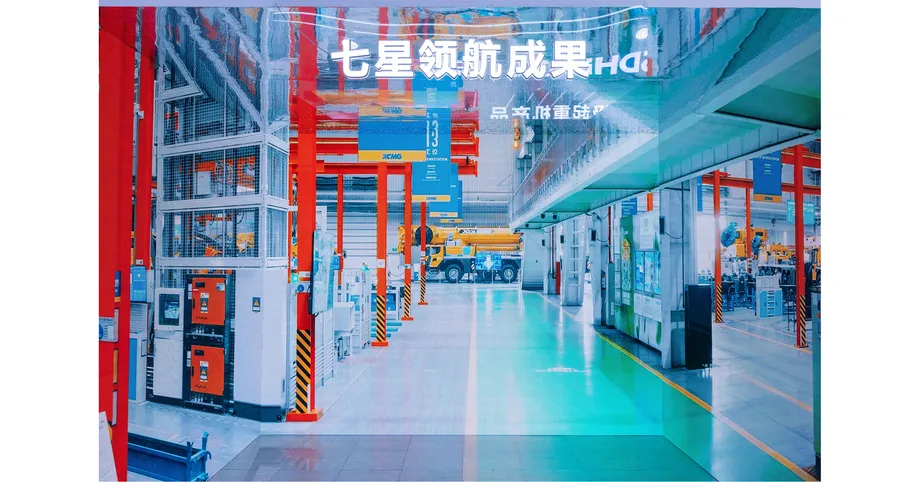
XCMG was among the 15 factories selected in the 2025 first group. Its project focuses on customized, fast delivery of mobile cranes, a type of construction machinery. The company says plant wide 5G connections, real time digital twins and global collaboration platforms help coordinate orders, production and delivery. A digital twin is a computer model that mirrors a physical factory or process and updates as real world data changes.
XCMG says its system cut the time from order to delivery by 55 percent. Its chairman, Yang Dongsheng, said the company planned to share its operating model across 35 global bases and with more than 120 supply chain partners. In the company's announcement at the 2025 conference, Yang described the recognition as "a monumental endorsement of our strategic direction and persistent innovation in intelligent manufacturing."
The ministry's January figures placed the first 15 factories within a wider national effort to build intelligent manufacturing capacity. XCMG's example also shows the kind of result the program wants factories to share: a method for handling many customized products without treating each order as a completely separate production problem.
Government support and the next steps
The national notice asks government departments to provide services and technical guidance, support data set development and help factories build intelligent supply chains. Local governments can also provide grants or support for equipment upgrades. The policy's aim is to turn successful plant level methods into practices that can spread through supplier networks and, in time, inform industry standards.
A short timeline traces the program's growth:
- 2024: China began its four level smart factory cultivation campaign.
- 2025: The first 15 pioneer factories were selected and presented at the World Intelligent Manufacturing Conference in Nanjing.
- Nov. 17, 2026: The joint notice carrying the new selection list was dated.
- Nov. 19, 2026: The 34 factory additions were announced, bringing the total to 49.
The notice gives no future date for another selection round. For now, the new factories are expected to build high quality datasets, develop industrial agents, test manufacturing methods and work with other firms in their supply chains. The practical test will be whether the gains reported at these plants can be carried into businesses that do not have the same scale or resources.
Key Points
- China added 34 factories to its pioneer level smart factory list, taking the total to 49.
- The new group's factories reported average increases of 34.4 percent in labor productivity and 19.3 percent in production efficiency.
- More than 70 percent of operations at the second batch of factories use AI, and the plants have built over 1,000 industrial agents.
- The ministry says the 34 factories have helped nearly 4,000 supply chain businesses upgrade their digital systems.
- The new group includes manufacturers in vehicles, medicine, apparel, liquor, electronics, power equipment and other industries.