More electricity, more room to compute
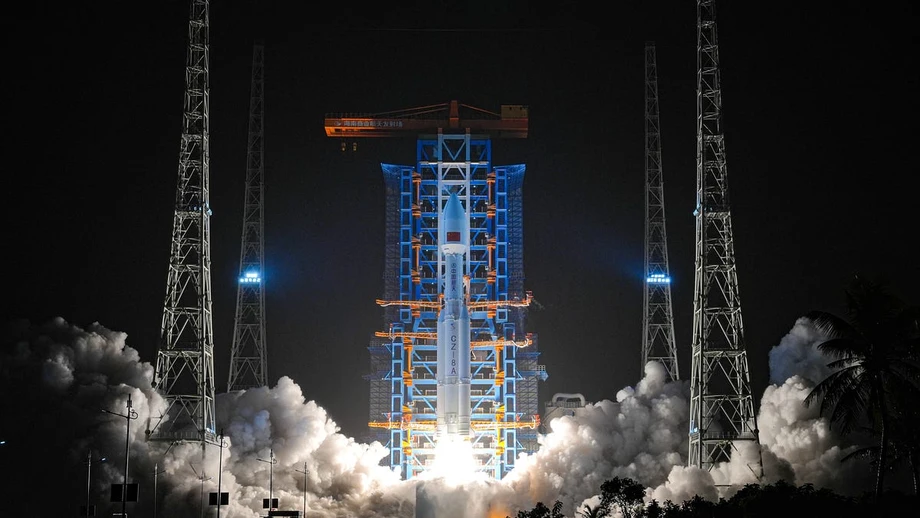
China generated 10.6 trillion kilowatt-hours of electricity in 2025, about one-third of the world's total and 2.4 times the amount produced in the United States. The scale matters in the contest over artificial intelligence: large groups of specialized chips need vast amounts of electricity to train and run AI models, while data centres also use power to keep those chips cool.
Contents
- More electricity, more room to compute
- What does an electron gap mean?
- China is adding renewables at historic scale
- Cheap power helps, but wires matter too
- Moving computing closer to power
- Can more chips make up for weaker chips?
- Export controls extend the contest overseas
- Power is one layer of a larger competition
- Key Points
China's power system is expanding quickly. Its installed generating capacity reached 3.9 billion kilowatts by the end of 2025, and the China Electricity Council expects about 4.3 billion kilowatts by the end of 2026. Under the 15th Five-Year Plan, covering 2026 to 2030, China aims to add another 1,500 gigawatts of capacity, with two-thirds of the increase expected to come from renewable sources.
The challenge for the United States is partly different. It has leading AI chipmakers and technology companies, but new data centres can wait years for electricity connections, transmission lines and equipment such as transformers. China's expanding supply could give it more room to operate large computing clusters, including systems that use more electricity because their chips are less powerful individually.
That is a potential advantage, not a simple measure of who will win. China still faces limits on its supply of advanced processors, while American chips and software remain difficult to match. The competition depends on whether each country can connect electricity, chips, networks and useful AI services.
What does an electron gap mean?
OpenAI has warned that an "electron gap" could threaten the United States' AI lead if the country cannot build energy capacity quickly enough. The phrase describes a practical problem: even if companies have advanced chips and money to build data centres, they cannot run the computers at full scale without reliable electricity.
Former Google chief executive Eric Schmidt told Congress in 2025 that the United States needed energy "in all forms" and needed it quickly. Elon Musk has also described electricity as a key limit on AI growth. The concern is that power projects and grid connections often take longer to complete than a data centre itself.
The International Energy Agency estimates that data centres used about 415 terawatt-hours of electricity worldwide in 2024, around 1.5% of global consumption. In its base case, use rises to about 945 terawatt-hours by 2030. The agency projects that China's demand will increase by about 175 terawatt-hours from 2024, a rise of 170%, while US demand grows by about 240 terawatt-hours, or 130%. Together, the two countries account for nearly 80% of the projected global increase.
The IEA's AI energy analysis also explains why forecasts vary: adoption of AI, improvements in hardware and software efficiency, and delays in electricity infrastructure could each change how much power data centres use. A data centre can be built in two or three years, while the wider power system may need longer planning and construction.
China is adding renewables at historic scale
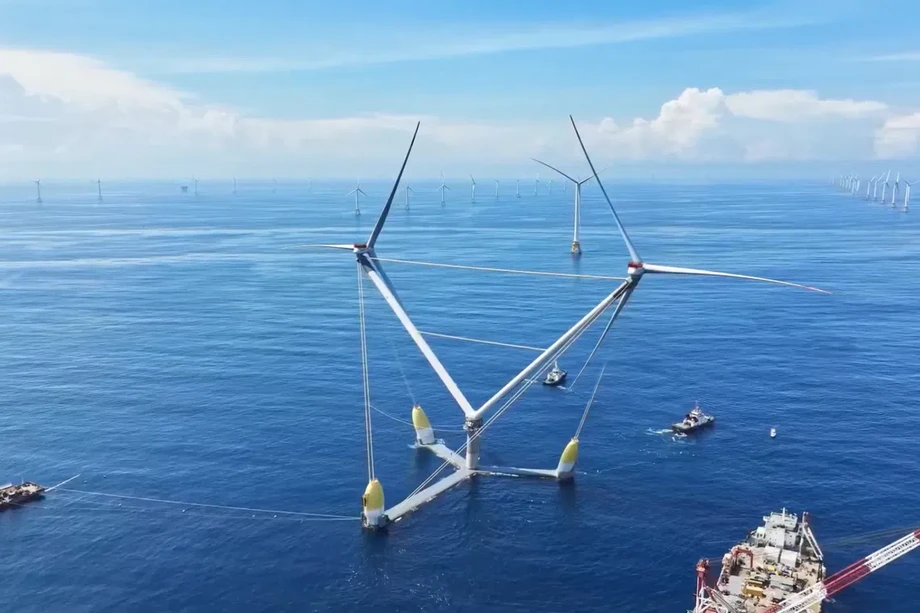
Renewables supplied all of China's growth in electricity demand in 2025, according to the government's renewable energy report. The report says renewable generation reached about 4 trillion kilowatt-hours, more than the roughly 3.8 trillion kilowatt-hours consumed by the European Union's 27 members combined. China added more than 60% of the world's new renewable power capacity that year.
Separate National Energy Administration figures put new wind and solar capacity in 2025 at more than 430 million kilowatts, up 22% from the previous year. Wind and solar together reached 1.84 billion kilowatts of grid connected capacity, 47.3% of China's total and more than thermal power capacity for the first time. Wind and solar supplied 22% of electricity generated during 2025.
Those figures describe different things. Capacity is the maximum electricity plants could produce under suitable conditions; actual output depends on sunshine, wind and other factors. When hydropower is included, renewables supplied about 38% of China's electricity in 2025. Renewables made up 82.7% of newly installed capacity that year, but coal remains a major source of round the clock electricity.
China's National Energy Administration figures say the country plans to expand energy storage in 2026. Storage systems hold electricity for later use, helping balance periods when wind and solar produce more power than consumers need with times when output falls. By the end of 2024, China had 73.76 gigawatts of new energy storage power capacity, with lithium ion batteries accounting for most of it.
Cheap power helps, but wires matter too
In western regions including Yunnan, Xinjiang, Gansu, Ningxia and western Inner Mongolia, industrial electricity averages about 0.39 yuan per kilowatt-hour. A small price difference can mean substantial costs for a facility that runs around the clock: at a steady 10 megawatts of information technology load, a difference of 0.1 US cent per kilowatt-hour changes yearly energy costs by about US$131,000. Electricity accounts for about 57% of data centre operating costs, according to a 2025 Schneider Electric report cited in the research.
Low prices do not guarantee that a data centre can get power at the right place and time. China's National Energy Administration said about 9% of potential wind and solar generation went unused in the first half of 2026. This is called curtailment: power plants could have generated electricity, but the grid could not take or move all of it.
China is building ultra high voltage lines to carry power from western energy producing regions to eastern cities thousands of kilometres away. The network stretches more than 50,000 kilometres. Even so, the unused renewable output shows why generating capacity alone is not enough. Connections, transmission and storage determine how much electricity reaches computers when they need it.
China's official renewable energy report projected about 300 gigawatts of new wind and solar capacity in 2026. A separate forecast from Wood Mackenzie expects Chinese data centre demand to grow about 17% a year, reaching 479 terawatt-hours by 2030. Those are forecasts, not current measured demand, and they reflect different estimates of how quickly the sector will expand.
Moving computing closer to power
China's East Data, West Computing programme, launched in 2022, is designed to move some computing and data storage from the eastern coast to inland areas with more land, cooler weather and greater access to electricity. The programme has eight national computing hubs and 10 data centre clusters. By March 2026, the hubs held more than 80% of China's installed AI computing capacity, according to the National Data Administration.
Guizhou province offers one example. Huawei, Tencent, Apple and China's main telecommunications companies have built data centres in the region, where cooler conditions can reduce the electricity needed for cooling. The facilities bring a new industry to an inland province that has had fewer large technology businesses than China's coastal centres.
In Qingyang, Gansu, a pilot project combines wind and solar power to supply data centres directly. Local authorities say clean sources provide 88% of the park's electricity and users pay about 0.40 yuan per kilowatt-hour. An underwater data centre near Shanghai's Lingang area draws more than 95% of its power from a nearby offshore wind farm and uses seawater for cooling.
Some newer facilities are also being planned with dedicated renewable power and batteries. One project in Inner Mongolia is connected to 200 megawatts of wind, 100 megawatts of solar and 45 megawatts of battery storage. China has also set a target for new data centres in its eight national computing hubs to source at least 80% of their electricity from clean sources.
Can more chips make up for weaker chips?
China's electricity expansion could help Huawei and other domestic companies deploy larger groups of processors despite restrictions on advanced American chips. Huawei's CloudMatrix 384 system connects 384 Ascend 910C processors. Nvidia's GB200 NVL72 system uses 72 graphics processing units, or GPUs, specialized chips that perform many calculations at once.
CloudMatrix's larger number of processors gives it about 1.7 times the raw computing power and 3.6 times the memory capacity of Nvidia's system on some measures. Huawei's UnifiedBus connection technology lets data move between processors at speeds of up to 392 gigabytes per second. Coordinating hundreds of chips is difficult, however: they must share information fast enough to avoid bottlenecks that waste computing time.
The trade off is electricity. CloudMatrix draws about 560 kilowatts, nearly four times the power of the comparable Nvidia system. More power can help run more processors, but it also means higher operating costs and a greater need for electricity supply and cooling. Research group Epoch AI estimated that Nvidia's B300 offers roughly seven times the theoretical computing performance of Huawei's Ascend 950 series.
DeepSeek founder Liang Wenfeng has acknowledged that Huawei still trails Nvidia at the individual processor level, while arguing that large groups of Huawei chips can perform tasks handled by larger rival systems. Brookings Institution fellow Kyle Chan has cautioned that China remains constrained by its production capacity for advanced semiconductors and that large clusters may face speed and reliability problems.
Earlier coverage of Huawei's CloudMatrix system described the same strategy of combining many domestic processors. More recent chip shipment figures showed Huawei narrowing the gap with Nvidia in China by volume, while shipment totals alone do not show that the processors deliver equal performance.
Export controls extend the contest overseas
Washington is also trying to limit access to advanced chips through overseas data centres. On Nov. 16, the Commerce Department's Bureau of Industry and Security issued an interim final rule tightening controls on advanced chip shipments to Singapore, Malaysia, Thailand, Indonesia and Brazil. It also requires licences for certain overseas facilities that use advanced chips to provide large amounts of computing power remotely to Chinese companies.
Facilities already serving large Chinese customers in Southeast Asia were given 90 days to apply for a licence under the rule. The region has become important because Chinese companies have sought computing capacity outside China while facing restrictions on the most advanced processors. An estimate by the Institute for Progress put about 75% of China's overseas AI computing capacity in Southeast Asia by the end of 2026.
The rule exempts companies headquartered in the United States, leaving a possible route for Chinese customers to rent computing power from American cloud providers. Operators in the region may face added checks and delays, while governments have said they will work with Washington to ensure chip use follows the rules. Malaysia is particularly exposed because more than half of its data centre capacity is in shared facilities, where Chinese firms account for a sizeable part of workloads.
The policy follows a wider US effort to speed up domestic construction. In July 2025, President Donald Trump signed an executive order to accelerate federal permits for large data centres and supporting energy infrastructure, including transmission lines and equipment for gas, nuclear and geothermal power. The United States still faces practical constraints: the International Energy Agency says transmission lines in advanced economies can take four to eight years to build, and waiting times for key grid equipment have doubled over the past three years.
Power is one layer of a larger competition
The energy race carries economic and environmental stakes. The IEA's base case says data centre electricity use will nearly double worldwide by 2030, while other scenarios range from about 700 terawatt-hours to more than 1,700 terawatt-hours by 2035. Efficiency gains, the pace of AI adoption and infrastructure bottlenecks will shape which path is closest.
More renewable generation does not mean every data centre runs on clean power every hour. Coal is still important in China's electricity supply, and the IEA expects it to provide about half of the electricity for China's AI data centres by 2030, with most of the remainder from renewables. The balance between power sources depends on when and where facilities operate and how well storage and transmission connect them to renewable generation.
China is also building for factories, transport and buildings that use more electricity, not just for AI. The power buildout can support those needs while expanding the supply available to computing companies. For poorer inland regions, data centres may bring infrastructure and jobs, although the number and quality of local jobs will vary by project.
AI performance rests on more than energy. Chips, the networks connecting them, software and models all affect what a data centre can do. Earlier coverage of the US-China AI contest explored how the countries pursue different advantages, while Huawei's chip supply chain shows Beijing's parallel effort to develop domestic technology. Electricity can help China deploy more computing, but it cannot by itself manufacture the most advanced chips or reproduce the software ecosystem built around them.
Key Points
- China generated 10.6 trillion kilowatt-hours in 2025, about 2.4 times US output.
- China's installed generating capacity reached 3.9 billion kilowatts at the end of 2025.
- The IEA projects global data centre electricity use will reach about 945 terawatt-hours by 2030 in its base case.
- China is moving computing inland and building transmission links, but some potential wind and solar power went unused in early 2026.
- Huawei's large processor clusters use substantially more electricity than comparable Nvidia systems.
- US export rules now require licences for some advanced chip use in overseas facilities serving Chinese customers.