A new institute with a model at its center
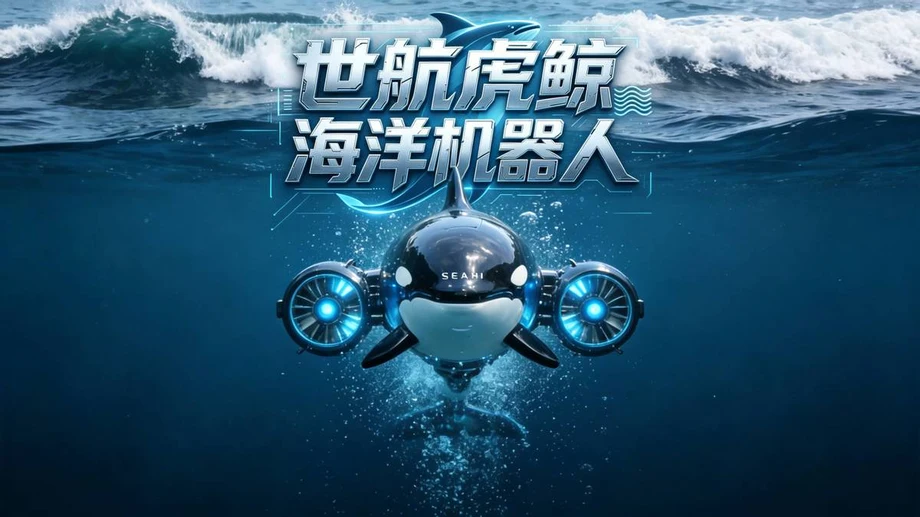
Harbin Engineering University (HEU) and Shihang Intelligent used a November 27 ceremony in Harbin to open a joint Deep Sea Robotics Research Institute and present Cangqiong CEORION, an artificial intelligence model intended to serve as a common foundation for ocean robots. The developers describe it as the world's first marine foundation model built for general use. More than 10 academicians from the Chinese Academy of Sciences and the Chinese Academy of Engineering attended the ceremony, which joined three efforts in one event: advanced research, industrial deployment and the development of a large AI model.
Contents
- A new institute with a model at its center
- How Cangqiong CEORION is meant to think and act
- Why ocean robots need their own AI
- The company behind the partnership
- Where the robots are already working
- A billion yuan in funding, and a billion in orders
- What the university and company plan to build together
- The dates behind the announcement
- Key Points
Chen Xiaobo, Shihang's founder and a 2007 cohort HEU alumnus, became the institute's first director. HEU professor Chen Yunsai was appointed executive director. Their remit covers basic research, work on crucial technologies, product design, transfer of research into commercial use, talent training and services for industry. The partners also intend to undertake major projects involving robots that operate at great depths and to develop new kinds of marine vehicles.
HEU describes its research mission as Three Seas and One Nuclear, meaning shipbuilding, naval equipment, ocean development and nuclear energy applications. Its relevant facilities include national key laboratories for intelligent marine vehicle technology and underwater acoustic technology. The new institute gives those research programs a direct connection to a company already selling underwater cleaning, inspection and maintenance services.
How Cangqiong CEORION is meant to think and act
A foundation model is a broad AI system that can be adapted to many tasks, rather than software built for only one job. An embodied model goes further by connecting those decisions to a physical machine. For an underwater robot, that could mean interpreting an instruction, understanding its surroundings and then moving its thrusters or tools without waiting for a person to issue every command.
Cangqiong uses what its developers call a unified architecture for language, world modeling and action. It combines visual images, acoustic signals, pressure readings, fluid measurements and attitude data, with attitude describing the robot's orientation. These inputs feed a single neural network running from sensor information to understanding and action. Cameras can show objects when the water is clear, sonar can provide acoustic information in darkness or murk, pressure helps establish depth, and motion sensors show how currents or the robot's own movement are changing its position.
The intended operating cycle covers underwater perception, assessment of the task, route planning, autonomous work and emergency responses. In practical terms, a robot using such a system would be expected to notice an obstacle, revise its route, continue an inspection and react to a fault as part of one continuous process. The developers also claim exponential generalization, their term for transferring abilities across a much wider range of tasks and conditions.
The university ceremony described Cangqiong as jointly developed by the academic and company teams and called it an original breakthrough by a Chinese enterprise in marine artificial intelligence. Shihang's product chronology separately dates the initial release of its Marine Embodied Large Model to April 25, 2026. The company says the model completed a filing in October 2026, before its presentation at the institute ceremony.
Why ocean robots need their own AI
Underwater machines operate under conditions that make constant remote control difficult. Radio signals and satellite positioning do not travel through seawater as they do through air, while acoustic communication carries much less data than networks on land. A robot that cannot continuously send detailed video to a ship or shore station must make more decisions locally. Darkness, suspended sediment, high pressure and moving currents add further complications.
Shihang cites the China Academy of Information and Communications Technology's Research Report on Artificial Intelligence Empowering the Development of the Marine Industry (2026), particularly its discussion of underwater communication and data bottlenecks. Cangqiong's combination of different sensors is designed for that setting. A world model gives the robot an internal representation of its surroundings, while the action component turns that representation and the assigned task into movement.
Commercial operations supply the training material. Shihang says more than 1 million hours of operating data were used to train its marine world model. That gives the company a body of experience drawn from cleaning, inspection and other paid work, rather than relying entirely on laboratory tests. The institute now plans to combine this industrial data and engineering experience with HEU research so that the model can be used in more complicated settings at great depths.
The company behind the partnership
Suzhou Shihang Intelligent Technology was established on May 26, 2023, and is headquartered in Huaqiao, Kunshan, in Jiangsu province. Chen Xiaobo, born in 1989, is its founder, chief executive and legal representative. He studied at HEU and Northwestern Polytechnical University and has promoted industrial uses of underwater robotics since 2016. The company develops and operates surface and underwater robots for ship cleaning, environmental monitoring, water rescue, inspection and maintenance of assets in the water.
Shihang says it develops six core systems itself: propulsion, control, sensing, navigation, sealing, and deployment and recovery. Sealing protects electronics against water and pressure, while deployment and recovery cover the difficult work of putting a robot into the sea and bringing it back safely. Its Orca range includes the Max, Mini, Pro and Shared Orca models, with stated operating depths from the surface to 10,000 meters. The company also describes a Killer Whale platform built around a common vehicle, a central control system and modules for different tasks.
The robots are described as having six degrees of freedom, meaning they can move in three spatial directions and rotate around three axes. That freedom matters when a machine must hold position beside a ship hull or approach equipment from a particular angle in a current. Other named technology includes the Pangu thruster, which runs entirely on electricity, and a stated attachment removal rate above 85 percent for cleaning work.
Where the robots are already working
Shihang robots have operated at more than 70 ports around the world, according to the company. Their uses extend across vessel maintenance, port dredging, offshore solar installations, marine wind power, aquaculture, deep sea exploration, customs inspection and environmental monitoring. Commercial cleaning robots have worked at Qingdao Port and Yantai Port, while ship maintenance deployments include China Merchants Shipping and COSCO. The company also says it won an inspection bid connected with China National Nuclear Corporation's Tianwan Nuclear Power Station.
Hull cleaning provides the clearest example of the commercial case. Marine growth attached to a hull increases drag, while sending divers to remove it can be slow and hazardous. Shihang puts its cleaning efficiency at 50 times that of human divers and says a fully loaded freighter can be cleaned in 10 hours rather than two weeks. In April 2026, the company was selected for the Maritime and Port Authority of Singapore's National Underwater Hull Inspection and Cleaning Programme. It describes itself as the only Chinese company selected.
Engineering recognition arrived in March 2026, when a modular underwater cleaning and inspection robot project using artificial intelligence won first prize in the 2025 China Institute of Navigation Science and Technology Progress Award. Shihang led the project with organizations including the Water Transport Research Institute of the Ministry of Transport, China Merchants Energy Shipping, COSCO Bulk Shipping, Shandong Port Technology and HEU. During the same month, it led work with research institutions on China's Code of Practice for Underwater Cleaning Robots. It had previously helped formulate a technical code for autonomous navigation of unmanned surface vehicles used in marine ranching.
A billion yuan in funding, and a billion in orders
Shihang announced Series A financing exceeding RMB 1 billion, approximately $138 million, on June 15, 2026. It called the round the largest single financing raised in the global marine robotics industry. Separately, the company reported orders worth RMB 1 billion in the first half of 2026. The financing supplies investment capital, while the orders represent customer commitments for its products and services.
New participants in the Series A included Shanghe Dongliang Fund, an industrial investment arm associated with chip designers Moore Threads and KunlunCore; Vertex Growth, backed by Temasek; CITIC Group's agricultural industry fund; Yuzun Capital; and Daya Electric. Existing investors GSR Ventures, Vertex China, Huaying Capital, Changshi Capital, Shengjing Jiacheng Capital and Anyu Capital increased their investments. The company's earlier financing included a September 2024 round led by China Merchants Qihang Capital and an Angel+ round in 2025.
Zhu Xiaohu, managing partner at GSR Ventures and an existing backer making his fifth investment in Shihang, presented the financing as a starting point for commercial execution.
SpaceX redefined space; ShiHang is redefining the ocean with embodied AI. A ¥1 billion Series A is not the end, but the starting point for turning demonstrations into commercial deployment.
What the university and company plan to build together
HEU's relationship with Chen began before the institute opened. In September 2025, the university's intelligence college appointed him as an industry mentor involved in graduate education. On September 5, 2026, Shihang joined 12 other companies in the EWEI alumni network to establish a development fund totaling more than RMB 15 million. The fund supports scientific and technological innovation at HEU and the cultivation of young researchers.
The next stage of the partnership includes joint applications for national innovation platforms, joint work on national and industry standards, and joint bids for major projects sponsored at national, provincial and municipal levels. The partners also plan to train specialists together and build a combined education and research team. For students, that could mean exposure to operating robots and commercial engineering problems alongside laboratory research. For Shihang, the institute provides access to HEU's work in underwater acoustics and intelligent vehicles as it attempts to move from established port services into more demanding deep sea assignments.
The dates behind the announcement
The April product release and the November institute presentation are separate entries in Cangqiong's history. The institute ceremony is dated November 27, but its announcement does not state a year alongside that date. Shihang's surrounding product and financing milestones use the following dates:
- May 26, 2023: Shihang Intelligent was founded in Kunshan, Suzhou.
- September 2024: China Merchants Qihang Capital led an early financing round.
- 2025: The company completed an Angel+ round, and Chen became an HEU industry mentor in September.
- March 2026: Shihang received the navigation science award and led work on the underwater cleaning robot code.
- April 25, 2026: The company dates the initial Cangqiong CEORION release to this day; Singapore selection followed within the same month.
- June 15, 2026: Series A financing of more than RMB 1 billion was announced.
- September 5, 2026: Shihang and 12 other alumni companies established the EWEI Development Fund.
- October 2026: Shihang says Cangqiong completed a filing.
- November 27: HEU and Shihang inaugurated their institute in Harbin and presented the model at the ceremony.
Public descriptions of Cangqiong do not provide its parameter count, computing requirements, independent benchmark scores, energy use, licensing terms or a date for broader access. The authority and technical scope of the October filing were also not specified. No date was given for a deep sea trial of the model or for the planned national platform applications. The immediate work announced by the partners consists of integrating university research with the model, undertaking joint projects and testing marine intelligence in more complex operating conditions.
Key Points
- HEU and Shihang Intelligent opened a joint robotics institute in Harbin on November 27 and presented Cangqiong CEORION.
- Chen Xiaobo became the institute's first director, with HEU professor Chen Yunsai as executive director.
- The model combines language understanding, environmental modeling and robot actions using visual, acoustic, pressure, fluid and orientation data.
- Shihang dates the model's initial release to April 25, 2026, and says it completed a filing in October 2026.
- The company reports more than 1 million hours of operating data, robots working at over 70 ports and products rated for depths down to 10,000 meters.
- Series A financing exceeded RMB 1 billion, while first half orders in 2026 also reached RMB 1 billion.
- The partners plan joint research projects, standards, talent training and applications for national innovation platforms.
- Independent model benchmarks, public access terms and a schedule for deep sea trials have not been disclosed.