Three vehicles arrive with drones in their sights
Three Chinese combat vehicles are bringing a new approach to land warfare to the 16th China International Aviation and Aerospace Exhibition in Zhuhai from 7 to 13 December 2026. The VT-4B main battle tank carries four radar panels and launchers for intercepting incoming weapons. The VT-8 light tank is small enough for a Y-20 transport aircraft to carry two at once, according to its stated deployment plan. An uncrewed combat vehicle combines a 40 mm cannon, four missiles and onboard artificial intelligence.
Contents
- Three vehicles arrive with drones in their sights
- What has changed on the VT-4B?
- How would the VT-4B fight a drone?
- Three crew members, with machines taking more of the work
- Why the VT-8 is built around a 30 tonne limit
- The M10 Booker offers a revealing contrast
- The uncrewed vehicle extends the tank's senses
- Export customers and the logic of technology transfer
- A 30th anniversary show that extends to the harbour
- Key Points
NORINCO's VT-4B is expected to make its first public appearance at the China Airshow Centre at Zhuhai Jinwan Airport, alongside the VT-8 and the uncrewed vehicle. Their shared feature is not simply thicker armour or a larger gun. It is the ability to detect danger earlier, exchange information with other forces and respond before a missile or drone strikes. Military expert Zhang Xuefeng described this as a substantial rise in the information processing and intelligent capabilities of Chinese armour designed for export.
Recent regional wars, including the war in Ukraine, have exposed tanks to cheap first person view drones, loitering munitions and missiles attacking their thinner roofs and sides. A first person view drone is piloted through a camera feed, while a loitering munition can search above an area before diving onto a target. Chinese designers have answered with radars, cameras, electronic equipment and automatic weapons mounted directly on armoured vehicles. Survival now depends as much on sensors and software as on steel.
What has changed on the VT-4B?
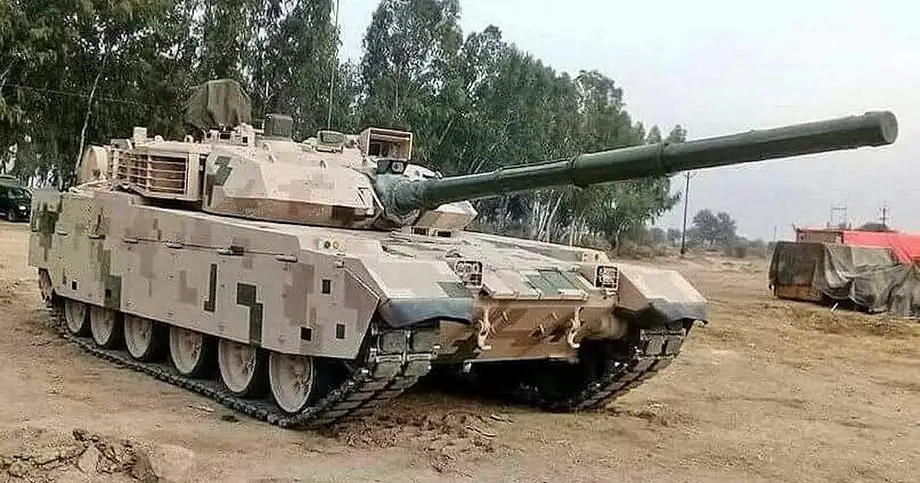
At a reported combat weight of 53 to 55 tonnes, the VT-4B retains the basic VT-4, or MBT-3000, chassis rather than starting with a new vehicle. Its 1,200 horsepower turbocharged diesel engine and automatic transmission are reported to provide a maximum road speed of 70 km/h. Three crew members operate the tank, with an automatic loader serving the 125 mm smoothbore gun and handling its reported 38 rounds.
Photographs of the prototype show much thicker explosive reactive armour across the front of the hull and turret. This armour uses explosive modules to disrupt an incoming projectile before it can penetrate the vehicle. Protection extends farther down the front than on earlier VT-4 versions and across the lower hull, sides and parts of the running gear. Additional side modules, cage armour and skirts are intended to protect the engine compartment, suspension and areas that earlier rubber side panels left more exposed.
A 125 mm gun remains the principal weapon, but reported ammunition options include the BTA4 armour piercing round. This fires a solid dart that uses speed rather than an explosive charge, with a claimed penetration of more than 700 mm of standard steel at 2,000 metres. Missiles launched through the gun barrel are reported to reach 5,000 metres. NORINCO has not yet published a complete official specification sheet for the prototype.
How would the VT-4B fight a drone?
Four radar panels arranged around the turret at 90 degree intervals provide the most visible part of the new defence system. They appear to belong to a GL-6 active protection system, or one derived from it, with two interceptor launchers near the rear of the turret. Active protection means detecting an incoming missile or drone and firing a small interceptor before impact. An active electronically scanned radar can steer its beam electronically, allowing it to watch different directions without rotating a large dish.
Military expert Zhang Xuefeng said the replacement for the commander's older panoramic sight is another major change. The new, independently stabilised pod combines optical and infrared sensors, giving the commander a wider and clearer view while automatic image processing helps search for targets. Zhang compared it with the sensor carried by an armed reconnaissance drone.
This is like putting the electro optical sensor of a reconnaissance and strike drone on a tank.
A 30 mm weapon station operated by remote control replaces the familiar 12.7 mm roof machine gun. A similar station previously appeared on the SH-16A 155 mm wheeled howitzer. The larger cannon can engage infantry, light vehicles, teams attacking tanks and small drones flying at low altitude, while the crew remains under armour. A small radio frequency array beside it has prompted two possible explanations: a millimetre wave radar for aiming the cannon, or a compact high power microwave emitter for disrupting drone electronics. The first would improve targeting; the second could disable several drones without firing an interceptor. Its function has not been officially identified.
Thicker rod antennas, resembling those used on the ZTZ-99B, support higher capacity data links between vehicles. The exact configuration and performance of the active protection system remain unconfirmed, since the present assessments rest largely on photographs of the vehicle.
Three crew members, with machines taking more of the work
Three people can operate this collection of equipment because continuous monitoring does not require three additional operators. The automatic loader handles the main gun, optical and thermal sights provide backups, and the roof cannon is controlled from inside. Sensor software takes over part of the search and recognition work, leaving the crew to interpret the information and decide how to respond.
NORINCO's earlier VT-4A1, displayed at Zhuhai in 2024, used jamming modules, millimetre wave sensors and its own small drone against aerial threats. That drone could take off, land and recharge automatically. The VT-4B moves further by integrating technologies associated with the Type 100, also called ZTZ-100, into an existing export chassis. These include the panoramic radar coverage, larger commander's sensor, high capacity communications and active protection.
Airshow visitors will be watching for three measurements that photographs cannot supply:
- The 30 mm cannon's actual rate of fire and whether its ammunition includes programmable airburst rounds, which explode near a drone and spread fragments.
- The active protection system's interception coverage, particularly against weapons diving from above.
- The distance over which the tank can exchange target information with uncrewed ground vehicles and aircraft.
Why the VT-8 is built around a 30 tonne limit
At about 30 tonnes, the VT-8 is 23 to 25 tonnes lighter than the reported weight of the VT-4B. Its 105 mm high pressure rifled gun fires a tungsten penetrator at a reported 1,530 metres per second. Public specifications give penetration of about 460 mm at 2,000 metres. That measurement uses rolled homogeneous armour, a standard steel target employed for comparing weapons, rather than describing the physical thickness of a modern tank's outer plate. The official description also claims that a laser beam riding missile launched from the gun can defeat the main armour of any current main battle tank within 5,000 metres. Beam riding means the missile follows a guidance laser directed at the target.
One Y-20 transport can reportedly carry two VT-8s, allowing rapid delivery to rainforests, plateaus, mountains and narrow urban routes where heavier vehicles struggle. Its intended targets include field fortifications, exposed infantry and lighter armoured vehicles, as well as older tanks. The vehicle reuses the VN17 infantry fighting vehicle chassis, allowing production lines, spare parts and mechanic training to be shared instead of creating a separate support system.
An estimated price of about $4 million places the VT-8 between the VT-5 light tank at roughly $3 million and the VT-4 main battle tank at about $5 million to $6 million. These figures are external estimates rather than a published NORINCO price list. For a customer that cannot afford a large main battle tank fleet, the attraction is a vehicle that costs less, uses existing support arrangements and can reach bridges or roads that cannot carry a 50 tonne tank.
The M10 Booker offers a revealing contrast
On 11 June 2025, the United States Army terminated its low rate initial production contract for the M10 Booker, citing the convenience of the government, and decided against full mass production. Low rate production is the first small manufacturing batch used before a wider commitment. The original contract, signed in June 2022, covered as many as 96 vehicles, with about 80 subsequently delivered or funded. The M10 cost about $12 million each, roughly three times the external estimate for a VT-8, and had been placed on an Army reduction list on 1 May 2025.
Requirements for the M10 initially included carrying two vehicles in a C-17 transport, air dropping them and protecting the front against 30 mm cannon fire. Its weight rose from 38 to 42 tonnes as requirements accumulated. The air drop requirement was abandoned, while a C-17 could carry only one vehicle. Testing at Fort Campbell also found that six of 11 bridges might fail under its weight. Its lower pressure 105 mm gun fired conventional ammunition but did not offer a missile launched through the barrel.
The Army did not issue a technical failure report and said funding would move to higher priorities. For prospective VT-8 customers, the contrast lies in the design choices: the Chinese vehicle starts with a mature chassis and a firm weight limit, then accepts protection suited to its intended missions. Shared parts and transportability may matter as much to a small army as gun performance, because they determine how many vehicles can be bought, moved and kept operational.
The uncrewed vehicle extends the tank's senses
Wang Liyu, a special observer of the display, described the new uncrewed vehicle as a combat unit, an assault scout, an information node and a forward reconnaissance post. Its 40 mm cannon and four missiles provide enough reported firepower to suppress infantry or attack armoured vehicles and fortified positions. A commander can send it into an exposed street or approaches to a defensive position without putting a vehicle crew at the same location.
Four rod antennas on the roof are intended to provide the bandwidth needed for high definition video, sensor information and control commands. Onboard artificial intelligence refers here to software that can plan routes, search for targets and conduct certain operations without continuous steering by a remote operator. Through a joint network, the vehicle can share what it sees with the VT-4B, VT-8, other crewed vehicles and drones. A commander farther back can then view the forward area through its cameras and sensors. Public descriptions have not explained the control arrangements if the communications link is lost.
Venue images show that the uncrewed display extends beyond one design. A small vehicle carries four Hongjian series missiles, while a tracked vehicle has a main gun and missiles for attacking armour. A separate counter drone vehicle uses a Dongfeng Mengshi chassis with six wheels and carries a large active electronically scanned radar at the rear. A detection range of 10 km against low altitude targets has been suggested online, but organisers have not released an official radar performance figure.
Export customers and the logic of technology transfer
Pakistan, Nigeria and Thailand already operate versions of the VT-4. SIPRI's Arms Trade Database recorded in 2022 that Pakistan had contracted for 679 vehicles, to be assembled and produced under licence there as the Haider. Pakistan has since inducted the tank. SIPRI also estimates that Chinese systems account for about 80 per cent of the equipment used by Pakistan's army, air force and navy. Islamabad has not announced whether it will seek the VT-4B upgrade.
An export contract for the VT-4B with a specific foreign customer has been reported, but neither the country nor the number of vehicles has been disclosed. Zhang Xuefeng's explanation for fitting so much equipment to an export tank is that Chinese armour technology has matured enough for features once reserved for the most advanced domestic vehicles to be offered more widely. For buyers, the package combines protection, drone defence and networking in one vehicle rather than requiring separate purchases.
China's own armoured fleet is following a different reported plan. Existing ZTZ-96, ZTZ-96A and early ZTZ-99 tanks would serve until retirement, while spending concentrates on the newer ZTZ-100 rather than bringing every older tank to the same equipment level. The VT-4B therefore serves as a richly equipped export flagship and a proving ground for technologies that could later appear in another generation of armour designed for foreign customers.
A 30th anniversary show that extends to the harbour
Gaolan Port will host the exhibition's first maritime equipment zone during an event marking its 30th anniversary. Public visits are planned for the Type 075 amphibious assault ship Hubei, a Type 055 destroyer and the Type 054A frigate Huangshan. Officials have described the participating Type 055 only as a mystery destroyer displacing about 10,000 tonnes. The J-35 fighter, KJ-600 early warning aircraft and Z-20F helicopter are also scheduled to make their first appearances at the show.
Ten Type 055 destroyers have now been publicly confirmed in service after training footage released in March showed the ninth ship, Dongguan, and the tenth, Anqing. Military expert Zhang Junshe said displaying a new vessel to the public indicates that its class has developed stable combat capability. He connected the ship display with the navy's wider development.
It was also a microcosm of the People's Navy's growth and transformation from a small force into a large one, and from near-seas to far-seas operations, demonstrating its confidence and determination to safeguard peace.
Key dates in the lead-up to the exhibition are:
- 2024: The VT-4A1 appeared at the previous Zhuhai show with jamming equipment, millimetre wave sensors and an organic reconnaissance drone.
- 23 November 2026: Naval visitor arrangements listed Hubei and Huangshan among the vessels open to the public.
- 25 November 2026: The VT-8 was confirmed at the exhibition site, fitted with its 105 mm gun and advanced fire controls.
- 7 to 13 December 2026: The 16th exhibition will present the ground vehicles, aircraft and the new maritime zone.
Key Points
- The VT-4B, VT-8 and uncrewed combat vehicle will appear at Airshow China in Zhuhai from 7 to 13 December 2026.
- The VT-4B combines thicker armour, four radar panels, two interceptor launchers, a 30 mm roof cannon and networking technology associated with the Type 100.
- Its active protection performance, roof cannon ammunition and communications range still await official figures.
- The roughly 30 tonne VT-8 uses a 105 mm gun, shares its chassis with the VN17 and has an estimated price of about $4 million.
- The uncrewed vehicle carries a 40 mm cannon and four missiles, with onboard software for route planning and target searches.
- Pakistan contracted for 679 VT-4 tanks for local production as the Haider; Nigeria and Thailand also operate the VT-4 family.
- The exhibition's first maritime zone will open warships to public visits at Gaolan Port.