A release aimed at production work, not just visual demonstrations
Tencent Hunyuan released Hy3D 3.6 on November 27, 2026, with a clear target: professional 3D creation rather than casual image generation alone. The model is designed to produce detailed geometry and physically based rendering (PBR) texture maps. It is already available through an API on Tencent Cloud Token Hub, while Tencent's Miora creative agent, Tencent Games' LAP asset generation platform and the WorkRally film and television AI platform have also integrated it.
Contents
- A release aimed at production work, not just visual demonstrations
- What improves in geometry and PBR materials?
- How does Hy3D 3.6 learn shape and texture?
- Why native 3D generation suits characters and clothing
- How strong is the evidence from Tencent's blind test?
- How can a beginner turn one picture into a 3D object?
- Where can developers and creators use it?
- What changes for games, film, printing and product design?
- The Bottom Line
For artists, modelers, technical artists and other 3D creators, the central promise is a more useful asset draft. A digital object can look convincing in a preview yet still require hours of repair before it can be animated, textured, printed or placed in a game. Tencent is concentrating on cleaner surfaces, clearer separation between parts and materials that more closely follow an original design. Those features could reduce the amount of manual correction needed before detailed creative work begins.
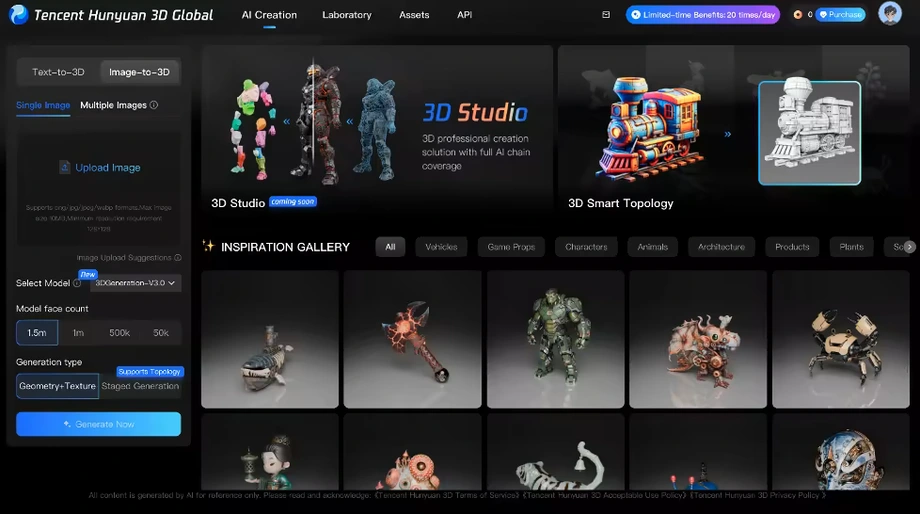
In Tencent's launch announcement, the company said the new version generates tidy geometric surfaces, clear structures and detailed models with high polygon counts. It also presented the model as a starting point for further work rather than a replacement for every stage of production. Creators can inspect the silhouette, clothing layers and individual components, then decide what to keep, adjust or rebuild. The public creation engine offers five free uses per day, giving beginners and professionals a limited way to test those claims with their own subjects.
What improves in geometry and PBR materials?
Reported technical specifications put the default target at 2 million polygons, compared with 500,000 for Hy3D 3.1. That is four times the earlier target, providing far more small surfaces with which to describe curves, ornaments and other detail. Texture resolution now reaches up to 8K. A polygon is one of the small flat pieces used to build a digital surface, so increasing their number can allow smoother curves and finer shapes, although it also creates heavier files for later processing.
Tencent has aimed the geometry improvements at three familiar problems: messy surfaces, unwanted local bumps and an appearance resembling molded clay. The company says flat areas on props, curved areas of clothing and rigid mechanical components now emerge with cleaner forms. Clearer boundaries should also make it easier to understand how a piece of equipment fits together, how layers of armor overlap and where an accessory begins and ends.
Faces, fabric and small decorations receive particular attention. Hy3D 3.6 is described as producing more variation in facial forms, clothing folds and local detail. That gives character sculptors a foundation on which they can first check the broad proportions and then refine the face, folds in the material and accessories. For figure design, the same starting point can help a creator assess whether an object has the intended outline before spending time on its finish.
PBR adds the appearance of materials to that geometric foundation. Physically based rendering is a method for making surfaces respond to light according to their material properties, helping metal look different from leather rather than simply giving both a different color. Tencent says the model can produce texture maps for skin, clothing and armor, as well as metal, wood and leather props. Those maps can feed later material work, rendered presentations and checks of how an asset looks inside a game engine.
How does Hy3D 3.6 learn shape and texture?
The wider Tencent HY 3D service is described as using a pipeline with two stages and separate large models for geometry and texture. The geometry stage concentrates on accurate contours and physical detail. The texture stage handles texture mapping, several material layers on a model's surface and different options for rendering its appearance. Separating those tasks allows each stage to concentrate on a different part of the asset.
The technical description of Hy3D 3.6 goes further into how shape and surface information are represented. A variational autoencoder (VAE) compresses geometry and texture into a unified sparse latent representation. In plain language, this is a compact mathematical description that retains useful features without storing every visible point and pixel in its original form. A diffusion transformer (DiT) then generates geometry and texture intended to match the reference image, keeping the surface colors and details coordinated with the object's shape.
Tencent's Hunyuan 3D team also organized a repeating training process built around agile evaluation, a data engine and algorithm experiments. Evaluation defines what ideal output should look like. The data engine adds quality examples and material covering areas where the model is weak. Algorithm experiments then measure the effect of those additions and feed the results into the next evaluation and data round.
After the main training phase, several expert systems produce varied candidates expressing different preferences. Winning samples are used for supervised fine tuning (SFT), which trains the model on selected examples. Direct preference optimization (DPO) then uses preference data to steer output toward results users favor. The process is intended to improve practical appeal and usefulness alongside technical similarity to the training material.
Why native 3D generation suits characters and clothing
Hy3D 3.6 is described as a native 3D generation model because it learns the distribution of geometry, texture and materials directly from 3D assets during training. This differs from asking a general language model to write code or assemble basic geometric pieces. The language model approach works well for regular objects with rigid surfaces, parametric parts and scene layouts, especially when a user needs to change an exact dimension.
Characters, creatures, garments and complex props present a different challenge. Their value often lies in a recognizable silhouette, flowing curves and small variations that are awkward to describe as a list of measurements. Hy3D 3.6 is intended to reconstruct those features from visual references and then add PBR maps, supplying an asset that another artist can continue to process. Tencent also envisions a division of labor in which language models understand requests and coordinate tasks, while native 3D models handle shape and material generation.
The head of Tencent Hunyuan's 3D team described the competitive shift in terms of whether an asset can survive contact with a real production process:
The focus of competition in 3D generation is shifting from being viewable to being usable. Production usability, including topology, component separation, UVs and PBR materials, is becoming increasingly important.
Topology is the arrangement of points, edges and polygons, and it affects how easily a model can be edited or animated. Component separation keeps a shoe, buckle or armor plate identifiable as an individual piece. UV mapping flattens the coordinates of a 3D surface into a 2D layout so a texture can be applied predictably. These are the practical details that turn an attractive object into something a production team can continue to work on.
How strong is the evidence from Tencent's blind test?
Hundreds of professional 3D artists and modelers participated in an internal blind test organized by Tencent. The company said Hy3D 3.6 ranked ahead of the participating industry models in general geometry quality, general texture quality and usability. Geometry feedback favored its reconstruction of large forms, clearer structures and flatter surfaces. Texture feedback said colors and details came closer to the original artwork, while the maps were cleaner and better matched to the shape beneath them.
A blind test means participants assess output without relying on the model's name as a guide to their preference. Tencent did not publish the exact number of participants, the names of the competing systems, individual scores or the collection of test assets. Those absent details leave outside teams without a public recipe for reproducing the comparison. The most concrete public test remains the free creation engine, where a user can supply different references and inspect the resulting geometry and textures directly.
How can a beginner turn one picture into a 3D object?
Tencent's demonstration was deliberately simple. An editor with no modeling background first tried the system using a familiar sticker image. A more detailed example used a music box featuring a goose and built around a 28th birthday theme. The example showed the intended route for an ordinary user, while work produced by experienced colleagues was used to display more demanding characters, clothing, equipment and surface finishes.
The demonstrated process has three stages, with Miora preparing the visual information before the Hunyuan engine creates the object:
- Prepare a 2D reference image of the subject, using the clearest and most precise image available.
- Ask Miora to generate images of the reference subject from several viewing angles.
- Import those views into the corresponding angle slots in the Tencent Hunyuan 3D creation engine and generate the model.
The wider service can accept text or image input, but the beginner demonstration relies on multiple views derived from one picture. Those extra views give the system information about sides and surfaces that a single flat image cannot show directly. The five free daily uses provide room for a small experiment, though they also limit how many alternative references or settings a user can try without moving to another access option.
Where can developers and creators use it?
Tencent Cloud Token Hub supplies the external API for developers and enterprises. An API, or application programming interface, lets another software product request a 3D result without reproducing the model itself. New users activating the cloud API service receive 100 credits for free trials. The global service also supports free testing and provides separate billing documentation, but the launch material does not state a price for each generation.
The three named integrations place the same capability in different working environments. Miora connects it to a creative agent that can help prepare multiple views. LAP brings it into Tencent Games' professional asset generation system. WorkRally makes it available within a platform aimed at film and television production. Creative tools, software as a service design platforms, AI workflow systems and API marketplaces can also embed 3D generation as a single capability within a broader product.
What changes for games, film, printing and product design?
Game artists can treat the generated result as a detailed sculpting base, then refine it, reduce its polygon count and bake texture information for later use. Reducing polygons makes an asset lighter to process, while baking transfers surface detail into texture maps. Film and television teams gain another starting point for props and visual development through WorkRally. In both settings, clearer parts and materials make review and local revision easier than working from an object with blurred boundaries.
Creators making figures can export STL files for 3D printing. STL is a common file format that describes the outer surface of an object for fabrication. The service is also intended to support structurally valid printable models, complex geometry and optimization, with the goal of improving print success and shortening the path from a sketch to a physical prototype. Industrial prototyping, product validation and personalized manufacturing are among the stated uses.
Product teams can turn photographs, sketches or reference visuals into models for design review and marketing. The stated examples include online product displays, jewelry and accessories, consumer electronics, vehicle exteriors and furniture. Multiple viewing angles can support listing images and promotional material, while a shared model gives design, engineering and marketing teams the same object to examine. The practical gain is not a finished answer for every discipline, but a faster way to reach a draft that specialists can inspect and improve.
The Bottom Line
- Tencent Hunyuan released Hy3D 3.6 on November 27, 2026, for professional 3D asset creation.
- The model is available through Tencent Cloud Token Hub and inside Miora, LAP and WorkRally.
- Reported specifications raise the default polygon target from 500,000 in Hy3D 3.1 to 2 million, with texture resolution up to 8K.
- Geometry work targets cleaner surfaces, clearer component boundaries and more detail in faces, clothing, armor and accessories.
- PBR texture generation covers materials including skin, fabric, metal, wood and leather.
- VAE and DiT technology coordinate geometry and texture, while repeated evaluation, data improvements and preference training refine results.
- Tencent's internal blind test involved hundreds of professionals, but public scores, competitor names and test assets were not provided.
- Beginners can use a reference image, Miora generated views and the Hunyuan creation engine, with five free uses per day.
- New cloud API users receive 100 trial credits; no public price per generation was given in the launch material.
- Potential uses span game and film assets, printable figures, industrial prototypes, online product displays and embedded design tools.