A new CLA with two sets of prices
Mercedes-Benz put its new hybrid CLA on sale in China on Friday, November 27, 2026, using the opening of the 24th Guangzhou International Auto Show to present a car built around three technologies: a hybrid system operating at 48 volts, ByteDance's Doubao artificial intelligence model and driver assistance developed jointly with the Chinese company Momenta. The launch gives Mercedes a combustion-based counterpart to the electric CLA while retaining much of that car's appearance and digital equipment.
Contents
- A new CLA with two sets of prices
- What the hybrid system changes
- How Doubao and Momenta divide the digital work
- Design details and a severe intersection test
- Which Mercedes models receive the software next
- The CLA anchors a broader Guangzhou display
- Why China is shaping Mercedes technology decisions
- The wider show race covers charging, automation and regulation
- What buyers still need to know
- What to Know
The two versions have official guide prices of RMB 229,000 and RMB 285,600. A promotion available for a limited time reduces the range to between RMB 199,000 and RMB 245,600. The guide figures are Mercedes' standard national prices, while the lower amounts are introductory sale prices rather than prices for additional versions. The company did not disclose how long the promotion would last or set out all of its conditions.
The car's significance extends beyond its price. Mercedes is placing software developed with Chinese partners in a hybrid model, rather than reserving it for electric vehicles. The CLA uses the MB.OS software architecture, can receive updates for vehicle systems over the air and supports assisted driving from one parking space to another. Its virtual assistant can process several instructions in one interaction and is described as capable of recognizing emotions. Those features accompany an engine and transmission package for which Mercedes claims fuel consumption as low as 4.91 litres per 100 km.
What the hybrid system changes
The powertrain combines an M252 turbocharged petrol engine with four cylinders, a dual clutch transmission with eight speeds and a lithium battery operating at 48 volts with a capacity of 1.3 kWh. The M252 is a 1.5 litre engine developed with Geely and manufactured in China. An electric motor integrated into the transmission can deliver as much as 22 kW and 200 Nm of torque, assisting the petrol engine during acceleration and helping make changes in speed smoother and quieter. The petrol engine alone produces 188 hp, and the two sources together give a combined system output of 208 hp and 380 Nm.
Mercedes says the CLA can coast using electric power when the powertrain requires less than 22 kW. In practical terms, the electric motor can support some gentle driving conditions instead of leaving every movement to the combustion engine. This is a hybrid without a charging plug, not a version of the battery electric CLA. Mercedes has not published an electric driving distance for the car.
The stated consumption of 4.91 litres per 100 km is a minimum figure supplied by Mercedes. No independent road measurement accompanied the launch, and the announcement did not identify the test protocol or divide consumption into city and highway results. The number therefore serves as the manufacturer's efficiency claim until detailed specifications and independent testing become available.
How Doubao and Momenta divide the digital work
Doubao handles part of the conversation inside the cabin, while Momenta supplies the underlying technology for assistance on the road. Mercedes says its virtual assistant, drawing on ByteDance's AI model, can respond to several commands in a single interaction and recognize emotion. The launch material did not give examples of supported sentences, explain how emotional recognition changes an answer or list the connected services available through the assistant.
Momenta's R7 world model supports a city and highway navigation assistance system developed jointly with Mercedes. A world model is AI software trained to interpret road scenes and anticipate how they may develop, rather than simply reacting to one detected object at a time. Mercedes says its system combines this approach with reinforcement learning, a training method that uses feedback to improve decisions. The company claims a threefold to fivefold improvement in capability for complex and rare traffic scenarios, without publishing a detailed baseline for that comparison.
The parking space to parking space function connects parking with assistance during the road portions of a journey. Mercedes describes the experience as shared driving between the person and the machine, and it did not announce unsupervised autonomous driving or publish the system's full operating limits. The company says it is the first luxury brand to deliver this capability and that it covers more cities in road testing than any other automaker partnering with Momenta.
MB.OS ties these functions to software updates delivered over the air, including updates involving driver assistance. Such updates can alter or add functions without a workshop visit, although Mercedes has not said how frequently individual CLA owners will receive them.
Design details and a severe intersection test
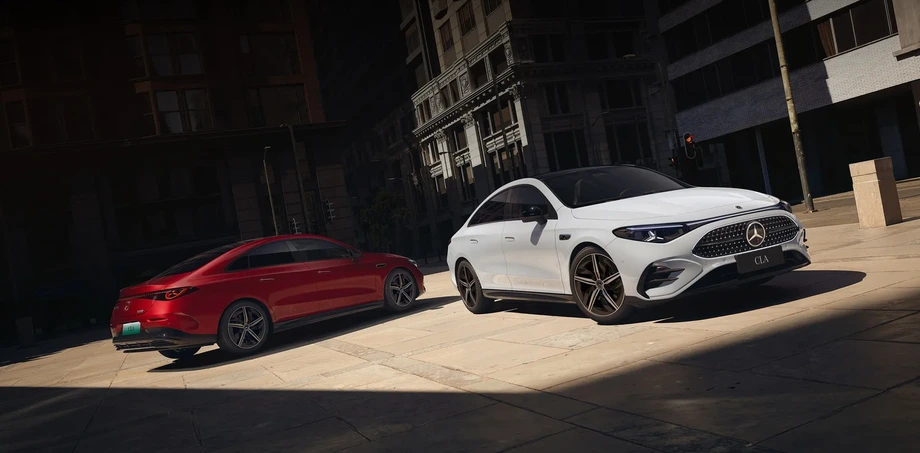
A vehicle displayed during a preview before the exhibition opened showed an exterior close to that of the electric CLA. The hybrid retains the profile of a coupe, frameless doors, concealed door handles and a tail light strip spanning the rear. Its star-pattern grille contains 142 lights that can illuminate independently. The grille surround and central Mercedes emblem also light up, while star motifs appear in the front and rear lamps.
Inside, Mercedes lists a digital instrument display measuring 10.25 inches, a central screen measuring 14 inches and a front passenger display measuring 14 inches. The company describes the passenger screen as the largest in the car's class. A panoramic roof is claimed to block 99.9 percent of ultraviolet radiation and 98.3 percent of infrared radiation, helping limit heat in summer and retain warmth in winter.
Mercedes also says the CLA completed more than 175 crash tests using actual vehicles. One company test simulated a collision at an intersection: a production hybrid CLA with a five-door shooting brake body struck the driver's side of a production electric CLA at a right angle, with both vehicles travelling at 56 km/h. Mercedes called it the world's first test of this kind using two production cars moving at that speed. The company said both passenger compartments preserved the space needed to protect occupants and that all safety systems operated as intended.
Which Mercedes models receive the software next
The Guangzhou announcements placed the CLA within a wider software rollout. Mercedes says its new AI cockpit was developed under the leadership of its Chinese research team, with an interface designed around local user habits. The display can refresh at 60 frames per second, while the voice assistant can wake in as little as 0.25 seconds and execute a vehicle command in 0.8 seconds. For combustion models, engineers also adjusted the initial response when setting off and optimized water cooling.
Daniel Lescow, president and chief executive of Beijing Mercedes-Benz Sales Service, presented the cockpit and assistance system as central parts of the company's message at the show.
We have also brought a new AI intelligent cockpit developed under the leadership of our Chinese research and development team, and we are the first among luxury brands to deliver parking space to parking space capability.
Mercedes published the following rollout schedule, covering both combustion and electric vehicles:
- November 27, 2026: The hybrid CLA joins the vehicles using MB.OS, Doubao and the jointly developed Momenta assistance system.
- During 2026: The first R7 parking space to parking space installations are planned for the electric GLC and electric CLA. The new AI cockpit is also scheduled for versions of the E-Class and GLC SUV with long wheelbases.
- First quarter of 2027: Mercedes plans a further expansion of R7 functions through software updates delivered over the air. Selected electric GLC versions are also due to receive an update raising maximum power from 310 kW to 350 kW.
- During 2027: R7 assistance is scheduled to reach more combustion models, including a GLE with a long wheelbase and the next S-Class generation, as well as a new electric C-Class. The AI cockpit will spread to additional combustion and electric models through updates.
The CLA anchors a broader Guangzhou display
Mercedes filled its space in Hall 5.1 with 26 vehicles spanning its main brand, AMG, Maybach and the G-Class range. Four products received launch announcements: the hybrid CLA, two additional electric GLC versions and the G 400. The VLE, a large electric MPV, also made its Chinese premiere. Oliver Thöne, the Mercedes-Benz board member responsible for Greater China, described China as one of the company's most important global markets and a source of innovation, saying the VLE had been developed around the needs of Chinese customers.
The electric GLC 400 L 4MATIC and 350 L 4MATIC additions were priced at RMB 362,200 and RMB 299,900 respectively. A GLC 300 L version opened for orders at RMB 269,900, with a promotional price of RMB 254,900. Mercedes included five years of city and highway navigation assistance across the four-version range. The G 400 arrived at RMB 1,523,000 with a 3.0 litre engine featuring six cylinders in line. It produces 230 kW, while an integrated electric motor can briefly add 17 kW and 205 Nm.
The VLE demonstrates where the same software strategy can lead in a much larger vehicle. It has a battery of 121 kWh, a claimed range of up to 810 km under China's CLTC test cycle and an electrical architecture operating at 800 volts. Mercedes says it can accept more than 300 kW of DC charging power and add roughly 300 km of range in 10 minutes under suitable conditions. A rear entertainment screen measuring 31.3 inches, a turning radius of 5.45 metres and Momenta R7 assistance are also part of the package. Mercedes calls it the first luxury MPV to use that model.
Why China is shaping Mercedes technology decisions
The emphasis on Chinese software and local product development comes during a difficult sales period for Germany's three established luxury brands. In 2025, BMW sold 625,500 vehicles in China, Mercedes sold 575,000 and Audi sold 617,500. Those figures represented declines of 12.5 percent, 19.5 percent and 5 percent respectively from 2024, with their combined sales falling by nearly 260,000 vehicles. Mercedes' 2025 total was also well below its 2023 peak of 765,000.
Pressure continued in 2026. The three companies' combined Chinese sales fell by more than 200,000 vehicles in the first half from a year earlier, while their combined net profit was EUR 1.535 billion lower, approximately RMB 12 billion. In the third quarter, BMW's Chinese sales fell 24.8 percent to 114,000 and Mercedes passenger car sales fell 31 percent to 87,000. Terminal sales data put Audi's decline at about 24.5 percent, to 94,600 vehicles.
Meanwhile, figures from the China Association of Automobile Manufacturers show that new energy vehicles accounted for 64.3 percent of new vehicle sales in October 2026. Chinese brands held 79.3 percent of the passenger vehicle market that month, up 6.8 percentage points from a year earlier, and 74.5 percent across the first 10 months. These figures help explain why Mercedes is promoting a hybrid priced below RMB 200,000 during its introductory offer while highlighting local AI partnerships.
Ola Källenius, chief executive of Mercedes-Benz, discussed the localization push at a public forum in Berlin in early November. He described a strategy of being 100 percent in China, for China, and used vehicle size to illustrate the need to follow local preferences.
Mercedes-Benz's product planning in China must match Chinese consumer preferences. In China, cars must be big, very big, astonishingly big.
Källenius said a new electric E-Class would be the first vehicle produced in China under that strategy, with manufacturing planned for the second half of 2027. Rivals are making comparable moves. BMW is integrating Momenta technology into systems for China and working with Alibaba on the cockpit, while Audi has adopted a strategy involving two brands and two partners. Audi also appointed Jeff Zhang as its first Chinese president of Audi China in November and opened its innovation technology centre in Shanghai on November 5.
The wider show race covers charging, automation and regulation
The Guangzhou exhibition provided a large stage for these competing approaches. Organizers listed 220,000 square metres of exhibition space, 1,106 vehicles on display, 115 vehicles making their debuts and 707 new energy vehicles. Electric technology featured prominently, including Zeekr's 7X with an architecture operating at 900 volts and Leapmotor's Lafa5 using 800 volts. Higher voltage architectures can support rapid charging when the battery, charging station and temperature conditions allow it. NIO also promoted battery exchanges taking about three minutes, while its LeDao L90 reached 70,000 deliveries on November 26.
Assisted and automated driving received equal attention. Zhou Lin, chief technology officer of AITO and Seres, described an L3 development program supported by about 11 million kilometres of testing using vehicles on roads and more than 1,300 safety strategies at vehicle level. L3 refers to conditional automation, in which a vehicle can handle driving within defined conditions but a person must resume control when requested. China's GB 44721-2026 safety standard adds verification across the lifecycle and staged testing on roads and by third parties to the path toward wider commercial use.
What buyers still need to know
Several practical details remain open. Mercedes has not published the full conditions or closing date for the CLA's promotional prices. The launch information also omits the distance and speed available during electric coasting and the test cycle behind the consumption claim. Those figures will matter when comparing the hybrid with the electric CLA and with competing hybrids.
The digital announcements leave similar gaps. Mercedes has not supplied examples of Doubao's supported commands, a detailed explanation of emotion recognition or the roads and weather conditions in which the Momenta system can operate. It has also not provided an update schedule for each CLA function. The broader expansion planned for the first quarter of 2027 and the additional model installations during that year are the next firm dates disclosed by the company.
What to Know
- Mercedes-Benz launched the hybrid CLA in China on November 27, 2026, at the Guangzhou auto show.
- Official prices are RMB 229,000 and RMB 285,600, with promotional prices ranging from RMB 199,000 to RMB 245,600.
- The hybrid system uses an M252 petrol engine, a transmission motor producing up to 22 kW and 200 Nm, and a 1.3 kWh battery operating at 48 volts, for a combined system output of 208 hp and 380 Nm.
- Mercedes claims minimum combined fuel consumption of 4.91 litres per 100 km.
- Doubao supports the cabin assistant, while Momenta's R7 model underpins supervised city, highway and parking assistance.
- The car has 142 individually illuminated grille lights and underwent more than 175 crash tests using actual vehicles.
- Mercedes plans broader cockpit and driver assistance updates during 2027 as it responds to falling luxury sales and rapid growth among Chinese brands.