Pakistan Puts Troops Inside Saudi Arabia and Says So in Public
Pakistan's military said on Sunday 29 November that it is sending army troops to Saudi Arabia to help strengthen the kingdom's defences against attacks by Yemen's Houthis, the first time it has publicly confirmed a deployment to the country. The announcement came one day after a farewell ceremony for the departing soldiers and two days after Pakistani, Saudi and Turkish defence and military officials met in Islamabad to discuss the war.
Contents
- Pakistan Puts Troops Inside Saudi Arabia and Says So in Public
- A Farewell Ceremony in Lahore and a Change of Tone
- What the Mecca Pact Requires of Its Three Signatories
- Two Months of Meetings Behind One Statement
- The Attacks Pakistan Says It Is Answering
- How Many Pakistani Soldiers Are Already There
- Talks With Qatar and the Search for a Ceasefire
- What the Deployment Changes for Riyadh and Islamabad
- Key Points
The statement was issued by Inter-Services Public Relations, the military's media arm. It said the troops would carry out their duties inside Saudi territory under existing defence cooperation arrangements, and framed the move around the close ties between the two countries.
The military deployment reflects Pakistan's unwavering commitment to the security, sovereignty and territorial integrity of the Kingdom of Saudi Arabia, rooted in the longstanding strategic partnership and fraternal bonds between the two brotherly countries.
Pakistan "remains steadfast in its commitment to safeguarding the Kingdom's security and the sanctity of Haramain Sharifain," the statement said, using the Arabic name for the two holy sanctuaries in Mecca and Medina. The soldiers would "discharge their assigned responsibilities within Saudi territory, under agreed commitments and the established framework of defence cooperation," and the deployment would "contribute towards further strengthening the Kingdom's defensive capabilities amid emerging security concerns," it added.
The military did not say how many soldiers are going, which units they come from, how long they will stay, when they will land in Saudi Arabia, or where in the kingdom they will be based. Those gaps leave open the size of the force now formally committed to a war in which Saudi cities, ports and refineries are being struck.
A Farewell Ceremony in Lahore and a Change of Tone
Defence Minister Khawaja Muhammad Asif and Saudi Arabia's ambassador to Pakistan, Rajeh Tami Albugamy, attended the ceremony held on Saturday for the troops heading to the kingdom, according to the army. Two generals were also present: Lieutenant General Omer Ahmed Bokhari, the army's Chief of General Staff, and Lieutenant General Muhammad Umer Bashir, the corps commander in Lahore.
The army said the ceremony reflected the "brotherhood, mutual trust and strategic cooperation" between the two countries. For a military that usually keeps its overseas deployments quiet, the statement was unusual in its timing rather than in its content.
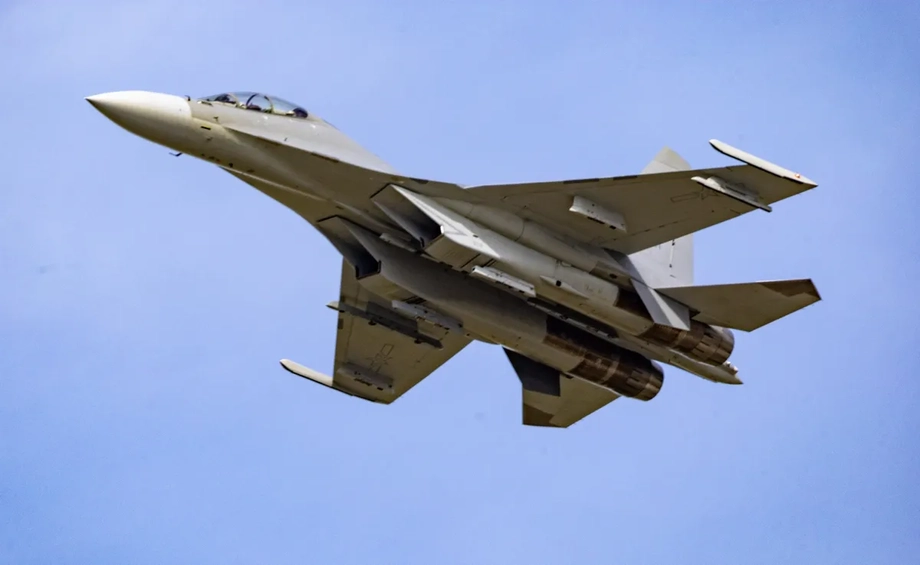
Pakistan and Saudi Arabia signed a bilateral defence pact last year, promising to defend each other if a third country attacked. Under that agreement, Pakistan sent several thousand soldiers, a squadron of fighter jets and other military equipment to the kingdom in May, during the war between the United States and Israel on one side and Iran on the other.
By October, Pakistani officials were describing a far larger presence: 30,000 to 40,000 soldiers inside Saudi Arabia, helping to defend land borders and to intercept drones and missile attacks. Sunday's statement put no figure on the new contingent, and it did not say whether the troops are additions to that force or a rotation of it.
What the Mecca Pact Requires of Its Three Signatories
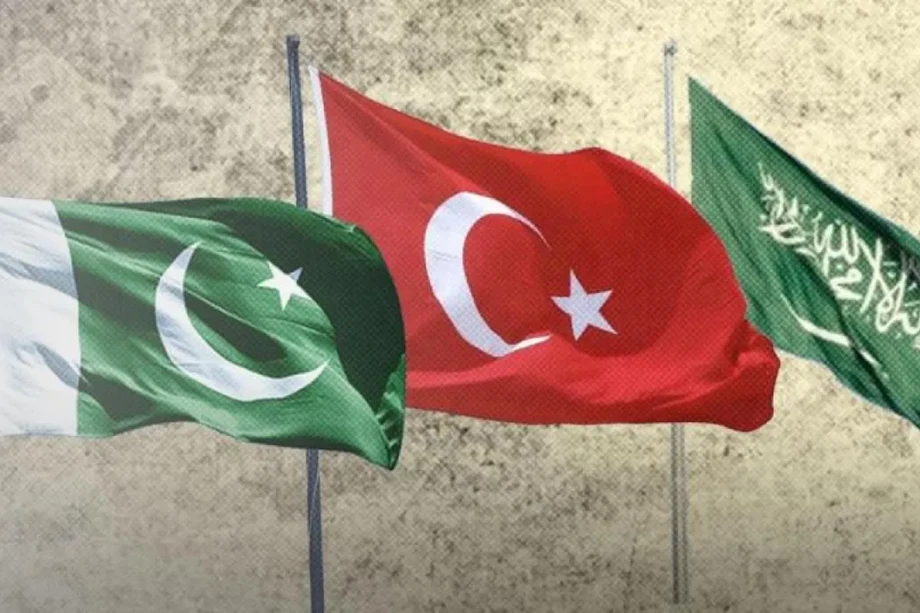
Saudi Crown Prince Mohammed bin Salman, Turkish President Recep Tayyip Erdogan and Pakistani Prime Minister Shehbaz Sharif signed the Mecca Joint Defence Agreement on 7 August. Its core clause treats an armed attack on any one of the three countries as an attack on all three, the kind of promise that turns a statement of friendship into an obligation.
Pacts of this type let a member that is attacked call on the others for help, while leaving each government to decide what form that help takes, whether troops, aircraft, intelligence or equipment. The three governments have called the Mecca agreement defensive and said it is not directed against any particular state. It was signed after a year in which fighting between the Houthis and forces backed by Saudi Arabia inside Yemen intensified, and Houthi drones and missiles repeatedly reached Saudi territory.
Details that would show how the alliance works in practice, including the composition of the forces each country would contribute and who would command them, have not been made public.
Two Months of Meetings Behind One Statement
An emergency meeting in Riyadh on 5 October agreed to begin carrying out the agreement, including arrangements to move military forces and equipment to Saudi Arabia quickly. A joint statement issued by Pakistan's foreign ministry said any deployment would follow "approved arrangements" and the national laws of the three countries.
On Friday, the alliance's Strategic Political and Defence Committee, its top decision making body, met in Islamabad, with senior civilian and military officials from Pakistan, Saudi Arabia and Turkey reviewing the regional security situation. The three sides condemned what they called "persistent and heinous" Houthi attacks on the kingdom and adopted resolutions on strengthening joint operations. The soldiers left the next day.
- 7 August: the Mecca Joint Defence Agreement is signed by Prince Mohammed bin Salman, Erdogan and Sharif.
- 5 October: an emergency meeting in Riyadh agrees to start implementing the pact, including rapid deployment of forces and equipment.
- Friday: the Strategic Political and Defence Committee meets in Islamabad.
- Saturday: a farewell ceremony is held for the troops.
- Sunday 29 November: the army announces the deployment.
The Attacks Pakistan Says It Is Answering
The Houthis, a movement that controls northern Yemen and is backed by Iran, have widened their targets over the past two days. Their military spokesman, Yahya Sarei, said Jeddah port and all Saudi ports on the Red Sea coast would be targets.
The group said it struck the Ras Tanura refinery of Saudi Aramco and two power plants in southwestern Saudi Arabia, and reported attacks on King Khalid International Airport in Riyadh and energy infrastructure in other areas. Saudi Civil Defence issued alerts in Eastern Province, the centre of the kingdom's oil industry and home to much of its Shia population.
Turki Al-Maliki, spokesman for the coalition led by Saudi Arabia, wrote on X that the kingdom's air defences had destroyed a missile aimed at the capital.
Air defense intercepted and destroyed a ballistic missile launched by the terrorist Houthi militia toward Riyadh.
On the Yemeni side, the Houthi affiliated al-Masirah outlet reported a Saudi attack on Ras Isa port, where the coalition had earlier warned civilians to evacuate. Al-Maliki said coalition forces were responding to the Houthis' "targeting of civilians and civilian objects".
How Many Pakistani Soldiers Are Already There
Pakistan's military role in the kingdom rests on two documents. The bilateral pact signed last year covered an attack by a third country. The three way agreement signed in Mecca in August widened that promise to include Turkey. What Sunday's statement did not do was attach a number to either obligation.
Earlier remarks give a sense of the scale. Khawaja Muhammad Asif, the defence minister, said before the announcement that Pakistan would use whatever means were available to defend the kingdom against Houthi attacks. The May contingent, several thousand soldiers and a fighter squadron, was sent under the older pact while Washington and Israel fought Iran. The October figure of 30,000 to 40,000, given by Pakistani officials, described a force large enough to guard borders and work air defences, far bigger than the group that flew out in May.
Whether the soldiers who left on Saturday belong to those numbers, or add to them, is not known. The army's statement described a deployment, not a reinforcement, and gave no date for their arrival.
Talks With Qatar and the Search for a Ceasefire
Alongside the deployment, Pakistan is working on a diplomatic track. Islamabad has been talking to countries including Qatar to bring the United States and Iran back to negotiations to end their conflict, and it brokered an interim agreement between the two sides in June. The three members of the Mecca alliance used Friday's meeting to back diplomatic efforts to ease regional tensions.
The two tracks sit awkwardly side by side. A Pakistani contingent inside Saudi Arabia is now part of the defence of a country the Houthis are attacking, while Pakistani diplomats try to keep channels open to Tehran, which arms and advises the Houthis.
What the Deployment Changes for Riyadh and Islamabad
For Riyadh, the value is partly practical and partly political. A declared Pakistani presence adds troops to air defence and border duties at a moment when Houthi missiles are reaching the capital and the group has threatened the Red Sea ports through which Saudi oil and goods move. It also shows that the Mecca agreement can produce forces, not only joint statements.
For Islamabad, the announcement ends months of ambiguity. Pakistan had faced questions about how it would answer repeated Houthi strikes on the kingdom after promising in August to treat an attack on Saudi Arabia as an attack on itself. Sending troops openly brings obligations with it: the soldiers can now be targets, and any casualties would be difficult to keep out of domestic politics.
What remains undecided is the shape of the mission. No arrival date, force size, area of operations or end date has been published, and no deadline has been given for the alliance to release those details.
Key Points
- Pakistan's military said on 29 November that troops are deploying to Saudi Arabia, its first public confirmation of such a deployment.
- A farewell ceremony was held on Saturday, attended by Defence Minister Khawaja Muhammad Asif and Saudi ambassador Rajeh Tami Albugamy.
- The move follows the Mecca Joint Defence Agreement signed on 7 August by Prince Mohammed bin Salman, Erdogan and Sharif, which treats an attack on one member as an attack on all three.
- An emergency meeting in Riyadh on 5 October agreed to start implementing the pact, and the alliance's Strategic Political and Defence Committee met in Islamabad on Friday.
- Officials have not disclosed troop numbers, units, duration or arrival dates; Pakistani officials said in October that 30,000 to 40,000 soldiers were already in the kingdom.
- The Houthis have threatened Jeddah and all Saudi Red Sea ports, said they struck the Ras Tanura refinery and two power plants, and fired a missile at Riyadh that Saudi air defences destroyed.
- Pakistan is also pressing Qatar and other governments to bring the United States and Iran back to talks, after brokering an interim agreement in June.