What Investigators Found Across 28 False Messages
Twenty eight pieces of misinformation with a combined reach of more than 2.8 million were traced to social media accounts believed to have links to Pakistan, according to an assessment prepared by India's security establishment. The analysis covered activity from September 13 to November 18, 2026, and recorded the reach of the posts at the time they were examined.
Contents
- What Investigators Found Across 28 False Messages
- How Military Leaders Became Central Targets
- Fabricated Religious Violence and a Real Police Case
- Why Kashmir Became the Centre of the False Flag Narrative
- Old Footage, New Dates and Invented Border Crises
- The Personas and Amplification System Behind the Posts
- The Main Dates in the Campaign
- A Pattern Already Visible Beyond These 28 Messages
- How Fact Checkers and Users Are Trying to Keep Pace
- What to Know
The security assessment itself has not been named, dated or published. Its authorship, title and whether it is an internal note or an official report cannot be checked.
The material included altered videos, fabricated news reports and genuine historical footage presented as current events. Its subjects ranged from Jammu and Kashmir, Punjab and Manipur to caste, protests and relations between religious communities. Accounts adopted Hindu names, caste references, regional identifiers and branding that resembled local news outlets, helping fabricated claims appear to come from ordinary Indians.
A deepfake is video or audio manipulated with artificial intelligence to make a person appear to say or do something that never happened. An unnamed source in India's security establishment described the scale of the activity and the subjects being exploited.
The activity is extensive, persistent and spread across multiple social media platforms. It involves the repeated circulation and amplification of narratives concerning the country's senior leadership, armed forces, defence establishment and internal fault lines, including communal relations, protests, Kashmir, Manipur, Punjab, caste and regional divisions.
Security personnel have identified and flagged numerous accounts, with some blocked or removed. Replacement profiles have continued to appear, sometimes resuming similar posts within a day.
How Military Leaders Became Central Targets
On November 17, the accounts @annu2030 and @RedDeFactoIND shared a fabricated video of General Anil Chauhan, the former Chief of Defence Staff. It purported to show him admitting that Pakistan had overtaken India in land, air, naval and cyber warfare. The clip drew more than 45,000 views. No official record contains such a statement, and the account that uploaded it later acknowledged that the video might have been generated artificially.
National Security Advisor Ajit Doval was targeted on October 22 through an altered version of a speech he delivered in 2019. The manipulation attached derogatory remarks about Pakistani political figures to his name and attracted nearly 389,000 views before the Press Information Bureau's Fact Check unit refuted it. The unit is commonly known as PIB Fact Check.
Posts about General Dhiraj Seth appeared between October 14 and 16, including a fabricated claim that the government intended to dismiss him. Those posts drew more than 300,000 views. The Indian Army's official Fact Check account, @MythBusters, identified the dismissal story as Pakistan linked misinformation on October 14. Two days later, photographs from Seth's visit to Nepal were combined with unrelated footage to invent allegations of improper conduct at a Border Security Force function.
False personal allegations concerning the newly appointed Air Chief Marshal Ashutosh Dixit followed on October 31. An earlier manipulation, dated September 30, placed a photograph of a Sikh Regiment major into unrelated international footage and claimed he had been arrested during a criminal sting in Mexico. That post received more than 569,000 views. The consistent choice of senior officers and serving personnel gave the campaign a clear institutional focus: weakening confidence in military leadership and the reliability of official defence information.
Fabricated Religious Violence and a Real Police Case
On November 10, @cutegirlindia21 and @indiantiwari01 claimed that five mosques had been demolished in Ghaziabad and that police had fired on worshippers. The same accounts alleged on November 15 that Kolkata Police had shot five Muslims dead during prayers. Two days later, @annu2030 claimed that members of the Rashtriya Swayamsevak Sangh had set fire to a church in West Bengal, killing five Christians. Investigations found no demolition, police firing or church arson matching these stories.
The West Bengal church allegation alone drew about 1.9 million views, equivalent to roughly two thirds of the campaign's stated combined reach of 2.8 million. Its precise death toll and named organisation supplied details that could provoke anger quickly, even though the underlying event was invented.
Ghaziabad cyber crime police turned the online claims into a criminal investigation. Additional Deputy Commissioner of Police Piyush Kumar Singh said Sub Inspector Vishal Kumar received information about an objectionable post on X on November 19. Police subsequently registered a First Information Report against the unknown operators of the relevant accounts after finding that the accompanying claims were false.
The investigation involved the Indian Cyber Crime Coordination Centre and a local cyber cell. Digital records associated with some suspect accounts pointed towards Rawalpindi and Islamabad in Pakistan. Police said no attack on religious places or communal violence of the kind shown in the videos had occurred in Ghaziabad. Some suspect accounts had not been fully shut down after the case was registered, and investigators were still trying to identify their operators. No completion date for the investigation has been announced.
No link or reference number for the Ghaziabad FIR is available, and no statement from Ghaziabad police or the cyber cell has been published directly.
Why Kashmir Became the Centre of the False Flag Narrative
A terrorist attack in Kulgam on November 11 injured three personnel of the Central Reserve Police Force. Accounts in the network then described the attack as a false flag operation, a term for an act deliberately attributed to someone other than its actual perpetrator. Their version claimed that Indian authorities had organised the violence against their own personnel.
Altered commentary attributed to retired military officer Praful Bakshi was used to support that story, receiving about 54,000 views. The assessment put the reach of the central false flag allegation at around 88,000. During the following two days, @cutegirlindia21 and @indiantiwari01 circulated a fabricated presentation styled as a television news broadcast, claiming that senior political leaders had plotted the attack. That broadcast and related posts about two police officers drew more than 179,000 views.
Two Special Police Officers who had disappeared were later found dead. Posts falsely asserted that their own command had killed them for refusing to participate in a staged operation. Investigators found no connection between their deaths and such a refusal. Other posts falsely accused the Army of denying an ambulance to the officers and concealing what happened.
Further claims said terrorists had seized Baramulla and that Jammu and Kashmir's Chief Minister had asked people to leave the Kashmir Valley. Baramulla Police had already rejected those stories. A separate post described an operation involving Lashkar-e-Taiba leader Lateef Bhat and a companion as fake, although both men were killed on November 16. Together, these narratives shifted blame away from armed groups while encouraging distrust of police, soldiers and emergency services.
Old Footage, New Dates and Invented Border Crises
Genuine video from protests and altercations in Madhya Pradesh, Jharkhand and along the Punjab-Haryana border in 2022 and 2024 reappeared in November 2026 with changed dates, misleading captions, altered audio or fabricated news tickers. Because the underlying footage was real, viewers could recognise genuine locations and crowds without realising that the events had happened years earlier.
The same technique supported a series of claims about India's borders and military security:
- Chinese soldiers were falsely said to have advanced seven kilometres into Arunachal Pradesh and pushed Indian troops back.
- A post about the 2020 Galwan confrontation claimed that China killed 20 Indian soldiers and captured 118. The assessment identified the figure of 118 prisoners as fabricated.
- A Chinese jet was falsely said to have remained over Sikkim for 20 minutes without challenge. The assessment found only one unconfirmed report of unidentified aerial activity.
- Bangladeshi forces were falsely accused of detaining between eight and 10 Indian soldiers.
Pakistani media also circulated a claim that Bashir Zeb, a senior Baloch Liberation Army figure, was receiving hospital treatment in India after being removed by the organisation's Shura, or leadership council. The assessment connected that story to an attempt to move attention away from developments inside Pakistan.
The Personas and Amplification System Behind the Posts
The persona Anushi Tiwari appeared across handles including @annu2030, @cutegirlindia21 and @indiantiwari01. Other accounts identified in the investigation included @RedDeFacto, @RedDeFactoIND, @HinduReformer and @Clashfire_. During one week in November, @annu2030 moved from the fabricated Ghaziabad story to Kartarpur and Sikh identity. @Clashfire_ combined Kashmir content with Delhi policing, including a false October 12 claim that the Army had been deployed in Delhi to beat protesters.
Initial uploads were reposted by other accounts and then echoed by Pakistani media handles and websites. In at least one instance, Pakistan's state news agency, the Associated Press of Pakistan, was the only outlet carrying a claim. Repetition across accounts and platforms could make a single fabrication look as though several outlets had independently confirmed it.
Indian security sources attribute the organised portion of the campaign to Inter-Services Public Relations, or ISPR, the Pakistani military's media and public relations wing. They say a social media volunteer and internship model developed around 2015, assigning participants tasks such as creating memes and videos and identifying useful material. Former ISPR director general Lieutenant General Asim Saleem Bajwa, now retired, is credited by those sources with initiating the model.
An unnamed security establishment source explained how the content was shaped around the beliefs of intended audiences.
Multiple false claims are propagated that would appeal to your own belief systems, caste, religion or politics. The aim is to divide.
Investigators are still working to identify individual operators and determine whether an organised institution directed them. Independent verification of the alleged connections between specific accounts and ISPR remains outstanding.
The Main Dates in the Campaign
The documented posts moved quickly between personnel, religious violence and Kashmir, with police action beginning after the main analysis window had closed.
- September 30: The fabricated Mexico arrest story involving a Sikh Regiment major was posted.
- October 14 to 16: Claims about General Dhiraj Seth circulated, followed by the spliced Nepal footage on October 16.
- October 22: The altered Ajit Doval speech appeared.
- November 10 and 11: The Ghaziabad mosque story was posted, followed by the Kulgam attack and the false flag narrative.
- November 15 to 17: The Kolkata and West Bengal religious claims appeared, alongside the General Chauhan video.
- November 16: Lateef Bhat and a companion were killed, contradicting claims that the operation had been fake.
- November 19: Ghaziabad police received the complaint that led to a case against unknown account operators.
The security assessment measured activity through November 18. Its findings became public on November 27, while the Ghaziabad investigation continued separately.
A Pattern Already Visible Beyond These 28 Messages
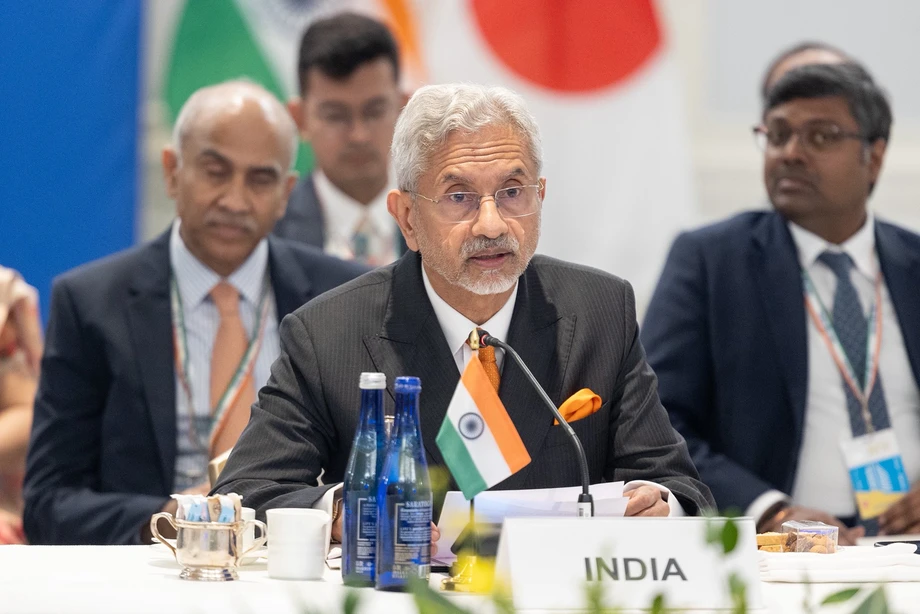
On March 10, 2026, PIB Fact Check flagged a different manipulated video featuring External Affairs Minister S Jaishankar. It falsely claimed that he had said India would not tolerate Muslim countries harassing Israel and that Israel had given $3 billion to the Afghan Taliban at India's request. The unit attributed circulation of the clip to Pakistani propaganda accounts.
Pakistani propaganda accounts are sharing a digitally manipulated video of the External Affairs Minister with false claims alleging that he said India would not tolerate Muslim countries harassing Israel and that Israel recently granted $3 billion to the Taliban at India's request.
The available accounts paraphrase PIB Fact Check's own releases on the Doval and Jaishankar clips rather than quoting or citing the releases directly.
Government figures cited with that case show that PIB Fact Check has debunked more than 2,400 pieces of fake or misleading information over four years, including more than 800 in the most recent year. Another fabricated video portrayed an Indian Air Force officer criticising aircraft maintenance standards. Footage of the 2020 Beirut port explosion was also presented online as a Pakistani missile strike on India.
During the 2025 tensions following the Pahalgam terrorist attack and India's Operation Sindoor, authorities blocked more than 1,400 URLs carrying anti-India propaganda. The four days of fighting ended with a ceasefire on May 10, but the ceasefire dispute continued through competing diplomatic campaigns over Kashmir, terrorism and water sharing.
How Fact Checkers and Users Are Trying to Keep Pace
The Indian Army's @MythBusters account and PIB Fact Check have issued rapid public refutations, while the Ministry of External Affairs, Ministry of Defence and Press Information Bureau participate in wider monitoring. Agencies are increasingly trying to identify false narratives as they spread, rather than responding only after they have accumulated large audiences. Investigators are also profiling technical infrastructure and proxy servers associated with suspect accounts.
The assessment cautions journalists and social media users against uploading altered clips again merely to debunk them, since repetition can expose new audiences to the manipulation. Where manipulated media must be referenced, it should be marked plainly as false and accompanied by a clear route to an official refutation.
Five basic checks can catch many of the techniques documented in the campaign:
- Use a reverse image search to find earlier versions of a photograph or video and establish its age.
- Examine the uploading account's history, location claims, names and previous subjects.
- Compare dramatic allegations with information issued by government departments, police or other relevant authorities.
- Trace the earliest available upload to see whether later posts simply repeat the same original claim.
- Look for signs of AI manipulation, including irregular mouth movements, inconsistent eye movement, blurred details and speech unlike the person's usual delivery.
For readers, the practical lesson is to pause before forwarding content that names a religious community, announces military casualties or appears to show a senior official making an extraordinary confession. For investigators, the immediate work remains identifying the people behind the accounts, preserving digital evidence and securing action from platforms against replacements that appear after removals.
What to Know
- An Indian security assessment documented 28 false messages with a combined reach exceeding 2.8 million between September 13 and November 18, 2026.
- Fabricated videos targeted General Anil Chauhan, Ajit Doval, General Dhiraj Seth and other military personnel.
- A false West Bengal church arson post on November 17 drew about 1.9 million views.
- The genuine Kulgam attack injured three CRPF personnel, but posts falsely presented it as an operation organised by Indian authorities.
- Ghaziabad police registered a case against unknown operators and traced some digital records to Rawalpindi and Islamabad.
- Security sources attribute the organised campaign to ISPR, while independent verification of specific account connections remains outstanding.
- Official fact checking, faster account action and basic verification by users are central to limiting further circulation.