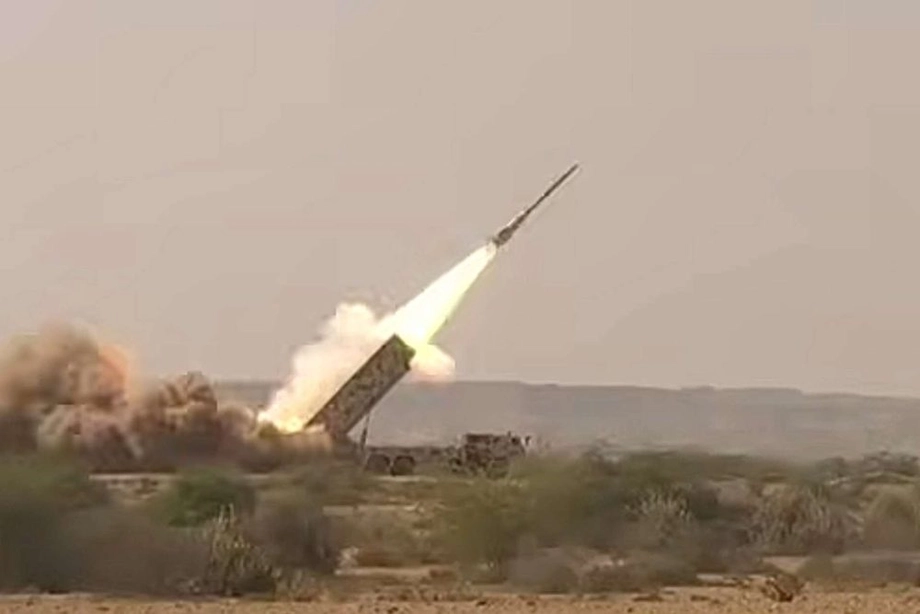
Pakistan Launches Fatah-3 to Expand Supersonic Strike Reach
Pakistan tested its new Fatah-3 supersonic cruise missile on November 18, 2026, marking a major step in the country's drive to expand conventional strikes against distant targets. Inter-Services Public Relations (ISPR), the military's media wing, confirmed the launch in an official statement and noted that the weapon is styled as both Fatah-3 and Fatah-III in government announcements.
Contents
- Pakistan Launches Fatah-3 to Expand Supersonic Strike Reach
- How Supersonic Cruise Missiles Work and Why Speed Matters
- What Technical Estimates and the Chinese HD-1 Connection Suggest
- Comparing Fatah-3 With India's BrahMos System
- Why Mobility and Logistics Decide Battlefield Readiness
- A Year of Rapid Missile Tests Across Pakistan's Armed Forces
- Strategic Risks and Missing Rules on Cruise Missiles
- Military Ambitions Meet Rising Poverty at Home
- At a Glance
Senior commanders, scientists, and engineers attended the firing alongside the leader of the Army Rocket Force Command. President Asif Ali Zardari, Prime Minister Shehbaz Sharif, and Field Marshal Syed Asim Munir issued statements welcoming the test, while Interior Minister Mohsin Naqvi congratulated the scientific teams behind the project.
Military planners had unveiled the Fatah-3 months earlier on May 7, 2026, during an ISPR press briefing marking the first anniversary of Operation Bunyan al-Marsoos. The missile belongs to the Fatah family, named after the Urdu word for victory and also called the F-series, which began under a Ministry of Defence Production initiative in 2015 and 2016 led by Global Industrial Defence Solutions to build rocket launchers with extended reach. Technical assessments also identify NESCOM as a key developer and integrator for the Fatah-3 system.
How Supersonic Cruise Missiles Work and Why Speed Matters
Cruise missiles differ fundamentally from ballistic missiles in how they fly to a target. While ballistic missiles climb high into the upper atmosphere before arcing downward under gravity, cruise missiles use continuous engine thrust to fly at lower altitudes, steer around obstacles, and follow terrain contours.
Most conventional cruise missiles travel below the speed of sound, whereas supersonic designs fly several times faster. Estimates for the Fatah-3 suggest speeds between Mach 2.2 and Mach 3.5, with some assessments narrowing that band to Mach 2.5 to Mach 3.5 and figures from its May 2026 unveiling citing Mach 3 to Mach 4. At Mach 3, a missile travels roughly three times the speed of sound, though actual velocity varies with altitude and air temperature.
Higher flight speed shrinks the window between radar detection and impact, leaving opposing air defence crews less time to classify an incoming object and launch interceptors. Detection time also depends on flight altitude, local terrain, radar coverage, and approach angle. Official announcements from ISPR did not disclose the Fatah-3's verified range, top speed, warhead mass, guidance architecture, propulsion type, or schedule for entering active military service, leaving its full performance outside public verification.
What Technical Estimates and the Chinese HD-1 Connection Suggest
Unofficial technical estimates put the Fatah-3's launch weight between 2,000 and 2,200 kilograms, its length at around 8.3 metres, its diameter near 375 millimetres, and its warhead at roughly 240 kilograms. Analysts note that the larger weight and length figures likely reflect a complete launch package inside its firing tube rather than the flying missile body alone. Most circulating estimates place its range between 290 and 450 kilometres, while unverified claims of 550 to 700 kilometres lack technical backing.
Images from the November test show a desert camouflaged truck carrying two launch canisters that closely resemble the launcher for China's HD-1 missile, built by Guangdong Hongda. Presented at Airshow China in Zhuhai in 2018 as an export weapon, the HD-1 has never been inducted by China's People's Liberation Army. Its propulsion pairs a solid rocket booster for initial acceleration with a ramjet burning solid fuel, an engine that scoops in outside air at high speed to sustain supersonic flight up to Mach 3.5.
Guangdong Hongda advertised the HD-1 with a 290 kilometre range, keeping it under the 300 kilometre and 500 kilogram payload limits set by the Missile Technology Control Regime, rules China pledges to follow despite not holding formal membership. Export variants include the ground launched HD-1, the aircraft launched HD-1A, and the ship launched HD-1C, designed to skim above ocean waves and strike from multiple angles. Visual similarity with the Chinese launcher leaves unconfirmed whether Pakistan uses the same internal fuel, guidance electronics, or components.
Comparing Fatah-3 With India's BrahMos System
Pakistan's pursuit of supersonic cruise technology invites direct comparison with India's BrahMos missile, developed jointly with Russia and derived from the P-800 Oniks family. Giving the Pakistan Army a mobile weapon flying at comparable speeds challenges India's longstanding regional advantage in fast conventional strike systems.
BrahMos first entered service as a weapon targeting naval vessels before adding land attack versions, whereas the Fatah-3 appears focused primarily on land targets, with any future naval version unconfirmed. Potential land targets include command centres, air defence batteries, and supply depots, though hitting vehicles that relocate demands live reconnaissance and rapid targeting updates.
Defending forces can complicate supersonic attacks by dispersing equipment, reinforcing concrete shelters, deploying decoys, and operating layered air defence networks. Speed and ground mobility make interception more demanding, yet verified combat effectiveness depends on real guidance accuracy, countermeasures, and system reliability.
Why Mobility and Logistics Decide Battlefield Readiness
Carrying twin canisters on road trucks allows commanders to move launchers away from fixed bases and conceal them under cover, complicating preemptive enemy strikes. Sustaining combat operations, however, depends on far more than a visible firing vehicle.
Each missile battery relies on reload trucks, maintenance equipment, trained crews, secure communications, and safe replenishment routes. Sealed canisters protect missiles from harsh weather, and a ramjet using solid propellant could offer simpler handling than liquid propellant systems once propulsion details are confirmed. Dispersed crews also face a constant operational tension because receiving updated target coordinates over radio networks risks revealing their hidden locations to enemy sensors. Pakistan has not disclosed battery numbers, missile stockpiles, production rates, service life limits, or reload timelines.
A Year of Rapid Missile Tests Across Pakistan's Armed Forces
November's launch capped a steep acceleration in weapons testing across Pakistan's army, navy, and air force following the creation of the Army Rocket Force Command in 2025. Between October 6 and November 18, 2026, the military announced four separate missile tests in roughly six weeks.
- 2015 to 2016: The Ministry of Defence Production launches a project led by Global Industrial Defence Solutions to develop rocket launchers with extended reach.
- 2018: Chinese defence firm Guangdong Hongda unveils the export HD-1 supersonic cruise missile at Airshow China in Zhuhai.
- February 2025: The International Institute for Strategic Studies uses satellite imagery to identify new facilities for developing larger solid propellant rocket motors.
- 2025: Pakistan establishes the Army Rocket Force Command to manage conventional precision strike weapons.
- January 10, 2026: The Pakistan Navy fires a LY-80(N) air defence missile from a Tughril-class frigate in the North Arabian Sea.
- March 2026: A US Congressional Research Service report reviews Pakistan's Shaheen-III and Ababeel ballistic missiles and potential reach beyond South Asia.
- April 16 and April 21, 2026: The Pakistan Navy tests an indigenous weapon fired from ships against naval targets and the air launched Taimoor cruise missile.
- April 28 and May 14, 2026: The Army conducts a Fatah-II launch, reported at roughly 400 kilometres range, and a Fatah-IV ground cruise missile test estimated at 750 kilometres.
- May 7, 2026: ISPR unveils the Fatah-3 supersonic cruise missile on the first anniversary of Operation Bunyan al-Marsoos.
- October 6 and October 13, 2026: The Army announces extended reach tests of Fatah-IV and Fatah-II, claiming Fatah-II performs as a manoeuvrable hypersonic ballistic missile without releasing technical data.
- November 3, 2026: The Pakistan Air Force fires the indigenous Fa'az air combat missile from a JF-17 fighter jet.
- November 18, 2026: The Pakistan Army conducts the test launch of the Fatah-3 supersonic cruise missile.
Despite the rapid pace of announcements, no public evidence confirms that all systems tested during 2026 have entered active frontline service or validates claims of hypersonic flight and missile defence penetration.
Strategic Risks and Missing Rules on Cruise Missiles
Arms control specialists at the James Martin Center for Nonproliferation Studies and the Nuclear Threat Initiative warn that expanding cruise missile arsenals heighten escalation risks between India and Pakistan, two neighbours armed with nuclear weapons. Unlike ballistic missiles, cruise missile tests are not covered by existing bilateral advance notification agreements between Islamabad and New Delhi.
Combining ballistic, cruise, naval, and air combat missiles adds pressure on India's early warning radars and layered air defences. Alongside conventional precision weapons, the International Institute for Strategic Studies assessment in February 2025 and the US Congressional Research Service report in March 2026 point to ongoing investments in larger solid propellant rocket facilities and longer reach ballistic systems such as Shaheen-III and Ababeel.
Military Ambitions Meet Rising Poverty at Home
Pakistan's burst of four missile tests between October 6 and November 18 unfolds alongside deepening economic hardship for ordinary families. According to the World Bank's October 2026 Poverty and Equity Brief, Pakistan's national poverty rate climbed by 7 percentage points, rising from 22 percent in 2018-19 to roughly 29 percent in 2024-25. In a nation of more than 240 million residents, that rate leaves around 70 million people living in poverty.
Average real wages fell by 3.4 percent per year between 2018-19 and 2024-25 as inflation outpaced pay increases. Roughly 3.5 million people enter Pakistan's workforce every year, outstripping job creation and leaving many households dependent on unstable daily wages without pensions or social safety nets.
Data from Pakistan's Economic Survey 2025-26 shows rural poverty reached 36.2 percent, more than double the urban poverty rate of 17.4 percent. Families in rural areas, along with religious minorities and low income households, face acute barriers to medicine, schooling, clean water, and steady employment. Pakistan allocated Rs 722.49 billion to the Benazir Income Support Programme in FY2026, yet the financial costs of the four missile programmes remain undisclosed, fueling public debate over how national budgets balance border defence with everyday needs.
At a Glance
- Pakistan Army tested the Fatah-3 supersonic cruise missile on November 18, 2026, to strengthen the Army Rocket Force Command established in 2025.
- ISPR withheld verified range, speed, warhead weight, propulsion type, and deployment timelines, though unofficial estimates suggest Mach 2.2 to 3.5 and 290 to 450 kilometres.
- Twin canisters on the test truck closely resemble China's export HD-1 launcher made by Guangdong Hongda, a ramjet system never adopted by the Chinese military.
- Fatah-3 was the fourth Pakistani missile test between October 6 and November 18, 2026, while cruise launches remain outside bilateral notification rules with India.
- World Bank figures from October 2026 show poverty rising from 22 percent to 29 percent, leaving about 70 million Pakistanis in poverty as real wages fall.