Four countries keep a diplomatic channel open
Iran, Saudi Arabia, Pakistan and Türkiye agreed on October 26, 2026, to continue regional security talks after a meeting at Saadabad Palace in northern Tehran, as fears grew of renewed American and Israeli strikes on Iran and expanding fighting involving Yemen. Their immediate agreement was to keep talking, with shipping, civilian infrastructure and regional stability under mounting pressure.
Contents
- Four countries keep a diplomatic channel open
- Pakistan proposed the meeting
- Eight months of war frame the talks
- The defense pact adds urgency
- Yemen's conflict reaches Saudi airports
- Hormuz connects the war to global trade
- Iran's nuclear position remains central
- Palestine and Lebanon remain on the agenda
- Warnings sharpen the diplomatic pressure
- Key Points
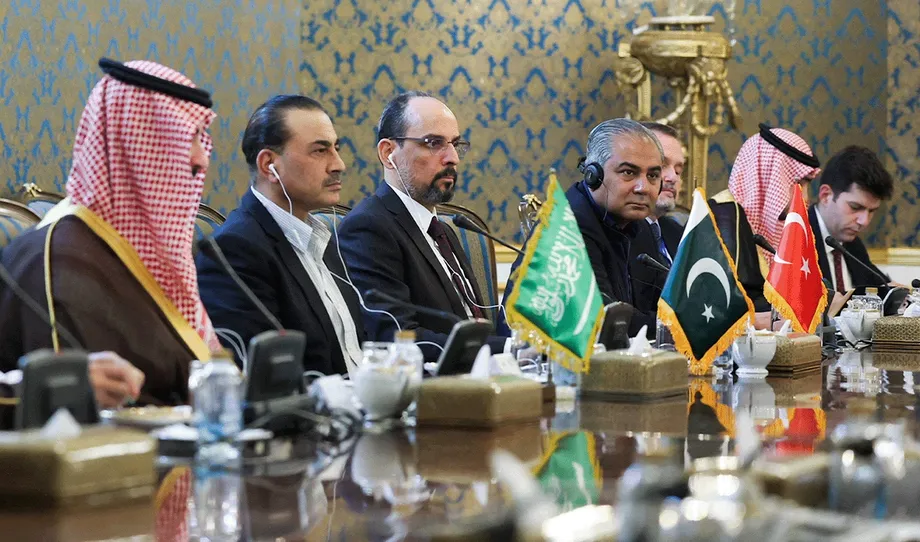
Mohsen Rezaei, secretary of Iran's Supreme National Security Council, hosted Saudi Defense Minister Prince Khalid bin Salman, Pakistan's army chief Field Marshal Asim Munir and Turkish intelligence chief Ibrahim Kalin. Iranian President Masoud Pezeshkian and Foreign Minister Abbas Araghchi also joined discussions with the visiting delegations. Pakistani Interior Minister Mohsin Naqvi accompanied Munir.
The four countries issued a joint statement setting out their agreed next step:
The participants agreed to continue the dialogue to strengthen cooperation among the four regional countries, including for peace and security in the region.
The statement gave no timetable, location or format for another meeting. The announced outcome was a commitment to further discussions, while the wider effort sought to reduce tensions and negotiate an end to the war.
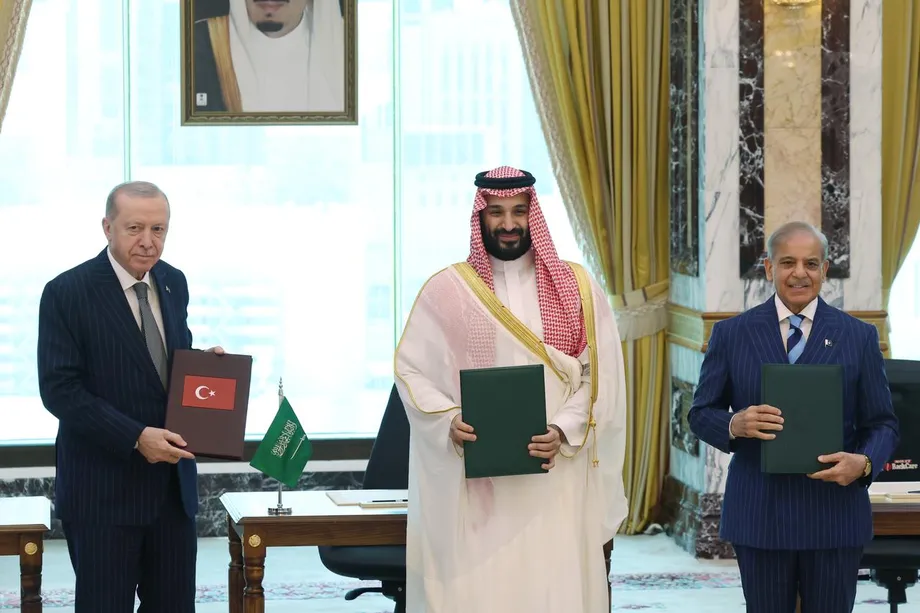
Monday's talks brought Iran together with the three members of the Makkah Joint Defense Agreement, signed in August. Saudi Arabia, Pakistan and Türkiye have promised to assist one another if attacked. Their joint visit placed that defense relationship alongside an effort to engage Tehran over a conflict increasingly affecting all four countries.
Pakistan proposed the meeting
Pakistan initiated the gathering, according to Iranian officials. Foreign Ministry spokesperson Esmail Baghaei said the proposal arose during Munir's visit to Tehran the previous week and was welcomed by Iran.
Munir's involvement connects the meeting to Pakistan's continuing mediation between Washington and Tehran. Pakistan and Qatar helped arrange an interim agreement in June, and both have continued carrying messages as efforts to reach a lasting settlement stalled.
Saudi Deputy Minister for Public Diplomacy Rayed Krimly described the Tehran visit as part of the Makkah pact countries' efforts to reduce tensions between the parties to the crisis. He said the visit supported dialogue, diplomatic solutions and mediation by Qatar and Pakistan.
Qatari mediators also traveled to Tehran on October 25 in coordination with Washington, according to an account citing a regional official familiar with the diplomacy. The consecutive visits show that the four country meeting was taking place alongside efforts to restore communication between Iran and the United States.
Iranian officials presented the gathering as a step toward security arrangements shaped by countries within the region. Baghaei said further consultations could help develop mechanisms for regional cooperation. In practical terms, that means building regular ways for governments to discuss threats and manage disputes before they lead to more fighting.
Eight months of war frame the talks
The diplomatic push followed nearly eight months of conflict that began with American and Israeli strikes on Iran on February 28. An April ceasefire ended the initial period of intense bombardment, but fighting and confrontation over maritime access continued.
Washington and Tehran have remained at odds over Iran's nuclear activities, sanctions, the American naval blockade of Iranian ports and passage through the Strait of Hormuz. Saudi Arabia has also faced escalating attacks by the Houthis, the armed movement in Yemen backed by Iran.
Several dates explain how the conflict and diplomacy reached Monday's meeting:
- February 28: The United States and Israel began their military campaign against Iran.
- April: A ceasefire ended the initial phase of intense bombardment.
- Mid June: Pakistan and Qatar helped broker the Islamabad Memorandum of Understanding between Washington and Tehran.
- August: Saudi Arabia, Pakistan and Türkiye signed the Makkah Joint Defense Agreement.
- October 5: The pact's members met in Riyadh to discuss implementing their defense commitments.
- October 26: The three countries met Iranian leaders in Tehran and agreed to continue security talks.
The June understanding aimed to end hostilities, reopen the Strait of Hormuz, lift the blockade and start negotiations on a broader settlement. It subsequently broke down as attacks resumed and disagreements over implementation persisted.
The defense pact adds urgency
The Makkah Joint Defense Agreement treats an armed attack on any one of its three members as an attack on all. Collective defense means that a country facing an attack can seek assistance from its partners under their shared commitments.
Saudi Arabia's exposure to Houthi missile and drone attacks has made those promises an immediate concern. At their October 5 meeting in Riyadh, the three countries agreed to move toward fulfilling the pact's commitments, including rapid deployment of agreed forces and military assets in Saudi Arabia.
Türkiye has described the agreement as defensive. Foreign Minister Hakan Fidan said on August 8 that it identified no common adversary. On October 8, he ruled out sending Turkish military personnel abroad to carry out attacks and said Ankara was considering support involving air defense, electronic warfare and technical assistance.
Air defense is intended to detect and intercept threats such as incoming missiles or drones. Electronic warfare uses electronic signals to disrupt systems such as communications or guidance equipment. Such assistance would give Saudi Arabia practical support while matching Ankara's stated focus on defense.
The Tehran meeting therefore joined two urgent tasks: discussing protection for Saudi Arabia and seeking cooperation with Iran to reduce the regional fighting. Saudi officials framed the visit around diplomacy, while Iranian officials welcomed discussion of security based on regional interests.
Yemen's conflict reaches Saudi airports
Houthi attacks on Saudi Arabia have brought the consequences of the wider war to airports and energy infrastructure. A strike claimed by the group on Riyadh's main airport earlier in October killed 13 people and halted operations.
Saudi Arabia said two terminals reopened on October 25 despite renewed Houthi threats. For travelers, airport closures mean canceled journeys and disrupted connections. For the authorities, reopening terminals while threats continue creates an immediate need to protect passengers, staff and aircraft.
Yemen and Houthi strikes on Saudi Arabia were discussed in Tehran, according to an account citing two regional officials who were not authorized to brief reporters. The issue links Saudi Arabia's immediate security concerns to its partners' defense commitments and their engagement with Iran.
Egypt's parliament approved President Abdel Fattah El-Sisi's request on October 26 to provide military support to help Saudi Arabia defend against the attacks. The decision widened the regional response as Saudi Arabia's pact partners pursued talks in Tehran.
The Houthis' relationship with Iran places Yemen within the broader diplomatic agenda. The concrete problem facing the meeting was how to reduce attacks and prevent further expansion of fighting while several governments were strengthening Saudi defenses.
Hormuz connects the war to global trade
The Strait of Hormuz remains one of the conflict's most consequential pressure points. Before the war, about one fifth of the world's oil and liquefied natural gas shipments passed through the narrow waterway, roughly one shipment in every five.
Iran claims control over passage and has targeted vessels attempting to cross without its authorization. The United States has imposed a naval blockade on Iranian ports. Together, the confrontation over transit and restrictions on port access have made shipping central to negotiations.
The Washington Institute recorded at least 30 vessels struck in the strait from the beginning of October, according to a published account citing its tracking. Attacks on vessels and energy infrastructure have increased costs for economies across the region and beyond.
Oil is used to produce transport fuels and many industrial products, while liquefied natural gas is natural gas cooled into liquid form for shipment. Interruptions can affect fuel deliveries, electricity generation and the cost of moving goods, carrying the effects of the war far beyond the countries fighting it.
Iran has reportedly put forward a proposal to reopen Hormuz within roughly a week if the blockade ends and certain restrictions on oil exports are eased, with nuclear discussions deferred. The central negotiating problem is the order of action: Tehran seeks relief from restrictions, while Washington seeks commitments from Iran.
Iran's nuclear position remains central
Pezeshkian used his meetings with the visiting officials to restate Iran's position that it seeks peaceful nuclear activities rather than nuclear weapons. He referred to Iran's membership of the Nuclear Non-Proliferation Treaty, commonly called the NPT.
The treaty combines commitments against the spread of nuclear weapons with provisions for peaceful nuclear cooperation and safeguards. Safeguards are checks intended to verify that nuclear material remains in peaceful use.
Iran's president said Tehran expected its rights to peaceful nuclear activity to be respected under international rules. He also argued that pressure and attacks on nuclear facilities, combined with invitations to negotiate, had deepened distrust among Iranian officials and the public.
Iranian officials said before Monday's meeting that nuclear negotiations were outside its agenda. Pezeshkian's comments set out Tehran's position while the discussions focused on regional security, the war and the blockade.
Baghaei said over the preceding weekend that Iran remained open to diplomacy and that messages were reaching Washington through intermediaries. He accused American officials of demanding Iran's "complete surrender," which he said Tehran would reject.
Palestine and Lebanon remain on the agenda
The Tehran discussions also covered Israel's activities across the region, developments in Palestine and Lebanon, and efforts to assist people in both places. Those issues widened the meeting beyond Iran's confrontation with the United States and Israel.
Pezeshkian called for coordination among Muslim countries in response to Israeli actions. He argued that regional governments should manage their differences and work through shared interests, while presenting stronger cooperation as a way to resist outside pressure.
Iran's president also outlined Tehran's willingness to take part in that cooperation:
The Islamic Republic of Iran, with firm conviction and serious determination, is ready to take steps toward deepening regional cooperation, resolving differences and drawing on the shared capabilities of Islamic countries.
Pezeshkian extended his proposals beyond military affairs. He advocated stronger trade, transport connections, scientific links and exchanges between universities and businesses. His argument was that closer economic and social relationships could give neighboring countries more shared reasons to preserve stability.
Iranian officials' references to regional security mechanisms point toward continued consultation among governments with different alliances and immediate priorities. Monday's joint statement placed peace and security within a common discussion, while leaving the detailed work for subsequent contacts.
Warnings sharpen the diplomatic pressure
Turkish President Recep Tayyip Erdogan warned on October 26 that renewed attacks on Iran would destabilize the region and damage countries outside the fighting. In a televised address, he urged restraint:
It is our hope that all parties will refrain from any actions that could drag our region into a new spiral of violence.
Israeli Prime Minister Benjamin Netanyahu said on October 25 that Iran or its allies could attack before Israel's election on October 27, citing intelligence. He said Israel's military was prepared to defend and strike. The United States was approaching its November 3 midterm elections.
American President Donald Trump had also raised the possibility of further military action against Iran if Tehran refused an agreement with Washington. The warnings added pressure to diplomatic efforts already struggling with the collapse of the June understanding.
For the four governments meeting in Tehran, the immediate achievement was preserving a channel that connects Iran to Saudi Arabia and its defense partners. The practical goals remain reducing attacks, protecting civilian infrastructure, restoring safer shipping and finding terms that Washington and Tehran can accept.
Key Points
- Iran, Saudi Arabia, Pakistan and Türkiye agreed in Tehran on October 26 to continue regional security talks.
- Pakistan proposed the meeting, which brought together senior security officials and Iranian leaders.
- The agenda included the war involving Iran, Yemen, maritime security, Palestine and Lebanon.
- Saudi Arabia, Pakistan and Türkiye are partners in the Makkah Joint Defense Agreement signed in August.
- Houthi attacks on Saudi Arabia and threats to shipping through Hormuz have increased the urgency of diplomacy.
- Pakistan and Qatar continue mediation after the June Islamabad understanding broke down.