A two year push to turn diplomatic ties into trade
Pakistan and the Maldives have agreed to raise annual bilateral trade from $13.9 million to $200 million within two years, setting a steep commercial target alongside 20 agreements covering areas from food supplies and healthcare to maritime security and artificial intelligence.
Contents
- A two year push to turn diplomatic ties into trade
- Food trade gives the economic plan a concrete starting point
- Direct flights could connect tourism and business
- Healthcare agreements build on an existing workforce
- Five university partnerships widen the education agenda
- Digital cooperation stretches from skills to data centres
- Security cooperation includes police and civil service institutions
- Pakistan pledges seeds and cuttings for five million trees
- Regional diplomacy accompanies the bilateral deals
- How the visit unfolded
- Key Points
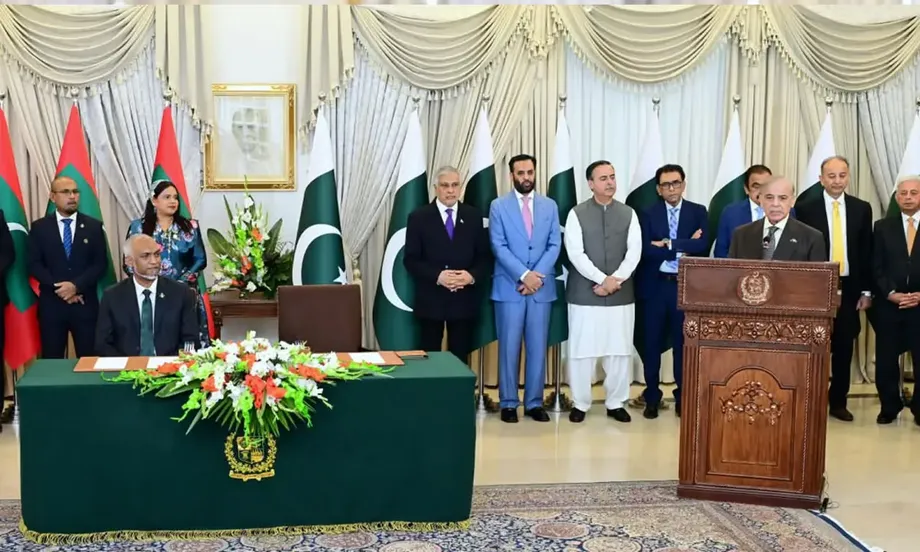
Prime Minister Shehbaz Sharif and Maldivian President Mohamed Muizzu witnessed the exchange of the agreements in Islamabad on October 21, 2026. Muizzu's visit, running from October 20 to 22, is the first by a Maldivian president to Pakistan since Abdulla Yameen Abdul Gayoom travelled there in May 2015.
The target would require trade to reach about 14.4 times its current value, an increase of $186.1 million. Sharif gave the starting figure as $13.9 million, although his announcement was also recorded as $130 million. The calculation here uses his more widely recorded $13.9 million figure.
The visit marks 60 years of diplomatic relations, established in July 1966. Both leaders said the economic relationship should become much larger, with businesses, universities, hospitals and public institutions taking a greater role.
Muizzu, explaining what he expected from the agreements, put their practical value at the centre of his remarks:
Our next step, of course, is to translate these understandings into tangible opportunities and meaningful benefits for the people of both nations.
The package contains memorandums of understanding, commonly called MoUs. These set out areas in which institutions intend to work together. Their practical effect depends on the projects, staffing, funding and commercial arrangements that follow. Sharif pledged to work personally with Muizzu to move the commitments into action through quicker decisions and implementation.
Food trade gives the economic plan a concrete starting point
The Maldives State Trading Organisation and the Trading Corporation of Pakistan signed an agreement covering agricultural commodities, food and other products. This provides a named institutional channel for expanding commerce, including bulk purchases of essential foods.
The two countries also concluded separate agreements on agriculture and fisheries. Together, these connect the trade ambition with specific sectors rather than leaving it solely as a headline figure. Businesses will still need to agree on products, prices, quantities and transport arrangements before additional trade takes place.
The Maldives-Pakistan Business Forum was scheduled for Thursday, October 22, bringing together business leaders, investors, inventors and innovators. Its purpose was to turn the leaders' commitments into investment proposals and business partnerships.
Deputy Prime Minister and Foreign Minister Ishaq Dar also met Muizzu in Islamabad. He identified trade, investment, education, climate change and tourism as priorities and welcomed the Maldivian business delegation's participation in the forum. Dar said direct engagement between companies could generate concrete opportunities.
The $200 million goal is ambitious because of the small starting base. The state trading agreement and business forum offer two routes towards it: purchases through established public trading bodies and new deals between private companies.
Direct flights could connect tourism and business
Muizzu welcomed discussions about establishing direct flights between Pakistan and the Maldives. The countries exchanged an agreement on air connectivity and committed to deeper tourism cooperation.
Direct services could make travel simpler for tourists, business visitors, students and healthcare professionals. The airlines, routes, service frequency and launch date had not been announced.
Muizzu identified halal and Muslim friendly tourism as an area with potential. In practical terms, this can include access to halal food, prayer facilities and accommodation services suited to Muslim travellers. He said shared values and experience offered a basis for cooperation.
Tourism also connects with the wider education agenda. Maldives National University identified hospitality and tourism as fields in which its own experience could support academic partnerships with Pakistan. This gives cooperation a reciprocal element, alongside Pakistan's offers of training and technical assistance.
Healthcare agreements build on an existing workforce
About 250 Pakistani doctors and paramedical professionals are serving in the Maldives, according to Sharif. Pakistan offered to send more professionals in response to Maldivian requirements, building on an existing relationship rather than starting a new staffing programme from scratch.
The agreements include the recruitment of health professionals and broader health cooperation. Another links the Maldives Food and Drug Authority with the Drug Regulatory Authority of Pakistan, bringing the institutions responsible for regulating medicines into the partnership.
Maldivian students have also studied at Pakistani universities and colleges, particularly in healthcare. The leaders discussed increasing medical placements under Pakistan's Technical Assistance Programme and exploring internships in Pakistan for Maldivian medical graduates.
For students and graduates, those proposals concern different stages of a medical career. Study placements provide education, while internships offer supervised practical experience. For Maldivian health services, the recruitment agreement concerns the professionals available to care for patients.
Pakistan's offer therefore combines immediate workforce support with education that could help train future staff. The number of additional workers, placements and internships will depend on subsequent arrangements between the responsible institutions.
Five university partnerships widen the education agenda
Pakistan's Higher Education Commission facilitated five agreements between Maldives National University and Pakistani universities during the visit. The partners were the National University of Sciences and Technology, Pir Mehr Ali Shah Arid Agriculture University Rawalpindi, the University of Wah, Government College University Lahore and Foundation University Islamabad.
Maldives National University Vice Chancellor Dr. Aishath Shehenaz Adam identified marine sciences, tourism and hospitality, environmental sustainability and climate change as promising areas for cooperation. She also described existing Pakistani partnerships in medical education, university management systems, agriculture and food sciences, and law.
HEC Chairman Dr. Niaz Ahmad Akhtar encouraged joint research, staff exchanges and joint or dual degree programmes. He said the number of Pakistani institutions appearing in international rankings had risen from two in 2015 to 56 in 2026, although he did not identify a particular ranking in those remarks.
The wider government package covers technical and vocational education, higher education, youth and sports. The leaders also discussed opportunities in Pakistan for Maldivian students, athletes, coaches and young professionals, including training in entrepreneurship, innovation and leadership.
Digital cooperation stretches from skills to data centres
Information technology cooperation includes cybersecurity, artificial intelligence, digital skills, technology and innovation. Sharif offered Pakistani technical expertise to support the Maldives as it develops data centres.
Data centres house the computers and equipment used to store and process digital information. Governments and businesses use them to run services and applications. Sharif said Pakistan had developed relevant professional capabilities through establishing such facilities in several locations.
Cybersecurity concerns protecting computer systems and information from intrusion, theft and disruption. Placing it alongside digital skills and artificial intelligence connects the training agenda with the protection and operation of digital services.
Muizzu also highlighted digitalisation and emerging technologies as areas where young Maldivians could gain new professional opportunities. The proposals combine institutional technical support with education and skills development.
Security cooperation includes police and civil service institutions
Defence and maritime security form part of the 20 agreements. Pakistan and the Maldives already have training ties, including a 2016 understanding to expand opportunities for Maldivian military personnel.
The new package also covers combating illicit trafficking and narcotic drug abuse. An institutional agreement links the Maldives Police Service's National College of Policy and Law Enforcement with Pakistan's National Police Academy in Islamabad.
Pakistan's Minister of State for Interior Talal Chaudhry separately met Maldivian Minister of Homeland Security, Labour and Technology Ali Ihusaan. Their discussions addressed human trafficking, irregular migration, organised crime and the exchange of security expertise. Pakistan's interior ministry announced no new joint operation or implementation timetable.
Chaudhry described why the two governments wanted closer law enforcement contacts:
Strengthening contacts and cooperation is essential to tackle shared challenges such as illegal immigration and human trafficking.
The Civil Service Commission of the Maldives also reached agreements with Pakistan's Federal Public Service Commission and Civil Service Academy. These extend the partnership into public administration, alongside separate commitments on social protection, arts, culture and heritage.
Pakistan pledges seeds and cuttings for five million trees
Pakistan will provide 100,000 olive cuttings and 100,000 seeds of other plant species to support the Maldives' plan to plant five million trees. Delivery is to take place within a mutually agreed timeframe.
The combined pledge amounts to 200,000 cuttings and seeds, numerically equal to 4% of the five million tree target. The number of trees eventually established will depend on successful propagation, planting and survival.
Muizzu described climate change as a direct challenge to the Maldives' security, development and future. He welcomed Pakistan's support and called for cooperation on environmental conservation, waste management, renewable energy and climate resilience.
Climate resilience means helping communities, infrastructure and services cope with climate pressures. The countries concluded a separate environmental cooperation agreement, while Maldives National University's proposed research partnerships offer another channel for work on environmental sustainability and the challenges facing small island nations.
Muizzu also planted a sapling at the Prime Minister's House after receiving a guard of honour. The gesture accompanied a visit whose environmental commitments extend beyond tree planting to energy, conservation and research.
Regional diplomacy accompanies the bilateral deals
Muizzu called for renewed activity through the South Asian Association for Regional Cooperation, or SAARC. The eight member organisation last held a leaders' summit in Kathmandu in November 2014. A summit planned for Islamabad in 2016 was postponed after India and several other members declined to participate amid regional tensions.
Muizzu said the Maldives was ready to work with all member states to create conditions for another summit. He also highlighted cooperation through the United Nations and the Organisation of Islamic Cooperation.
Both leaders reiterated support for Palestinian self determination. Muizzu backed an independent Palestinian state based on the borders before 1967, with East Jerusalem as its capital. Sharif also restated Pakistan's position that the Jammu and Kashmir dispute should be resolved in accordance with relevant United Nations Security Council resolutions and the wishes of the Kashmiri people.
Sharif raised India's decision to place the Indus Waters Treaty in abeyance in April 2025. He said legally binding treaties must be respected and shared water resources must not become instruments of political pressure. Calling water a national red line, he warned that Pakistan would regard a violation involving its water supplies as an act of war.
How the visit unfolded
Muizzu travelled at Sharif's invitation with First Lady Sajidha Mohamed, cabinet ministers and senior officials. His programme combined ceremonial events with government talks, institutional agreements and planned commercial meetings.
- July 1966: Pakistan and the Maldives established diplomatic relations.
- May 2015: Then Maldivian president Abdulla Yameen Abdul Gayoom visited Pakistan.
- October 20, 2026: Muizzu arrived in Islamabad for a visit lasting three days.
- October 21, 2026: Muizzu and Sharif held talks and witnessed the exchange of 20 cooperation agreements.
- October 22, 2026: The Maldives-Pakistan Business Forum was scheduled to bring the two business communities together.
Muizzu also received an honorary doctorate in politics from the International Islamic University Islamabad. His programme included a scheduled meeting with President Asif Ali Zardari and a state banquet.
The next practical work lies with the trading bodies, ministries, universities and businesses named in the agreements. Their purchasing contracts, recruitment arrangements, training programmes and investment decisions will determine how much of the promised expansion reaches people in both countries.
Key Points
- Pakistan and the Maldives set a target of $200 million in annual bilateral trade within two years.
- The leaders exchanged 20 agreements covering commerce, healthcare, education, technology, security and other sectors.
- A state trading agreement covers agricultural commodities, food and other products.
- Direct flights are under discussion, with no launch date announced.
- Pakistan offered more healthcare professionals and pledged 100,000 olive cuttings and 100,000 other seeds.
- Five university partnerships add research and academic exchanges to the wider cooperation programme.
- Muizzu called for renewed SAARC summit activity during the countries' 60th anniversary of diplomatic relations.