A Foreign Currency Buffer With a Repayment Deadline
India could face repayments of $160 billion to $170 billion, including interest, over the next three to five years on foreign currency deposits that have brought in more than $130 billion, according to Uday Kotak, founder and non-executive director of Kotak Mahindra Bank. His message was to start preparing while the funding still provides protection against global shocks.
Contents
- A Foreign Currency Buffer With a Repayment Deadline
- What the Deposits Give India
- Why the August 31 Closing Date Mattered
- How US Bond Returns Enter the Picture
- Taxes Are Steering Domestic Savings
- Domestic Buying and Foreign Selling Can Happen Together
- Gold Imports Add Another Demand for Dollars
- What India Should Build Before Repayments Arrive
- Key Points
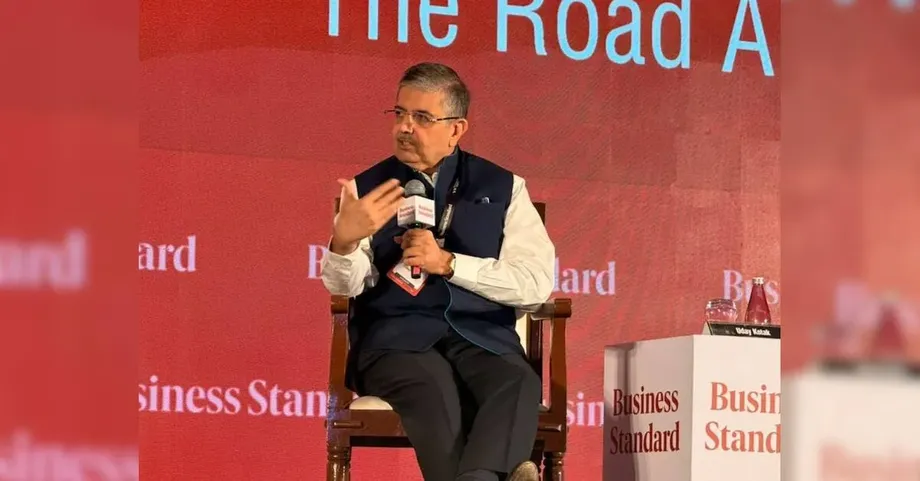
Speaking at the Business Standard BFSI Insight Summit 2026 at Mumbai's Jio World Convention Centre on October 26, Kotak praised the government and the Reserve Bank of India (RBI) for securing the money amid the Middle East conflict and the Russia-Ukraine war. He described the FCNR(B) mobilisation as a useful buffer that gives India time to strengthen its economy.
Kotak said the deposits would eventually have to be returned, making the next several years a period for preparation. The repayment range is his estimate; he did not give a schedule showing how much would mature in each year.
Kotak, explaining why policymakers should act before the deposits mature, said:
We don't need to panic about it today, but we must be strategic about it. We need to build India's economic and financial structure for that time, which will inevitably come.
His argument connected several pressures that are often discussed separately: the cost of borrowing dollars, competition for Indian savings, foreign investors taking money home, and the foreign currency spent on gold imports. Together, they shape how comfortably India can meet future external payments.
What the Deposits Give India
FCNR(B) stands for Foreign Currency Non-Resident (Bank). These are bank deposits held in foreign currencies by eligible people living outside India. Banks receive foreign currency funding and owe depositors their money back, together with the agreed interest, when the deposits mature.
Foreign currency funding matters because international payments require currencies accepted abroad. Indian rupee savings support domestic activity, while dollars and other foreign currencies help meet obligations to overseas suppliers, investors and lenders.
Kotak said the mobilisation strengthened India's foreign currency resources at a time of geopolitical uncertainty. Securing funds at a fixed interest rate also provided protection against a subsequent rise in global borrowing costs.
The benefit comes with a future obligation. When deposits mature, banks need foreign currency to repay them or must persuade depositors to renew. Kotak's concern is that India should build stronger sources of external income and financial resilience during the breathing space the deposits provide.
The practical challenge is therefore spread across time: funding arrives first, supports the financial system, and later generates repayment needs. Preparation involves considering both the amount owed and when the payments fall due.
Why the August 31 Closing Date Mattered
Kotak credited the RBI with closing the mobilisation scheme on August 31, before US bond yields rose sharply in early September. He said India had secured funding in dollars at a fixed rate before the increase, avoiding costs that would have been at least 100 basis points higher.
A basis point is one hundredth of a percentage point. An increase of 100 basis points means, for example, that an annual interest rate rises from 5% to 6%. For a large borrowing programme, even that single percentage point can make a substantial difference to interest payments.
Kotak's account set out the following sequence:
- August 31: The RBI closed the deposit mobilisation scheme, according to Kotak.
- Early September: US bond yields rose sharply, making new dollar funding more expensive.
- October 26, 2026: Kotak urged preparation for eventual repayments during his Mumbai summit address.
- The following three to five years: His estimated window for strengthening India's financial position before the deposits require repayment.
The timing delivered a saving at the point of raising funds, in Kotak's assessment. His warning focused on what comes afterward: using that cheaper funding period to improve India's ability to meet the eventual bill.
How US Bond Returns Enter the Picture
Kotak also pointed to competition between returns on US government bonds and Indian government securities. He cited a US Treasury bond maturing in 10 years yielding around 5%, compared with approximately 7.4% on India's government bond of the same maturity.
Currency arrangements can change that comparison. A rupee investor buying a dollar asset faces movements in the exchange rate as well as changes in the bond's value. Hedging means arranging a future currency exchange to reduce uncertainty about the rupee value of the investment.
Kotak cited an annual currency hedging component of about 3.5% and put the resulting return in rupees on the US investment at roughly 8.5%. That calculation treats the currency component as an addition to the dollar yield. In practice, the direction of the currency transaction determines whether an investor pays or receives the relevant forward currency difference.
Using his figures, the suggested return advantage over the Indian government bond is 1.1 percentage points, or 110 basis points. Actual returns depend on the transaction's terms, access to the market and other costs.
Kotak's broader concern was that investors compare opportunities across currencies. He also said India's government bond yield for a maturity of 10 years had risen by around 75 to 80 basis points amid inflation and geopolitical tensions. Those movements affect the rates against which other domestic borrowing is priced.
Taxes Are Steering Domestic Savings
Indian investors face another comparison before choosing where to put their money: how much of the return remains after tax. Kotak cited an effective capital gains tax rate of about 14.95%, including surcharge and other charges, against tax on interest income that could reach 39% for large individual investors.
Capital gains are profits from selling an investment for more than its purchase price. Interest is the payment earned on money placed in a deposit or lent through an interest bearing instrument. Their tax treatment can influence which investments look more attractive to a saver.
At the rates Kotak cited, an illustrative taxable gain of 100 rupees would leave about 85.05 rupees after tax, while 100 rupees of taxable interest would leave 61 rupees. The example holds the income amount constant to show the tax difference; actual tax bills depend on the investor and the investment.
Kotak said the gap was encouraging people with surplus money to choose investments generating capital gains, including shares, and putting pressure on demand for deposits and other instruments paying interest.
For banks, the allocation of household savings matters because deposits are a major source of funding. Kotak's argument brought domestic tax choices into the same discussion as foreign currency funding: both affect where the financial system obtains money and how much it must pay for it.
Domestic Buying and Foreign Selling Can Happen Together
Kotak estimated that foreign portfolio investors held about $700 billion in Indian assets. Including foreign direct investment, he put the total foreign investment stock at approximately $1.5 trillion.
Portfolio investment includes holdings of financial assets such as shares and bonds. Foreign direct investment generally involves a more lasting ownership interest in a business. Kotak used the figures to describe the scale of foreign participation in India's economy and markets.
Domestic investors can support share prices by buying when foreign investors sell. The foreign sellers may then exchange the rupee proceeds for dollars and send the money abroad, creating demand for foreign currency even while domestic participation in the market remains strong.
Kotak, describing the role of Indian buyers in those transactions, said:
At one level, the Indian investor is the counterpoint as foreign flows happen. At another level, the Indian investor, directly or indirectly, is giving exit to the foreigners, and I'm not against that. It's free markets. We must respect that.
His concern linked the domestic investment surge to India's external accounts. Local buying can absorb assets being sold, while the currency market still has to accommodate investors moving their proceeds overseas.
Gold Imports Add Another Demand for Dollars
Kotak cited a current account deficit of $26 billion for the financial year ending March 2026 alongside gold imports of $72 billion. He argued that India would have recorded a current account surplus without those gold imports.
The current account records trade in goods and services, together with income and transfers across borders. A deficit means that payments abroad under those categories exceed receipts. India then needs financing from investment flows, borrowing or other external resources.
On the figures Kotak used, removing $72 billion in gold imports from a deficit of $26 billion would produce a surplus of $46 billion, with every other part of the account unchanged. Gold imports were therefore about 2.8 times the size of the deficit he cited.
For the financial year ending March 2027, Kotak said gold imports could reach $90 billion, while oil imports could be $60 billion to $65 billion. His gold projection would be $18 billion, or 25%, above the $72 billion figure for the preceding year.
Kotak acknowledged the right of Indian households to hold gold, while urging strategic consideration of the foreign currency required to buy it. He warned that heavy gold imports, combined with pressure from portfolio flows, could weigh on the rupee.
What India Should Build Before Repayments Arrive
Kotak called for investment in research, technology and industries serving demand beyond India's borders. He argued that the country should use the next three to five years to become more competitive in selected areas, rather than depend solely on overseas investors seeking access to its domestic market.
Kotak, setting out his ambition for Indian industry, said:
India has to build, at least in a few areas in the next five years, to be a counterpoint and to be counted in the world in what the world needs from us.
Businesses that sell goods and services abroad can bring in foreign currency through earnings. That creates a different source of external resources from deposits that must later be repaid or investments whose owners may eventually take their proceeds home.
Kotak's proposals connect the repayment question to the wider economy. More competitive industries could generate overseas income, while decisions on savings, taxation and imports influence how much foreign financing India needs.
The immediate message was preparation, rather than alarm. Kotak remained positive about India's longer prospects, while urging policymakers and financial institutions to use the time secured by the deposits to strengthen the country's capacity to handle external payments.
Key Points
- Kotak estimated that more than $130 billion in FCNR(B) funding could require repayments of $160 billion to $170 billion, including interest, over three to five years.
- He praised the RBI's August 31 closing date, saying later funding would have cost at least 100 basis points more.
- His bond comparison put a currency hedged US Treasury return at about 8.5% in rupees, against 7.4% on India's government bond.
- He said differences in taxation were directing domestic savings toward capital gains and away from interest income.
- Kotak cited $72 billion in gold imports against a $26 billion current account deficit for the financial year ending March 2026.
- He urged investment in research, technology and industries meeting global demand before the deposits mature.