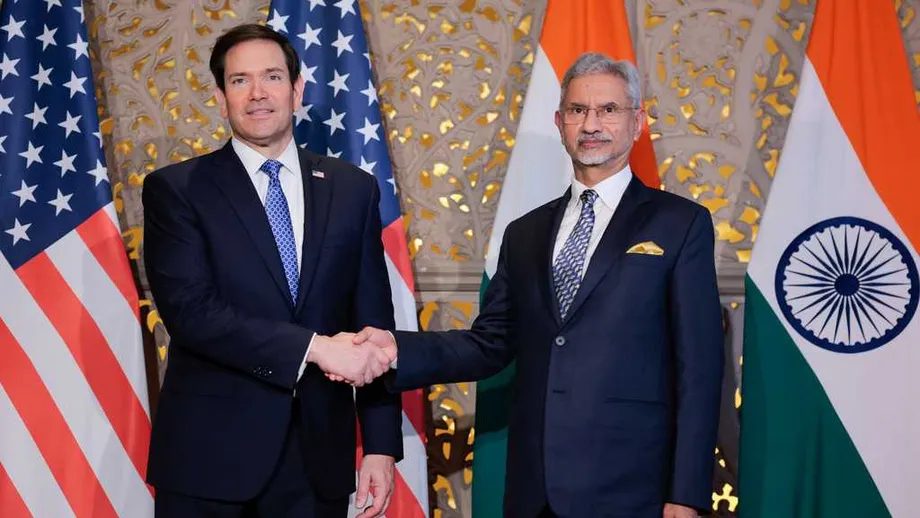
Mumbai talks bring a trade agreement closer
U.S. Secretary of State Marco Rubio said on October 20, 2026, that Washington and New Delhi were weeks away from completing a trade agreement, as talks in Mumbai linked tariff negotiations with India's purchases of oil, American technology and defence equipment. He described 99 percent of the work as complete, with negotiators still settling the wording of the remaining provisions.
Contents
- Mumbai talks bring a trade agreement closer
- Why the final wording still matters
- Tariffs and a court ruling changed the bargain
- Farm markets remain a sensitive issue
- Russian oil connects energy policy to trade
- Jamnagar puts alternative oil supplies in focus
- Defence talks extend beyond the trade agreement
- Visa concerns remain part of the relationship
- Business meetings and further diplomacy follow
- Key Points
Rubio met Indian External Affairs Minister Subrahmanyam Jaishankar as both governments sought to move beyond months of friction over American import duties, India's purchases of Russian crude and tighter U.S. immigration rules. India's Ministry of External Affairs said the ministers welcomed progress on the India-U.S. Bilateral Trade Agreement and reaffirmed their commitment to an early conclusion.
Rubio, speaking to reporters in Mumbai, offered an optimistic assessment of the negotiations:
We're very, very close. I would say we're about as close as you can be without having executed the agreement.
President Donald Trump echoed that optimism in Washington on Tuesday. Speaking at the Oval Office alongside Vice President JD Vance, he said the countries were close to an agreement and described the proposed arrangement as different from earlier deals.
Trump's comments brought no new tariff cuts, investment commitments or market access concessions. The remaining negotiating provisions, the final tariff schedule and a signing date were not disclosed.
For Indian exporters, the practical issue is the cost of selling goods into the American market. For Washington, the discussions also offer a chance to increase American sales to India while encouraging a shift away from Russian energy and military supplies.
Why the final wording still matters
Rubio said the outstanding work involved technical details, including making sure both governments understood the agreement's language in the same way. In a Mumbai interview, he explained why even a nearly completed negotiation can require more time.
Technical details matter because there has to be agreement. Both sides have to agree that the language means the same thing. So, it's down to that level.
A trade agreement turns political promises into rules that officials and businesses must apply. The wording determines which goods qualify for a benefit, what conditions apply and when a commitment takes effect. Agreement on a broad goal therefore leaves negotiators with the task of making those obligations precise.
Commerce and Industry Minister Piyush Goyal has said the first tranche, or initial part, of the agreement had been finalised and was undergoing legal drafting. Earlier in October, he met U.S. Trade Representative Jamieson Greer in Milwaukee and Washington to discuss the details.
Greer, however, said an agreement was not "imminent," while Finance Minister Nirmala Sitharaman said earlier this month that negotiations had reached a plateau. Rubio acknowledged that the U.S. trade representative, rather than his own department, leads the negotiations. His forecast of weeks rather than months was the most optimistic timetable offered during the visit.
U.S. Ambassador to India Sergio Gor had said the previous week that the big items were settled. Jaishankar also expressed encouragement, saying the two sides were heading toward a landing point. Together, those comments suggest political support for completion, even as negotiators continue working through the text.
Tariffs and a court ruling changed the bargain
Washington imposed tariffs of up to 50 percent on most Indian goods in August 2025, including a penalty connected to India's purchases of discounted Russian oil. A tariff is a tax collected on an imported product. It adds to the cost of bringing that product into the country and can affect prices, profit margins and purchasing decisions.
The February 2026 framework envisaged reducing the U.S. tariff rate to 18 percent. That represented a reduction of 32 percentage points from the earlier maximum of 50 percent. Days after the framework, the U.S. Supreme Court struck down Trump's sweeping tariffs, creating uncertainty over the duties underpinning the proposed exchange of concessions.
Ajay Srivastava, founder of the Global Trade Research Initiative, explained in a note earlier this month that the court's decision changed the value of what Washington had offered India.
Once that tariff regime was struck down, the value of the U.S. offer became unclear.
India has continued seeking tariff terms comparable to those available to competing manufacturing countries such as Vietnam. Rubio said Washington's priority was a sustainable trading relationship rather than a particular tariff figure, while acknowledging that better rates were a purpose of making a deal.
The main steps leading to the Mumbai talks were:
- August 2025: Washington imposed tariffs of up to 50 percent on most Indian goods.
- February 2026: The countries announced a framework for the first phase of a trade agreement, envisaging an 18 percent tariff rate.
- Days later: The U.S. Supreme Court struck down Trump's sweeping tariffs, prompting further uncertainty and negotiations.
- Earlier in October: Goyal met Greer in Milwaukee and Washington.
- October 16: Trump waived threatened tariffs of up to 100 percent on buyers of Russian energy.
- October 20: Rubio and Jaishankar met in Mumbai and backed an early conclusion of the agreement.
Farm markets remain a sensitive issue
India's resistance to opening poultry, dairy, rice and wheat markets to greater American competition has been among the obstacles to an agreement. Agriculture is politically sensitive because changes in import rules can affect the prices farmers receive and the competition they face.
Washington wants fewer barriers for American exports and greater access for U.S. companies. New Delhi is balancing those demands against the interests of domestic producers while seeking better conditions for Indian exports, including pharmaceuticals, engineering goods, textiles and electronics.
Indian goods exports to the United States reached $8.3 billion in August, up 21 percent from the same month a year earlier. That puts the previous August's value at roughly $6.9 billion, a gain of about $1.4 billion. The figures show the scale of business continuing while the governments negotiate.
Exporters have a direct interest in the final tariff schedule because even a small difference in duties can affect the price a buyer pays. Farmers and manufacturers supplying India's domestic market have a different concern: how much additional competition the agreement will permit. The final text will set out how the two governments balance those interests.
Russian oil connects energy policy to trade
India expanded purchases of discounted Russian crude after Russia's invasion of Ukraine in February 2022. New Delhi has defended its purchasing decisions as a way to keep energy affordable and maintain stable supplies, while saying it would broaden its suppliers, including through more imports from the United States.
Rubio said India had made substantial progress in diversifying its oil supplies. Before leaving the United States, he also acknowledged that India continued buying substantial volumes from Russia because changing suppliers could not happen overnight.
The Trump administration's pressure has included a law allowing tariffs of up to 100 percent on countries purchasing Russian energy. Trump waived those threatened measures on the Friday before Rubio's Mumbai talks. The waiver reduced an immediate threat hanging over the negotiations.
Rubio, explaining Washington's position during an interview in India, said the measures formed part of its policy toward the war in Ukraine:
None of these tariffs are meant to punish or harm India. They are part of a broader foreign policy that, unfortunately, involves a war going on between Russia and Ukraine that we would like to see come to an end.
India's energy decisions involve both cost and refinery requirements. Refineries are designed to process particular types of crude, and replacing one supply with another involves arranging shipments and ensuring the oil suits the equipment. Rubio's acknowledgment of the time required for a shift accompanied his push for more American energy sales.
Jamnagar puts alternative oil supplies in focus
Rubio was scheduled to visit Reliance Industries' refinery complex at Jamnagar in Gujarat on Wednesday, October 21. Operated by the company led by Mukesh Ambani, the world's largest refining complex processes roughly 1.4 million barrels of crude a day.
Jamnagar can handle Venezuela's ultra-heavy crude, a particularly thick form of oil that requires suitable processing equipment. Rubio said he planned to encourage Reliance to refine more Venezuelan oil and discuss opportunities for the company to produce oil inside Venezuela.
Rubio, describing those planned discussions to reporters, said Reliance had experience processing Venezuelan supplies:
They have done so in the past, and I think as more and more of Venezuelan oil comes online, that is something they can do.
The visit gives the energy talks a concrete industrial focus. Washington is seeking a larger role in supplying India's energy needs while also discussing another crude source that Reliance's facilities can process. India, meanwhile, is seeking a broader range of suppliers without sacrificing affordable fuel.
Defence talks extend beyond the trade agreement
Jaishankar and Rubio also discussed defence, technology and civil nuclear cooperation. According to the U.S. State Department's account of their meeting, Rubio welcomed recent progress and advocated increased Indian purchases of American technologies and systems.
Washington is seeking closer defence interoperability, meaning that the two countries' forces and equipment can work together more easily. The discussions also fit its effort to reduce India's reliance on Russian military supplies while expanding commercial opportunities for American companies.
The ministers linked their discussions to the India-U.S. COMPACT initiative, launched by Prime Minister Narendra Modi and Trump in 2025. Its name stands for Catalyzing Opportunities for Military Partnership, Accelerated Commerce and Technology, bringing several strands of cooperation under a shared framework.
At Mumbai's Freedom 250 reception, marking the United States' 250th anniversary, Rubio called for a free and open Indo-Pacific where no country could claim dominance over international shipping. He described India as a strong geopolitical partner and pointed to shared commitments to individual dignity, democratic principles and the rule of law.
Rubio also met Jaishankar and United Arab Emirates Foreign Minister Sheikh Abdullah bin Zayed Al Nahyan in a trilateral discussion. He said the three addressed regional energy security and shared economic priorities. The bilateral discussions included developments in West Asia, according to the State Department.
Visa concerns remain part of the relationship
Jaishankar said the ministers discussed ties between their peoples, a subject that includes Indian concerns about U.S. immigration policy and administration of the H-1B visa programme. H-1B visas allow American employers to hire foreign workers for specialised jobs.
Indian students and skilled professionals have faced tighter rules and scrutiny as the Trump administration changes immigration procedures. Rubio said the measures were part of a global overhaul rather than an effort directed at India, describing the system as having suffered from 20 years of neglect.
Rubio said Washington continued to welcome people seeking to visit, study, work temporarily or invest in the United States, provided they followed immigration law. He acknowledged that India could feel the effects strongly because large numbers of Indians apply in certain visa categories.
For businesses, universities and families, immigration procedures are a practical part of the relationship alongside trade. Jaishankar told the anniversary gathering that Indian talent and skills had helped shape the technology era in the United States, bringing those personal and professional connections into the diplomatic discussions.
Business meetings and further diplomacy follow
Mumbai's role as India's financial centre shaped Rubio's itinerary. He was scheduled to meet business leaders including Tata Sons chairman N. Chandrasekaran and Adani Group chairman Gautam Adani, with the State Department describing the commercial programme as promoting investment and economic cooperation.
Rubio also laid a wreath at the Taj Mahal Palace Hotel to remember the 166 people killed in the 2008 Mumbai attacks. The State Department said he reaffirmed solidarity with India and the administration's commitment to dismantling terrorist networks and bringing those responsible to justice.
The next diplomatic engagements were expected later in October, when Jaishankar and Rubio were due to meet at the G20 foreign ministers' gathering in Atlanta and join their Japanese and Australian counterparts for Quad talks. Officials were also working toward possible meetings involving national leaders in Manila the following month.
Rubio suggested that leaders could sign the trade agreement after an announcement of progress. For businesses planning orders, investment or supply contracts, the immediate milestone is a completed text that sets out the tariffs and market access terms both governments will implement.
Key Points
- Rubio and Jaishankar met in Mumbai on October 20, 2026, and backed an early conclusion of the bilateral trade agreement.
- Rubio said 99 percent of the work was complete and forecast completion in weeks, while Greer said a deal was not imminent.
- The February framework envisaged an 18 percent U.S. tariff rate, down from duties of up to 50 percent, before a Supreme Court ruling complicated the bargain.
- Agriculture, tariff terms and legal wording remain central to completing the agreement.
- Trump waived threatened tariffs of up to 100 percent on Russian energy buyers before Rubio's visit.
- Rubio's planned Jamnagar visit focused on energy cooperation, including possible additional Venezuelan crude purchases.
- The ministers also discussed defence, technology, immigration concerns and regional security.