A stock market milestone for a teacher from Uttar Pradesh
PhysicsWallah shares closed at ₹155.20 on November 18, 2025, up 42.39% from their ₹109 issue price, turning a business built around free physics lessons into a listed company valued at about ₹44,382 crore. For cofounder Alakh Pandey, the debut marked a striking financial milestone after a childhood in which his family sold its home to meet everyday expenses.
Contents
- A stock market milestone for a teacher from Uttar Pradesh
- How financial hardship led Pandey to teaching
- Free lessons became a business reaching millions
- What happened during the IPO
- What the listing changed for the founders
- Why a digital educator is building classrooms
- Funding and acquisitions broadened the business
- Revenue grew, while losses continued
- The test is keeping scale affordable
- Key Points
The education technology company's initial public offering, or IPO, totalled about ₹3,480 crore, approximately $390 million. Of that, ₹3,100 crore came from newly issued shares to fund the business, while ₹380 crore came from shares sold by its founders. An IPO allows investors to buy shares before a company begins trading on a stock exchange.
Pandey, described as 33 at the time of the listing, joined India's billionaire ranks. Forbes estimated his wealth at around $1.5 billion. His remaining PhysicsWallah shares were valued at about ₹16,044 crore at the closing price on the first trading day, illustrating how strongly his fortune is tied to the company's share price.
PhysicsWallah entered public markets with millions of paying learners, 303 physical centres and a growing collection of education businesses. It also brought continuing losses and substantial spending plans. The central business challenge is now concrete: keep courses affordable while paying for more teachers, classrooms, technology and marketing.
For students preparing for engineering, medicine and government recruitment examinations, those choices will affect where they can study, which courses they can access and how much they pay.
How financial hardship led Pandey to teaching
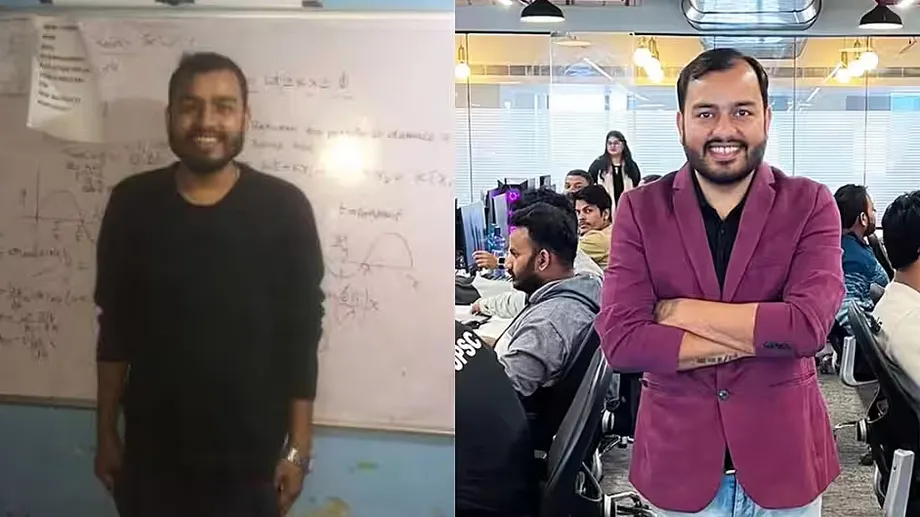
Pandey grew up in Prayagraj, Uttar Pradesh, in a family supported by his father's work as a private contractor and his mother's work as a teacher. When money became scarce, his father sold their home in parts to cover expenses. The family eventually moved into rented accommodation in a slum.
By sixth grade, Pandey was tutoring classmates and younger children. He walked five kilometres a day to teach and earned ₹200 per session, continuing the work through the end of school. Teaching began as a practical way to earn money long before it became the basis of a company.
Pandey did not pass the IIT entrance examination, the highly competitive route into the Indian Institutes of Technology. He performed well in Uttar Pradesh's engineering entrance examination and enrolled in mechanical engineering at Harcourt Butler Technical Institute in Kanpur.
He left during his third year after deciding that engineering was not the career he wanted. Returning home, he concentrated on teaching physics, eventually reaching students far beyond the neighbourhoods where he had once walked to give lessons.
Accounts of the channel's beginnings give different dates: the biographical account places its launch in 2014, while the listing history dates its start to 2016. By 2019, the channel had more than two million subscribers.
Free lessons became a business reaching millions
Pandey's appeal rested on explaining difficult subjects through familiar examples, humour and an informal classroom manner. He even used his tattoos as visual references during lessons. Students preparing for competitive examinations could watch without paying the fees charged by conventional coaching centres.
In 2020, he partnered with Prateek Boob, also identified in accounts of the listing as Prateek Maheshwari. His partner had developed the education application PenPencil. Together, they turned the teaching audience into a business offering structured courses through an app and other channels.
Engineering and medical entrance preparation formed the initial core. JEE is used for admission to engineering programmes, while NEET is the entrance examination for undergraduate medical courses. PhysicsWallah later added school subjects, civil service and other government recruitment examinations, alongside professional courses in areas such as data science, finance and software development.
By February 2025, its app had passed 10 million Android downloads. The original channel approached 14 million subscribers, while the wider business grew to more than 200 YouTube channels with a combined subscriber count approaching 100 million. Those channel totals can include the same person subscribing more than once across the network.
Paying users provide a more direct measure of the business. PhysicsWallah recorded 4.46 million paid users in the financial year ended March 31, 2025, with reported average annual growth of 59.19% between the 2023 and 2025 financial years.
What happened during the IPO
PhysicsWallah's share sale opened on November 11 and closed on November 13, 2025, with a price range of ₹103 to ₹109. At the final price of ₹109, the minimum application of 137 shares cost ₹14,933.
Demand reached 1.81 times the shares available for subscription. Qualified institutional buyers, a category that includes large professional investment organisations, subscribed 2.7 times their allocation. Retail investors subscribed 1.06 times theirs, while the category for larger investors outside the institutional group reached 0.48 times its allocation.
The shares began trading at ₹143.10, a 31.28% premium to the issue price. They reached ₹162.05 during the day before closing at ₹155.20. The frequently cited gain of about 42% describes the closing performance; the opening gain was about 31%.
The key dates were:
- November 10, 2025: bidding opened for anchor investors, which buy an allocation before the wider public subscription.
- November 11 to 13: the IPO accepted public applications.
- November 14: the schedule set the basis of share allotment.
- November 17: refunds and credits of allotted shares were scheduled.
- November 18: shares began trading on the BSE and NSE.
The trading debut gave PhysicsWallah access to a public shareholder base and a market price that changes throughout each trading session. Its founders now face scrutiny of both the company's educational reach and its financial results.
What the listing changed for the founders
Pandey and his cofounder each held about 40.31% before the IPO, giving them a combined 80.62% stake. Each sold approximately 1.74 crore shares for about ₹190 crore, retaining roughly 103.37 crore shares apiece. A crore equals 10 million.
At the ₹155.20 closing price, each retained holding was worth about ₹16,044 crore. The founders therefore remained heavily invested in PhysicsWallah after selling a small part of their stakes.
The Hurun India Rich List 2025 had estimated Pandey's wealth at ₹14,510 crore in October, before the listing. Wealth estimates depend on the valuation date and the assets included, so that figure and the debut value of his remaining shares describe different snapshots of his finances.
The distinction between newly issued shares and founder sales matters for the company's expansion. The ₹3,100 crore fresh issue brings money into PhysicsWallah. The ₹380 crore sale of existing shares pays the selling shareholders. Based on those figures, about 89% of the IPO consisted of fresh capital and 11% of founder sales.
Why a digital educator is building classrooms
PhysicsWallah's operations by June 30, 2025, included 303 physical centres, 6,267 faculty members and 18,028 employees. Its reported learner figures included 4.13 million unique online transacting users and about 330,000 students enrolled at physical centres.
The company uses three teaching formats. Students can learn through websites and apps, attend a classroom where a teacher is physically present, or join a hybrid centre combining streamed lessons with local teaching support.
In the hybrid format, one teacher delivers a live lesson online while another is present at the centre to answer questions and conduct revision sessions. This allows a lesson to reach multiple locations while retaining someone in the room who can help a student who gets stuck.
The spending plan shows how much the next stage depends on physical locations. PhysicsWallah earmarked ₹460.5 crore for preparing new centres and ₹548.3 crore for lease payments at existing centres. Together, those two allocations total ₹1,008.8 crore, about one third of the ₹3,100 crore fresh issue.
For learners, more centres can bring organised coaching closer to home and provide an alternative to studying entirely through a screen. For the company, every additional location creates rent, staffing and running costs that must be supported by enrolment and fees.
Funding and acquisitions broadened the business
PhysicsWallah raised ₹9 billion in 2022 and ₹18.6 billion in 2024, a combined ₹27.6 billion, or ₹2,760 crore, before the IPO. Its investors included WestBridge Capital and Lightspeed Venture Partners.
The second funding round was slightly more than twice the size of the first. That capital helped the company move beyond its original subjects and audience through acquisitions as well as internal expansion.
In 2022, PhysicsWallah acquired Knowledge Planet in the United Arab Emirates, extending its reach among Indian families abroad. In 2023, it bought a 50% stake in Kerala's Xylem Learning for about ₹5 billion, equivalent to ₹500 crore. It added a 40% stake in a business preparing students for public service commission examinations in 2025.
The IPO plan set aside ₹47.2 crore for Xylem Learning, including spending associated with centres, leases and hostels. It also allocated ₹28 crore for centres operated by Utkarsh Classes & Edutech and ₹26.5 crore to acquire an additional stake in that subsidiary.
Further acquisitions were among the planned uses of the remaining funds, although those targets were not identified. The strategy gives PhysicsWallah access to established teaching networks and regional audiences, while adding businesses that must be managed alongside its original platform.
Revenue grew, while losses continued
PhysicsWallah's financial summaries show a business growing rapidly but still spending more than it earns. For the year ended March 31, 2025, a consolidated financial table recorded total income of ₹3,039.09 crore and a loss after tax of ₹243.26 crore, compared with a loss of ₹1,131.13 crore a year earlier.
Other figures published before the IPO put revenue at ₹2,886.6 crore, up 48.7%, and the annual loss at ₹225.8 crore. For the quarter ended June 30, 2025, the consolidated table recorded a ₹127.01 crore loss, while the other figures gave a ₹152 crore loss on revenue of ₹847 crore. The reason for the differences in the loss figures was not specified.
Using the consolidated annual table consistently, total income increased from ₹2,015.35 crore in the 2024 financial year to ₹3,039.09 crore in 2025, a rise of about 50.8%. The annual loss fell by approximately 78.5% over the same period.
Those changes show a substantial improvement in the annual results, but profitability remains a task for management. The spending commitments extend well beyond classrooms: PhysicsWallah allocated ₹200.1 crore to servers and cloud infrastructure and ₹710 crore to marketing.
Marketing alone represents about 22.9% of the fresh issue, compared with about 6.5% for servers and cloud infrastructure. Online teaching requires reliable systems to deliver lessons at scale, while promotional spending is intended to attract learners in a crowded coaching market.
The test is keeping scale affordable
Pandey's personal connection with students helped PhysicsWallah build its audience. Dependence on that appeal is also a business risk identified ahead of the IPO. A company serving millions through thousands of teachers needs students to trust its wider teaching system as well as its best known founder.
Competition from other education platforms and coaching providers adds pressure. PhysicsWallah must attract and retain students while paying for premises, employees, technology and expansion. Low fees can bring more learners into the business, but the cost of serving them still has to be covered.
The company's next phase therefore links two groups with different priorities. Shareholders will watch whether rising enrolment produces lasting profits. Students and families will judge whether the lessons are understandable, the teaching support is useful and the fees remain within reach.
The November debut rewarded a business that began with accessible physics lessons. Its expansion plans now put more than ₹1,000 crore toward new centre preparation and existing leases alone. Turning that investment into useful teaching, without losing the affordability that built its audience, is the practical test behind the billionaire milestone.
Key Points
- PhysicsWallah began trading on November 18, 2025, and closed at ₹155.20, up 42.39% from its ₹109 IPO price.
- The approximately ₹3,480 crore IPO included ₹3,100 crore in fresh capital and ₹380 crore in founder share sales.
- Alakh Pandey's remaining shares were worth about ₹16,044 crore at the debut closing price.
- The company recorded 4.46 million paid users in the 2025 financial year and had 303 physical centres by June 30, 2025.
- Its spending plan included ₹1,008.8 crore for new centre preparation and existing leases, ₹710 crore for marketing and ₹200.1 crore for servers and cloud infrastructure.
- Annual income grew and losses narrowed, but the business remained unprofitable as it expanded.