A Record Deal, Two Singles and a CCTV Stage
Belle, the daughter of actor Lu Yi, moved from releasing songs to securing a national television stage in less than three months. On November 18, the 18 year old singer signed with Baimu Entertainment and formally announced her debut. Six days later, on November 24, her first major stage appearance was confirmed for the CCTV HarmonyOS Starlight Gala on December 5.
Contents
- A Record Deal, Two Singles and a CCTV Stage
- Why Guo Zirui's Answer Struck a Nerve
- A Friendship From Crazy Stone Becomes Concrete Support
- Passing On a Craft Is Different From Passing On Advantage
- There Is Less Work for Actors at the Same Time
- Why Are Celebrity Children Arriving During a Downturn?
- The Objection Is to Skipping the Selection Process
- Which Routes Remain Open to Unknown Performers?
- The First Contract Is Only the Start of the Test
- Key Points
Her rapid progress has made her the latest focus of a widening argument about celebrity children in Chinese entertainment. The dispute concerns the speed with which family recognition can become a contract, publicity and access to major stages, often before a newcomer has built a public record of work.
Belle's schedule shows how compressed that process can be:
- September: she released her first single.
- October 18: she marked her 18th birthday with a second single.
- November 18: she signed with Baimu Entertainment, whose artists include singer Shan Yichun.
- November 24: her appearance at the December 5 CCTV gala was announced.
Her agency concentrates on singing rather than placing her directly in the film and television productions familiar to her parents. That choice puts vocal performance at the center of her public assessment. The CCTV broadcast is expected to use a fully open microphone, meaning that her live singing will be exposed without prerecorded lead vocals carrying the performance. Neither CCTV nor the gala organisers have announced that the broadcast will use an open-microphone format; that expectation belongs to this article rather than to a confirmed production plan.
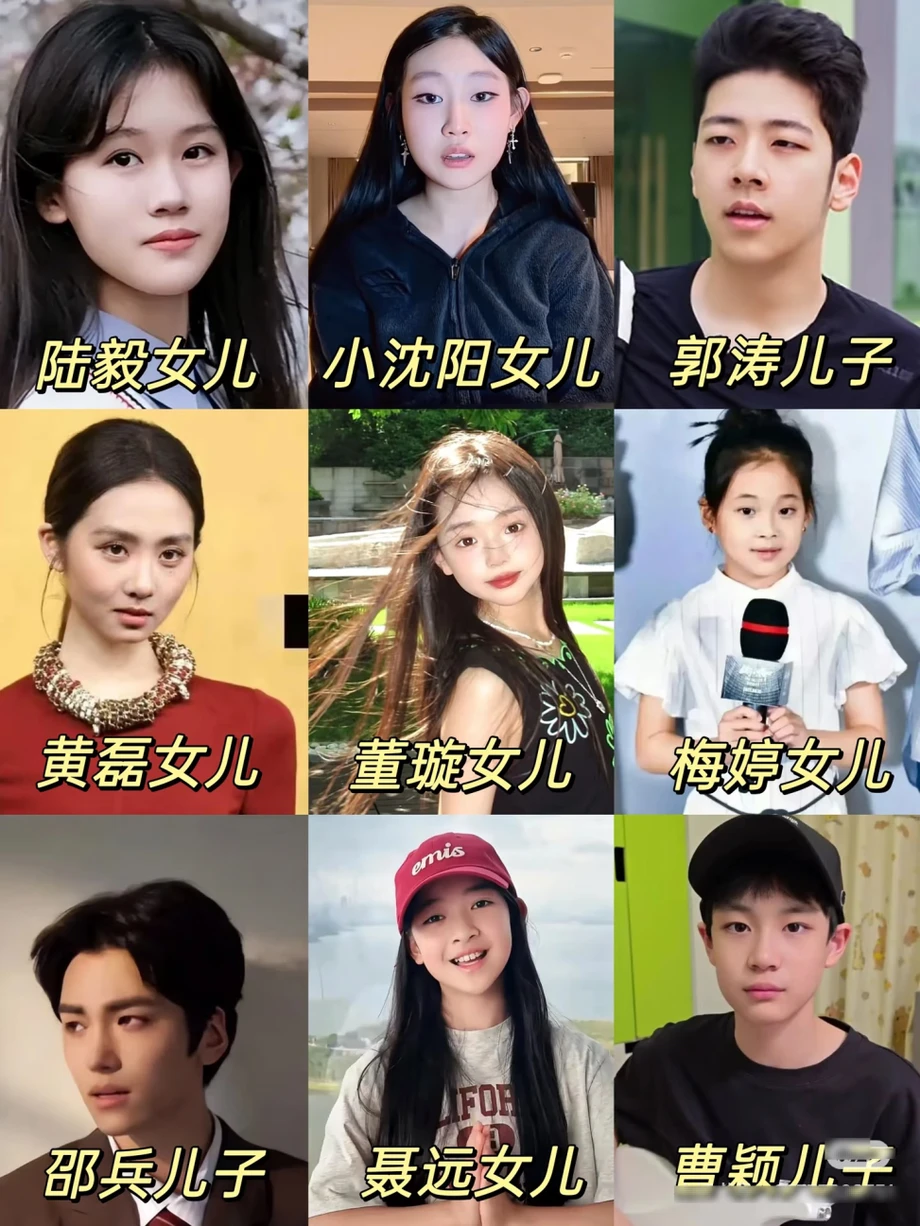
Other celebrity families have been making similar announcements. Shen Jiarun, the daughter of comedian Xiao Shenyang, launched her music career in South Korea last year. Constance Chan, the daughter of Eason Chan, signed with Warner Music and received the gold award for new female singers at the Ultimate Song Chart Awards. Huang Lei's daughter Huang Duoduo appeared on a VOGUE red carpet, while Guo Tao's son Guo Zirui entered a prominent selection program for young actors. Children of performers including Nie Yuan, Cao Ying and Shao Bing have also been entering public view.
Why Guo Zirui's Answer Struck a Nerve
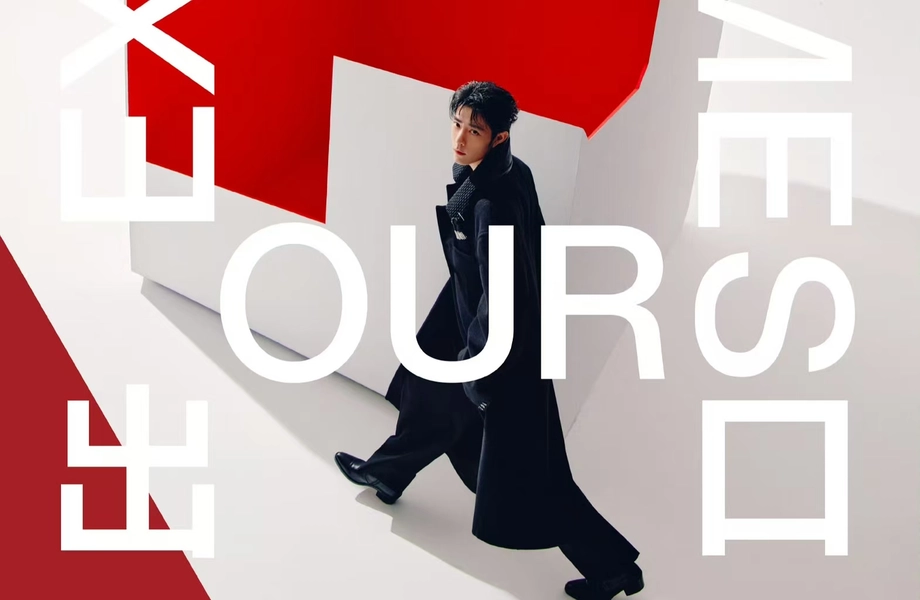
Guo Zirui, an aspiring actor known by the childhood nickname Little Stone, gave the debate its most revealing exchange. Asked during an interview why he wanted to enter entertainment, the 19 year old son of actor Guo Tao pointed directly to his father's career.
After all, my father has worked in this industry for many years. Why shouldn't I follow in his footsteps and try my best to catch up with him?
Many respondents drew a distinction between inheriting an occupation and inheriting access to it. Acting requires personal skill and audience acceptance, they argued, while introductions, recommendations and production opportunities can be passed from one generation to another. The question became whether Guo was continuing a craft or receiving his father's network.
The circumstances of his selection intensified that reaction. He entered the China Movie Channel's Starry Ocean Young Actors Selection Program at a time when its intake had been reduced from nearly 40 people in previous years to 26. Every place was filled through a recommendation, with senior industry figures and professional colleges among those able to nominate candidates.
Guo's recommender was director Ning Hao. Guo had twice failed to gain admission to the acting program at the Beijing Film Academy and did not yet have a publicly released screen performance. His arrival therefore rested on an established director's judgment rather than on admission to a leading school or a body of work that viewers could assess.
A Friendship From Crazy Stone Becomes Concrete Support
Ning Hao's connection with the Guo family dates to 2005, when the then little known director invited Guo Tao to play Bao Shihong in Crazy Stone. The film helped establish Ning as a major director and gave Guo Tao nationwide recognition after 15 years in acting. Guo Tao later gave his son the nickname Little Stone in memory of the production.
That old professional relationship now surrounds the son's entry into the business. Ning used his Starry Ocean recommendation for Guo Zirui. He is also supervising the film Xiao Ti Da Zuo as its producer, with Guo in the leading role. Ning's company, Dirty Monkeys, is among the film's producers.
For a performer still waiting for his first released work, the package is substantial: selection for a competitive industry program, a starring film role and support from an established studio. Unknown actors can spend years visiting production crews, attending auditions and accepting minor parts without approaching any one of those opportunities.
The friendship itself is not unusual in a business built on trust and repeated collaboration. Its importance here is the visible sequence. A director's relationship with a father became a recommendation for his son, and the recommendation arrived alongside a film role backed by the same director's professional interests.
Passing On a Craft Is Different From Passing On Advantage
Chinese opera and performance families offer an older model. Children could begin training extremely young, but the family was expected to transmit technique, discipline and stage judgment. The principle was to pass on the art, not the benefits. A poor performance could still draw boos, regardless of the performer's surname.
Several celebrated careers followed long apprenticeships. Ge You entered the All China Federation of Trade Unions performance troupe at 22, received his first film opportunity at 28 and earned a Golden Rooster best actor nomination at 31 for The Troubleshooters. His early career also included years of minor roles. Chen Peisi was 25 when he appeared alongside his father, Chen Qiang, in the comedy What a Family. He was 30 when the Spring Festival Gala sketch Eating Noodles, performed with Zhu Shimao, made him a central figure in Chinese comedy.
Wang Xiao, the son of actress Wang Fuli, entered acting at 27. He built his reputation through supporting performances and won the Golden Rooster Award for best supporting actor at 46 for The Lonely Warrior. Within opera, Mei Baojiu began studying with his father at 10 and took the stage at 13, developing the foundations needed to sustain the Mei school of Peking opera. Liu Xiao Ling Tong undertook extensive physical and eye training to play the Monkey King in the 1986 CCTV production of Journey to the West.
The latest generation is becoming visible much earlier. Mei Ting's daughter Zeng Mumei appeared in her first film at 8 and received a Hundred Flowers Award nomination for best newcomer at 12 for Her Story. Huang Duoduo began touring with her parents in the stage production Secret Love in Peach Blossom Land at 5. Dong Xuan's daughter, known as Xiao Jiuwo, acted in the television drama The Double and the film Formed Police Unit at 8, then appeared with Tong Liya in a dance production at the National Centre for the Performing Arts at 10.
Early instruction can give a child real skills. Public anxiety rises when that instruction is accompanied by immediate access to famous collaborators, major venues and prominent roles that remain unavailable to equally young performers without family connections.
There Is Less Work for Actors at the Same Time
The concentration of famous newcomers is colliding with a contracting market. Distribution permits for online dramas fell from 166 in 2024 to 122 in 2025. That is a reduction of 44 permits, or about 27 percent. The 2024 baseline is confirmed by the NRTA's 2024年全国广播电视行业统计公报, published on May 9, 2025 by the planning and finance department of the National Radio and Television Administration, which records 166 key online dramas among the productions granted distribution licences that year, alongside 219 key online films, 659 online animated series and 602 online micro-dramas. The 122 figure is traceable to the 2025 industry statistical bulletin; the two-year comparison is not sourced to either document. Capital has become more cautious, production has slowed and the growing use of artificial intelligence in short dramas is reducing some of the work previously available to real actors.
Figures cited in the industry discussion put celebrity children at 37 percent of new generation actors in 2025, while placing broad public recognition at just 12 percent. The numbers capture two sides of the discontent: famous families appear highly visible among new entrants, but visibility does not automatically produce a performer whom audiences remember.
For acting graduates without connections, a traditional expectation was already demanding. After leaving schools such as the Central Academy of Drama or the Beijing Film Academy, a performer might need 10 to 15 years to reach a substantial role. Fewer productions and a larger supply of hopeful actors can stretch that wait further.
Xu Peng, a Central Academy of Drama graduate, appeared in popular series including Who Rules the World and A Journey to Love but spent eight years without securing an important role. He moved into vertical dramas, short productions designed for phone screens, and became a regular player of wealthy, domineering executives. As artificial intelligence spread through that market, his schedule went from full to empty. After completing his last short drama in March, he returned to his hometown in Shandong and began selling vegetables at markets from an electric tricycle.
Shi Yuanting, 36, studied acting at the Central Academy of Drama alongside Wei Daxun and Lan Yingying and had played a male lead in an online series. He worked for only four days during the first half of 2025, and his savings at one point fell below 20,000 yuan. In July 2026, he joined Changchun Zoological and Botanical Park as a resident NPC portraying the deity Erlang Shen. NPC comes from video games and here means a costumed character employed to interact with visitors.
Their experiences give the fairness debate a practical setting. When an established graduate can measure a year's screen work in days, every prominent opportunity awarded to an untested newcomer receives closer attention.
Why Are Celebrity Children Arriving During a Downturn?
Parents and entertainment companies face the same scarcity from different directions. Performers know that fame, public attention, professional influence and high fees can fade. The period in which parents remain influential is also the period in which their introductions and recommendations carry the greatest value. Waiting for a child to mature can mean waiting until those contacts are less useful.
Agencies and producers, meanwhile, are trying to limit financial risk. A celebrity child may already have public recognition, a base of supporters, useful industry relationships and an ability to generate online discussion. Promoting such a newcomer can cost less than introducing a completely unknown name. Familiarity does not guarantee a successful film or song, but it gives investors an audience to measure from the first day.
Belle illustrates the value of that existing recognition. She appeared at the age of 6 in the 2014 second season of Dad! Where Are We Going?, and many viewers still remember her as a child from the program. Supporters have circulated old screenshots while encouraging her singing ambitions. Critics have instead focused on the density of her announcements and questioned whether her vocal ability has caught up with the scale of the opportunity.
The apparent contradiction therefore has a straightforward business explanation. A colder market makes parents more eager to transfer their advantages while they can, and it makes companies more interested in newcomers who arrive with attention already attached. The same conditions that discourage speculative investment can encourage investment in a familiar surname.
The Objection Is to Skipping the Selection Process
The strongest criticism is not directed at a child choosing a parent's profession. It concerns the possibility that family ties can replace the competitive steps facing everyone else. An unknown singer may have to submit demonstration recordings and pass several rounds of auditions. An unknown actor may spend years attending castings and accumulating small parts. In the cases that anger audiences, connections appear convertible into a role, a publicity budget or a prominent position on social media.
Two expressions have become popular shorthand for this concern. The English term nepo baby refers to a child who benefits from nepotism. The Chinese expression commonly translated as umbilical cord economy suggests that a family connection continues feeding professional advantages after childhood.
The argument also extends beyond casting. Critics describe a closed circuit in which a famous family supplies entry, an insider network supplies major projects and industry awards then supply prestige. When audiences consider an award undeserved, the result can deepen distrust rather than settle the performer's standing.
Comparisons involving awards have fed that suspicion. Online discussions have contrasted the popular and commercial success of performers such as Wang Baoqiang and Shen Teng with their relatively limited recognition at major mainland awards, while mocking some victories associated with insider circles. The demand that follows is not for every award to match a popularity contest. It is for selection rules and artistic reasons to be visible enough for viewers to understand and accept.
Families with money can provide better education, earlier exposure and superior training in many occupations. The entertainment dispute becomes more intense when bloodline appears to serve as an entry pass, when auditions are not open to all plausible candidates or when judging standards seem determined by the preferences of the same circle receiving the honors.
Which Routes Remain Open to Unknown Performers?
Some celebrity children have built reputations that extend beyond their parents. Guo Qilin became established through acting rather than remaining known simply as Guo Degang's son. Wang Xiao earned respect through years of supporting roles. Singer Dou Jingtong developed a musical identity distinct from her famous family. In these cases, audiences often remember the performance or character before dwelling on the performer's ancestry.
Other routes into entertainment also remain active. Performers have emerged from Yue opera, comedy and stand up stages after building their skills in front of live audiences. Newcomers on the comedy program Xiren Qimiaoye have gone through months of creative work and repeated rounds of selection, giving viewers a chance to follow their development.
Audience judgment now travels quickly. Bullet comments, the messages that scroll across an online video, short clips and ratings sites can examine a performance on the night it appears. A publicity campaign can announce that a newcomer is promising, but viewers can separately circulate a weak line reading, an unstable stage appearance or an impressive scene.
That scrutiny is already touching the current group. Guo Zirui's first appearance connected with the Golden Rooster Awards drew criticism for an unsteady stage manner. Shao Bing's son Shao Ziheng faced complaints about awkward acting during a variety show appearance. Such reactions demonstrate why a recommendation can secure an introduction without securing audience loyalty.
The First Contract Is Only the Start of the Test
Belle's December 5 gala performance supplies the next concrete test in this debate. Some listeners have described her voice as clear but lacking a distinctive character, while others see her singing career as a natural extension of ambitions they watched develop from childhood. A live national broadcast will give both groups the same performance to judge.
For Guo Zirui, the equivalent test will come when audiences can watch his film work and compare the scale of his role with the performance he delivers. For agencies, the calculation is whether inherited attention can produce durable commercial value. For parents, it is whether an early advantage helps a child develop or leaves every later achievement shadowed by the way the first opportunity was obtained.
Unknown actors have a more basic stake. Open auditions, accessible recommendation channels and visible reasons for casting and awards determine whether years of training can still lead somewhere. A famous surname may secure the first hearing, and financial pressure may make that hearing especially valuable. Sustained applause still depends on what happens after the contract is signed and the camera or microphone switches on.
Key Points
- Belle signed with Baimu Entertainment on November 18 and confirmed a CCTV gala appearance six days later.
- Her December 5 performance is expected to feature fully live vocals, putting her singing ability at the center of the discussion.
- Guo Zirui entered the 26 person Starry Ocean program through director Ning Hao's recommendation and also received a leading film role.
- Ning Hao's support grows out of a friendship with Guo Tao that began with Crazy Stone in 2005.
- Online drama distribution permits fell from 166 in 2024 to 122 in 2025, a decline of about 27 percent.
- Graduates Xu Peng and Shi Yuanting illustrate the scarcity of acting work, with one selling vegetables and the other taking a park performance job.
- Parents want to transfer influence while it remains valuable, while companies see familiar names as less expensive to promote.
- The central public demand is for open competition and transparent selection, with lasting recognition determined by performances rather than family connections.