A Night of Arson, and 386 Arrests by Morning
Police in Bangladesh arrested 386 leaders and activists of the banned Awami League and its allied organisations in 24 hours, counted from 8am on Friday 27 November to 8am on Saturday 28 November, according to Police Headquarters. Sixty of them were held in Dhaka, and the previous 24 hours had produced 380 arrests.
Contents
Mohammad Abu Sufian, a deputy inspector general at Police Headquarters in charge of crime and operations, said the detainees were picked up over arson, unauthorised processions and attempts to make districts across the country unstable.
They were arrested on charges of arson, of bringing out processions and of creating an unstable situation in different places.
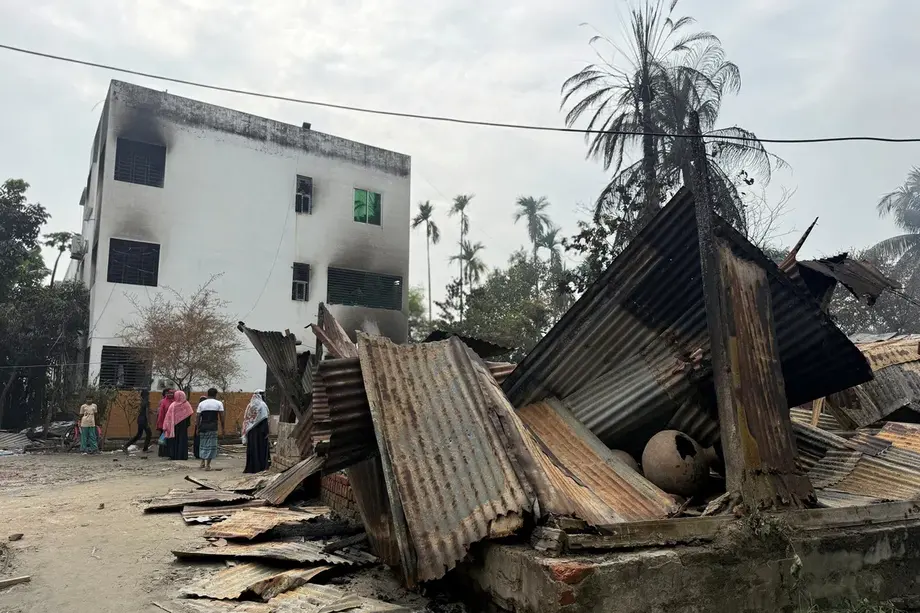
Those 24 hours also brought petrol bombs thrown at buses in Dhaka and Narayanganj, fire in the rear coach of an intercity train at Chandpur, a burning transformer at a rural power substation in Rajshahi, two petrol bombs at a Grameen Bank branch in Chattogram, a crude bomb thrown at a police station in Faridpur and a petrol bomb at the Sylhet home of a member of parliament. Attackers set fire to buses in Savar and Ashulia before dawn, and to a moving bus in Mirpur on Saturday evening.
Among those arrested was H.M. Kabir Hira, law affairs secretary of the Awami League unit for ward 34 of Dhaka South City Corporation. Md Juel Rana, additional deputy commissioner of the Mohammadpur zone under the Tejgaon division of Dhaka Metropolitan Police, said the Rubber Bazar police outpost picked him up at about 1am on Sunday. Police officials put the number of cases filed over the unrest at 46, with 80 people arrested in connection with the incidents.
Where the Fire Landed
Police and fire service officers described the sequence of attacks from Friday night into Sunday morning.
- Friday, about 9:40pm: two young men boarded a Meghla Paribahan bus heading from Narayanganj to Dhaka near Dashtola, sat at the back and got off by the Mouchak U-turn in Siddhirganj, throwing fire into the bus as they left. The driver, his assistant and 10 to 12 passengers got out quickly; the assistant, Tanjil, said the passengers panicked and fled the vehicle. Additional Superintendent of Police Tarek Al Mehedi said a flammable substance was suspected and that officers were collecting CCTV footage to identify the attackers.
- Friday, about 9:45pm: a crude bomb thrown at Kotwali police station in Faridpur exploded on the tin roof of the third floor of Pouro Market, beside the station boundary wall, spreading alarm with a loud blast. Additional Superintendent of Police Azmir Hossain said marks of the explosion were visible on the roof.
- Friday, about 10:30pm: fire broke out in the rear coach of the intercity Meghna Express beside Chandpur Court railway station, burning two seats. Station master Maruf Hossain said staff and local people doused the flames with water after seeing smoke, and workers found a bottle near the coach. The train left for Chattogram at 5am as scheduled.
- Friday, about 11pm: attackers poured kerosene inside a moving bus at Kalshi in Mirpur and set it alight, burning 10 seats. Mahmudul Hasan, assistant commissioner of the Pallabi zone, said passengers were on board and none was hurt. Witnesses said the men escaped through the windows and local people put out the fire.
- Saturday, about 2am: three petrol bombs exploded at the Paba-2 substation of the Palli Bidyut Samity in Kharkhori, Parila union of Paba upazila, Rajshahi, setting a transformer alight. Workers said 8 to 10 attackers also fired gunshots and that four unexploded bottles were found at the site. Saptarshi Pal, deputy general manager of the Rajshahi Palli Bidyut Samity, said the substation itself was undamaged and power supply stayed normal. A case had been filed over an attempted attack there the previous night.
- Saturday, before dawn: a petrol bomb was thrown at the Tetli home of A M Malek, the member of parliament for Sylhet-3, in South Surma upazila. Malek was inside with his wife and son, and part of the tin roof burned before four security staff put out the fire. Malek said he had learned the attackers came in a Leguna. Md Afzal Hossain, additional deputy commissioner of Sylhet Metropolitan Police, said video footage suggested two people were involved and that police suspected supporters of the banned Awami League.
- Saturday, about 5am: three men stepped out from behind trees and threw two petrol bombs at the wall beside the gate of a Grameen Bank branch in Kashimaish (Pingala) village of Patiya upazila, Chattogram. Night guard Mohammad Fazal raised the alarm, and manager Shambhu Chandra De and the guards smothered the fire with sand and water. A written complaint was filed with the police.
- Saturday, 8pm to 11:30pm: a crude bomb exploded at Kurmitola bus stand, one went off near Taj Hotel in the Wireless area of Magbazar, two exploded in front of a passenger shed on Basila Road in Mohammadpur, and buses were set on fire at Tinshed in Bhasantek and at the Daily Bangla crossing in Paltan. Duty officers at Bhasantek and Paltan, Mehedi Hasan and Mansur, said nobody was hurt; Mansur said police could not immediately establish who set the Paltan bus alight.
An out of service bus parked outside the roadside workshop of SPBN-1 on Basila Road in Mohammadpur was set on fire before dawn on Saturday and its seats burned, according to Abdul Halim, officer in charge of Mohammadpur police station.
Attackers Who Rode Along as Passengers
Several of the attacks followed the same method. In Narayanganj, two youths paid fares and sat at the rear before stepping off and throwing fire back into the bus. In Mirpur, witnesses said the men sat at the back, poured kerosene and climbed out through the windows. At Mirpur-10 on Saturday evening, vandals used gunpowder to set a moving Itihas Paribahan bus alight opposite the Fire Service office, said Hafizur Rahman, officer in charge of Mirpur Model police station, and nobody was hurt.
Faridpur police found a different trail. Benjir Ahmed, president of the city unit of Juba Dal, said the crude bomb that landed on the Pouro Market roof could have been thrown from one of the floors of a nearby seven storey building. Police have not said how many people have been injured across the country, and no nationwide damage assessment has been published.
120 Platoons in Seven Districts
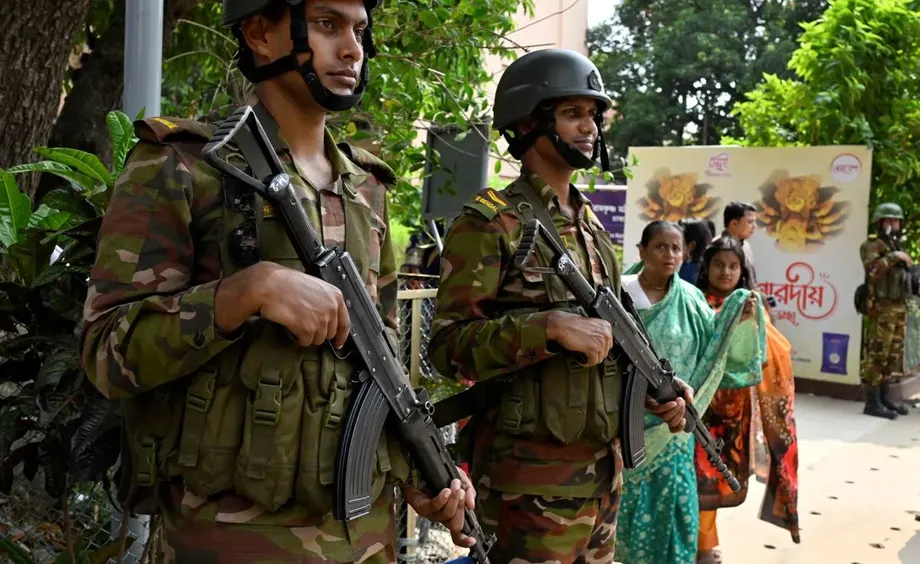
On Saturday the Home Ministry ordered the Border Guard Bangladesh into seven districts to steady law and order, and the force announced the deployment in a statement. Savar and Ashulia received 17 platoons, Gazipur 19, Narayanganj 7, Bhaluka in Mymensingh 2, Gopalganj 56, Chattogram 8 and Cox's Bazar 7, for a total of 120. Another four platoons were kept ready to move.
The troops are working alongside district administrations and other law enforcement agencies, with security tightened at key installations and industrial belts. A monitoring cell at the border force headquarters is watching the ground situation around the clock through drones, body-worn cameras and live video feeds.
Gopalganj, the district that includes the Tungipara home of former prime minister Sheikh Hasina, drew by far the largest share of soldiers. Torch processions were held in several places there on Friday evening, checkpoints went up at key installations and patrols increased, with police, the Special Response Battalion, the border force, the Ansar Battalion and the Armed Police Battalion all on duty. The district is the site of some of the worst violence of the past fortnight, including the night when Tungipara police station was burned on 17 November, an attack Home Minister Salahuddin Ahmed blamed on the banned party and promised to prosecute using video and photo evidence.
Nineteen Days of Bombs and Burning Vehicles
The weekend fits a wider pattern. Between 7 and 25 November, at least 100 crude bomb explosions were recorded around Bangladesh and 92 vehicles were set on fire, with four police establishments among the targets. The banned Awami League, which has been holding online programmes since the start of this month, has called a lockdown for Sunday and Monday.
Police say the pattern is deliberate: supporters of a party barred from politics are trying to create chaos, and the state is answering with mass arrests and street deployments. Each new round of arrests feeds the next protest, since many of those detained are held after demonstrations demanding the release of earlier detainees.
A diplomatic cost has appeared as well. Malaysia has postponed a scheduled visit by Prime Minister Anwar Ibrahim, a senior foreign ministry official said on Saturday, without giving a new date.
A Banned Party, a Leader Waiting in Delhi
The unrest is tied to one question: whether Sheikh Hasina can come home. Her spokesperson, Syed Mozammel Ali, said she was flown to India on a Bangladesh aircraft on 5 August 2024 and is now asking the government to arrange her return from Delhi to Dhaka, including through a request to Biman Bangladesh Airlines. Her stated target is 16 December, the anniversary of the country's 1971 victory in the Liberation War.
Prime Minister Tarique Rahman's government has closed that door. Information and Broadcasting Adviser Zahed Ur Rahman dismissed the plan on Saturday morning.
December is approaching, and an ousted autocrat, Sheikh Hasina, is talking about returning to the country. But there is no possibility of her return.
Foreign Minister Shama Obaed Islam said Hasina, who faces a death sentence, would be arrested and jailed if she returned. The former prime minister was convicted in absentia by the International Crimes Tribunal in November 2025 over the crackdown on the 2024 student protests, and her passport was revoked. Her allies have kept the pressure on through street action, and her planned December return has become the rallying date for the campaign.
The Order Books Move to India
The instability is costing Bangladesh the business that pays for much of its government. Between 1 and 18 November, global brands diverted about US$254 million worth of orders out of the country, with most of the work moving to India, according to three factory owners who spoke about their buyers on condition of anonymity. Zara, H&M, Marks and Spencer and Celio were among the brands shifting volumes, while Inditex, which owns Zara, declined to comment and the others did not respond to requests for comment.
The Bangladesh Garment Manufacturers and Exporters Association, the main industry body, has put production losses from the protests at more than US$400 million in a sector that supplies more than 80% of the country's export earnings and nearly 40% of its manufacturing jobs. A BGMEA survey of 317 factories counted losses of US$428 million in the value of goods before freight for 1 to 18 November, with plants shut for one to 16 days.
Indian textile shares rose on the news. Gokaldas Exports jumped as much as 11% and Trident gained about 5%, while Welspun Living, KPR Mill and Vardhman Textiles each added around 2%.
Costs at home are part of the squeeze. On Wednesday the government approved a 36% rise in the minimum wage for garment workers, the smallest increase in four decades and well short of the doubling that unions demanded. Abdur Rahman Tarafder, secretary of the Ministry of Labour and Employment, called the increase satisfactory and said he hoped workers would return to the floors from Saturday.
M. Mohiuddin Chowdhury, a BGMEA director, said higher wages, utility bills and raw material prices were piling pressure on manufacturers at a time when buyers are demanding lower prices and competition from rival sourcing countries is intensifying. He said buyers who wanted speed could get goods from India about a week sooner, and from Vietnam or Cambodia up to 15 days sooner, with rival hubs finishing in 60 to 90 days against roughly 120 in Bangladesh.
The challenge is restoring buyers' confidence before temporary shifts become long-term sourcing decisions. Brands have options. They will not wait for us if instability persists.
Factories around Dhaka have lost an estimated 20 to 25 production days, and some are weighing overtime and costly air freight to keep delivery promises. Khan Monirul Alam, managing director of Alps Apparels Group, which mainly supplies European brands, said new business has dried up.
Since Nov 1, most of my buyers have stopped placing orders because of the unrest. They are telling us our orders have shifted, postponed or cancelled and that they have already found alternative solutions.
Babul Akhter, a union leader who sat on the government wage board as the workers' representative, said retailers already weigh political risk when they choose where to buy, which makes the rush to the exit hard to justify and casts serious doubts on whether the unrest is anything more than an excuse.
What the Next Two Weeks Hold
The immediate test comes on Sunday and Monday, when the banned party's lockdown call meets 120 platoons of border troops and thousands of police already on the streets. Police have not said whether they will detain organisers before the programme begins, and the party has not said how it will enforce a shutdown without legal standing.
A second date sits on the calendar: 16 December, the day Hasina says she wants to land in Dhaka. No flight has been arranged, no airline has confirmed a booking and the government says she would be arrested on arrival. India has kept to the position that extradition is a legal matter.
For factory owners, the count is simpler. Every week of disruption adds to a backlog of three to four weeks and hands buyers another reason to leave orders in India, Vietnam or Cambodia, where the goods can arrive faster and without a curfew.
Key Points
- Police arrested 386 Awami League leaders and activists in the 24 hours to 8am on Saturday, 60 of them in Dhaka, after 380 arrests the day before.
- Buses were burned in Dhaka, Narayanganj, Savar and Ashulia, a train coach at Chandpur, a bank branch in Chattogram and the Sylhet home of MP A M Malek.
- A crude bomb hit near Kotwali police station in Faridpur and petrol bombs struck a Palli Bidyut Samity substation in Rajshahi; no injuries were reported in those attacks.
- The Home Ministry deployed 120 platoons of Border Guard Bangladesh across seven districts, with 56 in Gopalganj alone, and four more platoons on standby.
- Police recorded at least 100 crude bomb explosions and 92 vehicles torched between 7 and 25 November, and the banned party has called a lockdown for Sunday and Monday.
- The government says Sheikh Hasina, who wants to return on 16 December, will be arrested and jailed if she arrives.
- Brands moved about US$254 million of orders out of Bangladesh between 1 and 18 November, mostly to India, while BGMEA put production losses above US$400 million.
- Malaysia has postponed Prime Minister Anwar Ibrahim's visit, and no new date has been given.