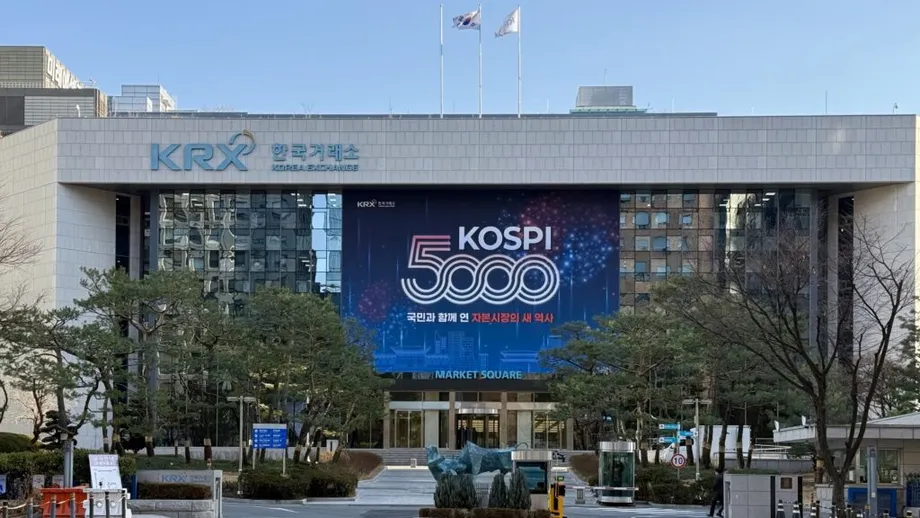
A Sharp Reversal After an Early Buy Signal
South Korea's KOSPI closed 3.31% lower at 4,708.54 on Nov. 23, after a morning that briefly suggested buyers might steady the market. The benchmark index opened at 4,734.90, down 135.06 points or 2.77%, then slipped further to 4,717.67 by 9:20 a.m., down 152.29 points or 3.13%. Foreign investors bought a net 99.5 billion won of KOSPI shares in early trading, institutions bought 97.4 billion won, and individuals sold 212.6 billion won. By the close, that early foreign buying had reversed.
Contents
- A Sharp Reversal After an Early Buy Signal
- What Sparked the AI Shock
- Minute by Minute, the Selloff Deepened
- Who Was Buying and Who Was Selling
- Why Chip Shares Became the Center of the Storm
- Foreign Money Changed Shape, Not Disappeared
- Why Strong Earnings Did Not Calm the Market
- Government Tries to Put a Floor Under Confidence
- The Damage in Numbers
- Can the Market Find a Bottom?
- Households, Politics and the Real Economy
- What Investors Are Watching Next
- Key Points
The KOSPI is South Korea's main stock index, a score based on the share prices of the country's largest listed companies. The KOSDAQ, the smaller market for growth companies, fell 1.28% to 637.43 at 9:20 a.m. and ended the day down 1.58% at 635.45. Stock prices matter far beyond trading screens because they are held in mutual funds, pension funds and household investments. A sharp drop can reduce the paper value of savings and make families less willing to spend.
The fall was smaller than first feared because Nasdaq 100 futures rose more than 2% in morning trading. Even so, the KOSPI spent the session close to the 4,700 line, a level it had not touched during trading since Jan. 16. Overnight futures had closed 7% lower, so the opening decline looked contained at first.
What Sparked the AI Shock
The trigger came from the United States. On Nov. 20, local time, the Nasdaq fell 5.28% and the Philadelphia Semiconductor Index plunged 10.73%. Nvidia dropped 14.01%, AMD fell 13.25%, Micron lost 13.89% and Broadcom slid 12.19%. These companies make chips or systems tied to artificial intelligence, or AI, which is software that can perform tasks once thought to need human intelligence.
Investors have been asking whether the huge sums spent on AI data centers can earn enough profit. A data center is a large building filled with servers, which are powerful computers that store and process data. Much of this demand centers on graphics processing units, or GPUs, the chips that run many AI workloads. News that the U.S. Securities and Exchange Commission was examining Nvidia's accounting added pressure. Investors also worried about a circular financing structure, in which Nvidia funded data center companies that then bought its GPUs. If that chain weakens, the money flow supporting AI expansion could slow.
Other worries piled up. Expectations that the U.S. Federal Reserve could raise interest rates again pushed investors away from riskier assets. U.S. President Donald Trump warned that overseas data centers could face regulations. The planned Nasdaq listing of Anthropic, a U.S. AI startup, moved money ahead of an initial public offering, or first sale of shares to the public, and added pressure on some AI linked holdings. SK Telecom, which holds a stake in Anthropic, fell 7.32% on Nov. 23.
Minute by Minute, the Selloff Deepened
The session had several distinct turns. Early buying by foreign investors and institutions helped the KOSPI recover from the worst premarket signs, when large chip stocks were indicated down 5% to 6%. The selling pressure later returned with force.
- At 9:04 a.m., Samsung Electronics traded at 177,300 won, down 3.17%, after a premarket decline of 5.57%. SK hynix was down 2.61% at 1.084 million won, after a premarket fall of 6.11%.
- At 9:10 a.m., the KOSPI stood at 4,734.94, down 2.77%. Foreign investors bought 169.7 billion won, institutions bought 19.7 billion won and individuals sold 193.5 billion won. The KOSDAQ was down 0.53% at 642.25, with foreign investors buying 56.7 billion won and institutions buying 28.1 billion won.
- At 9:20 a.m., the KOSPI was at 4,717.67, down 3.13%. Foreign buying had slowed to 99.5 billion won, institutional buying had risen to 97.4 billion won, and individual selling stood at 212.6 billion won. The KOSDAQ was down 1.28% at 637.43.
- At 9:25 a.m., the KOSPI had fallen as low as 4,709.03 and then edged back to 4,719.04. Foreign investors had bought 301.1 billion won, institutions 40.8 billion won, and individuals had sold 338.4 billion won. The KOSDAQ briefly rose 0.04% to 645.93 before slipping to 639.18.
- At 11:33 a.m., an automatic halt on program sell orders, often called a sidecar, paused trading for five minutes as the KOSPI fell 5.11%. The index later sank as low as 4,586.80.
- At the close, the KOSPI was down 161.42 points at 4,708.54, its lowest close since Jan. 13. The KOSDAQ ended at 635.45, down 10.23 points.
The path explains why market snapshots looked different. Some updates described the KOSPI as falling into the 4,500 range because the index reached 4,586.80 intraday. The closing price was 4,708.54.
Who Was Buying and Who Was Selling
Foreign investors were net buyers in early trading for the first time in seven sessions. Net buying means the value of shares purchased was greater than the value sold. That early support did not hold through the day. At the close, one set of exchange figures put foreign net selling at 247.2 billion won and individual selling at 366.9 billion won, while institutions bought 187.2 billion won. Another dataset put individual selling at 247.1 billion won and foreign selling at 366.9 billion won, with institutions buying 187.1 billion won. The gap changes which group is labelled the biggest seller, but the direction is clear: institutions absorbed shares while foreign investors and individuals sold on balance.
The reversal fits a longer retreat. In foreign selling of chips during Nov. 2 to 6, overseas investors sold a net 7.6 trillion won of Samsung Electronics and SK hynix shares, about 73% of their net selling on the KOSPI over those five days. Samsung fell 16.13% that week and SK hynix lost 20.17%. Foreign ownership of Samsung fell to its lowest level since July 2009, while foreign ownership of SK hynix fell to its lowest since November 2021.
October showed a split picture. An 18.6 trillion won outflow from South Korea's listed stock and bond markets included 25.978 trillion won of net stock selling and 7.375 trillion won of net bond buying. Foreign investors reduced share exposure while adding bonds, particularly government bonds, where returns can be easier to plan. By the end of October, foreign investors held 34% of the total value of listed South Korean shares, down from 34.8% at the end of September.
Why Chip Shares Became the Center of the Storm
Samsung Electronics fell 3.06% to 177,500 won on Nov. 23, extending losses to a third session and reaching its lowest level since March 31. SK hynix declined 2.52% to 1.085 million won, its lowest since April 13. The two companies make memory chips that are central to AI servers, so investors often treat their share prices as a test of the entire AI trade.
Samsung disclosed preliminary third quarter results on Oct. 8 showing operating profit of 107.4 trillion won, up 782.5% from a year earlier, and revenue of 195 trillion won, up 126.6%. A quarterly operating profit above 100 trillion won was a first among global technology companies, supported by higher AI server DRAM prices and expanded HBM4 sales. DRAM is the common memory used in computers and servers. HBM stands for high bandwidth memory, which stacks memory layers to move data quickly beside powerful AI processors, and HBM4 is the fourth version.
Strong results did not stop the selling. On Oct. 12, Samsung closed down 4.39% at 250,500 won, while SK hynix fell 4.52% to 1.605 million won. By Nov. 23, both shares were lower again. Hanmi Semiconductor fell only 0.33% and Isu Petasys 0.57% in early trading, while Samsung Electro-Mechanics was down 1.81%. Battery related shares also slipped, with Samsung SDI down 0.62%, LG Energy Solution down 1.84% and EcoPro BM down 1.21%. APR rose 1.91%, the only gainer among the 100 largest stocks by market value.
The rout spread well beyond chips. At 9:25 a.m., every KOSPI sector was lower, including IT services down 5.19%, construction down 4.88% and insurance down 4.78%. All 10 of the largest KOSPI companies fell, including KB Financial Group down 4.5%, Samsung Biologics down 4.2%, Hyundai Motor down 3.5%, Samsung Electronics down 3.2% and SK hynix down 2.5%. Early losses were also steep for Kia, down 4.65%, Doosan Enerbility, down 4.54%, and Hanwha Aerospace, down 4.30%.
KOSDAQ sectors were lower as well. General services fell 2.24%, medical and precision instruments fell 2.00%, and IT services fell 1.89%. Alteogen dropped 2.3%, Rainbow Robotics fell 2.0%, EcoPro lost 1.6% and Leeno Industrial slid 1.3%. Robotechs rose 2.3% and SIMMTECH gained 1.8%, showing that even on a weak day, a few smaller stocks moved against the tide.
Foreign Money Changed Shape, Not Disappeared
Foreign investors sold a net 199.1045 trillion won, about $148.8 billion, of KOSPI cash shares from Jan. 2 through Oct. 12, excluding ETFs and other instruments. During the same period, they bought a net 9.6595 trillion won, about $7.2 billion, of domestically listed ETFs. An ETF is a fund that holds a basket of shares and trades like a stock. It lets investors buy a slice of many companies at once.
- Net buying in the KOSPI cash market happened only in January, at 118.6 billion won, and April, at 1.1283 trillion won.
- Selling was heaviest in May at 44.7147 trillion won and June at 48.6248 trillion won.
- July through September brought five straight months of net selling, with monthly outflows in the 9 trillion won to 21 trillion won range.
- From Oct. 1 to Oct. 12, foreign investors sold another 8.4635 trillion won of KOSPI shares.
ETF flows moved in the opposite direction. Foreign investors net bought ETFs in every month of the year. Inflows began at 151.4 billion won in January, peaked at 3.5101 trillion won in June, then stayed positive at 1.2582 trillion won in July and 1.1458 trillion won in September. October had 76.6 billion won of net ETF buying through Oct. 12. Foreign ownership of South Korean equity ETFs reached 6.5% in June, fell to 4.3% by the end of September, and remained well above the average of 2.75% over 16 years.
The ETF choices show how investors shifted. In the first half, TIGER MSCI Korea TR attracted 1.7379 trillion won, KODEX SK Hynix Single Stock Leverage drew 607.2 billion won and TIGER US Nasdaq 100 received 485.7 billion won. From July, as the KOSPI corrected, KODEX Leverage attracted 641.1 billion won, TIGER US Nasdaq 100 received 634.9 billion won and KODEX 200 drew 584.3 billion won. Leverage, in this setting, means a product designed to magnify daily index moves. An inverse product goes the other way, aiming to rise when its target falls. From Oct. 1 to 12, KODEX Leverage gained 68.7 billion won, inverse product KODEX 200 Futures Inverse 2X drew 33.3 billion won, and TIGER Semiconductor TOP10 Leverage saw 15.6 billion won.
Lee Sang-hyun, an analyst at Meritz Securities, said direct foreign inflows had not returned this year, while ETF flows had turned toward areas whose share prices had lagged, including semiconductors, financials and nuclear power. He described the pattern as a change in how investors held Korean stocks and in how they rotated among sectors.
"Foreign capital inflows have not returned since the start of the year," Lee said.
South Korea is not alone in this pattern. Foreign investors in Taiwan net sold more than 2.28 trillion New Taiwan dollars through the end of July, yet foreign holdings still accounted for 48.7% of that market's total capitalization. In Japan, foreign investors net sold 6.2935 trillion yen of stocks and investment trusts in September. Large foreign holdings can fall while selling is heavy because the starting position is big.
Why Strong Earnings Did Not Calm the Market
Lee Jae-won, an analyst at Yuanta Securities, said the biggest worry for Korean shares was the balance of buying and selling, rather than chip earnings. He pointed to Samsung's better than expected third quarter profit, solid memory prices and continued investment in AI infrastructure, while noting that the KOSPI kept lagging because foreign selling continued.
"The biggest concern for the South Korean stock market right now is not semiconductor earnings but foreign supply-demand dynamics," Lee said.
That distinction matters because a good company report can lift a share only when there are enough buyers. When large holders sell, the price can fall even if sales and profits are strong. ETF buying can keep some exposure to Korean shares while reducing the risk of picking the wrong individual stock. It can also help investors move quickly into or out of a theme such as semiconductors.
Government Tries to Put a Floor Under Confidence
South Korean authorities prepared emergency measures over the weekend, including plans for a stock market stabilization fund of about 10 trillion won, or $6.8 billion, and easier limits on share buybacks. A stabilization fund is a pool of money from financial firms and related institutions that can be used to buy shares when sell orders flood the market. Officials said the fund could be used depending on conditions.
Deputy Prime Minister for Economy Lee Hyung-il said the government would review the procedures needed to operate the fund when market conditions justify it. He also said the timing and scale would be decided after monitoring the market, because volatility in global semiconductors could spread into the wider economy.
"Regarding the stock market stabilization fund, in preparation for cases where we operate it in line with market conditions based on the fund amount previously created according to what we announced, we will review the necessary procedures this time," Lee said.
Lee Kyoung-min, an analyst at Daishin Securities, compared the decline with past crises and gave traders specific levels to watch. He said the fall was already similar in scale to the Asian financial crisis and the global financial crisis, and he suggested buying in stages between 4,600 and 5,000, then pausing if the index broke below 4,600 to see whether the stabilization fund was actually used.
"The scale of the price decline is already comparable to the Asian financial crisis and the global financial crisis," Lee said.
The government did not give a deployment date or confirm the amount that would be used. Its main immediate tool was signaling that it was watching the market and could act if selling accelerated.
The Damage in Numbers
The KOSPI's close of 4,708.54 was its lowest since Jan. 13, when it ended at 4,692.64. The intraday low of 4,586.80 meant the index briefly surrendered both the 4,700 and 4,600 levels. The sidecar at 11:33 a.m. was the second straight session in which that safeguard was triggered. The KOSPI 200 Volatility Index, often called South Korea's fear gauge because it measures expected market swings, rose 2.63 points, or 4.95%, to 55.81.
Market value shrank sharply. KOSPI market capitalization stood at 3,860 trillion won, about $2.9 trillion, at the close. That was 3,590 trillion won, about $2.7 trillion, below the June peak of 7,450 trillion won. The index itself had fallen from 9,385.59 at its June high, leaving it close to half of that level in about five months.
Currency and bond markets also moved. The won traded at 1,345.9 won per dollar at 3:30 p.m., weaker by 9.7 won. Bonds maturing in three years ended at a yield of 3.623%, down 1.9 basis points, while benchmark bonds maturing in five years ended at 3.711%, down 1.7 basis points. Bond yields fall when bond prices rise, often a sign that investors want safer assets.
Can the Market Find a Bottom?
Kim Jae-seung, an analyst at Hyundai Motor Securities, said the market was in its biggest correction since the 2008 global financial crisis and that weak sentiment and thin buying demand made the endpoint hard to see.
"Deteriorating investor sentiment and a lack of buying demand have left the bottom of the Korean stock market nowhere in sight," Kim said.
Kim said retail investors had less room to keep buying because many bought during the earlier fall from 6,000 to 6,500. Some with spare cash were turning to high interest products or U.S. stocks. Trading value had fallen back to levels seen at the beginning of the year, and the retail share of total KOSPI trading value had dropped to its lowest level since 2020.
Kim pointed to three forces behind foreign sales of Korean semiconductors: crowded global portfolios heavy in AI stocks, money moving ahead of Anthropic's listing and a stronger dollar as investors considered a possible U.S. rate move in December. He identified the Dec. 9 meeting of the Federal Open Market Committee, the U.S. central bank's rate setting panel, and index rebalancing in late December as possible turning points. Samsung also estimated in its Oct. 29 earnings announcement that 55 trillion won to 75 trillion won could be available for shareholder returns in 2026. The amounts and plans are to be finalized at a board meeting in late January 2027, with large buybacks expected early that year.
Han Ji-young, an analyst at Kiwoom Securities, said losses had become more painful after a series of stepwise declines. He said AI concerns were likely to keep investors focused on risk control.
"Market participants' sense of loss has intensified following successive stepwise declines against a fragile supply-and-demand backdrop," Han said.
Han's worst case view put the KOSPI in the 4,200 to 4,300 range, where its forward price to book ratio would be about 0.8 times. That ratio compares share prices with a company's accounting value, and 0.8 means the market value would be below book value. Kim recommended lower volatility holdings such as high dividend bank and insurance shares, plus large pharmaceutical and health care companies with more predictable earnings.
Households, Politics and the Real Economy
The stock decline reaches into everyday finances. Stock trading deposit balances fell from 136.8 trillion won in late June to 86.9 trillion won as of Nov. 16, a withdrawal of about 49.9 trillion won. That figure covers cash set aside for share trading, not all household savings. It shows how investors were pulling money away from the market or using it after losses.
The selloff also fed political criticism. In the political backlash over market losses, People Power Party lawmaker Na Kyung-won said about 3,460 trillion won in market capitalization had evaporated since the June peak and argued that officials had encouraged citizens to invest during the boom. Party leader Jang Dong-hyuk said officials ignored investor pain while dealing with the fallout.
South Korea's export story complicates the picture. The country was on track to reach $1 trillion in annual exports, joining the United States, China and Germany. Memory chip makers still had strong demand from AI data centers. A country can therefore see strong export orders while households with shares feel poorer, because company sales and household investment values move through different channels.
What Investors Are Watching Next
Several dates now matter. Traders will watch whether stabilization fund procedures move forward, the Dec. 9 Federal Open Market Committee meeting, late December index rebalancing and the late January 2027 Samsung board meeting on shareholder returns. Kim expects stock market volatility could remain high through the first half of next year if AI companies cannot show that large spending plans can earn profits and secure steady financing.
The basic chain is simple. AI worries shook U.S. technology shares. Korean chip stocks followed because Samsung and SK hynix sit at the center of the AI memory supply chain. Foreign investors sold direct KOSPI shares heavily for much of the year, while buying ETFs that gave them broader or more flexible exposure. On Nov. 23, early foreign and institutional buying slowed the fall, but selling later pushed the KOSPI to its lowest close in about 10 months. The next test is whether buyers return in size or whether the decline continues until policy support, Federal Reserve signals and company buybacks change the balance.
Key Points
- The KOSPI closed down 3.31% at 4,708.54 on Nov. 23, with an intraday low of 4,586.80.
- Foreign investors bought shares early, then ended the day as net sellers under the main closing data set.
- U.S. AI share losses, Nvidia accounting concerns, rate worries and data center regulation fears drove the selloff.
- Foreign investors sold 199.1045 trillion won of KOSPI cash shares from Jan. 2 to Oct. 12 but bought 9.6595 trillion won of ETFs.
- Samsung posted a record 107.4 trillion won third quarter operating profit, yet its shares still fell.
- Authorities prepared a 10 trillion won stabilization fund but did not announce a deployment date or amount.
- Analysts pointed to Dec. 9, late December rebalancing and Samsung's 2027 buyback plans as possible turning points.