Two chipmakers account for nearly three quarters of foreign selling
Foreign investors sold about 7.6 trillion won more than they bought in Samsung Electronics and SK hynix shares during November 2 to 6, 2026, concentrating roughly 73% of their net selling on South Korea's KOSPI market in just two companies. Samsung fell 16.13% over the week, while SK hynix lost 20.17%.
Contents
- Two chipmakers account for nearly three quarters of foreign selling
- How far did the shares and foreign holdings fall?
- Local buyers stepped in as overseas investors withdrew
- A market halt followed the November 6 plunge
- The retreat had been building for months
- Why AI construction worries reached Korean chip shares
- Earlier gains also created pressure to sell
- Lower valuations split analysts on the next move
- Key Points
Korea Exchange and Koscom Check figures put total foreign net selling on the main market at about 10.4 trillion won across those five trading days. A detailed trading table using Korea Exchange data recorded 5.45936 trillion won in net sales of SK hynix and 2.20784 trillion won of Samsung Electronics, a combined 7.6672 trillion won.
The amounts are in Korean won. The rounded total is 7.6 trillion won, rather than $7.6 billion. Net selling means the value of shares sold exceeded the value purchased by that amount.
The retreat pushed foreign ownership of Samsung to its lowest level since July 2009 and SK hynix to its lowest since November 2021. Domestic individuals and institutions bought substantial amounts of both stocks, taking the opposite side of a market increasingly divided over artificial intelligence spending and chip company valuations.
The immediate pressure came as investors worried about tighter rules for AI data centers following the US midterm elections. A longer retreat from Korean semiconductor shares, however, was already under way before election concerns intensified.
How far did the shares and foreign holdings fall?
Samsung closed November 6 at 188,700 won, down 36,300 won from its October 30 close of 225,000 won. SK hynix fell from 1,418,000 won to 1,132,000 won, losing 286,000 won per share. Its weekly percentage decline was about four percentage points larger than Samsung's.
Korea Exchange figures cited for November 6 put Samsung's foreign ownership at 45.95%, its lowest since July 7, 2009, when the ratio was 45.83%. A figure of 45.59% was also published for November 6. The repeatedly cited exchange figure of 45.95% puts the decline from July's 46.69% at 0.74 percentage points.
SK hynix's foreign ownership fell to 48.27%, its lowest since November 22, 2021, when it stood at 47.97%. The ratio had been 49.76% on October 2, meaning foreign ownership fell another 1.49 percentage points in just over a month.
Eugene Investment & Securities calculated foreign ownership across Korea's semiconductor sector at 46.6% on November 5, the lowest since 2013. That was 8.4 percentage points below the 55% peak recorded in July 2024. The retreat therefore extended beyond the final week and beyond the two largest companies.
Local buyers stepped in as overseas investors withdrew
Individual investors bought a net 2.2 trillion won of SK hynix and 1.9 trillion won of Samsung during the week. Their combined purchases of about 4.1 trillion won were equivalent to roughly 54% of the rounded 7.6 trillion won foreign net sales total.
Institutions bought another 1.4 trillion won of SK hynix and 261 billion won of Samsung. Together, individuals and institutions recorded about 5.761 trillion won in net purchases of the two stocks.
The willingness to buy varied sharply between the companies. Individual and institutional net purchases of Samsung totaled about 2.161 trillion won, close to the roughly 2.2 trillion won foreigners sold. Their combined SK hynix purchases of 3.6 trillion won were smaller than foreign sales of about 5.4 trillion won.
Domestic buying continued even as prices fell. For households adding shares during the week, the immediate result was greater exposure to companies whose market prices were moving rapidly lower. The scale of those purchases made domestic investors central to whether the market could absorb further overseas selling.
A market halt followed the November 6 plunge
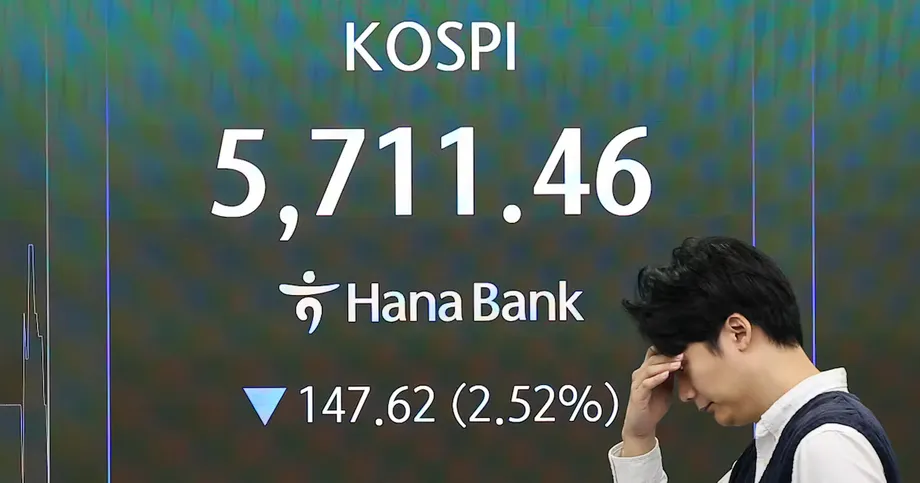
The KOSPI dropped to 4,911.28 shortly after trading opened on November 6, falling below 5,000 during a session for the first time in nine months. At its weakest point, the index was down 8.78% from the previous close.
A first stage circuit breaker was triggered at about 9:03 a.m., stopping trading for 20 minutes. A circuit breaker temporarily pauses the market during an extreme fall. After trading resumed, a sell sidecar was activated at 9:34 a.m., temporarily restricting certain automated orders linked to futures trading.
The index recovered part of its losses to close at 5,059.69. Published figures put the closing decline at 6.02% and 5.99%, respectively. On the smaller KOSDAQ market, the index fell 5.03% to 644.27.
Foreign investors sold a net roughly 2.769 trillion won of KOSPI shares that day, extending their selling streak to six sessions. Institutions bought 1.7041 trillion won and individuals bought 601 billion won. Market breadth showed how widely the pressure spread: 760 KOSPI stocks declined, while 131 advanced.
The November 6 trading breakdown put foreign net sales of SK hynix at 1.9205 trillion won and Samsung at 129.8 billion won; another published tally put them at 1.8227 trillion won and 94.8 billion won. Both sets of figures showed that SK hynix bore most of the foreign selling in the pair that day.
The retreat had been building for months
Korea Exchange figures show that the November selloff followed a substantial withdrawal in September and October. From September 1 through October 2, foreigners sold a net 20.305 trillion won on the KOSPI, including transactions in the after market session introduced on September 15. They were net buyers on only seven of the period's 22 trading days.
SK hynix accounted for 12.009 trillion won of that selling and Samsung for 5.186 trillion won. Their combined 17.195 trillion won represented about 85% of the period's foreign net sales, an even greater concentration than the roughly 73% recorded during November 2 to 6.
- September 1 to October 2: Foreign KOSPI net sales reached 20.305 trillion won.
- October: Foreign net sales totaled 18.6756 trillion won on the KOSPI and about 19.5423 trillion won across the KOSPI and KOSDAQ.
- November 2 to 5: Foreigners sold a net 7.7741 trillion won on the KOSPI.
- November 2 to 6: Foreign KOSPI net sales reached about 10.4 trillion won, led by Samsung and SK hynix.
Across both markets, average daily foreign net selling rose from about 977.1 billion won in October to 1.988 trillion won in November's first four sessions, an increase of 103.5%. The acceleration was concentrated on the main market rather than the KOSDAQ.
From October 1 through November 6, foreigners sold a combined 19.8655 trillion won of the two chipmakers: 13.9222 trillion won of SK hynix and 5.9433 trillion won of Samsung. Those overlapping trading periods show a sustained withdrawal that became faster in early November.
Why AI construction worries reached Korean chip shares
US election results intensified concern that stricter rules could slow construction of data centers, the facilities filled with computers that train and run AI systems. Samsung and SK hynix supply memory chips used in computing infrastructure, making expectations for those projects important to their sales outlook.
Mirae Asset Securities said 28% of data center capacity had already faced delays of at least 90 days. It also pointed to a 167 basis point increase in CoreWeave's credit default swap premium following the midterms. A credit default swap provides protection against a borrower failing to repay debt; a higher premium means that protection has become more expensive.
Investors also reacted to concerns about financing for AI infrastructure and Microsoft's reassessment of its Neocloud project. The Nasdaq Composite fell 5.52% in the US session before the November 6 Korean selloff, while the Philadelphia Semiconductor Index lost 12.25%.
Kim Seong-geun and Kim Seok-hwan, analysts at Mirae Asset Securities, linked the volatility to a reassessment of AI investment expectations, hedge funds reducing borrowed positions, and selling by leveraged exchange traded funds and commodity trading advisers. These investment strategies can require positions to be reduced as markets fall, adding sell orders during an already weak session.
Meritz Securities analyst Kim Seon-woo offered a more reassuring assessment of current chip orders. After checking the Americas sales networks of Samsung, SK hynix and Micron, he described what those checks found.
No abnormal signs of immediate demand changes are being detected.
Earlier gains also created pressure to sell
Foreign selling had accompanied Korea's earlier rally as well. Goldman Sachs estimated net foreign KOSPI outflows at roughly $62 billion as of late May, while Man Group managing director Nick Wilcox estimated domestic retail inflows at $70 billion during that year's trading through the period discussed.
Nomura's Asia-Pacific equity strategist Chetan Seth described pressure from investors having to reduce their positions.
This is essentially forced selling that we are seeing from our investors and clients.
Wilcox pointed to Korea's increasing weight in emerging market benchmarks and limits on how much active funds could hold. When a stock rises quickly, it can become a larger share of a portfolio than a fund's rules permit. A manager may then sell part of the holding to bring it back within those limits.
The earlier optimism was substantial: Goldman raised its KOSPI target for the following 12 months to 12,000, forecasting 37% further upside at that time. By November, the debate had shifted toward whether lower share prices offered value or whether selling pressure would continue to dominate.
Foreign investors still bought selected Korean companies. The November 2 to 6 trading table recorded net purchases of 119.15 billion won in NAVER and 85.4 billion won in Daeduck Electronics. Eugene Investment & Securities also identified rising foreign ownership in construction, insurance, shipbuilding and retail after semiconductor shares peaked in late June.
Lower valuations split analysts on the next move
Mirae Asset Securities managing director Seo Sang-young said the market's price relative to company earnings had reached unusually low levels.
Stock prices on the KOSPI relative to earnings have entered historically undervalued territory.
Meritz Securities calculated that, at one point during November 6 trading, Samsung's price to book ratio based on projected 2027 results had fallen to 1.13, while SK hynix's reached 1.00. This ratio compares a company's stock market value with its accounting net assets. A ratio of one means the two values are equal, using the particular asset estimate in the calculation.
Hanwha Investment & Securities analyst Park Jun-young favored buying Samsung gradually around 170,000 to 180,000 won, while also describing a possible decline to 163,000 won under a lower valuation scenario. Korea Investment & Securities identified potential support levels of 175,000 won for Samsung and 1 million won for SK hynix.
Caution centered on how long selling could last. Hana Securities researcher Lee Kyung-soo said previous episodes combining steep KOSPI declines with prolonged foreign selling suggested a sustained return to net buying could take at least three months. He pointed to improving corporate profit forecasts and lower risk premiums on US high yield corporate bonds as conditions that could help.
Korea Investment & Securities analyst Ko Young-min identified CoreWeave's November 11 earnings release and Nvidia's November 18 results as the next important tests of confidence in AI investment. Investors were waiting for company responses and spending forecasts; the duration of the selling remained uncertain.
Key Points
- Foreign investors sold about 7.6 trillion won of Samsung Electronics and SK hynix shares during November 2 to 6, roughly 73% of foreign KOSPI net selling.
- Samsung fell 16.13% over the week and SK hynix declined 20.17%.
- Individuals bought about 4.1 trillion won of the two stocks, while institutions bought about 1.661 trillion won.
- The KOSPI touched 4,911.28 on November 6, triggering a trading halt, before closing at 5,059.69.
- The selloff combined a longer foreign retreat with concerns about AI construction, financing and investment positions.
- CoreWeave's November 11 results and Nvidia's November 18 results were the next scheduled tests identified by analysts.