Foreign investors sell 3.39 trillion won as chip shares tumble
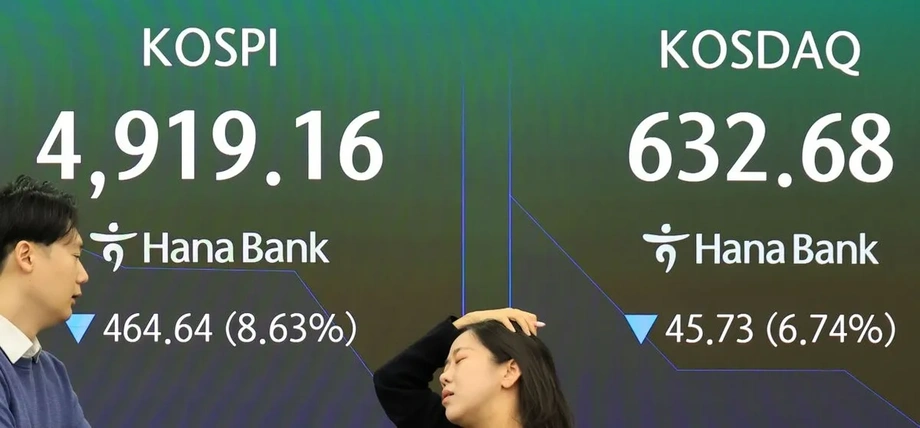
South Korea's KOSPI plunged 300 points, or 5.28%, to 5,383.80 on November 5, 2026, as investors feared that Democratic victories in the United States would slow construction of artificial intelligence data centers and weaken demand for Korean semiconductors. Foreign investors sold a net 3.39 trillion won, about $2.5 billion, while Samsung Electronics fell 7.57%.
Contents
- Foreign investors sell 3.39 trillion won as chip shares tumble
- How the selloff unfolded
- Why a US construction debate hit Korean manufacturers
- Texas puts state permits at the center of concern
- Samsung and its suppliers bear the heaviest losses
- Why US technology giants rose while chipmakers fell
- Asian markets split along industry lines
- Local buyers step in as the won barely moves
- A fresh shock after March's record fall
- Key Points
The KOSDAQ, which includes many smaller technology companies, dropped 36.54 points, or 5.11%, to 678.41. Both markets activated sell side sidecars, temporary pauses affecting automated trading, as losses spread through chipmakers, equipment suppliers and electronic component companies.
The selling followed Democratic victories in both chambers of the US Congress and governor races in states attracting major data center investment. Investors focused on whether new political leadership would make construction permits harder to obtain or require developers to bear more of the costs associated with their projects.
No enacted restriction or implementation date was identified in the election reaction. Share prices moved on expectations that slower construction could eventually mean fewer orders for servers, memory chips and the equipment used to manufacture them.
How the selloff unfolded
The KOSPI opened at 5,580.09, down 1.82%, before selling accelerated. By 10:16 a.m., the exchange had activated a sidecar that suspended program sell orders for five minutes. Program trading uses computer systems to execute groups of orders, so pausing those orders temporarily reduces one source of rapid selling.
The KOSDAQ opened down just 0.20% at 713.49, then followed the main market lower as semiconductor and battery shares weakened. Its sidecar was activated later in the session, about an hour before the close.
- November 4: US shares broadly rose after the election, while semiconductor stocks fell.
- November 5, market opening: The KOSPI started down 1.82%, and the KOSDAQ opened down 0.20%.
- 10:16 a.m.: A KOSPI sidecar suspended program sell orders for five minutes.
- Later in the session: The KOSDAQ also activated a sidecar.
- Market close: The KOSPI finished at 5,383.80 and the KOSDAQ at 678.41.
Trading on the main market reached 256.8 million shares worth 22.6 trillion won. Declining stocks outnumbered advancing stocks 534 to 344, showing that losses extended beyond the biggest semiconductor companies even though those companies exerted particularly strong pressure on the index.
Why a US construction debate hit Korean manufacturers
Samsung Electronics and SK hynix supply memory used in the servers that run AI systems. High bandwidth memory, a type designed to move large amounts of data quickly, has been central to the investment enthusiasm surrounding Korean chipmakers.
A data center is a building containing computers, networking equipment, cooling systems and power infrastructure. When a planned center is delayed, the installation of servers can also move back. That can shift the timing of chip purchases and, eventually, spending on machines that manufacture those chips.
South Korean shares had enjoyed a strong run on expectations of growing demand for AI servers and memory. The election result challenged the expected pace of that spending, exposing companies whose share prices depended heavily on continued expansion.
Kim Seok-hwan, an analyst at Mirae Asset Securities, attributed the selling to the Democratic sweep and its possible effect on investment. He described the connection between US politics and the Korean market:
The 'blue wave' hit the KOSPI, dragging down shares within the semiconductor value chains and stoking a foreign sell-off.
Kim said Democratic control of both chambers of Congress had raised concerns about tighter rules for data centers and slower AI investment. The new Congress was due to take control in January, making the election an immediate market event even though legislative decisions lay ahead.
Texas puts state permits at the center of concern
Texas attracted particular attention because it was expected to account for about 30% of US data center capacity coming online by 2028. That is nearly three tenths of the planned new capacity, making construction decisions there important to suppliers far beyond the state.
Democratic victories in Texas and Ohio featured in concerns about permitting delays; Georgia was also identified as a major investment destination where a Democratic governor won. The issue reaches beyond Congress because state and local authorities make decisions affecting where projects can be built and how they connect to essential infrastructure.
Votes in 45 small US communities also showed resistance to data center development. Measures banning or restricting such projects passed with support above 75% in most of those communities.
Kim Ye-seul, a researcher at IBK Investment & Securities, assessed a federal construction ban as unlikely and identified state regulation as the greater risk. Her analysis focused on who would pay costs associated with data center development, along with the possibility of extended permit delays or a formal construction moratorium in Texas.
For Korean suppliers, the practical concern is timing. A project that waits longer for approval can push purchases into a later period, changing the revenue that investors expect a manufacturer to earn in a particular quarter or year.
Samsung and its suppliers bear the heaviest losses
Samsung Electronics closed at 201,500 won after falling 7.57%. Its shares briefly dropped below 200,000 won before recovering that level near the close, illustrating the intensity of selling during the session.
SK hynix fell roughly 9.5%. Closing figures put its shares at 1.26 million won, down 9.46%; other closing figures were 1.264 million won and 1.262 million won, with the latter accompanied by a 9.60% decline.
Hanmi Semiconductor dropped 9.13% to 169,100 won, while Samsung Electro-Mechanics lost 15.34% to 944,000 won. SK Square also fell about 10%. The losses spread across businesses supplying chips, components and manufacturing equipment rather than stopping at the two largest memory producers.
Several smaller suppliers suffered even sharper falls during trading. Daeduck Electronics was down 16.58% and Isu Petasys 10.56% at one point. On the KOSDAQ, Simtech, Wonik IPS, EO Technics and Jusung Engineering also came under heavy pressure. Battery companies added to that market's weakness, with EcoPro BM down around 8% and EcoPro around 7% during the session.
Why US technology giants rose while chipmakers fell
US trading showed a split between companies buying AI infrastructure and those supplying it. On November 4, Nvidia fell 3.17%, Broadcom lost 2.00%, Micron dropped 7.00% and SanDisk declined 7.91%. ASML fell 3.60%, while the Philadelphia Semiconductor Index lost 3.1%.
Microsoft and Amazon, by contrast, gained more than 6%, and Apple rose more than 5%. Investors saw the possibility that slower data center construction could reduce spending pressure on large technology companies, leaving them with more cash.
A company's spending becomes another company's sales. If a technology group spends less on new servers, it may retain more money, while its hardware suppliers receive fewer or later orders. That helps explain why the same political development produced opposite share price moves across the AI industry.
The wider US market rallied. The Dow Jones Industrial Average rose 3.03%, gaining more than 1,500 points, while the S&P 500 advanced 1.58% and the Nasdaq Composite gained 1.44%.
Ipek Ozkardeskaya of Swissquote said the Democratic shift could increase pressure to reverse some tariffs and improve trade ties. For AI investment, however, she described a different concern:
The Democratic victory is expected to become a potential obstacle to an investment story already facing questions over massive spending, future returns and financing.
Asian markets split along industry lines
Japan and Taiwan also suffered as investors sold companies exposed to AI spending. Tokyo's Nikkei 225 fell 1.8% to 61,077.90, while Taiwan's Taiex lost 3.2%. South Korea's 5.28% decline was deeper than either.
Japanese technology shares reflected the same pressure seen in Seoul. SoftBank Group, an investor in OpenAI, fell 6.9%. Semiconductor equipment maker Tokyo Electron dropped 9.5%, and testing equipment company Advantest tumbled 15%.
Other Asian markets advanced. Hong Kong's Hang Seng gained 3.7% to 24,796.98, the Shanghai Composite edged up 0.1% to 3,689.91, Australia's S&P/ASX 200 rose 2.6%, and India's Sensex gained 2.8%. European markets also opened higher.
South Korea had some winners of its own. Hyundai Motor rose 3.53% to 293,500 won, Kia gained 5.22% to 100,800 won, and Naver jumped 8.26% to 184,900 won. Samsung Biologics, KB Financial Group and Celltrion also advanced. Their gains were insufficient to offset the losses in large technology stocks.
Oil and defense shares faced a different pressure: hopes for diplomatic progress in the Middle East and Eastern Europe. SK Innovation fell 7.68% and Hanwha Aerospace lost 7.48%, adding another source of weakness to the Korean market.
Local buyers step in as the won barely moves
Domestic investors bought while foreign investors sold. Institutions purchased a net 841.8 billion won of shares, and individuals bought 2.28 trillion won. Together, those purchases amounted to about 3.12 trillion won, compared with foreign net selling of 3.39 trillion won.
The won weakened only slightly despite the steep equity losses. At 3:30 p.m., the exchange rate stood at 1,342.1 won per US dollar, up 0.6 won from the previous close. A higher number means more won are needed to buy one dollar.
Government bond prices rose. The yield on debt maturing in three years fell 4.5 basis points to 3.669%, while the yield on bonds maturing in five years dropped 6.8 basis points to 3.769%. A basis point is one hundredth of a percentage point; bond prices generally rise when their yields fall.
South Korea's finance minister said the government would closely monitor US AI and tariff policies, geopolitical developments and market volatility, and was prepared to respond. Investors were also watching foreign trading flows and the exchange rate for signs of further pressure.
A fresh shock after March's record fall
South Korea had already experienced a much larger market shock during the year. The KOSPI's record March selloff took it down 12.06% to 5,093.54 on March 4 as war involving the United States, Israel and Iran drove investors out of Asian stocks.
November's 5.28% loss was less than half that March percentage decline, although still severe. March brought a 20 minute market trading halt after losses crossed the circuit breaker threshold. November's sidecars paused program orders for five minutes, leaving a different kind of trading interruption.
Lee Kyung-min, a researcher at Daishin Securities, judged that investors might already be pricing in several stages of deterioration: passage of restrictions, halted data center construction and reduced semiconductor orders. Seok Byeong-hun, an economics professor at Ewha Womans University, focused on the business risk that delayed investment could weaken chip demand and company earnings.
The KOSPI ended 16.20 points below 5,400, a level market participants were watching for signs of near term stability. The more concrete test for chipmakers will be whether state permitting decisions and customer spending plans change enough to alter orders and earnings forecasts.
Key Points
- The KOSPI fell 5.28% to 5,383.80, while the KOSDAQ lost 5.11% to 678.41.
- Foreign investors sold a net 3.39 trillion won as domestic institutions and individuals bought shares.
- Samsung Electronics fell 7.57%, and SK hynix lost roughly 9.5%.
- Investors feared slower US data center approvals would delay demand for Korean chips and equipment.
- Texas was expected to account for about 30% of US data center capacity coming online by 2028.
- US and several Asian markets rose, showing a split between AI suppliers and other businesses.
- State permitting decisions, customer spending plans and the incoming Congress in January are the next policy and business developments to watch.