Seoul shares slide as futures trigger a trading safeguard
South Korea's KOSPI fell more than 5% on October 30, 2026, as a sharp decline in futures prices triggered a five-minute suspension of program sell orders. Samsung Electronics and SK hynix were among the major stocks under pressure after losses on Wall Street renewed concerns about spending on artificial intelligence.
Contents
- Seoul shares slide as futures trigger a trading safeguard
- From a weak opening to a deeper fall
- What the five-minute pause actually covered
- Alphabet's earnings shock reaches Korean stocks
- Samsung and SK hynix lead a broader retreat
- Who was buying during the decline?
- A second intervention after October 15
- Key Points
The Korea Exchange activated the sell-side sidecar at 10:04:55 a.m. At that moment, KOSPI 200 futures stood at 887.92, down 47.92 points, or 5.12%, from the previous session's reference price of 935.84.
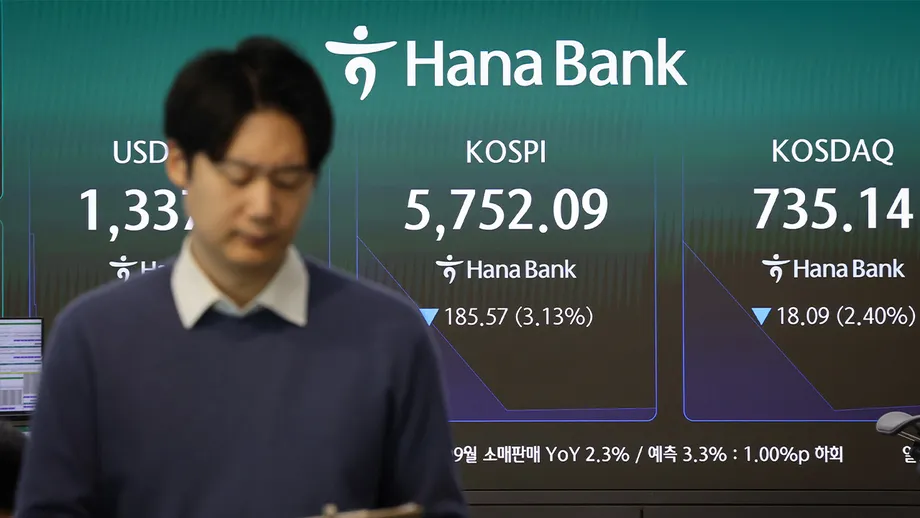
The benchmark KOSPI, which tracks shares on South Korea's main stock market, continued falling during the morning. By 10:16 a.m., it was at 5,640.04, a decline of 5.01%. The figures describe trading during the session, not the day's closing result.
The immediate overseas backdrop was a 12.64% plunge in Google parent Alphabet after its third-quarter revenue missed market expectations. Concerns about the company's growing cash spending on AI spread to other technology shares and then to South Korea, where major semiconductor companies were caught in the retreat.
From a weak opening to a deeper fall
The KOSPI opened at 5,760.35, down 177.31 points, or 2.99%, from the previous close. Selling pressure then pushed the index below 5,700. At about 10:04 a.m., it stood at 5,655.41, down 282.25 points, or 4.75%.
At 10:06 a.m., the index was at 5,661.7, down 4.68%, before falling further by 10:16 a.m. From its opening level to the 10:16 reading, it lost another 120.31 points. Its percentage decline had deepened by about two percentage points in just over an hour.
The morning's key developments followed this sequence:
- October 15: The KOSPI fell 7.57%, and a sell-side sidecar was activated.
- October 29 in New York: The three major US stock indexes closed lower, with Alphabet falling 12.64%.
- October 30 at the Seoul opening: The KOSPI began trading at 5,760.35, down 2.99%.
- 10:04:55 a.m.: The Korea Exchange activated the sidecar after KOSPI 200 futures met the trigger conditions.
- 10:16 a.m.: The KOSPI stood at 5,640.04, down 5.01%.
The October 30 intervention was the first on the KOSPI market since October 15. That earlier session's 7.57% decline was larger than the fall recorded by 10:16 a.m. on October 30, although the latter session was still in progress.
What the five-minute pause actually covered
The Korea Exchange's sell-side sidecar applies when KOSPI 200 futures fall at least 5% from the previous session's close and remain at or below that threshold for at least one minute. Once triggered, it suspends the effectiveness of program sell orders on the main market for five minutes.
Futures are contracts tied to the value of an asset or index. KOSPI 200 futures track an index of 200 major Korean stocks. Investors use them to take positions on market direction or to reduce the risk of losses in shares they already own.
Program trading uses computer systems to submit orders according to preset conditions, sometimes across a basket of stocks. A rapid movement in futures can therefore be accompanied by orders affecting many shares at once. The sidecar briefly interrupts that channel of selling.
The measure covered program sell orders rather than all stock trading. Investors could still see share prices move while the restriction was in place. Its five-minute duration explains why an intervention at about 10:04 a.m. could be followed by further declines later in the morning.
The trigger also explains why the KOSPI itself was down about 4.75% when the safeguard took effect: the rule uses the change in KOSPI 200 futures, which had already fallen 5.12%, rather than the percentage change in the broader cash index.
Alphabet's earnings shock reaches Korean stocks
Alphabet's third-quarter revenue came in below market expectations, while its results showed a sharp increase in cash being consumed by AI spending. Its shares fell 12.64%, with the decline reported to have erased about $500 billion in market value.
Market value is the share price multiplied by the number of shares in a company. A fall of that size means investors placed a much lower total price on Alphabet's equity during the session. For other technology companies, the concern was whether large investments in AI would generate revenue and profits quickly enough to satisfy shareholders.
AI businesses need substantial computing capacity. Spending on that capacity can support demand for equipment and chips, while also putting pressure on the cash available to the companies making the investments. Alphabet's results brought both sides of that spending into focus.
The weakness extended beyond Alphabet. Intel fell 3.6% during regular US trading and then dropped more than 16% in trading after the market closed. All three major US indexes finished lower on October 29, giving Korean investors a weak international backdrop before Seoul opened.
The connection between the two markets was especially visible in semiconductor shares. Samsung Electronics and SK hynix are major Korean chip companies, so changing expectations for technology spending abroad can quickly affect how investors value them at home.
Samsung and SK hynix lead a broader retreat
Samsung Electronics fell more than 4% early in the session and later traded with losses in the 5% range. SK hynix initially fell more than 7%, with its decline subsequently reaching the 8% range.
Both companies are major constituents of the KOSPI. The index gives greater weight to companies with larger market values, so substantial falls in its biggest members can pull the benchmark lower even when movements in smaller shares are less severe.
The retreat extended to other prominent companies, including SK Square, Samsung Electro-Mechanics, LG Energy Solution and Hyundai Motor. The spread across technology, batteries and vehicles showed that the pressure reached beyond the two leading chipmakers.
The KOSDAQ, a separate Korean market with many smaller and growth companies, also opened lower. It began the session at 737.76, down 15.47 points, or 2.05%. Its opening percentage decline was smaller than the KOSPI's 2.99% drop, though both markets started the day under pressure.
Who was buying during the decline?
Foreign investors and institutional investors were net buyers early in the session, while individual investors were net sellers. Net buying means a group bought more shares by value than it sold during the period measured.
The direction of those flows matters because the falling index coincided with buying by two major investor groups. The early trading figures therefore give a more detailed picture than a simple description of investors selling across the board.
Share prices depend on the prices at which buyers and sellers agree to trade, as well as which stocks are changing hands. A group can buy more than it sells while the market declines, particularly if transactions take place at progressively lower prices.
The early flow figures did not include amounts for each investor group. Without those totals, the scale of foreign and institutional buying, and the value of individual selling, remained unspecified. The figures also covered the opening part of the session rather than the completed trading day.
A second intervention after October 15
The October 30 sidecar followed another activation on October 15, when the KOSPI fell 7.57%. Two interventions within the same month show that the futures market had reached the exchange's threshold for unusually rapid selling on more than one occasion.
For investors holding Korean shares, the immediate change was a sharp reduction in market prices, particularly among major semiconductor stocks. For those placing orders, the exchange's intervention temporarily restricted one form of automated selling while the wider market continued trading.
The next benchmark for the session was the closing level. The 10:16 a.m. reading captured a decline exceeding 5%, with the direction of the remaining trading day still open. By that point, the market had already moved from a weak opening to a futures-triggered safeguard and deeper losses in the cash index.
Key Points
- The KOSPI fell 5.01% to 5,640.04 by 10:16 a.m. on October 30, 2026.
- The Korea Exchange activated a sell-side sidecar at 10:04:55 a.m., suspending program sell orders for five minutes.
- KOSPI 200 futures were down 5.12% at 887.92 when the safeguard took effect.
- Alphabet's 12.64% decline and concerns about AI spending weighed on technology shares.
- Samsung Electronics fell in the 5% range and SK hynix in the 8% range during the morning.
- Foreign and institutional investors were net buyers early in trading, while individuals were net sellers.
- The previous KOSPI sidecar activation occurred on October 15, when the index fell 7.57%.