KOSPI Falls Below 5,000 as Chip Shares Sink
South Korea halted trading on its main stock market on November 6 after the KOSPI plunged more than 8% within minutes of opening, as a sharp retreat in American technology shares spread to Samsung Electronics and SK Hynix. The government responded by announcing temporary relief from a collateral requirement that can force investors to sell shares when prices fall.
Contents
- KOSPI Falls Below 5,000 as Chip Shares Sink
- A Market Shock in Minutes
- Samsung and SK Hynix Lead the Decline
- Why American AI Concerns Reached Seoul
- What the Trading Halts Actually Do
- KOSDAQ Investors Face a Similar Retreat
- How the Government Plans to Limit Forced Sales
- A Sharp Reversal for the AI Investment Trade
- Key Points
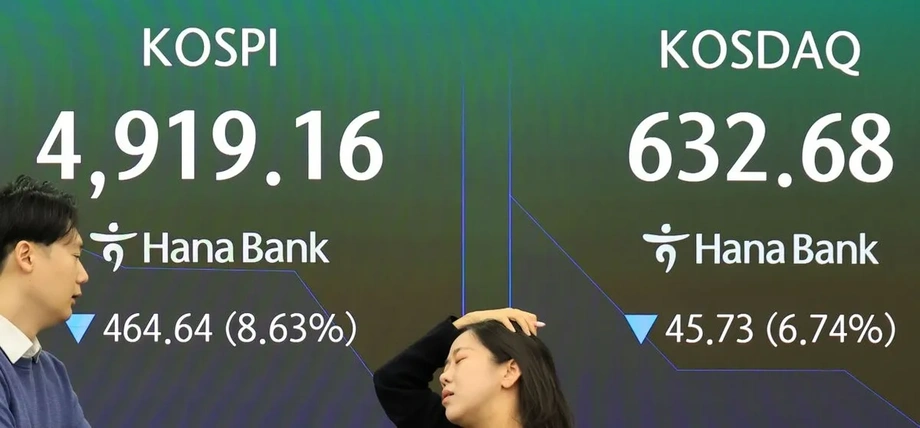
At 9:02 a.m., the KOSPI stood at 4,935.81, down 8.32%. One minute later, it was down 8.52% at 4,924.61 when a Level 1 circuit breaker stopped trading for 20 minutes. The index had fallen below 5,000 for the first time since February 6, about nine months earlier.
Samsung Electronics initially dropped 10.07% to 181,200 won, while SK Hynix fell 12.18% to 1.11 million won. Both companies supply memory chips used in the expansion of artificial intelligence infrastructure, leaving their shares exposed to worries about the pace and profitability of that investment.
The overnight shock was severe: the Philadelphia Semiconductor Index fell 12.3%, while the Nasdaq Composite lost 5.52%. Investors were responding to concerns about possible American restrictions on AI and data center construction following the United States midterm elections, alongside existing doubts about whether spending on AI would generate enough profit.
Deputy Prime Minister and Minister of Economy and Finance Lee Hyoung-il convened an emergency meeting with relevant agencies. Officials agreed to waive securities firms' obligation to maintain a 140% collateral ratio on margin loans for three months, starting November 9.
A Market Shock in Minutes
The detailed opening sequence put the KOSPI at 5,263.26, down 120.54 points, or 2.24%, before losses accelerated. An alternative opening figure of 4,923.47, down 8.55%, was also reported. The timed readings placed the index below 5,000 by 9:02 a.m., followed by the trading halt at 9:03 a.m.
The morning brought several different trading restrictions across the two main markets. All times below are South Korean local time.
- November 5, United States trading: The Nasdaq Composite fell 5.52%, and the Philadelphia Semiconductor Index dropped 12.3%.
- November 6, market opening: Samsung Electronics and SK Hynix triggered temporary restrictions after sharp price movements.
- 9:02 a.m.: The KOSPI was down 8.32% at 4,935.81.
- 9:03 a.m.: A Level 1 circuit breaker stopped trading on the main market for 20 minutes.
- 9:06 a.m.: A separate restriction paused program sell orders linked to the KOSDAQ market for five minutes.
- 9:23 a.m.: Trading resumed on the main market.
- 9:34 a.m.: A five minute restriction on program sell orders took effect after KOSPI 200 futures fell sharply.
- November 9: The government's temporary collateral relief is scheduled to begin.
The KOSPI continued to trade roughly 6% to 8% lower after reopening. The figures describe the morning session; a closing level and the detailed terms governing how individual brokerages would apply the collateral relief were not given.
Samsung and SK Hynix Lead the Decline
Samsung briefly fell below 180,000 won, reaching its lowest level since April 2. SK Hynix dropped below 1.1 million won, its lowest since April 14. Their declines placed two of South Korea's most prominent technology companies at the center of the market's retreat.
Both stocks later recovered part of their initial losses. At 9:40 a.m., Samsung was down 7.25% at 187,100 won, while SK Hynix was down 8.39% at 1,158,000 won. Compared with their early readings of 181,200 won and 1.11 million won, those prices represented rebounds of 5,900 won and 48,000 won respectively, even as both remained sharply below the previous close.
Samsung and SK Hynix had been major drivers of the KOSPI's earlier rally linked to AI investment. Memory chips help computer systems store and move the large amounts of information needed to develop and operate AI services. Expectations of continued demand had helped support the companies' share prices.
Data centers are buildings filled with computers and related equipment. If their construction slows, investors may expect chip purchases to arrive later or grow more slowly. Share prices can react to that change in expectations well before any corresponding change appears in a company's sales.
Why American AI Concerns Reached Seoul
Wall Street's losses followed concerns that Democratic majorities in both chambers of Congress after the United States midterm elections could bring greater regulatory scrutiny of AI and data center construction. Investors were pricing in the possibility of policy changes; no particular new restriction or implementation date was identified.
The Nasdaq's 5.52% decline was its worst session since April 2025. The 12.3% fall in the Philadelphia Semiconductor Index was more than twice as large in percentage terms, showing the especially heavy selling pressure on chip companies.
Seo Sang-young, an executive at Mirae Asset Securities, pointed to several pressures on demand for shares: questions about AI profitability, delays involving data centers and concerns about credit connected to AI investment. His assessment described a market in which buyers were reluctant to commit aggressively while several risks were developing at once.
South Korean officials similarly identified uncertainty over AI industry policy and weaker global investor sentiment as reasons for the decline. The government judged that domestic shares were reacting excessively to external developments.
The connection runs through both business expectations and investment decisions. Samsung and SK Hynix sell into the international technology supply chain, while investors can reduce exposure to the same AI investment theme across American and Korean markets in quick succession.
What the Trading Halts Actually Do
The main market's Level 1 circuit breaker activated after the KOSPI remained at least 8% below its previous closing level for one minute. It stopped trading in all shares on that market, along with related stock futures and options, for 20 minutes.
A circuit breaker gives the market a temporary pause during an unusually fast decline. Buyers and sellers have time to reassess orders, but the market resumes with prices still determined by their willingness to trade. On November 6, the resumption at 9:23 a.m. was followed by continued heavy losses.
Samsung and SK Hynix also triggered static volatility interruptions around the opening. Those measures apply to individual securities and briefly pause trading when prices move beyond specified limits. The two stocks faced interruptions of two minutes after movements exceeding 10% from the previous close.
The later sell sidecar was narrower than the circuit breaker. At 9:34 a.m., KOSPI 200 futures were down 56.80 points, or 6.77%, at 781.00. The measure suspended the effectiveness of program sell orders for five minutes. Program trading uses preset instructions to buy or sell groups of securities, often in connection with movements in futures.
These controls operate at different levels: individual shares, program orders or the main market as a whole. The succession of restrictions showed how quickly selling pressure moved through those different parts of the market.
KOSDAQ Investors Face a Similar Retreat
The KOSDAQ, a separate market with many smaller and growth focused companies, opened at 654.43, down 23.98 points, or 3.53%. Its decline later reached 6.47%, taking the index to 634.51, near its lowest intraday level of the year.
At 9:06 a.m., a sell sidecar suspended the effectiveness of program sell orders for five minutes. The KOSDAQ trigger requires its KOSDAQ 150 futures price to fall at least 6% and the underlying KOSDAQ 150 index to fall at least 3%, with both conditions lasting one minute.
Both the KOSPI and KOSDAQ experienced sell sidecars for a second consecutive trading day. The repetition showed that the pressure extended beyond a single opening burst and beyond the largest semiconductor companies.
Foreign investors were net sellers of shares on the main market for six consecutive trading days, while individuals and institutions were net buyers during the reported session. Net selling means selling more shares by value than buying; net buying means the reverse. Domestic purchases were taking place, but prices continued to fall as sellers accepted lower bids.
How the Government Plans to Limit Forced Sales
Lee's emergency meeting produced a measure aimed at a specific source of selling pressure: investments made with borrowed money. Starting November 9, securities firms will receive a three month waiver from the obligation to maintain a 140% collateral ratio on margin loans.
A margin loan allows an investor to borrow money through a securities firm to buy shares. The firm holds assets as collateral, meaning assets it can use to recover the debt. A 140% ratio means collateral worth 140 won for every 100 won borrowed.
For a simple illustration, an investor borrowing 1 million won would need collateral worth 1.4 million won at that ratio. If the collateral fell 10% in value, it would be worth 1.26 million won. The investor could then face a demand to provide more collateral or reduce the debt.
When investors cannot meet such demands, securities firms may sell their holdings. Those forced sales can push prices lower, reducing the collateral supporting other loans and creating further pressure to sell. The government's waiver targets that chain reaction.
Investors still owe the money they borrowed, and their holdings remain exposed to changing prices. The announced intervention concerns the collateral maintenance obligation rather than the size of their debt. Its practical effect will depend partly on how securities firms manage affected accounts.
A Sharp Reversal for the AI Investment Trade
The morning decline extended a much larger retreat from earlier highs. Reported estimates placed the KOSPI more than 19% below its late October intraday peak and nearly 48% below its June record. Those figures describe a market already under substantial pressure before the latest opening plunge.
Borrowing linked to AI investments added another potential source of strain. Some exposure to Samsung and SK Hynix came through Korean exchange traded funds using leverage. An exchange traded fund is a basket of investments bought and sold on an exchange; leverage increases exposure through borrowing or financial contracts, making gains and losses larger than an ordinary investment of the same starting amount.
Sharp declines can therefore affect investors through several channels at once: falling share prices, losses in funds with amplified exposure and demands connected to borrowed investments. The government's collateral measure addresses one of those channels, while the trading restrictions temporarily slow particular forms of market activity.
Officials said they would monitor the semiconductor industry, policy developments in major economies, domestic and international stock markets, and movements of investment money in real time. For households holding shares or funds, the immediate consequences were lower investment values and, for some borrowers, pressure on the assets backing their loans.
Key Points
- The KOSPI fell more than 8% on November 6, dropping below 5,000 for the first time in about nine months.
- A circuit breaker halted main market trading from 9:03 a.m. to 9:23 a.m.; program selling restrictions followed.
- Samsung Electronics and SK Hynix suffered sharp early losses before recovering some ground by 9:40 a.m.
- The selloff followed a 12.3% decline in the Philadelphia Semiconductor Index and a 5.52% fall in the Nasdaq Composite.
- Foreign investors had been net sellers for six consecutive trading days, while domestic individuals and institutions were buying during the reported session.
- The government announced three months of relief from the 140% margin loan collateral requirement, beginning November 9, to reduce pressure from forced sales.