Retail buyers absorb selling as Seoul stocks slide
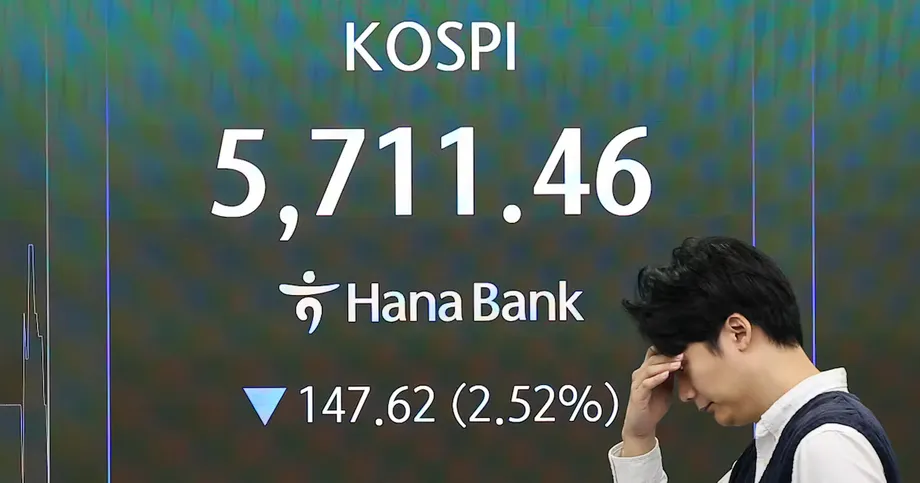
South Korea's KOSPI recovered part of a steep morning decline on November 3, 2026, as individual investors bought 946.5 billion won of shares while foreign investors and institutions sold. The buying helped lift the benchmark above 5,700 after concerns about the cost and profitability of artificial intelligence investment hit semiconductor stocks.
Contents
- Retail buyers absorb selling as Seoul stocks slide
- A rebound within a day of renewed selling
- Why AI spending unsettled chip investors
- Semiconductor weakness spread across markets
- Who supported the previous day's rally?
- KOSDAQ losses showed pressure beyond large companies
- Losses reached steel, batteries and refining
- Lower oil prices met uncertainty over interest rates
- US voting kept investors cautious
- Key Points
According to Korea Exchange figures, the KOSPI stood at 5,715.23 at 11 a.m., down 143.85 points, or 2.46%, from the previous session. It had fallen as much as 3.77% to 5,638.06. Another intraday account put the low at about 5,626, a decline of roughly 4%.
The recovery was limited. At 11:20 a.m., the index was still down 145.02 points, or 2.48%, at 5,714.06. Samsung Electronics and SK Hynix remained under pressure, and losses extended to steel, batteries and oil refining.
Foreign investors sold a net 699.8 billion won on the main board, while institutions sold 354.3 billion won. Their combined net selling of 1.0541 trillion won exceeded retail investors' net purchases by 107.6 billion won. Net buying means purchases exceeded sales; net selling means the reverse.
The morning therefore brought a change in who was supporting the market. Institutions had driven a strong rebound the previous day. On November 3, individual investors stepped in as those institutions joined foreign sellers, leaving the market dependent on a different group of buyers.
A rebound within a day of renewed selling
The KOSPI opened at 5,715.19, already 2.46% below its previous close, and its loss widened to 3.27% by 9:06 a.m. Buying later lifted it 77.17 points from the quoted low of 5,638.06 to its 11 a.m. level.
Even after that recovery, the benchmark had surrendered the previous day's move above 5,800. The sequence shows how quickly support changed:
- October 29: SK Hynix began a share repurchase programme valued at roughly 20 trillion won.
- November 2: The KOSPI rose 2.24% to close at 5,859.08, supported by institutional buying.
- November 3, early trading: The index opened 2.46% lower before its losses deepened.
- November 3, late morning: Retail buying helped the index recover above 5,700, although it remained more than 2% lower.
The distinction matters for investors watching a rebound: prices had recovered from their morning lows, but the benchmark was still well below the previous close. No closing figures for November 3 were available in the morning updates.
Why AI spending unsettled chip investors
US technology shares had fallen overnight as investors questioned how quickly heavy spending on AI infrastructure would generate profits. The Nasdaq Composite lost 1.07%, the S&P 500 declined 0.51%, and the Philadelphia Semiconductor Index dropped 3.37%.
Oracle's financing plans gave those concerns a concrete focus. The company planned to issue $10 billion in shares and $10 billion in bonds to fund AI infrastructure, bringing the proposed total to $20 billion. Its stock fell 8.76%.
Share issuance brings in money by selling ownership in a company. Bonds raise money that must be repaid, usually with interest. Both can fund expansion, but investors also weigh the effect of more shares on existing holdings and the cost of servicing debt.
AI infrastructure includes the chips, servers and data centres needed to train and run AI systems. Suppliers can benefit from that construction. Their shares can also fall when investors become less confident that customers will earn enough from AI services to sustain their spending plans.
Anthropic illustrated the tension between fast growth and rising expectations. Its quarterly revenue was reported to have increased more than elevenfold from a year earlier, while growth from the preceding quarter slowed from about 144% to about 47%. Reported plans to spend more than $895 billion over several years added to scrutiny of the sums involved.
The concern spreading through markets was therefore about the relationship between spending, revenue and financing. Even rapid sales growth can leave investors uneasy when the investment required is exceptionally large.
Semiconductor weakness spread across markets
US chip stocks fell broadly. Nvidia lost 1.26%, AMD declined 7.52%, Intel dropped about 8.8%, SanDisk fell 6.59%, and Micron lost 5.78%. Microsoft also declined 2.83%, showing that the selling reached beyond companies making semiconductors.
Japan's Kioxia had fallen 15.78% on November 2 after its outlook for the October to December quarter fell short of market expectations. Slower increases in NAND flash prices were cited as a concern. NAND flash is memory that retains data when power is switched off and is used in storage devices.
Samsung Electronics and SK Hynix initially suffered sharp losses in Seoul. Early updates showed Samsung down 4.59% and SK Hynix down 5.2%, with another morning update putting SK Hynix's decline at 5.57%. By around 11 a.m., their losses had narrowed to 2.95% and 3.53%, respectively.
Related companies also weakened. Hanmi Semiconductor fell 4.17%, Samsung Electro-Mechanics declined 3.60%, and SK Square lost roughly 4%. The selling affected equipment makers and investment holdings as well as chip manufacturers.
Hebe Chen, a market analyst at Vantage Global Prime, described South Korea's semiconductor industry as being at the forefront of investors' reassessment of global AI investment. The concentration of pressure in chips helps explain why the US semiconductor decline quickly became a major issue for Seoul.
The effects also reached Hong Kong. The listed XL二南方海力士 product, trading under code 07709, fell nearly 10%, while XL二南三星, code 07747, declined about 7%. Their moves extended the impact of the Korean chip selloff to investors trading related products outside South Korea.
Who supported the previous day's rally?
Institutions bought approximately 1.23 trillion won of Korean shares on November 2, when the KOSPI rose 2.24%. Retail investors sold about 1.35 trillion won, and foreign investors sold roughly 370 billion won. Foreign selling continued for a second consecutive session that day.
Other corporations bought a net 480 billion won. That category includes corporate transactions such as share repurchases, and part of the buying was linked to SK Hynix's programme, which began on October 29.
A share repurchase occurs when a company buys its own stock. Those purchases can provide demand when other investors are selling. The roughly 20 trillion won figure described the size of SK Hynix's programme, rather than the amount purchased during one trading session.
Hyundai Motor Securities analyst Kim Jae-seung said pension fund purchases and corporate buybacks had eased concerns about the balance of buying and selling in a market with weak liquidity. He viewed that support as more important to the rebound than a substantial improvement in investor confidence.
Kim said foreign buying was needed for a sustained recovery, but had yet to appear. By late morning on November 3, foreign net selling had reached 699.8 billion won, already about 1.9 times the roughly 370 billion won sold during the entire previous session.
Retail investors' 946.5 billion won of net purchases suggested that many viewed the recent decline as an opportunity to buy at lower prices. The market's immediate problem was whether that demand could continue to absorb sales from larger investment groups.
KOSDAQ losses showed pressure beyond large companies
The KOSDAQ, which includes many smaller technology and growth companies, stood at 718.54, down 15.82 points, or 2.15%, in the morning. It had opened at 723.92 before declining further and then recovering some ground.
Individuals bought a net 218 billion won on that market. Foreign investors sold 101.2 billion won, and institutions sold 104.4 billion won. Retail net buying therefore exceeded the combined 205.6 billion won sold by those two groups by 12.4 billion won.
Across the KOSPI and KOSDAQ together, individual investors bought a net 1.1645 trillion won. That combined figure shows the scale of retail participation during the selloff, even as both indices remained lower.
Battery companies EcoPro and EcoPro BM fell 3.73% and 3.47%, respectively, while semiconductor equipment company Jusung Engineering dropped 4.82%. Other shares advanced: Alteogen gained 2.35%, Wonik Holdings rose 1.24%, and Hugel climbed 4.37%.
The mix of gains and losses was also visible on the main board. Samsung Biologics rose 1.90%, Hanwha Aerospace advanced 2.97%, and Hyundai Mobis edged up 0.14%. Investors continued buying selected pharmaceutical, defence and automotive shares despite the broader decline.
Losses reached steel, batteries and refining
POSCO Holdings fell 5.3%, and SK Innovation dropped 7.76% in late morning trading. Hyundai Motor declined 4.18% in a morning update, while LG Energy Solution was down about 3%.
Medical and precision equipment shares lost 5.30%, machinery and equipment fell 3.28%, and electrical and electronics declined 3.26%. Entertainment and culture gained 1.58%, pharmaceuticals rose 0.89%, and general services added 0.88%.
Those sector moves show that semiconductor selling was the centre of the decline, while pressure also reached businesses outside the AI supply chain. At the same time, gains in pharmaceuticals and entertainment offered some support elsewhere in the market.
The won traded at 1,341 per US dollar at 11:20 a.m., with the dollar buying 3.4 won more than at the previous close. In practical terms, the won had weakened: more Korean currency was needed to buy the same dollar.
Lower oil prices met uncertainty over interest rates
Brent crude futures fell 7.63% amid hopes that the United States and Iran would resume talks. Falling oil prices can reduce fuel and other energy costs, offering relief to businesses and households that pay for imported energy.
Kiwoom Securities analyst Han Ji-young nevertheless expected Korean indices to open lower because renewed concerns about AI profitability were weighing on US technology stocks. He described falling oil prices and interest rates as a favourable economic backdrop that was being outweighed by the technology correction.
South Korea's domestic inflation figures presented another issue for investors. Consumer prices rose 2.8% in October from a year earlier, down slightly from 2.9% in September. The decline was 0.1 percentage point.
The inflation reading reinforced expectations among market participants that the Bank of Korea could raise its policy rate at its November meeting. Higher interest rates make borrowing more expensive, affecting the cost of financing expansion and the returns investors expect from shares.
Korean investors were therefore weighing several forces at once: cheaper oil, pressure on technology profits, and the possibility of a domestic rate increase. The favourable movement in energy prices was insufficient to offset the immediate selling in major technology stocks.
US voting kept investors cautious
The US midterm elections added uncertainty to the trading session. Voting was scheduled for November 3 in the United States, with results being watched in South Korea on November 4 because of the time difference.
Suh Sang-young, an executive director at Mirae Asset Securities, said concerns about data centre regulation ahead of the elections were increasing volatility in South Korea's semiconductor sector. He pointed to both US chip weakness and election caution as reasons for selling pressure.
Anna Wu, founder of Floodlines Research, said investors were reducing technology holdings ahead of the elections and amid geopolitical risks involving Iran. She described the move as a continuation of the selling already under way.
Kim of Hyundai Motor Securities said uncertainty could ease after the election results, potentially allowing shares to rise. He also said unpredictable outcomes were keeping foreign investors cautious and inclined to wait.
The next developments investors were watching were election results arriving on November 4 in Korea and the Bank of Korea's policy meeting later in November. For the stock market, the immediate test was whether foreign capital would return and whether institutional and corporate purchases would resume alongside retail demand.
Key Points
- The KOSPI stood at 5,715.23 at 11 a.m. on November 3, down 2.46% after recovering from deeper morning losses.
- Retail investors bought a net 946.5 billion won on the main board, while foreigners and institutions sold a combined 1.0541 trillion won.
- AI spending and financing concerns followed a 3.37% fall in the US semiconductor index and hit Samsung Electronics, SK Hynix and related companies.
- The KOSDAQ fell 2.15% to 718.54 despite 218 billion won of retail net buying.
- Institutions and corporate purchases had supported the previous day's rally, but institutions turned net sellers on November 3.
- US election results and the Bank of Korea's November policy meeting were the next events investors were watching.