Chip profits power a sharp recovery in Seoul
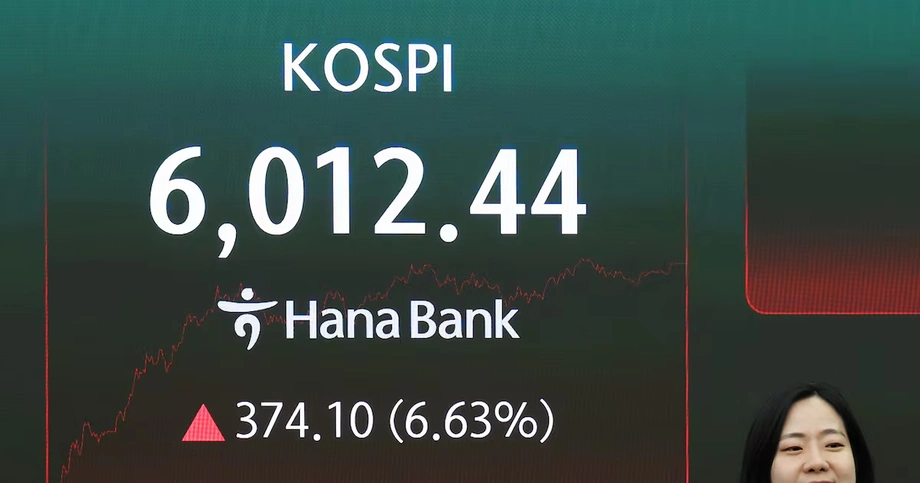
South Korea's Kospi surged 6.63% on October 28 to close at 6,012.44 after SK Hynix announced record quarterly operating profit of 83.3338 trillion won and said memory supply would struggle to meet demand through 2030. Samsung Electronics and SK Hynix both jumped as investors returned to companies supplying the artificial intelligence spending boom.
Contents
- Chip profits power a sharp recovery in Seoul
- How large was the earnings jump?
- Why the shortage outlook stretches to 2030
- Customer contracts give the forecast more substance
- A substantial payout adds to the appeal
- US financing news helps revive the AI trade
- A powerful rally, with clear sector winners
- Cash returns while borrowing retreats
- The recovery follows a volatile October
- Samsung and other chipmakers face the next test
- Key Points
The benchmark gained 374.10 points, recovering the 6,000 level for the first time since October 14, a gap of 10 trading sessions. SK Hynix climbed 10.89% to 1,487,000 won, while Samsung rose 9.01% to 242,000 won ahead of its detailed earnings announcement on October 29.
SK Hynix gave investors several reasons to look beyond the latest quarter: production effectively committed through 2029, agreements with major customers covering future factory capacity, and plans for roughly 100 trillion won in dividends and share purchases during the fiscal year.
The rally followed a bruising retreat driven by doubts about whether enormous AI investments would generate enough income. Investors now had evidence of exceptional profits at a major supplier, alongside renewed demand for financing by companies building AI services.
Foreign investors and institutions bought approximately 1.15 trillion won and 1.17 trillion won of Kospi shares, respectively, while individual investors sold about 2.3 trillion won. The buying was concentrated largely in semiconductor stocks. The smaller Kosdaq index also advanced, gaining 27.45 points, or 3.69%, to 771.28.
How large was the earnings jump?
SK Hynix reported third quarter revenue of 104.6155 trillion won, up 328% from a year earlier. Operating profit increased 632% to 83.3338 trillion won. Both figures exceeded market expectations, and the company said revenue and operating profit had reached records for six consecutive quarters.
The figures put operating profit at approximately 79.7% of revenue. Operating profit measures what a company earns from its business after operating costs, before items such as taxes and financing expenses. The ratio shows how much of the quarter's sales remained after those operating costs.
High bandwidth memory, known as HBM, and server DDR5 helped drive the results. HBM places memory chips in stacks so they can deliver large amounts of data quickly to powerful processors. Server DDR5 is working memory used in computers that run data centers. Both are central to the equipment supporting AI services.
Rising memory prices added to the benefit of stronger demand. For SK Hynix, the combination meant selling valuable products into a market where customers were competing for limited supply.
Why the shortage outlook stretches to 2030
SK Hynix said increasingly complicated manufacturing processes and the time required to build production facilities would keep memory supply from catching up with demand through 2030. Expanding output requires factories, equipment and production processes that can reliably make advanced chips in large quantities.
The company also described a broader customer base. AI investment is spreading beyond the largest technology companies to ordinary businesses and governments, bringing more buyers into a market already under pressure from data center construction.
Samsung and SK Hynix had already increased spending at existing Chinese factories as the shortage deepened. Their investment in Chinese plants reached a combined 1.4871 trillion won in 2025. Samsung's Xi'an facility produces roughly 40% of its NAND flash memory, while SK Hynix's Wuxi plant supplies more than 30% of its DRAM.
Those factories matter because new plants typically take three to five years to build, equip and bring into full production. Existing sites offer a faster route to additional output, although upgrades in China depend on United States approvals for controlled equipment. Manufacturers of phones, computers and other electronics also face tighter access to conventional memory as suppliers prioritize more profitable products for data centers.
Customer contracts give the forecast more substance
SK Hynix said its DRAM and HBM production through 2029 was effectively sold. It also disclosed agreements with 14 major customers, including global cloud providers, covering more than half its production capacity for 2027 and 2028.
These commitments give the company a clearer picture of future orders. Customers gain access to scarce chips, while SK Hynix can plan production and investment around demand secured further in advance.
SK Hynix chief executive Kwak Noh-Jung said the agreements were changing the company's business structure and making future earnings easier to anticipate.
The customer trust built through our technological competitiveness is leading to long-term contracts, and our business structure is transforming into one with earnings stability and mid-to-long term demand visibility,
Daishin Securities researcher Lee Kyung-min said the strong results and expansion of supply contracts reaffirmed a solid outlook for memory demand and earnings growth. Investors were responding to both the profits already earned and customers' willingness to reserve future output.
A substantial payout adds to the appeal
SK Hynix announced an additional 60 trillion won in shareholder returns, bringing planned dividends and share purchases for the fiscal year to approximately 100 trillion won. The annual total includes purchases announced previously, with some returns funded by gains from its investment in Japanese memory maker Kioxia.
For the third quarter, the company decided on a 14 trillion won cash dividend and 20 trillion won share buyback. A dividend distributes cash to shareholders. A buyback uses company money to purchase its own shares, reducing the number remaining in other investors' hands when those shares are retired.
The payout plans added a direct financial benefit to the demand forecast. Investors were weighing a company earning record profits, securing future customers and returning part of its windfall to shareholders.
US financing news helps revive the AI trade
Anthropic's move toward a Nasdaq initial public offering helped improve sentiment toward AI companies. The developer of Claude was pursuing a listing expected to be exceptionally large, drawing attention back to the industry's ability to attract capital.
Broadcom chief executive Hock Tan reportedly provided a direct guarantee and led negotiations for Anthropic's financing alongside major financial institutions. His involvement helped ease concerns after he had referred earlier in the month to funding constraints.
Meta's planned equity offering also attracted heavy demand. During the October 27 bookbuilding process, when banks gathered investor orders, the proposed offering expanded from $60 billion to $98 billion. Demand for common shares exceeded five times the amount offered.
The $38 billion increase made the planned fundraising about 63% larger than initially proposed. For chip investors, the financing news supported expectations that customers would continue funding AI infrastructure. The Philadelphia Semiconductor Index rose 3.60% overnight, giving South Korean chip shares another positive lead.
A powerful rally, with clear sector winners
The Korea Exchange activated a temporary restriction on program buying after Kospi 200 futures rose more than 5% during the session. The measure, commonly called a buying sidecar, suspends the effect of certain program purchase orders for five minutes when futures move sharply enough to trigger it.
Program trading uses preset rules to buy and sell groups of shares. Pausing those orders can slow the transmission of a sudden futures move into the share market. This was the second consecutive session with the restriction and its 27th activation of the year.
SK Square gained more than 11%, and Samsung Electro-Mechanics rose more than 8% after better than expected earnings. On the Kosdaq, Rainbow Robotics surged and PSK Holdings advanced more than 14%. Institutions were net buyers on that market, while foreign investors and individuals were net sellers.
Shipbuilding and shipping shares moved in the opposite direction. HD Hyundai Heavy Industries fell about 2% amid softer earnings, while Hanwha Ocean and HMM also declined. The day's gains were strongest around technology and the AI investment chain.
Cash returns while borrowing retreats
Investor deposits stood at 90.103 trillion won on October 27, according to Korea Financial Investment Association figures. That was the first reading above 90 trillion won in five sessions, following 90.2976 trillion won on October 20. Deposits represent money held in investment accounts that can be used to buy securities.
Borrowing to purchase shares was moving lower. Margin loan balances fell to 29.6372 trillion won, slipping below 30 trillion won for the first time since August 7. They had reached 38 trillion won at the end of May, making the latest balance about 22% lower.
Forced liquidations also declined to 19.3 billion won, compared with 89.3 billion won on October 14 and 80.5 billion won on October 15. A forced liquidation happens when a broker sells an investor's holdings because the investor cannot meet a payment or collateral requirement. The latest amount was about 78% below the October 14 figure.
Seo Jae-wan, a senior official overseeing capital markets at the Financial Supervisory Service, urged securities firms to strengthen margin lending risk management and investor protection at a meeting with industry representatives. The regulator warned that additional rules could follow if industry measures were insufficient. Heavy borrowing can turn falling prices into further selling when brokers close positions.
The recovery follows a volatile October
The return above 6,000 followed steep swings rather than a steady climb. SK Hynix shares had lost more than half their value since a June record by the October 27 close and were down nearly 25% during the month before the latest surge.
The main dates show how quickly conditions changed:
- October 14: The Kospi closed at 6,008.81, while forced liquidations reached 89.3 billion won.
- October 15: The index fell 7.57% toward the 5,500 level, and forced liquidations totaled 80.5 billion won.
- October 27: The Kospi gained 3.09% to 5,638.34, while investor deposits returned above 90 trillion won.
- October 28: The index climbed 6.63% to 6,012.44 after SK Hynix's earnings announcement.
The two latest sessions together lifted the Kospi approximately 9.9%. Despite that rapid rebound, the closing level was only 3.63 points above its October 14 finish, showing how much of the advance restored ground lost earlier in the month.
Yuanta Securities researcher Lee Jae-won recommended expanding positions in stages while watching whether foreign buying continued and confidence in AI investment profitability strengthened. Hyundai Motor Securities researcher Choi Je-min viewed seasonal weakness as a buying opportunity ahead of a possible rally toward the end of the year.
Samsung and other chipmakers face the next test
Samsung's detailed third quarter results on October 29 are the next major checkpoint. Investors will be looking for evidence that stronger prices and demand are benefiting another major memory supplier. Kioxia is scheduled to report on October 30, followed by China's CXMT on October 31.
The positive reaction had already spread across Asian semiconductor shares. Kioxia rose 13.8% in Japan, chip testing equipment maker Advantest gained more than 3%, and Tokyo Electron advanced 4.4%. Japan's Nikkei 225 rose more than 1%, while strong Taiwan Semiconductor Manufacturing shares helped lift Taipei's market.
Hong Kong, Shanghai, Singapore and Wellington also advanced. Sydney was nearly unchanged, and Manila fell. In currency trading, the won weakened by 14 won to 1,337.7 per dollar at 3:30 p.m., even as Korean shares surged.
SK Hynix's results have shifted attention toward the profits earned by companies supplying AI infrastructure. The next earnings releases will give investors more figures to compare with that performance, while continued foreign buying and customer financing remain central to the recovery.
Key Points
- The Kospi rose 6.63% to 6,012.44 on October 28, reclaiming 6,000 after 10 trading sessions.
- SK Hynix reported quarterly revenue of 104.6155 trillion won and operating profit of 83.3338 trillion won.
- The company expects memory supply to struggle to meet demand through 2030 and described production through 2029 as effectively sold.
- Planned shareholder returns total approximately 100 trillion won for the fiscal year.
- Investor deposits returned above 90 trillion won, while margin borrowing fell below 30 trillion won.
- Samsung's October 29 results are the next major test of the improved memory market outlook.